
Close Reading and Complex Text Grades 6 8



- Slides: 50
Close Reading and Complex Text Grades 6 -8 ELA I Day 2
At Unbound. Ed, we ground our learning in the intersection of the standards, content, aligned curriculum and the equitable instructional practices that are essential for closing the opportunity gap caused by systemic racism and bias. 2
Plusses/Deltas and Next Steps: Highlights of Yesterday’s Feedback 3
Debriefing the Keynote Take five minutes to reflect in your journal on one or more of the following prompts: • OPTION A: What are three salient points or ideas that you want to remember from the keynote, and why? • OPTION B: List three questions that this keynote bubbles up about teaching and learning that are immediately relevant to your work. • OPTION C: How did the keynote link to the learning from yesterday, and how does the keynote provide a specific lens through which you read objectives for today? 4
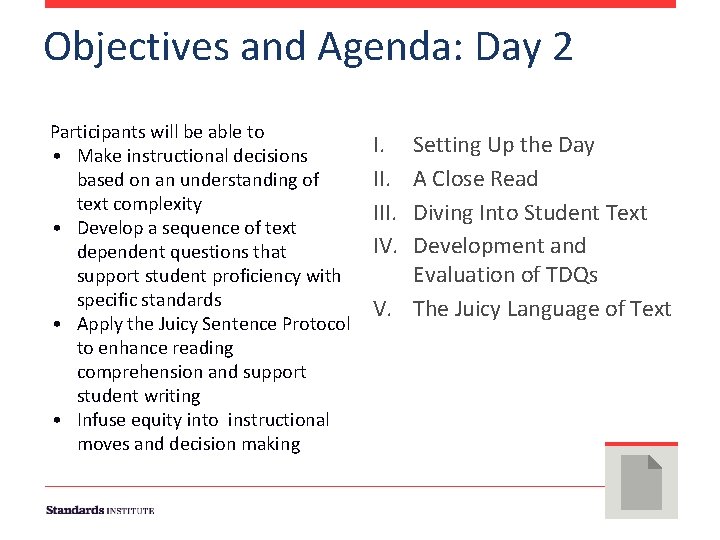
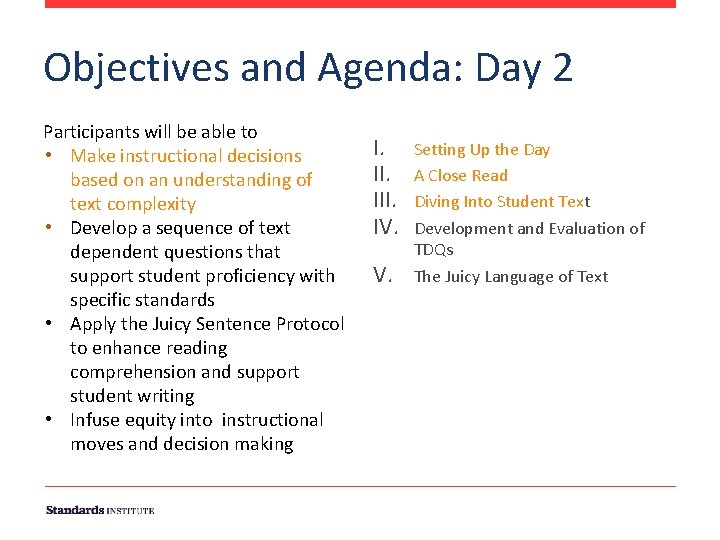
Objectives and Agenda: Day 2 Participants will be able to • Make instructional decisions based on an understanding of text complexity • Develop a sequence of text dependent questions that support student proficiency with specific standards • Apply the Juicy Sentence Protocol to enhance reading comprehension and support student writing • Infuse equity into instructional moves and decision making I. III. IV. Setting Up the Day A Close Read Diving Into Student Text Development and Evaluation of TDQs V. The Juicy Language of Text 5
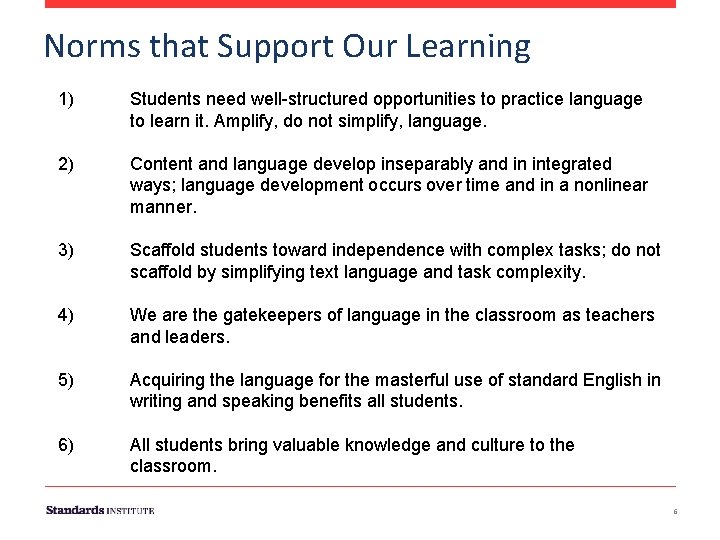
Norms that Support Our Learning 1) Students need well-structured opportunities to practice language to learn it. Amplify, do not simplify, language. 2) Content and language develop inseparably and in integrated ways; language development occurs over time and in a nonlinear manner. 3) Scaffold students toward independence with complex tasks; do not scaffold by simplifying text language and task complexity. 4) We are the gatekeepers of language in the classroom as teachers and leaders. 5) Acquiring the language for the masterful use of standard English in writing and speaking benefits all students. 6) All students bring valuable knowledge and culture to the classroom. 6
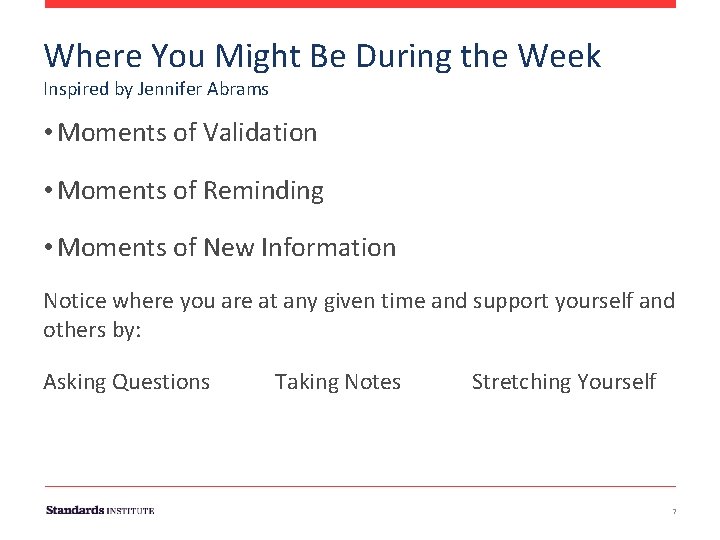
Where You Might Be During the Week Inspired by Jennifer Abrams • Moments of Validation • Moments of Reminding • Moments of New Information Notice where you are at any given time and support yourself and others by: Asking Questions Taking Notes Stretching Yourself 7
Student Profile Stude nt Profil e Develop a Student Profile 2 minutes: • Share • Question • Answer 8
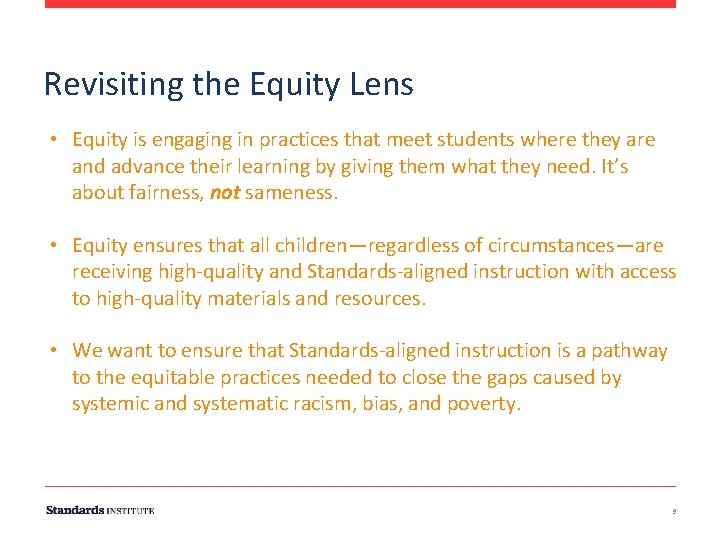
Revisiting the Equity Lens • Equity is engaging in practices that meet students where they are and advance their learning by giving them what they need. It’s about fairness, not sameness. • Equity ensures that all children—regardless of circumstances—are receiving high-quality and Standards-aligned instruction with access to high-quality materials and resources. • We want to ensure that Standards-aligned instruction is a pathway to the equitable practices needed to close the gaps caused by systemic and systematic racism, bias, and poverty. 9
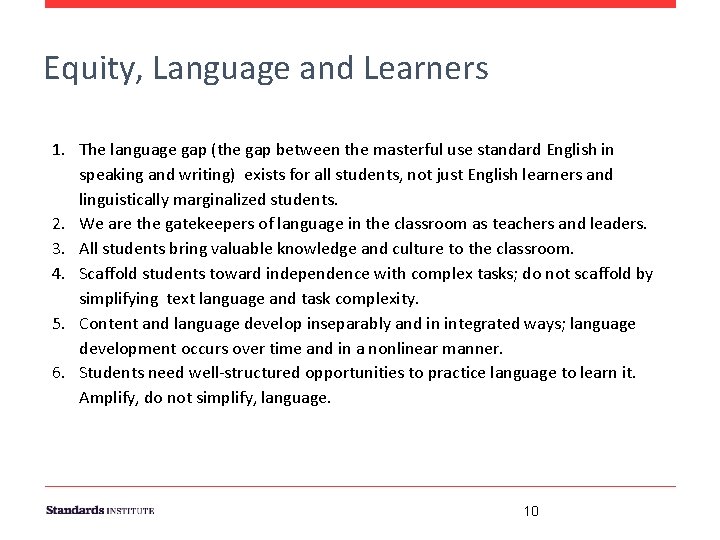
Equity, Language and Learners 1. The language gap (the gap between the masterful use standard English in speaking and writing) exists for all students, not just English learners and linguistically marginalized students. 2. We are the gatekeepers of language in the classroom as teachers and leaders. 3. All students bring valuable knowledge and culture to the classroom. 4. Scaffold students toward independence with complex tasks; do not scaffold by simplifying text language and task complexity. 5. Content and language develop inseparably and in integrated ways; language development occurs over time and in a nonlinear manner. 6. Students need well-structured opportunities to practice language to learn it. Amplify, do not simplify, language. 10
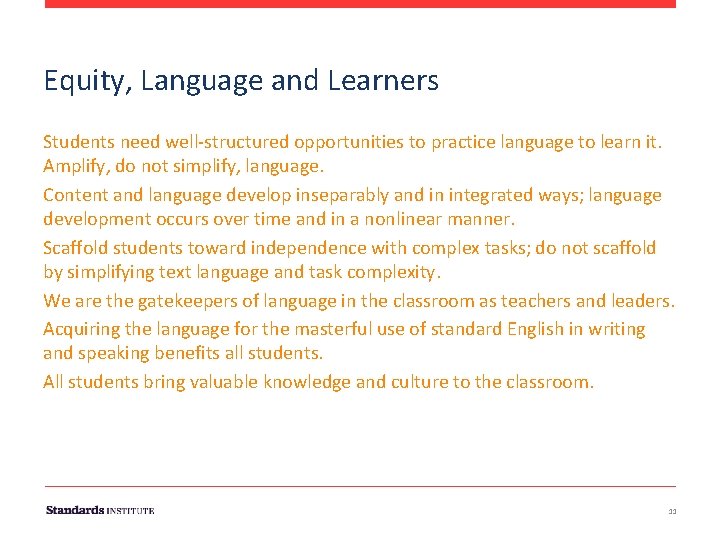
Equity, Language and Learners Students need well-structured opportunities to practice language to learn it. Amplify, do not simplify, language. Content and language develop inseparably and in integrated ways; language development occurs over time and in a nonlinear manner. Scaffold students toward independence with complex tasks; do not scaffold by simplifying text language and task complexity. We are the gatekeepers of language in the classroom as teachers and leaders. Acquiring the language for the masterful use of standard English in writing and speaking benefits all students. All students bring valuable knowledge and culture to the classroom. 11
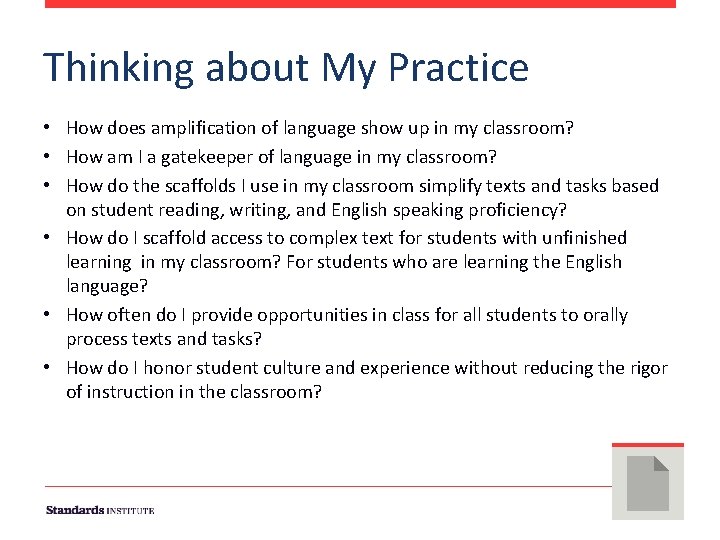
Thinking about My Practice • How does amplification of language show up in my classroom? • How am I a gatekeeper of language in my classroom? • How do the scaffolds I use in my classroom simplify texts and tasks based on student reading, writing, and English speaking proficiency? • How do I scaffold access to complex text for students with unfinished learning in my classroom? For students who are learning the English language? • How often do I provide opportunities in class for all students to orally process texts and tasks? • How do I honor student culture and experience without reducing the rigor of instruction in the classroom?
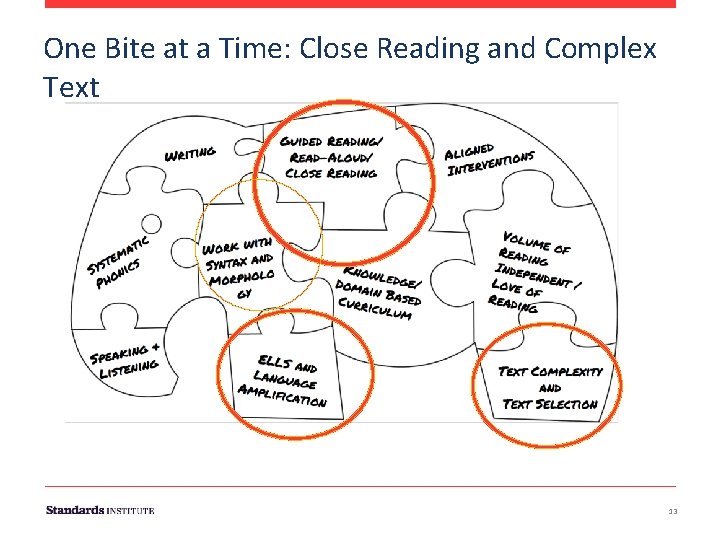
One Bite at a Time: Close Reading and Complex Text 13
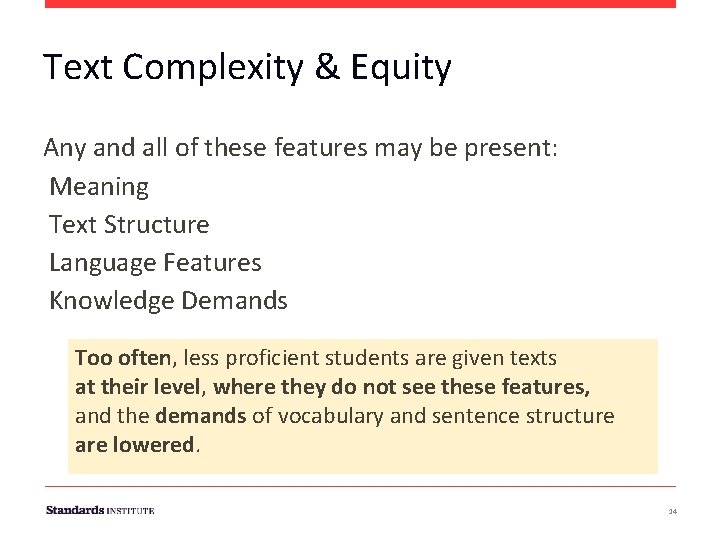
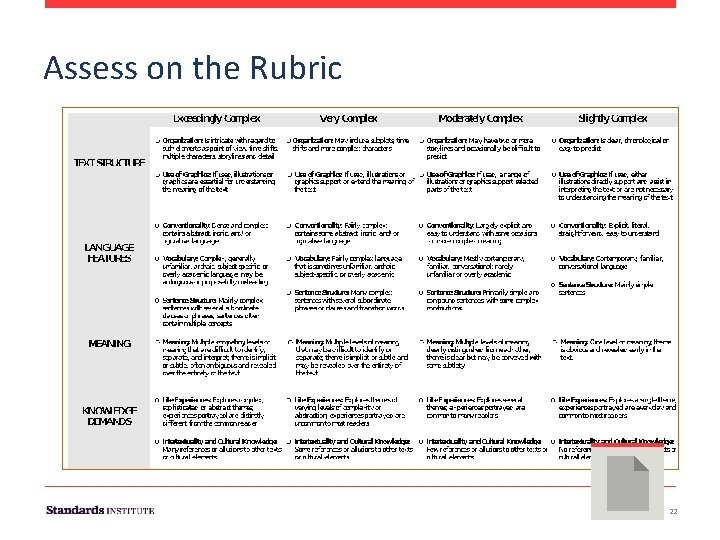
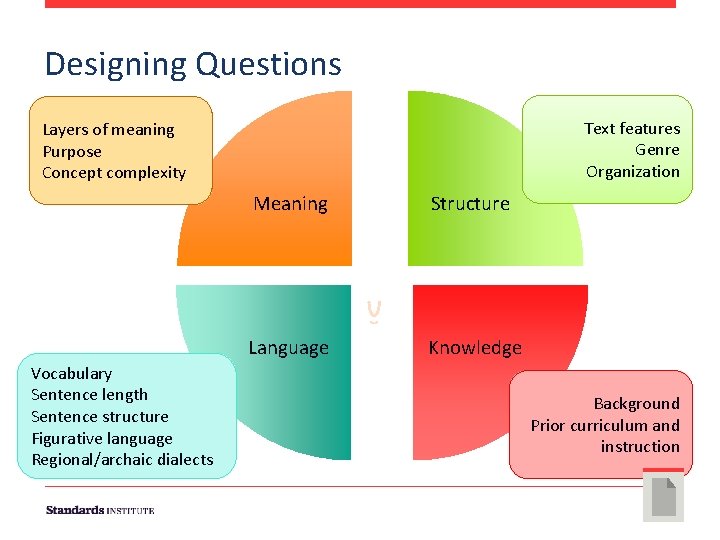
Text Complexity & Equity Any and all of these features may be present: Meaning Text Structure Language Features Knowledge Demands Too often, less proficient students are given texts at their level, where they do not see these features, and the demands of vocabulary and sentence structure are lowered. 14 14
Getting Meta About Close Reading Part 1: Reading Independently The Progression of Reading Comprehension P. David Pearson and David Liben Read the text independently • Provide a bulleted summary for each section in the space provided as you read • Identify and look up key vocabulary if it interferes with comprehension. Think about implications for: • • Content and language develop inseparably and in integrated ways; language development occurs over time and in a nonlinear manner. Students need well-structured opportunities to practice language to learn it. Amplify, do not simplify, language.
Getting Meta About Close Reading Part 2: Partnering Up Partner up with someone you don’t know: –Share summaries with partners. –Clarify paragraph meanings. –Identify key ideas of the text. When talking to peers: “To add to xxx’s idea…. ” “I agree, and I also think…. ” “I looked at that differently. I think that passage means…” Think about: We are the gatekeepers of language in the classroom as teachers and leaders. Scaffold students toward independence with complex tasks; do not scaffold by simplifying text language and task complexity.
Framing the Day Part 3: Sitting With Synthesis Taking into consideration “The Progression of Reading Comprehension, ” the Shifts for ELA, the Morning Keynote, and Reading and Language Standards, take 5 minutes to craft a written answer to the following question: How does each text contribute to a shared idea? • Identify a theme/central idea common to all texts (CCRA. R. 9). • Provide evidence from each text to support your claim. 17
Step Back What strategies did we employ to make the text more accessible for students who may not be able to read it independently? 18
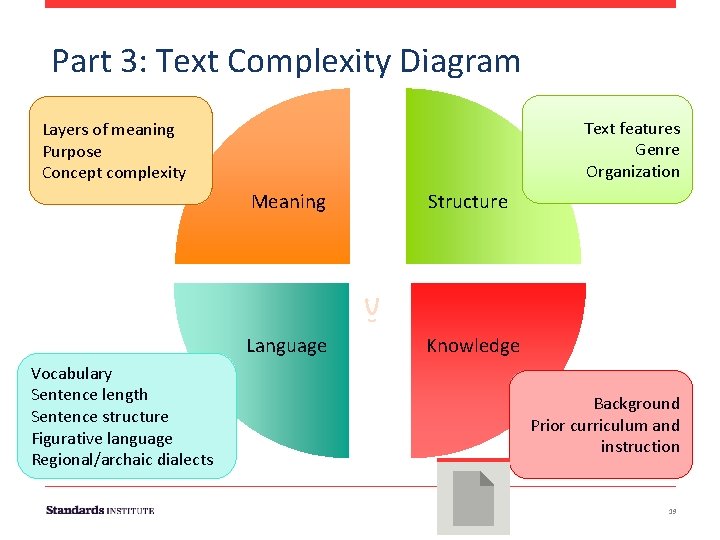
Part 3: Text Complexity Diagram Text features Genre Organization Layers of meaning Purpose Concept complexity Vocabulary Sentence length Sentence structure Figurative language Regional/archaic dialects Meaning Structure Language Knowledge Background Prior curriculum and instruction 19
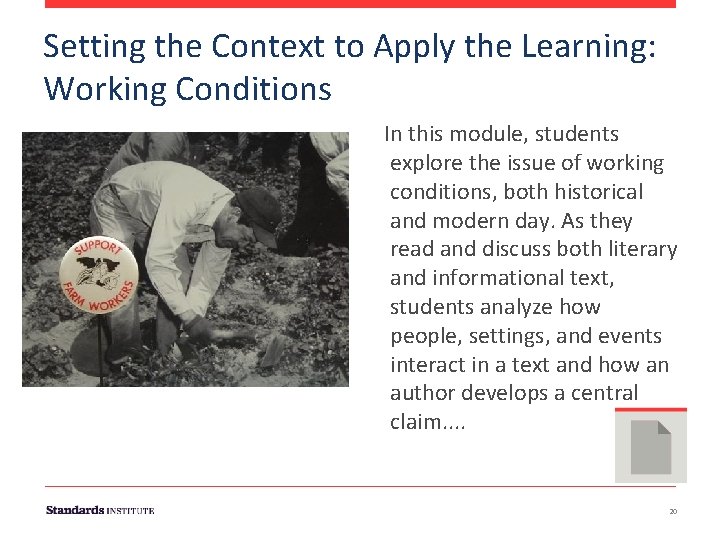
Setting the Context to Apply the Learning: Working Conditions In this module, students explore the issue of working conditions, both historical and modern day. As they read and discuss both literary and informational text, students analyze how people, settings, and events interact in a text and how an author develops a central claim. . 20
“California Commonwealth Club Address: ” What Makes This Text Complex? Text features Genre Organization Layers of meaning Purpose Concept complexity Vocabulary Sentence length Sentence structure Figurative language Regional/archaic dialects Meaning Structure Language Knowledge Background Prior curriculum and instruction 21
Assess on the Rubric 22
Morning Take-Aways 23
Lunch
Objectives and Agenda: Day 2 Participants will be able to • Make instructional decisions based on an understanding of text complexity • Develop a sequence of text dependent questions that support student proficiency with specific standards • Apply the Juicy Sentence Protocol to enhance reading comprehension and support student writing • Infuse equity into instructional moves and decision making I. III. IV. V. Setting Up the Day A Close Read Diving Into Student Text Development and Evaluation of TDQs The Juicy Language of Text
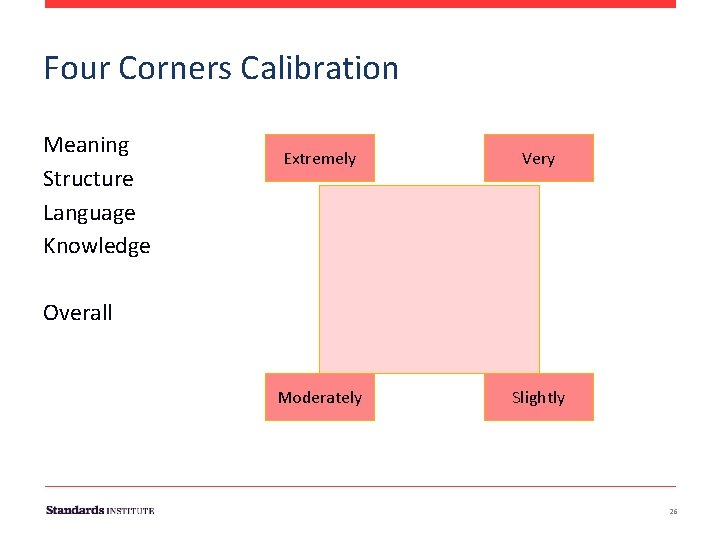
Four Corners Calibration Meaning Structure Language Knowledge Extremely Very Moderately Slightly Overall 26
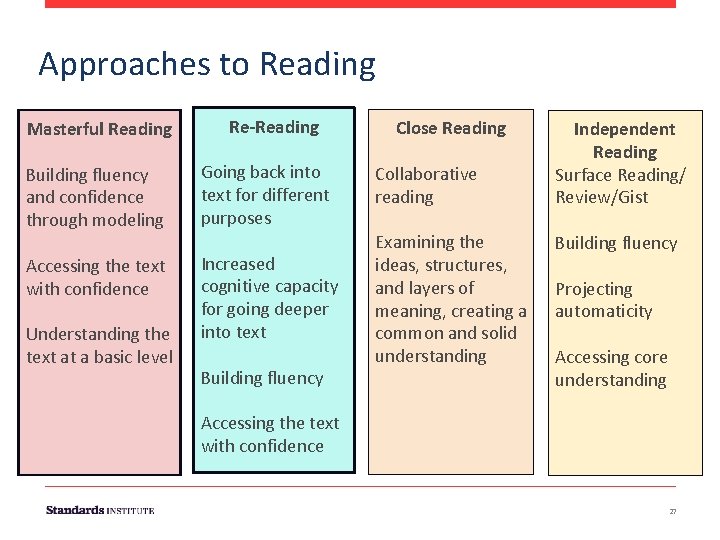
Approaches to Reading Masterful Reading Re-Reading Building fluency and confidence through modeling Going back into text for different purposes Accessing the text with confidence Increased cognitive capacity for going deeper into text Understanding the text at a basic level Building fluency Close Reading Collaborative reading Examining the ideas, structures, and layers of meaning, creating a common and solid understanding Independent Reading Surface Reading/ Review/Gist Building fluency Projecting automaticity Accessing core understanding Accessing the text with confidence 27
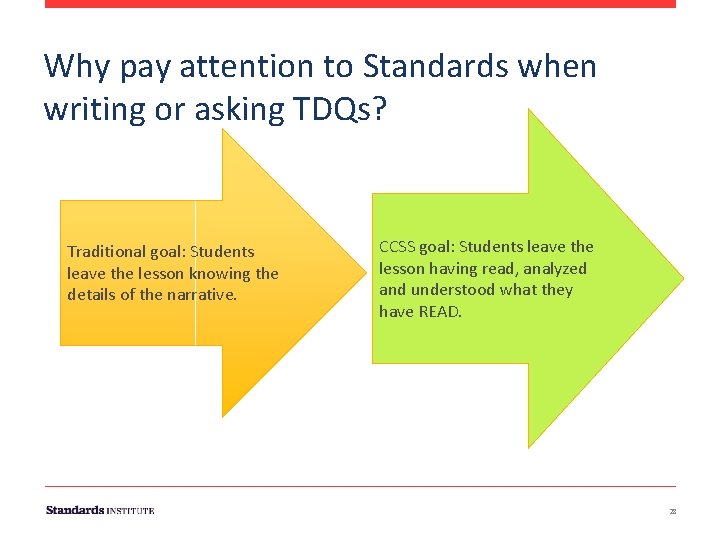
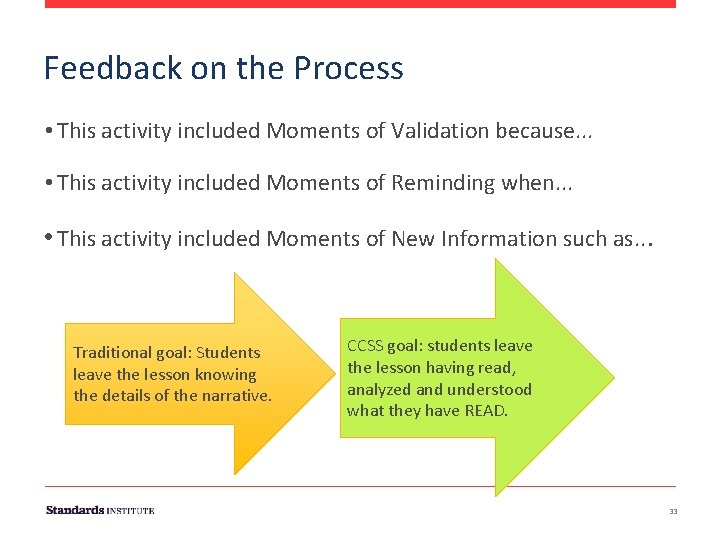
Why pay attention to Standards when writing or asking TDQs? Traditional goal: Students leave the lesson knowing the details of the narrative. CCSS goal: Students leave the lesson having read, analyzed and understood what they have READ. 28
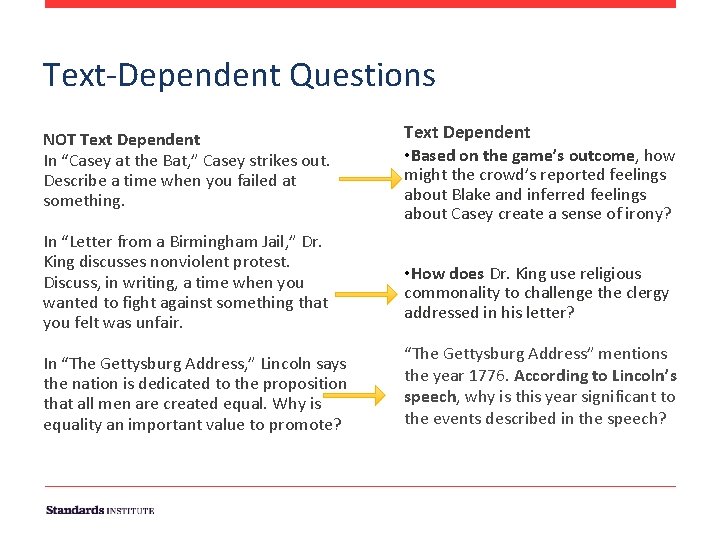
Text-Dependent Questions NOT Text Dependent In “Casey at the Bat, ” Casey strikes out. Describe a time when you failed at something. In “Letter from a Birmingham Jail, ” Dr. King discusses nonviolent protest. Discuss, in writing, a time when you wanted to fight against something that you felt was unfair. In “The Gettysburg Address, ” Lincoln says the nation is dedicated to the proposition that all men are created equal. Why is equality an important value to promote? Text Dependent • Based on the game’s outcome, how might the crowd’s reported feelings about Blake and inferred feelings about Casey create a sense of irony? • How does Dr. King use religious commonality to challenge the clergy addressed in his letter? “The Gettysburg Address” mentions the year 1776. According to Lincoln’s speech, why is this year significant to the events described in the speech?
Designing Questions Text features Genre Organization Layers of meaning Purpose Concept complexity Vocabulary Sentence length Sentence structure Figurative language Regional/archaic dialects Meaning Structure Language Knowledge Background Prior curriculum and instruction 30
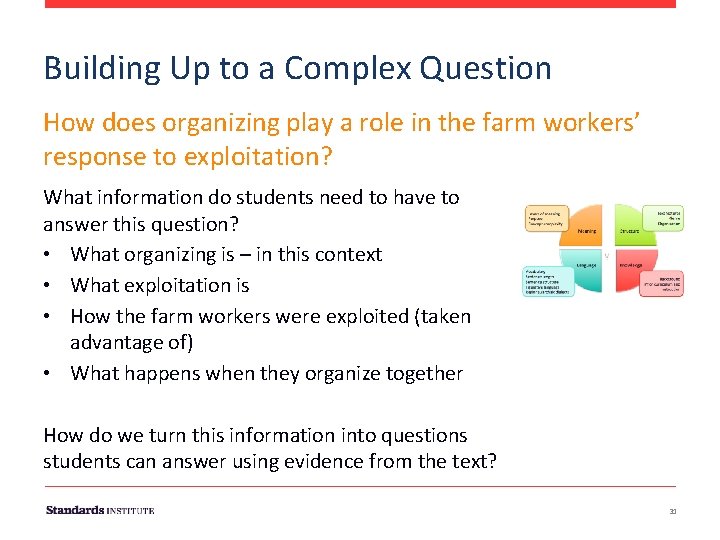
Building Up to a Complex Question How does organizing play a role in the farm workers’ response to exploitation? What information do students need to have to answer this question? • What organizing is – in this context • What exploitation is • How the farm workers were exploited (taken advantage of) • What happens when they organize together How do we turn this information into questions students can answer using evidence from the text? 31
Developing a Series of Text-based Scaffolding Questions • Choose a question • Identify the standard(s) • Answer the question • Identify what students need to know • Craft 2 -3 scaffolding questions • Post these questions on chart paper • Answer the questions on the chart paper. • Prepare to share out 32
Feedback on the Process • This activity included Moments of Validation because. . . • This activity included Moments of Reminding when. . . • This activity included Moments of New Information such as. . . Traditional goal: Students leave the lesson knowing the details of the narrative. CCSS goal: students leave the lesson having read, analyzed and understood what they have READ. 33
Juicy Sentences: Getting Deeper Text Part 1: Digging Deeper into Comprehension and Complexity What happens when students struggle with making sense of sentences that are critical to reaching an overall comprehension? • Fluent reading is basically reading at a sensible rate so you can making meaning from the words as you read. • Fluent reading does not ensure comprehension. • Lack of fluent reading ensures lack of comprehension. 34
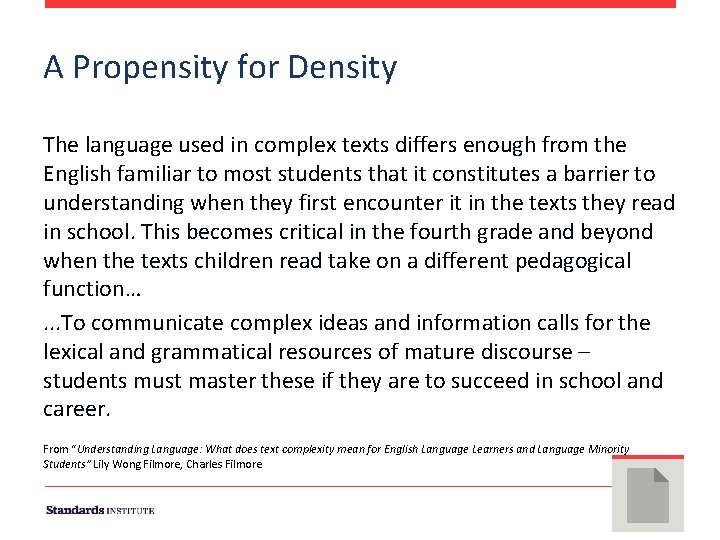
A Propensity for Density The language used in complex texts differs enough from the English familiar to most students that it constitutes a barrier to understanding when they first encounter it in the texts they read in school. This becomes critical in the fourth grade and beyond when the texts children read take on a different pedagogical function…. . . To communicate complex ideas and information calls for the lexical and grammatical resources of mature discourse – students must master these if they are to succeed in school and career. From “Understanding Language: What does text complexity mean for English Language Learners and Language Minority Students” Lily Wong Filmore, Charles Filmore 35
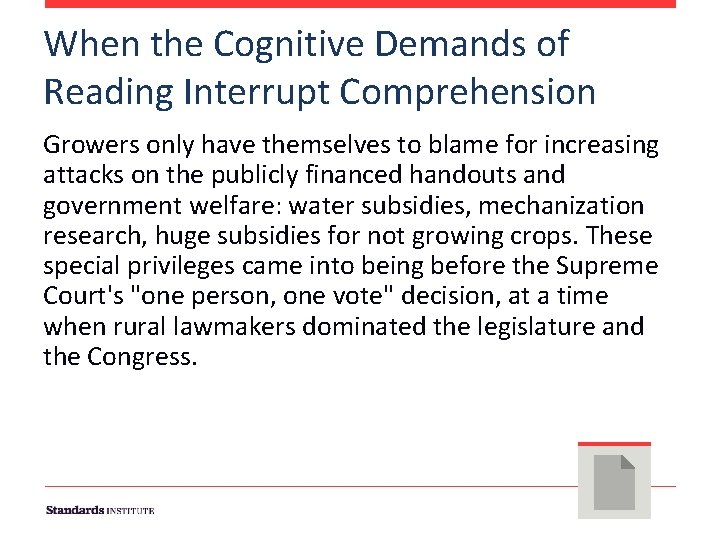
When the Cognitive Demands of Reading Interrupt Comprehension Growers only have themselves to blame for increasing attacks on the publicly financed handouts and government welfare: water subsidies, mechanization research, huge subsidies for not growing crops. These special privileges came into being before the Supreme Court's "one person, one vote" decision, at a time when rural lawmakers dominated the legislature and the Congress.
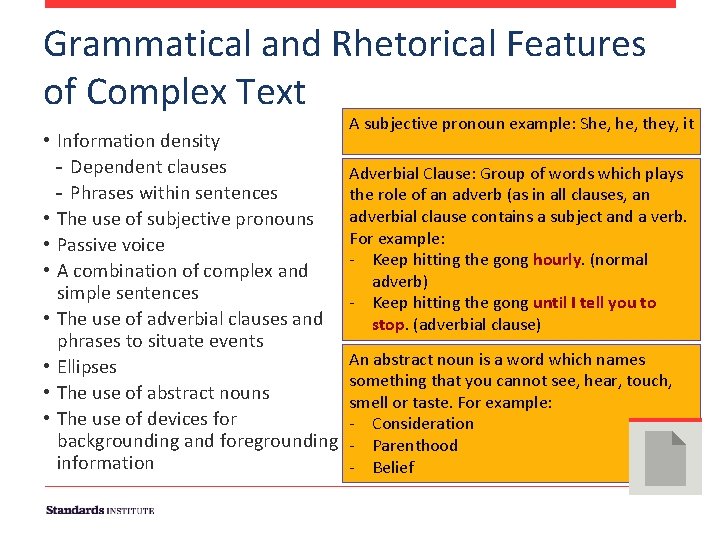
Grammatical and Rhetorical Features of Complex Text • Information density - Dependent clauses - Phrases within sentences • The use of subjective pronouns • Passive voice • A combination of complex and simple sentences • The use of adverbial clauses and phrases to situate events • Ellipses • The use of abstract nouns • The use of devices for backgrounding and foregrounding information A subjective pronoun example: She, they, it Adverbial Clause: Group of words which plays the role of an adverb (as in all clauses, an adverbial clause contains a subject and a verb. For example: - Keep hitting the gong hourly. (normal adverb) - Keep hitting the gong until I tell you to stop. (adverbial clause) An abstract noun is a word which names something that you cannot see, hear, touch, smell or taste. For example: - Consideration - Parenthood - Belief
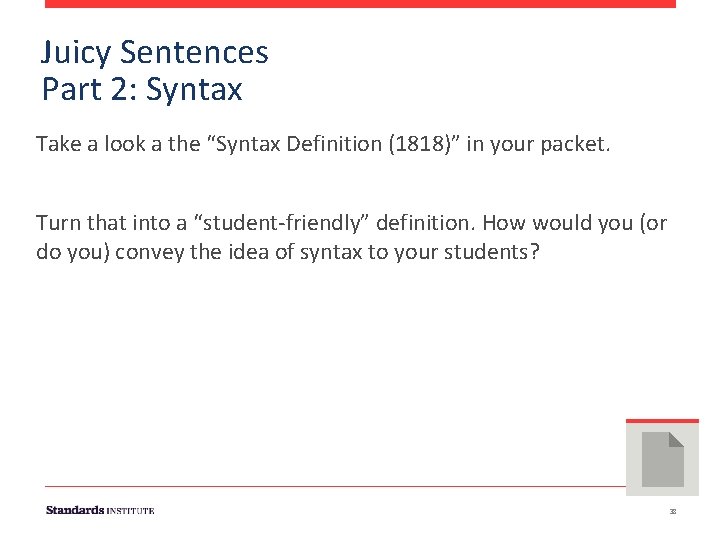
Juicy Sentences Part 2: Syntax Take a look a the “Syntax Definition (1818)” in your packet. Turn that into a “student-friendly” definition. How would you (or do you) convey the idea of syntax to your students? 38
Break: 15 minutes 39
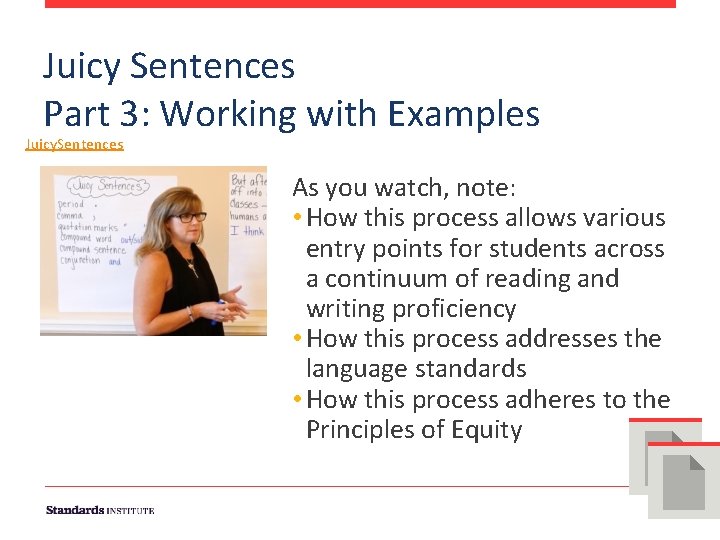
Juicy Sentences Part 3: Working with Examples Juicy. Sentences As you watch, note: • How this process allows various entry points for students across a continuum of reading and writing proficiency • How this process addresses the language standards • How this process adheres to the Principles of Equity 40
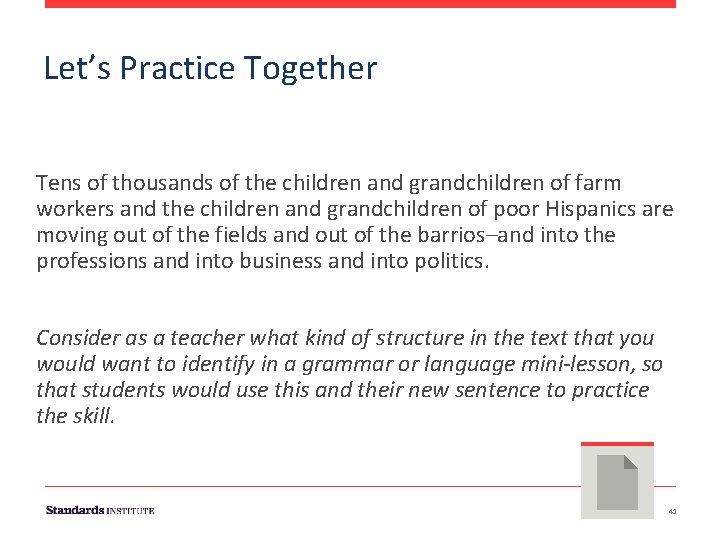
Let’s Practice Together Tens of thousands of the children and grandchildren of farm workers and the children and grandchildren of poor Hispanics are moving out of the fields and out of the barrios–and into the professions and into business and into politics. Consider as a teacher what kind of structure in the text that you would want to identify in a grammar or language mini-lesson, so that students would use this and their new sentence to practice the skill. 41
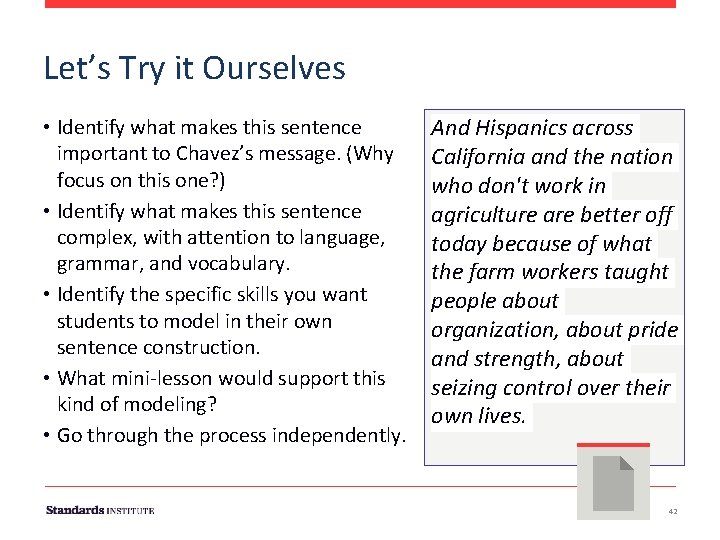
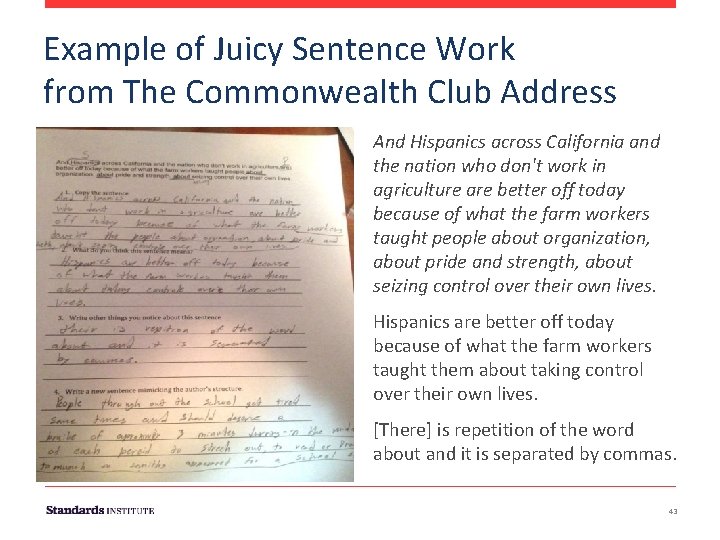
Let’s Try it Ourselves • Identify what makes this sentence important to Chavez’s message. (Why focus on this one? ) • Identify what makes this sentence complex, with attention to language, grammar, and vocabulary. • Identify the specific skills you want students to model in their own sentence construction. • What mini-lesson would support this kind of modeling? • Go through the process independently. And Hispanics across California and the nation who don't work in agriculture are better off today because of what the farm workers taught people about organization, about pride and strength, about seizing control over their own lives. 42
Example of Juicy Sentence Work from The Commonwealth Club Address And Hispanics across California and the nation who don't work in agriculture are better off today because of what the farm workers taught people about organization, about pride and strength, about seizing control over their own lives. Hispanics are better off today because of what the farm workers taught them about taking control over their own lives. [There] is repetition of the word about and it is separated by commas. 43
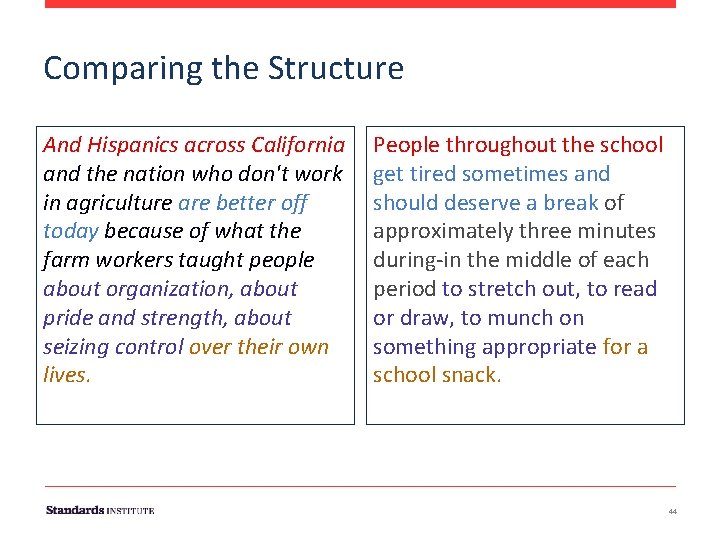
Comparing the Structure And Hispanics across California and the nation who don't work in agriculture are better off today because of what the farm workers taught people about organization, about pride and strength, about seizing control over their own lives. People throughout the school get tired sometimes and should deserve a break of approximately three minutes during-in the middle of each period to stretch out, to read or draw, to munch on something appropriate for a school snack. 44
Sharing Thinking About Juicy Sentences Juicy Sentence: Copy down yours on chart paper and identify: ● What makes the sentence you chose complex enough for deep analysis? ● What reading standard (besides Standard 1) would you want to explore with this sentence? ● What opportunities for Language Standard-based direct instruction (or review) does this sentence provide? ● What additional instructional opportunities does this sentence present? ● How is using this sentence in this way supporting a Principle of Equity? notes and chart 45
Think about your student Review your Reflection and Student Profile from this morning. In the three remaining spaces, answer the following questions: ● Two adjustments I can make immediately in the classroom based on today’s learning. ● Two adjustments I can make to address the Principles of Equity and/or the Equity, Language, and Learner Principles in my classroom, instruction, or planning. ● How would these adjustments help the student I described in my profile? 46
Day 2: Have we met our objectives? Are we now better prepared to • Make instructional decisions based on an understanding of text complexity? • Develop a sequence of text dependent questions that support student proficiency with specific standards? • Apply the Juicy Sentence Protocol to enhance reading comprehension and support student writing? • Include equitable practices into instructional moves and decision making?
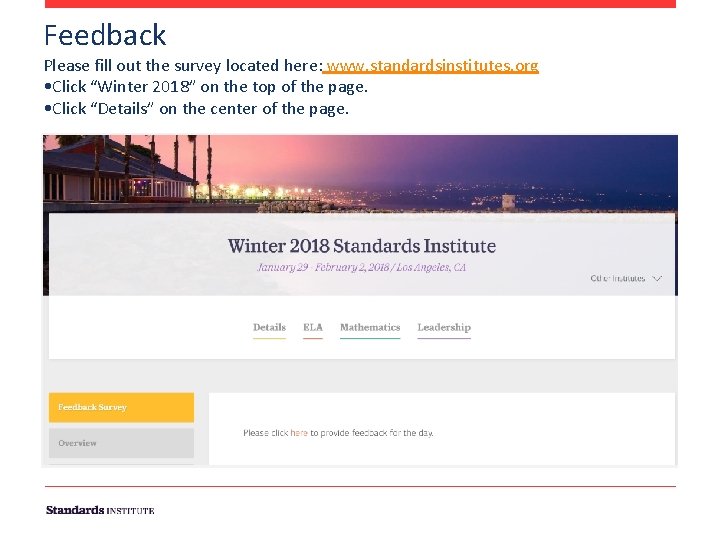
Feedback Please fill out the survey located here: www. standardsinstitutes. org • Click “Winter 2018” on the top of the page. • Click “Details” on the center of the page.
Image credits • • • Slide 1: Unbounded. org / Nick Lue Slide 7: Flickr/Michael. Crane blip_4 Speed Dating Jelly Babies Slide 13: Amy Rudat Slide 15: Flickr/Kelly. Short/Child Labor; Flickr/John. Schulze/Token Reminder of Where Our Food Comes From Slide 30: Flickr/Maryland. Gov. Pics/First Lady’s Art Exhibition Slide 36: NEEDS image credit Slide 44: Amy Rudat Slide 46: Flikr/Derek. Bruff Slide 47: Flikr/Derek. Bruff Slide 48: Jogi. Baer 2 “Post-It” Slide 50: Flickr/Michael. Crane blip_4 Speed Dating Jelly Babies Slide 52: http: //www. standardsinstitutes. org/institute/summer-2017#vertical-panel-101 49
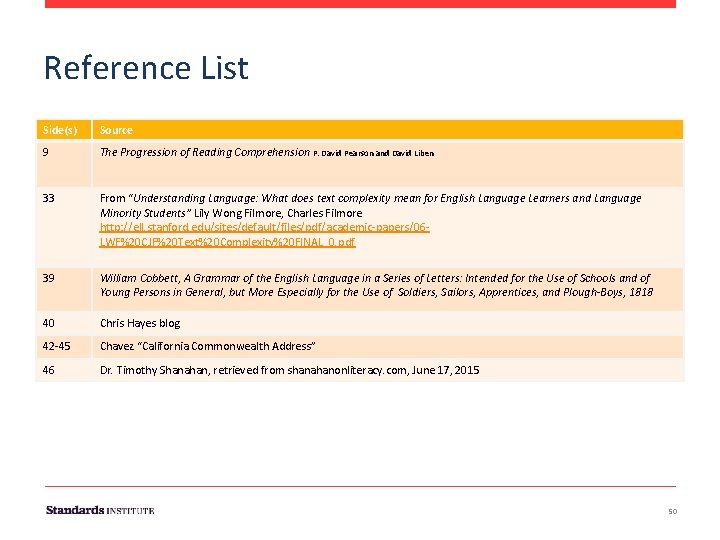
Reference List Side(s) Source 9 The Progression of Reading Comprehension P. David Pearson and David Liben 33 From “Understanding Language: What does text complexity mean for English Language Learners and Language Minority Students” Lily Wong Filmore, Charles Filmore http: //ell. stanford. edu/sites/default/files/pdf/academic-papers/06 LWF%20 CJF%20 Text%20 Complexity%20 FINAL_0. pdf 39 William Cobbett, A Grammar of the English Language in a Series of Letters: Intended for the Use of Schools and of Young Persons in General, but More Especially for the Use of Soldiers, Sailors, Apprentices, and Plough-Boys, 1818 40 Chris Hayes blog 42 -45 Chavez “California Commonwealth Address” 46 Dr. Timothy Shanahan, retrieved from shanahanonliteracy. com, June 17, 2015 50