
CLONING CLUB Manlio Fusciello Jaakko Itkonen Maarja Laos
CLONING CLUB Manlio Fusciello Jaakko Itkonen Maarja Laos Tania Quirin Group 3 11 th October 2016
AIM • To create 2 expression plasmids for expression of: 1) Fusion protein between Heat-shock protein 27 (Hsp 27) and C-terminal intein Npu. NΔ 16, 2) Fusion protein between Heat-shock protein A 1 (Hsp. A 1) and C-terminal Npu. NΔ 16 using p. IVEX_GAA_Omega_e. YFP-His as a backbone • Created plasmids will be used for cell-free protein synthesis in tobacco BY-2 cell lysates
STRATEGY 1: Standard Nebuilder 2 Fragment Assembly • Vector p. IVEX_GAA_Omega_e. YFP_His linearized and amplified with PCR, resulting in the removal of the e. YFP_His insert • Hsp 27 and Hsp. A 1 PCR-amplified with primers that introduce 5’-overhangs with complementarity to the 3’ end of the plasmid, and to the 5’ end of the Npu. NΔ 16 • Intein Npu. NΔ 16 PCR-amplified with primers that introduce 5’-overhangs with complementarity to the 3’ end of the Hsp. XX and to the and 5’ end of the plasmid
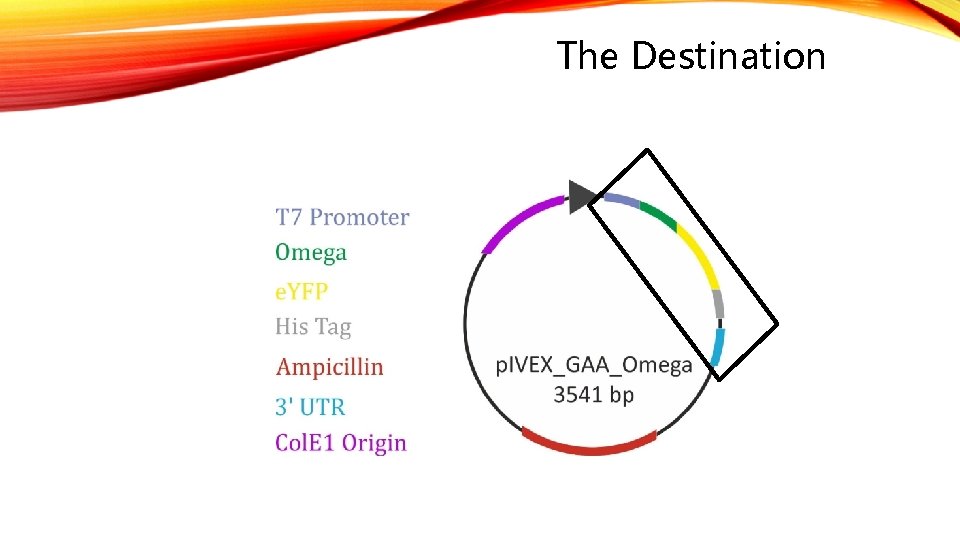
The Destination
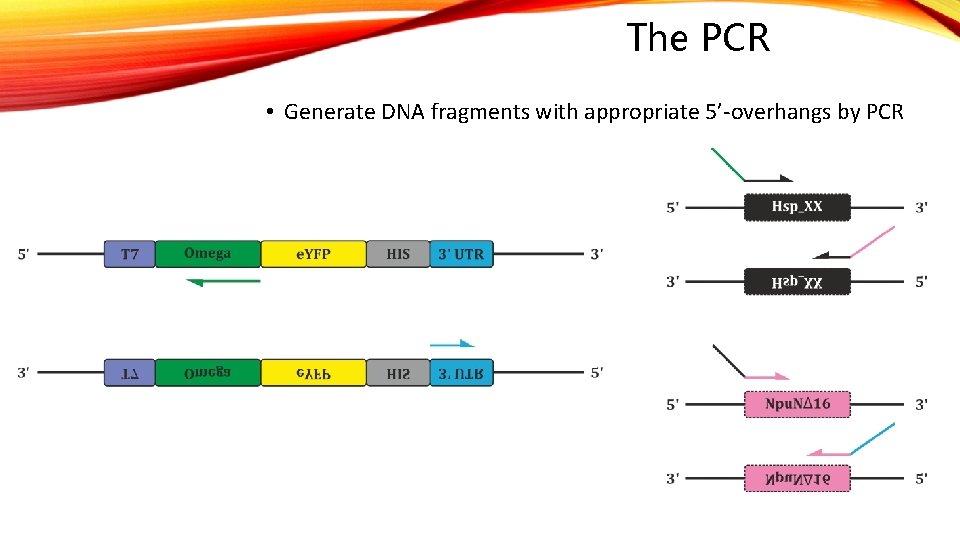
The PCR • Generate DNA fragments with appropriate 5’-overhangs by PCR
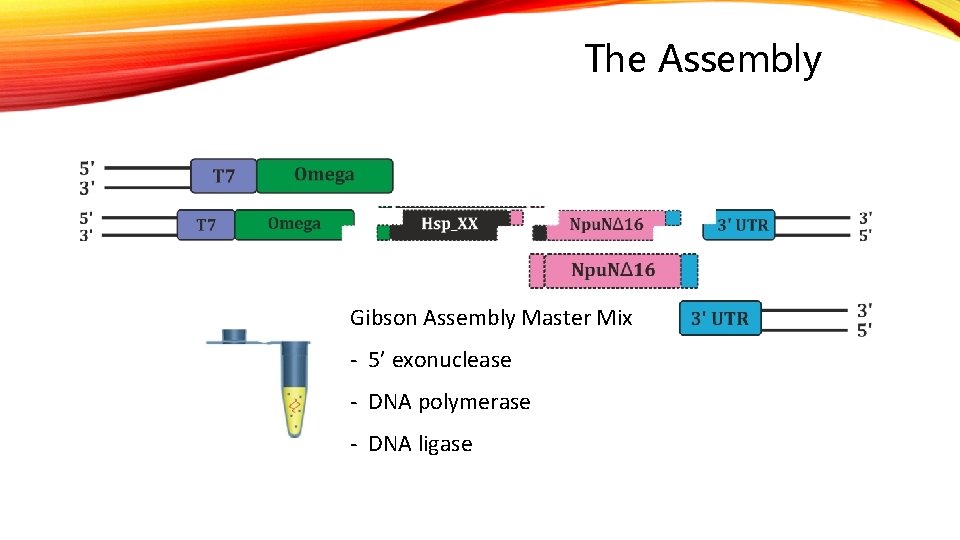
The Assembly Gibson Assembly Master Mix - 5’ exonuclease - DNA polymerase - DNA ligase
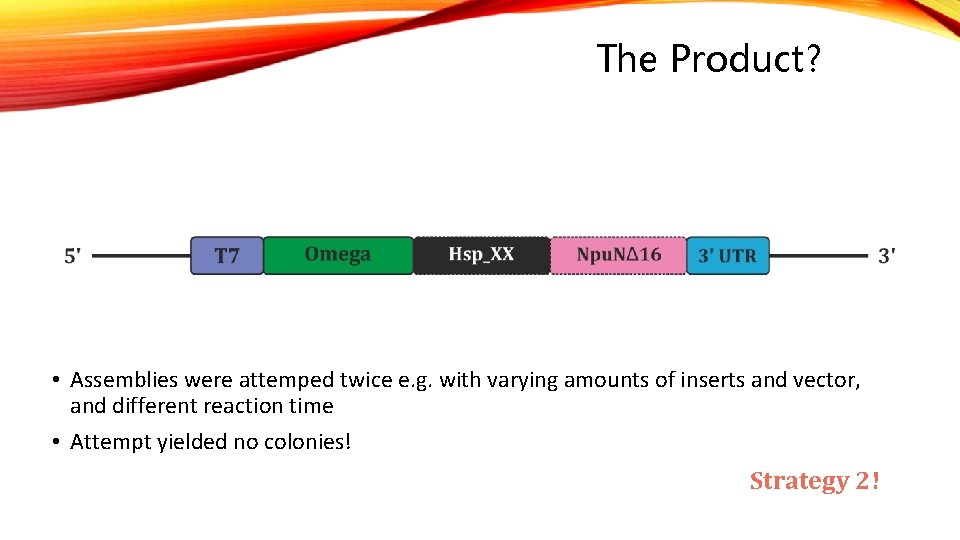
The Product? • Assemblies were attemped twice e. g. with varying amounts of inserts and vector, and different reaction time • Attempt yielded no colonies! Strategy 2!
Strategy 2: Overlap Extension PCR • Instead of using 2 fragments in the Gibson Assembly, the fragments can be fused together in a separate PCR-reaction, and then used as a single fragment in the assembly reaction • Template generation: Fragments are PCR-amplified with primers that introduce 5’overhangs complementary to the fusion partners
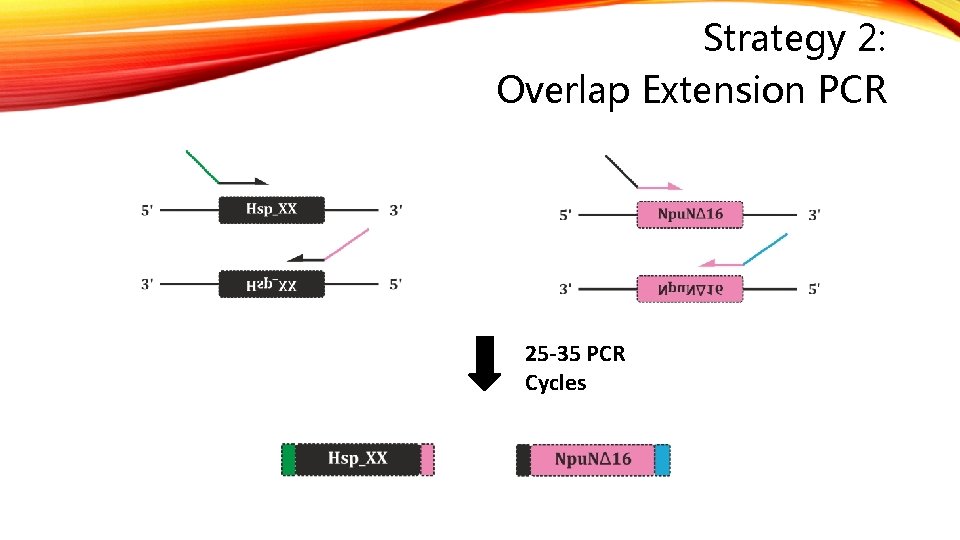
Strategy 2: Overlap Extension PCR 25 -35 PCR Cycles
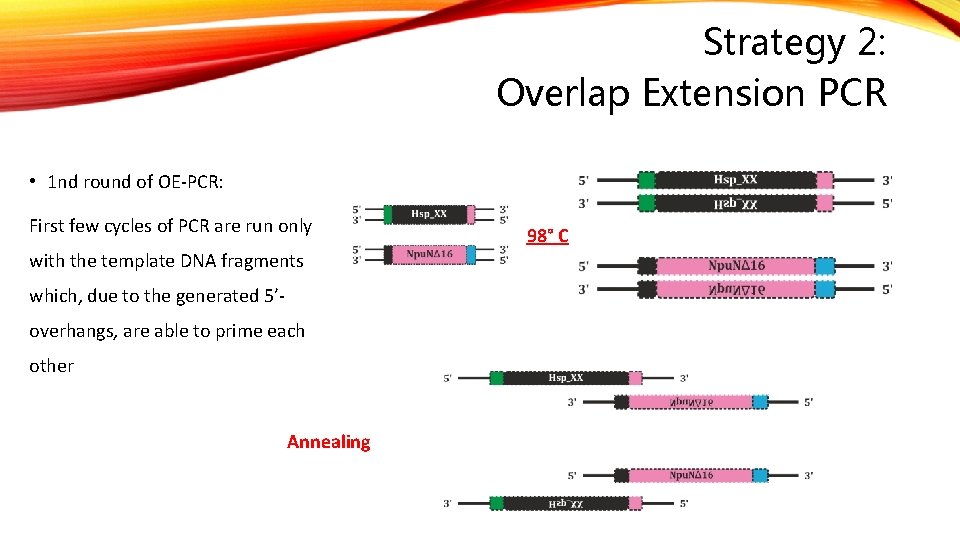
Strategy 2: Overlap Extension PCR • 1 nd round of OE-PCR: First few cycles of PCR are run only with the template DNA fragments which, due to the generated 5’overhangs, are able to prime each other Annealing 98° C
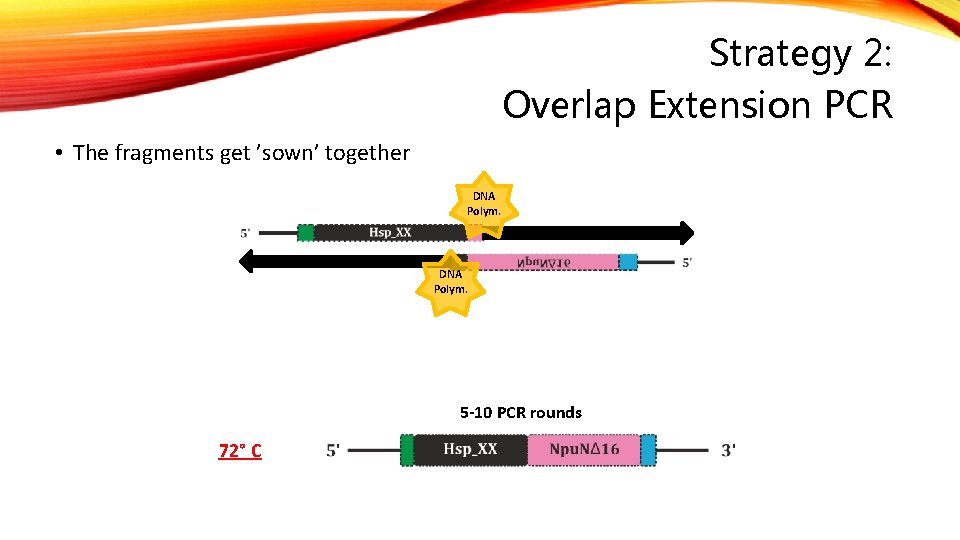
Strategy 2: Overlap Extension PCR • The fragments get ’sown’ together DNA Polym. 5 -10 PCR rounds 72° C
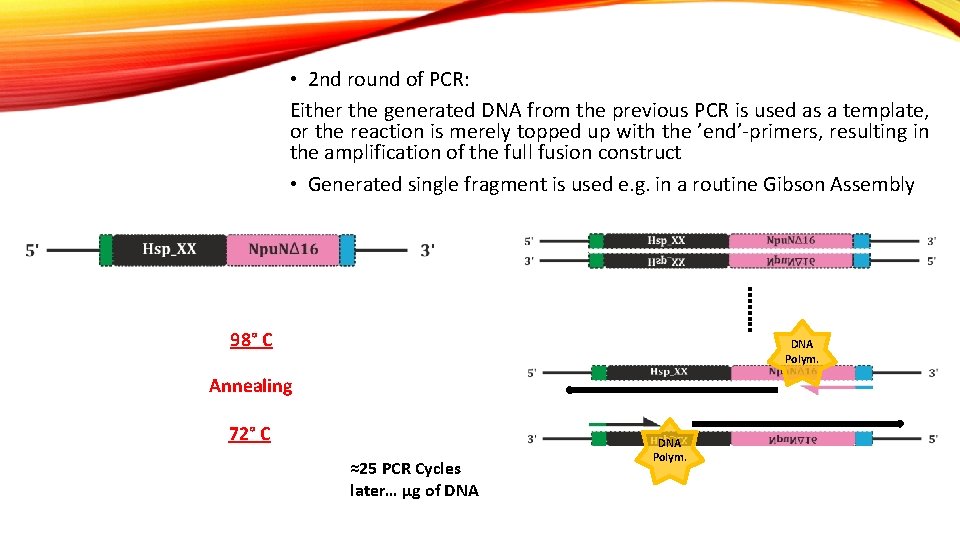
• 2 nd round of PCR: Either the generated DNA from the previous PCR is used as a template, or the reaction is merely topped up with the ’end’-primers, resulting in the amplification of the full fusion construct • Generated single fragment is used e. g. in a routine Gibson Assembly 98° C DNA Polym. Annealing 72° C ≈25 PCR Cycles later… µg of DNA Polym.
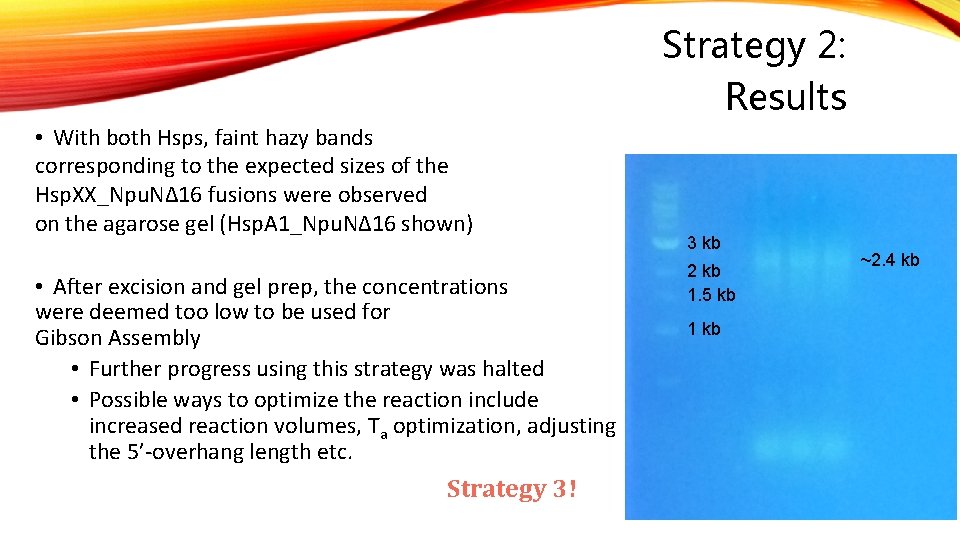
Strategy 2: Results • With both Hsps, faint hazy bands corresponding to the expected sizes of the Hsp. XX_Npu. NΔ 16 fusions were observed on the agarose gel (Hsp. A 1_Npu. NΔ 16 shown) • After excision and gel prep, the concentrations were deemed too low to be used for Gibson Assembly • Further progress using this strategy was halted • Possible ways to optimize the reaction include increased reaction volumes, Ta optimization, adjusting the 5’-overhang length etc. Strategy 3! 3 kb 2 kb 1. 5 kb 1 kb ~2. 4 kb
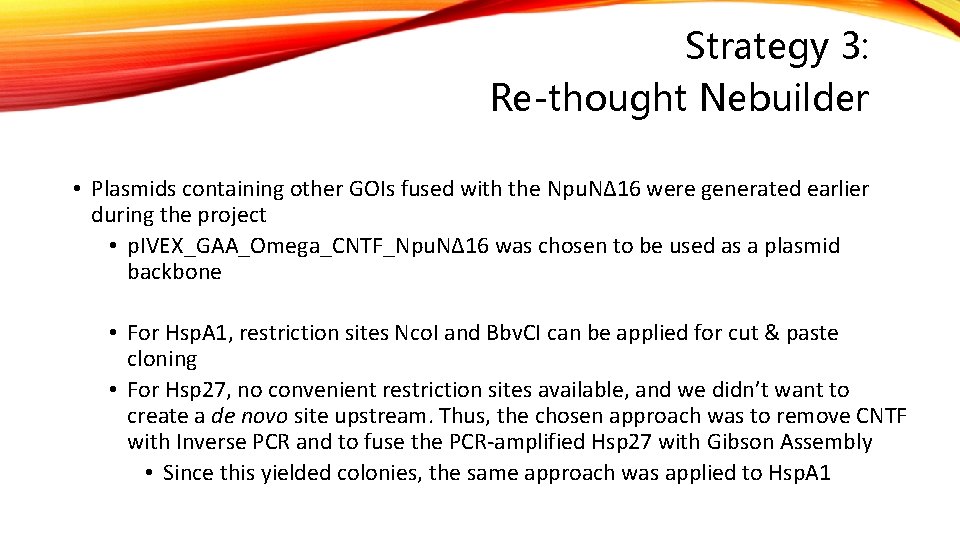
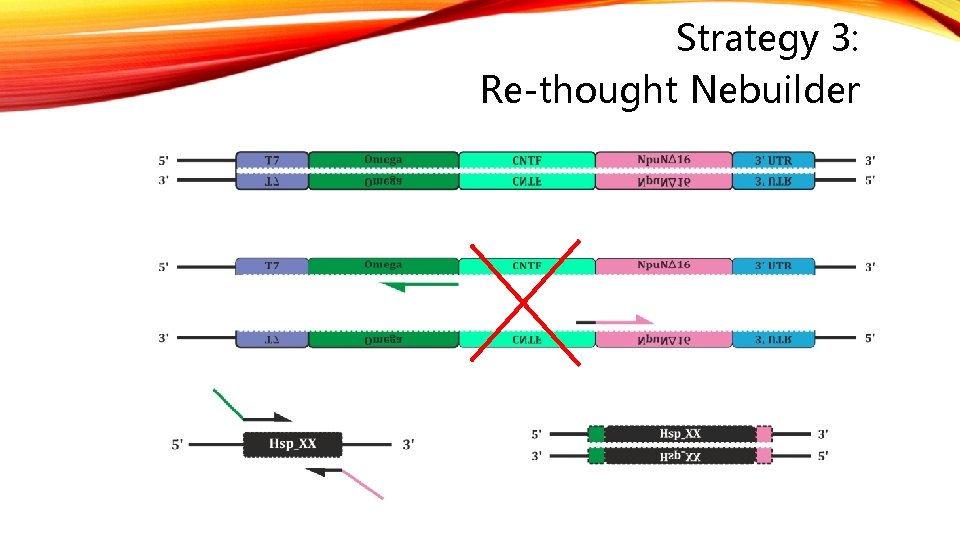
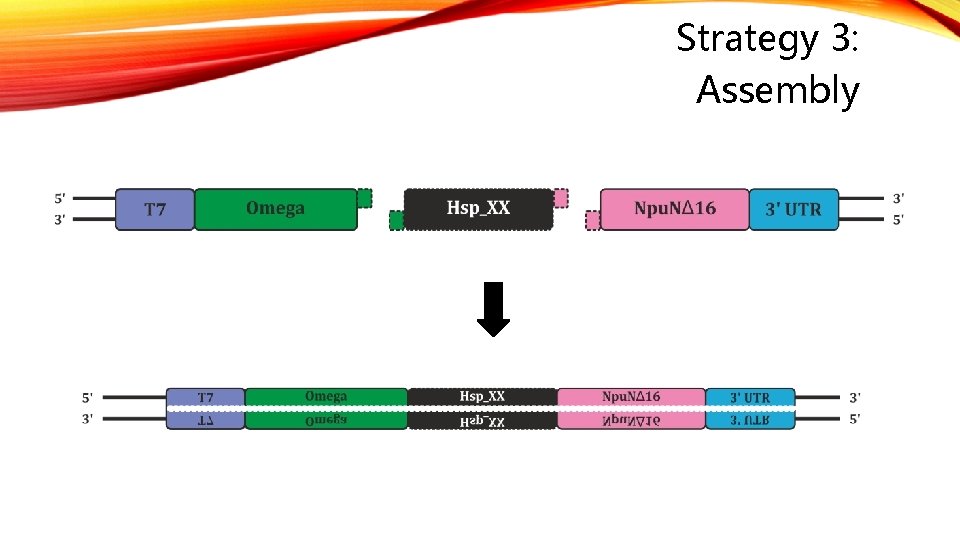
Strategy 3: Re-thought Nebuilder • Plasmids containing other GOIs fused with the Npu. NΔ 16 were generated earlier during the project • p. IVEX_GAA_Omega_CNTF_Npu. NΔ 16 was chosen to be used as a plasmid backbone • For Hsp. A 1, restriction sites Nco. I and Bbv. CI can be applied for cut & paste cloning • For Hsp 27, no convenient restriction sites available, and we didn’t want to create a de novo site upstream. Thus, the chosen approach was to remove CNTF with Inverse PCR and to fuse the PCR-amplified Hsp 27 with Gibson Assembly • Since this yielded colonies, the same approach was applied to Hsp. A 1
Strategy 3: Re-thought Nebuilder
Strategy 3: Assembly
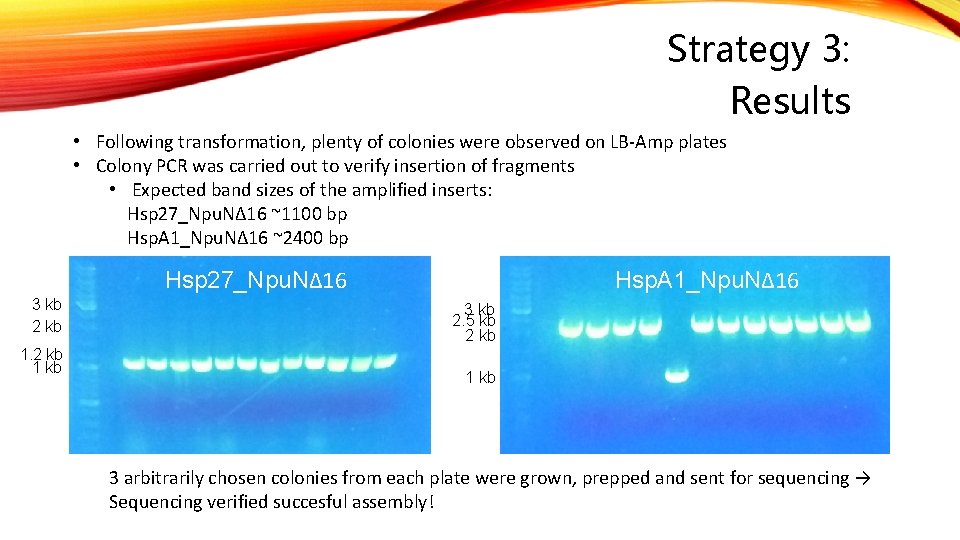
Strategy 3: Results • Following transformation, plenty of colonies were observed on LB-Amp plates • Colony PCR was carried out to verify insertion of fragments • Expected band sizes of the amplified inserts: Hsp 27_Npu. NΔ 16 ~1100 bp Hsp. A 1_Npu. NΔ 16 ~2400 bp Hsp 27_Npu. NΔ 16 3 kb 2 kb 1 kb Hsp. A 1_Npu. NΔ 16 3 kb 2. 5 kb 2 kb 1 kb 3 arbitrarily chosen colonies from each plate were grown, prepped and sent for sequencing → Sequencing verified succesful assembly!
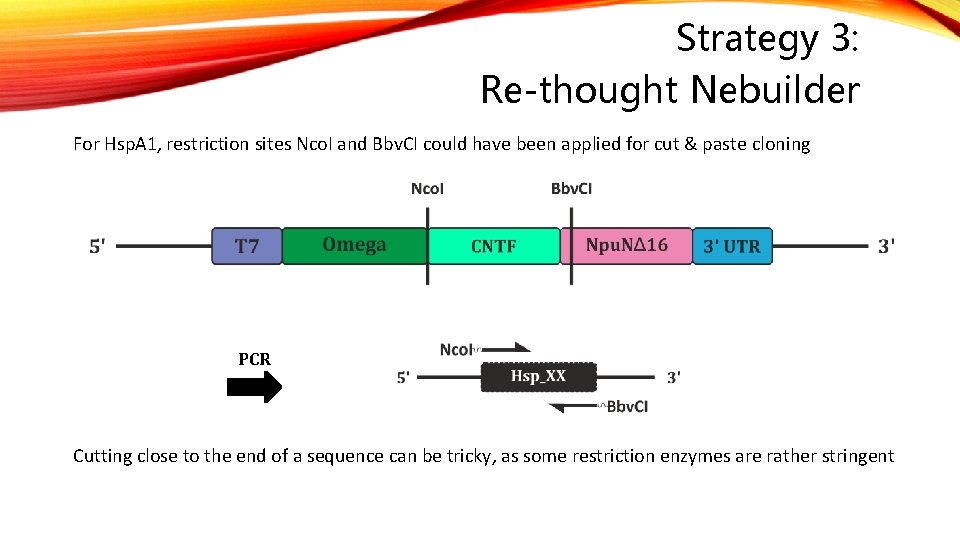
Strategy 3: Re-thought Nebuilder For Hsp. A 1, restriction sites Nco. I and Bbv. CI could have been applied for cut & paste cloning PCR Cutting close to the end of a sequence can be tricky, as some restriction enzymes are rather stringent
Moral of the Story • When it comes to cloning, there’s a plethora of different strategies to choose from • No definite success can be guaranteed with any given method • Develop yourself a thick skin and a hard head, (re)think both in and outside the box, and most importantly, don’t give up! Thank you
Questions? University of Helsinki Jaakko Itkonen Tania Quirin Manlio Fusciello Maarja Laos
- Slides: 20