
ClockAware Ultra Scale FPGA Placement with Machine Learning

![Previous Works • Routablility-driven placement for Ultra. Scale FPGAs • Ripple. FPGA[1] • UTPlace.](https://slidetodoc.com/presentation_image_h2/f030e157bfe8772169e2cadf50a92be8/image-4.jpg "Previous Works • Routablility-driven placement for Ultra. Scale FPGAs • Ripple. FPGA[1] • UTPlace.")
![Experimental Result Ripple. FPGA[1] This work WL ratio Design FPGA 01 350060 1 350802](https://slidetodoc.com/presentation_image_h2/f030e157bfe8772169e2cadf50a92be8/image-29.jpg "Experimental Result Ripple. FPGA[1] This work WL ratio Design FPGA 01 350060 1 350802")

- Slides: 31
Clock-Aware Ultra. Scale FPGA Placement with Machine Learning Routability Prediction Chak-Wa Pui, Gengjie Chen, Yuzhe Ma, Evangeline F. Y. Young, Bei Yu CSE Department, Chinese University of Hong Kong, Hong Kong Speaker: Jordan, Chak-Wa Pui 1
Outline • Background • Problem Formulation • Algorithms • Experimental Results • Conclusion 2
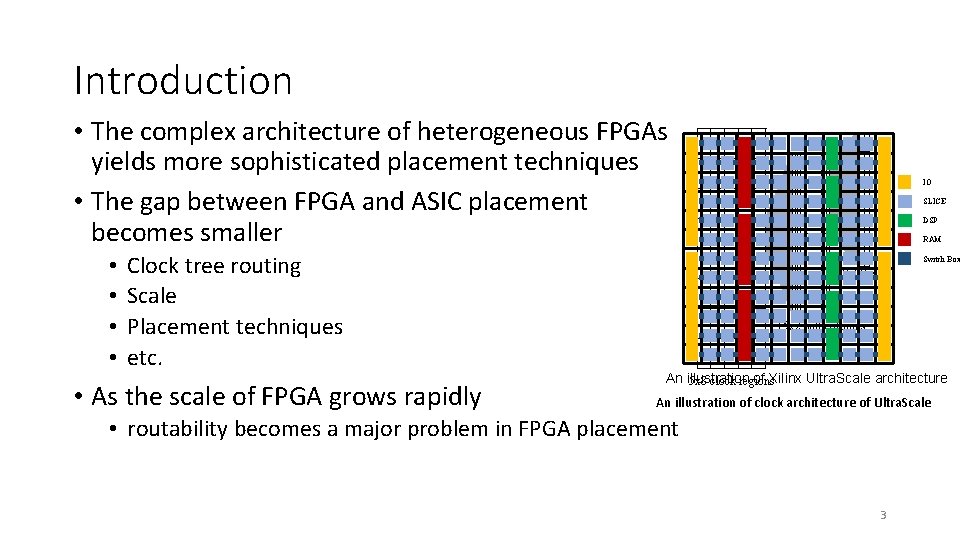
Introduction • The complex architecture of heterogeneous FPGAs yields more sophisticated placement techniques • The gap between FPGA and ASIC placement becomes smaller • • Clock tree routing Scale Placement techniques etc. • As the scale of FPGA grows rapidly IO … SLICE DSP RAM Switch Box … 2 x 30 sites 15 x 2 half columns An illustration of Xilinx Ultra. Scale architecture 5 x 8 clock regions An illustration of clock architecture of Ultra. Scale • routability becomes a major problem in FPGA placement 3
Previous Works • Routablility-driven placement for Ultra. Scale FPGAs • Ripple. FPGA[1] • UTPlace. F[2] • GPlace[3] • Congestion estimation methods in FPGAs • Probabilistic model[1][4] • Global router[2] [1] Ripple. FPGA: A routability driven placement for large-scale heterogeneous FPGAs. ICCAD 2016 [2] UTPlace. F: A routability-driven FPGA placer with physical and congestion aware packing. ICCAD 2016 [3] GPlace: A congestion-aware placement tool for Ultra. Scale FPGAs. ICCAD 2016 [4] A congestion driven placementalgorithm for fpga synthesis. FPL 2006 4
Contributions • Several placement techniques for Ultra. Scale FPGAs to meet the challenges of clock constraints, routability, wirelength • A two-step displacement-driven legalization is introduced to remove all clock constraint violations • Chain move is proposed to put a cell into a desired site efficiently • We study the performance of different routability prediction methods in FPGAs • All the above techniques are incorporated into our FPGA placer 5
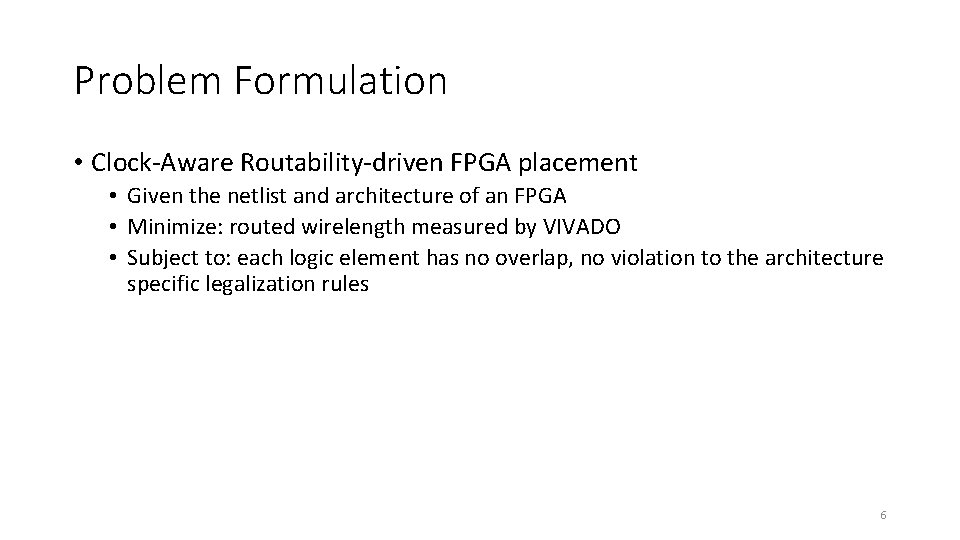
Problem Formulation • Clock-Aware Routability-driven FPGA placement • Given the netlist and architecture of an FPGA • Minimize: routed wirelength measured by VIVADO • Subject to: each logic element has no overlap, no violation to the architecture specific legalization rules 6
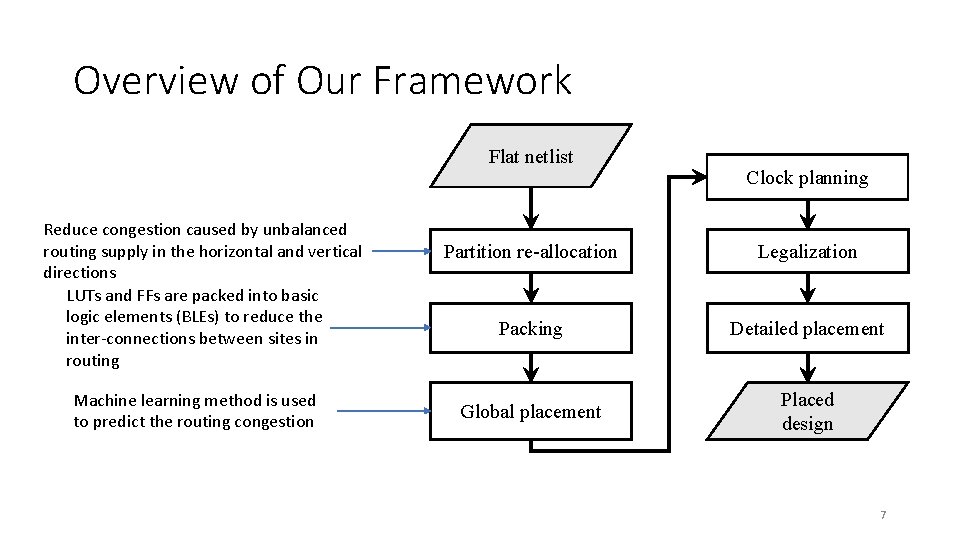
Overview of Our Framework Flat netlist Reduce congestion caused by unbalanced routing supply in the horizontal and vertical directions LUTs and FFs are packed into basic logic elements (BLEs) to reduce the inter-connections between sites in routing Machine learning method is used to predict the routing congestion Clock planning Partition re-allocation Legalization Packing Detailed placement Global placement Placed design 7
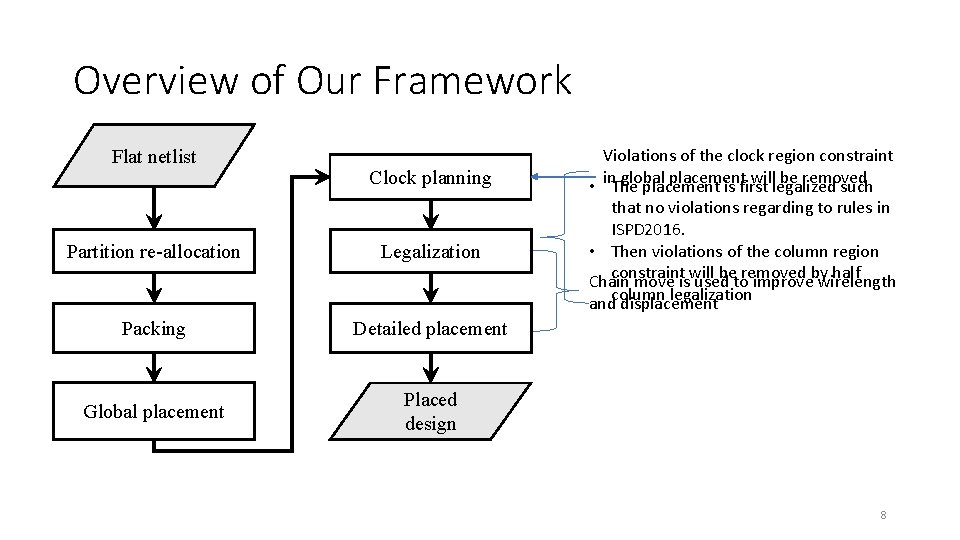
Overview of Our Framework Flat netlist Clock planning Partition re-allocation Legalization Packing Detailed placement Global placement Placed design Violations of the clock region constraint global placement will be removed • in. The placement is first legalized such that no violations regarding to rules in ISPD 2016. • Then violations of the column region constraint will be removed by half Chain move is used to improve wirelength column legalization and displacement 8
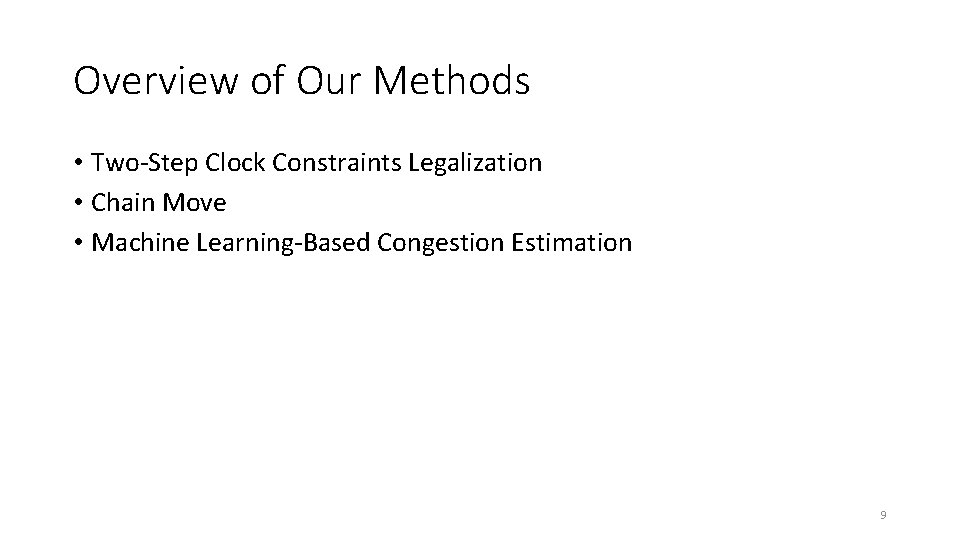
Overview of Our Methods • Two-Step Clock Constraints Legalization • Chain Move • Machine Learning-Based Congestion Estimation 9
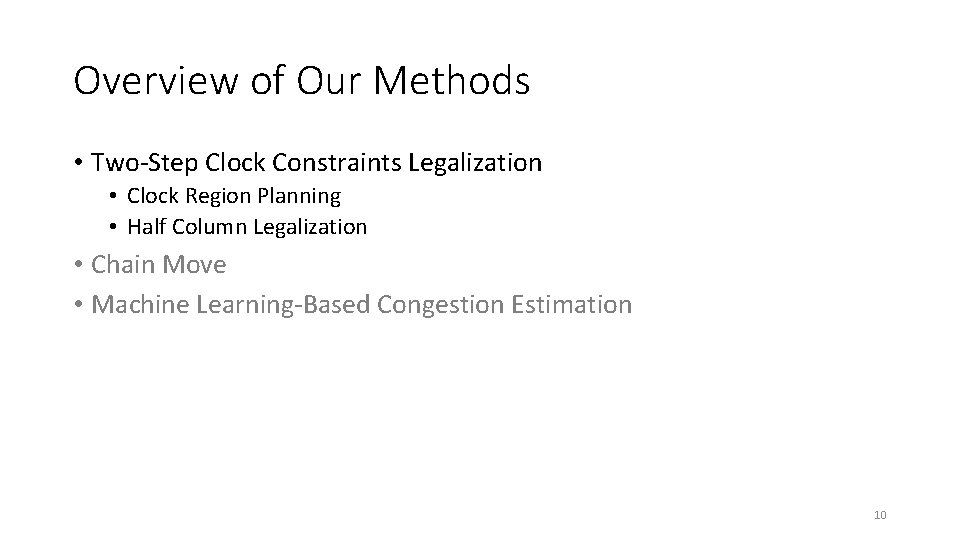
Overview of Our Methods • Two-Step Clock Constraints Legalization • Clock Region Planning • Half Column Legalization • Chain Move • Machine Learning-Based Congestion Estimation 10
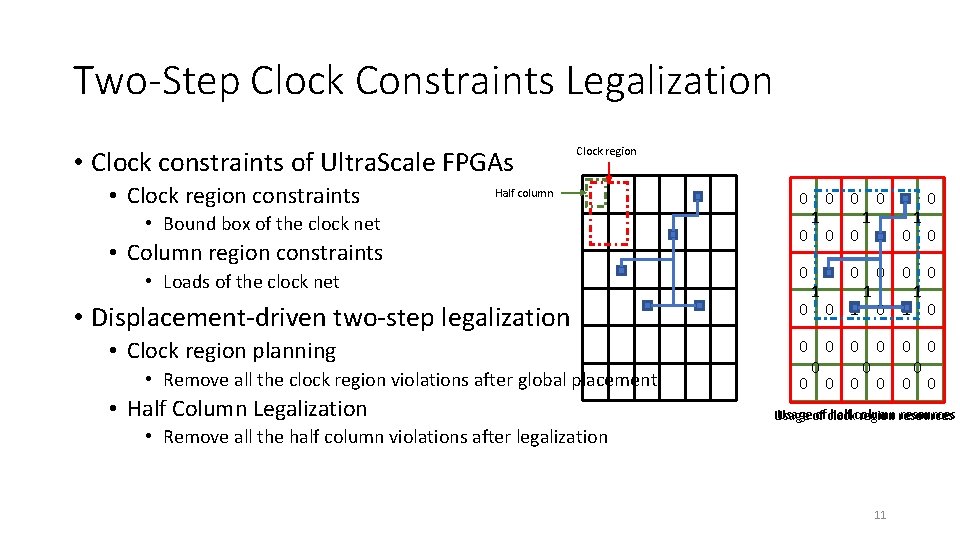
Two-Step Clock Constraints Legalization • Clock constraints of Ultra. Scale FPGAs • Clock region constraints Clock region Half column • Bound box of the clock net • Column region constraints • Loads of the clock net • Displacement-driven two-step legalization • Clock region planning • Remove all the clock region violations after global placement • Half Column Legalization 0 0 1 0 1 1 1 0 0 0 1 1 1 0 0 0 0 0 Usageof ofclock half column resources Usage region resources • Remove all the half column violations after legalization 11
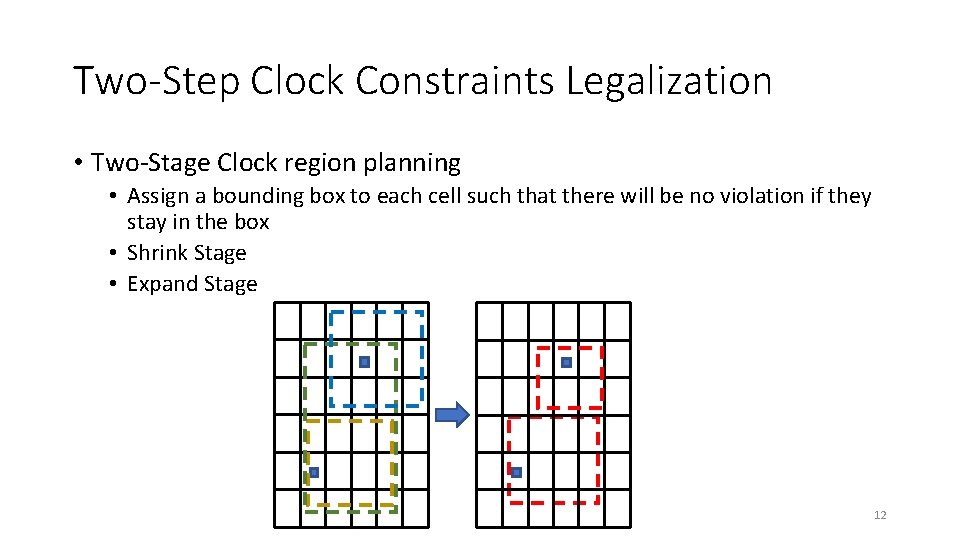
Two-Step Clock Constraints Legalization • Two-Stage Clock region planning • Assign a bounding box to each cell such that there will be no violation if they stay in the box • Shrink Stage • Expand Stage 12
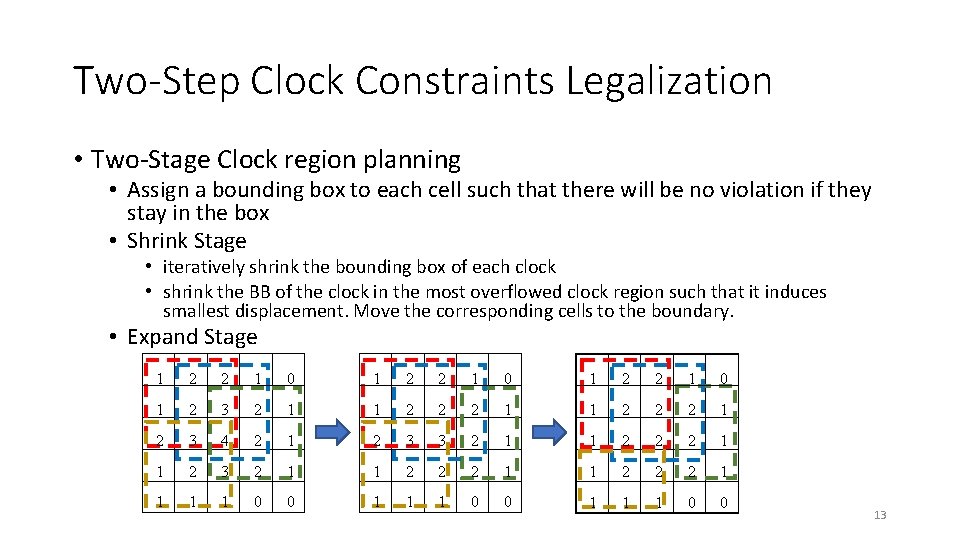
Two-Step Clock Constraints Legalization • Two-Stage Clock region planning • Assign a bounding box to each cell such that there will be no violation if they stay in the box • Shrink Stage • iteratively shrink the bounding box of each clock • shrink the BB of the clock in the most overflowed clock region such that it induces smallest displacement. Move the corresponding cells to the boundary. • Expand Stage 1 2 2 1 0 1 2 3 2 1 1 2 2 2 1 2 3 4 2 1 2 3 3 2 1 1 2 2 2 1 1 0 0 13
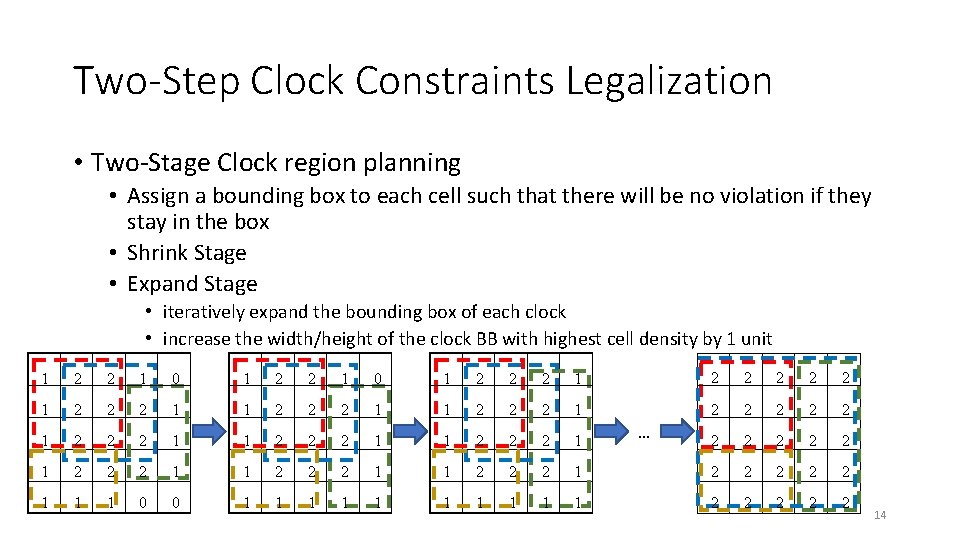
Two-Step Clock Constraints Legalization • Two-Stage Clock region planning • Assign a bounding box to each cell such that there will be no violation if they stay in the box • Shrink Stage • Expand Stage • iteratively expand the bounding box of each clock • increase the width/height of the clock BB with highest cell density by 1 unit 1 2 2 1 0 1 2 2 2 2 2 1 2 2 2 1 1 2 2 2 2 2 1 1 2 2 2 2 2 1 1 1 0 0 1 1 1 1 1 2 2 2 … 14
Two-Step Clock Constraints Legalization • Half Column Legalization • All the future movement cannot induce any new half column violation • Iteratively select the most overflow column and remove the clock s. t. the smallest displacement is induced • Each load will be moved to its nearest site in another half column 15
Overview of Our Methods • Two-Step Clock Constraints Legalization • Chain Move • Machine Learning-Based Congestion Estimation 16
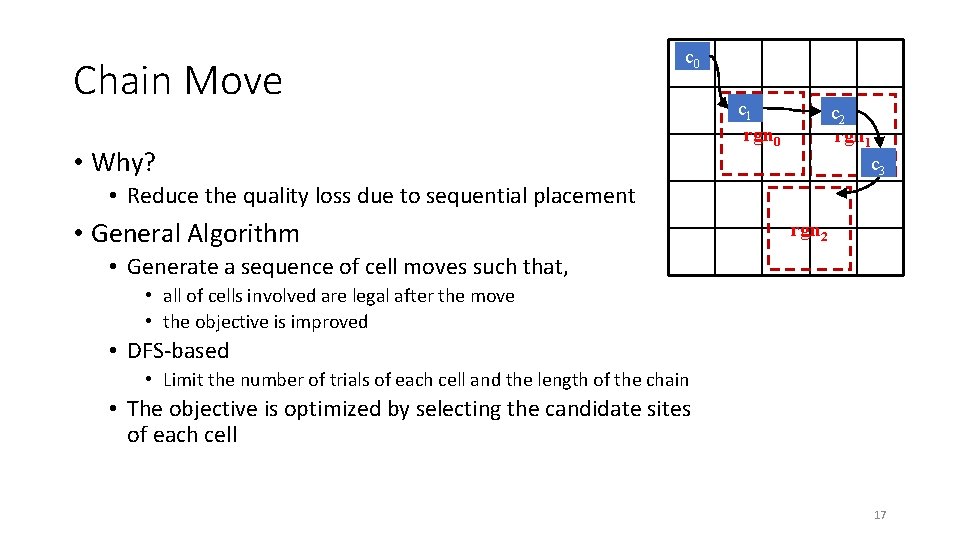
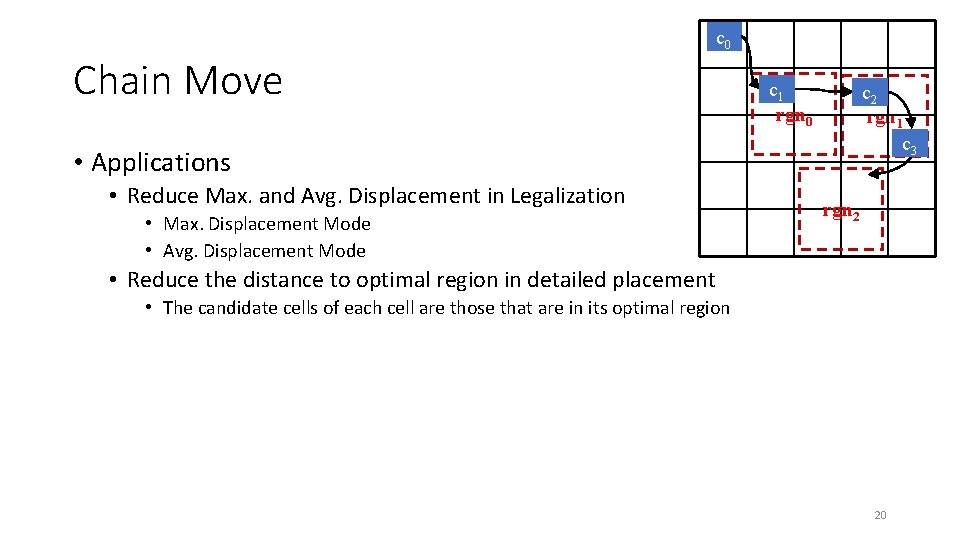
Chain Move c 0 • Why? c 1 rgn 0 c 2 rgn 1 c 3 • Reduce the quality loss due to sequential placement • General Algorithm rgn 2 • Generate a sequence of cell moves such that, • all of cells involved are legal after the move • the objective is improved • DFS-based • Limit the number of trials of each cell and the length of the chain • The objective is optimized by selecting the candidate sites of each cell 17
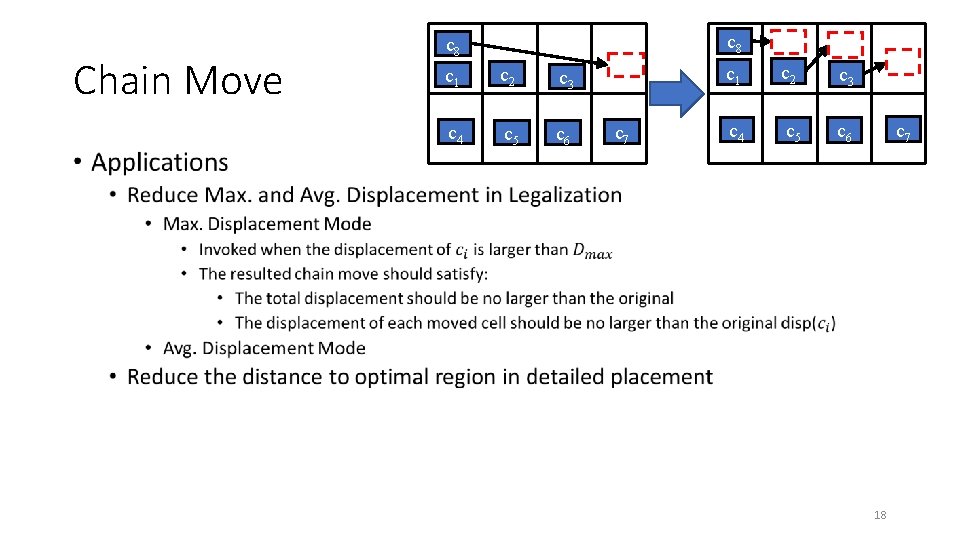
Chain Move • c 8 c 1 c 2 c 3 c 4 c 5 c 6 c 7 18
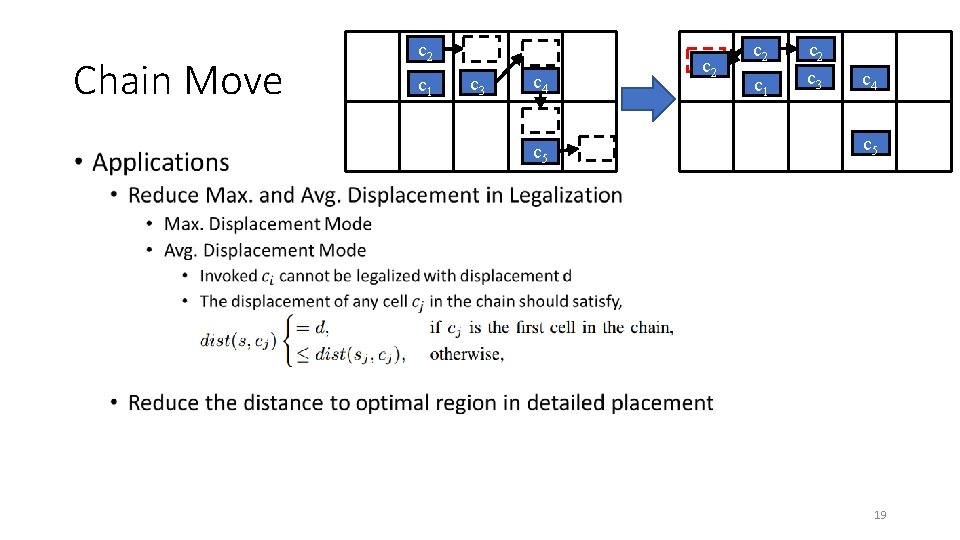
Chain Move • c 2 c 1 c 3 c 4 c 5 c 2 c 1 c 2 c 3 c 4 c 5 19
c 0 Chain Move c 1 rgn 0 c 2 rgn 1 c 3 • Applications • Reduce Max. and Avg. Displacement in Legalization • Max. Displacement Mode • Avg. Displacement Mode rgn 2 • Reduce the distance to optimal region in detailed placement • The candidate cells of each cell are those that are in its optimal region 20
Overview of Our Methods • Two-Step Clock Constraints Legalization • Chain Move • Machine Learning-Based Congestion Estimation 21
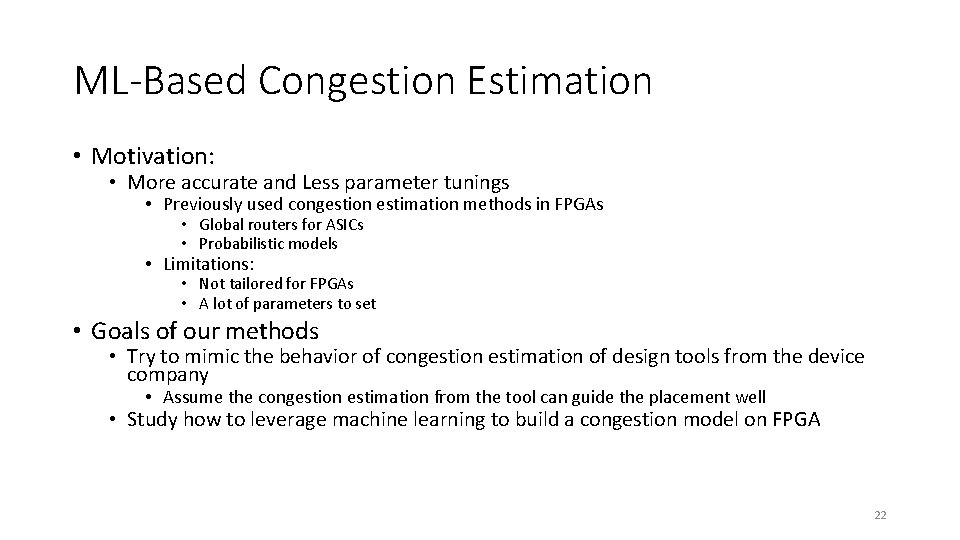
ML-Based Congestion Estimation • Motivation: • More accurate and Less parameter tunings • Previously used congestion estimation methods in FPGAs • Global routers for ASICs • Probabilistic models • Limitations: • Not tailored for FPGAs • A lot of parameters to set • Goals of our methods • Try to mimic the behavior of congestion estimation of design tools from the device company • Assume the congestion estimation from the tool can guide the placement well • Study how to leverage machine learning to build a congestion model on FPGA 22
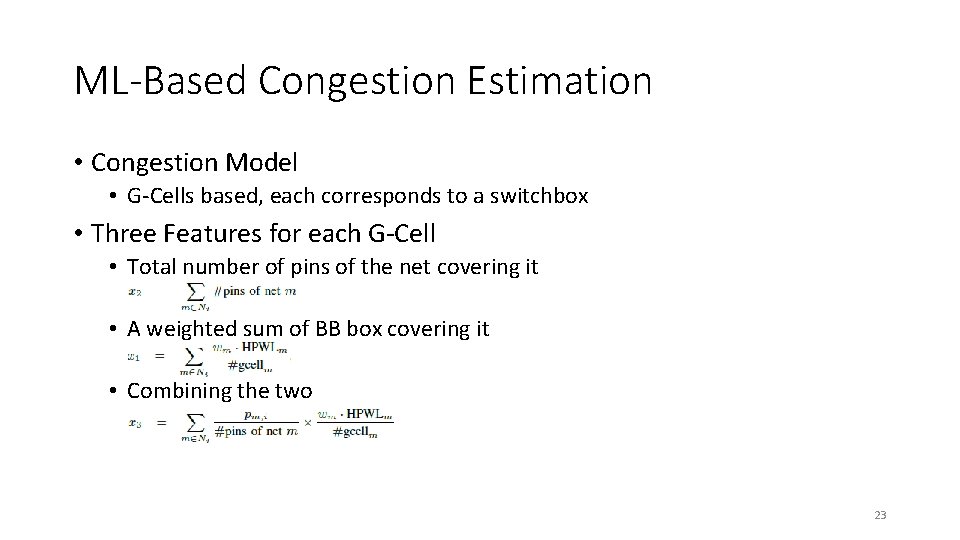
ML-Based Congestion Estimation • Congestion Model • G-Cells based, each corresponds to a switchbox • Three Features for each G-Cell • Total number of pins of the net covering it • A weighted sum of BB box covering it • Combining the two 23
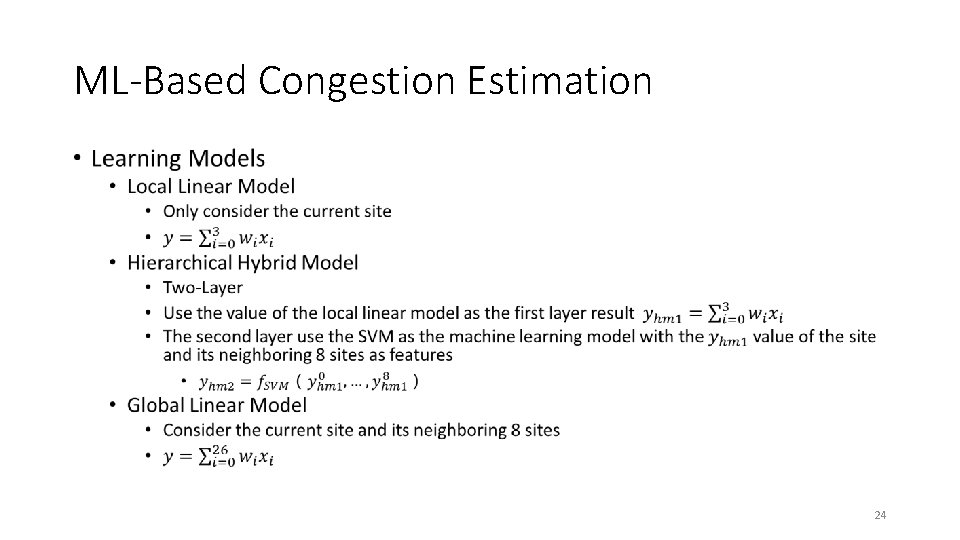
ML-Based Congestion Estimation • 24
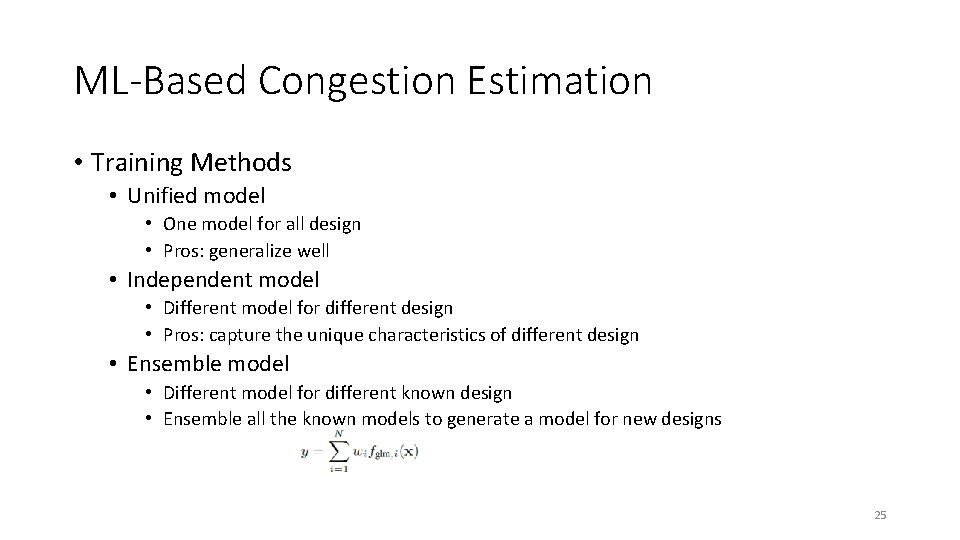
ML-Based Congestion Estimation • Training Methods • Unified model • One model for all design • Pros: generalize well • Independent model • Different model for different design • Pros: capture the unique characteristics of different design • Ensemble model • Different model for different known design • Ensemble all the known models to generate a model for new designs 25
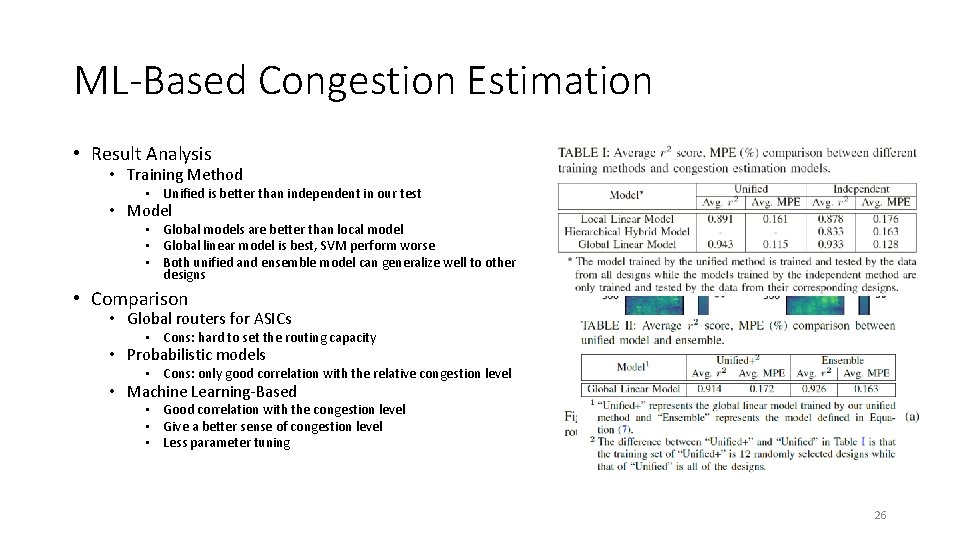
ML-Based Congestion Estimation • Result Analysis • Training Method • Unified is better than independent in our test • Model • Global models are better than local model • Global linear model is best, SVM perform worse • Both unified and ensemble model can generalize well to other designs • Comparison • Global routers for ASICs • Cons: hard to set the routing capacity • Probabilistic models • Cons: only good correlation with the relative congestion level • Machine Learning-Based • Good correlation with the congestion level • Give a better sense of congestion level • Less parameter tuning 26
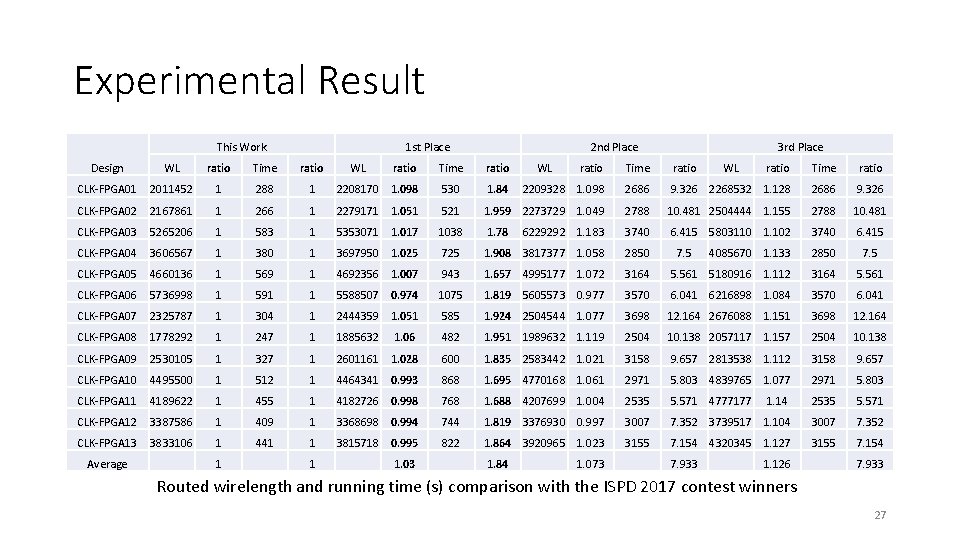
Experimental Result This Work 1 st Place Design WL ratio Time ratio CLK-FPGA 01 2011452 1 288 CLK-FPGA 02 2167861 1 CLK-FPGA 03 5265206 CLK-FPGA 04 ratio Time ratio 1 2208170 1. 098 530 1. 84 266 1 2279171 1. 051 1 583 1 3606567 1 380 CLK-FPGA 05 4660136 1 CLK-FPGA 06 5736998 CLK-FPGA 07 Time ratio 2209328 1. 098 2686 9. 326 2268532 1. 128 2686 9. 326 521 1. 959 2273729 1. 049 2788 10. 481 2504444 1. 155 2788 10. 481 5353071 1. 017 1038 1. 78 6229292 1. 183 3740 6. 415 5803110 1. 102 3740 6. 415 1 3697950 1. 025 725 1. 908 3817377 1. 058 2850 4085670 1. 133 2850 7. 5 569 1 4692356 1. 007 943 1. 657 4995177 1. 072 3164 5. 561 5180916 1. 112 3164 5. 561 1 591 1 5588507 0. 974 1075 1. 819 5605573 0. 977 3570 6. 041 6216898 1. 084 3570 6. 041 2325787 1 304 1 2444359 1. 051 585 1. 924 2504544 1. 077 3698 12. 164 2676088 1. 151 3698 12. 164 CLK-FPGA 08 1778292 1 247 1 1885632 1. 06 482 1. 951 1989632 1. 119 2504 10. 138 2057117 1. 157 2504 10. 138 CLK-FPGA 09 2530105 1 327 1 2601161 1. 028 600 1. 835 2583442 1. 021 3158 9. 657 2813538 1. 112 3158 9. 657 CLK-FPGA 10 4495500 1 512 1 4464341 0. 993 868 1. 695 4770168 1. 061 2971 5. 803 4839765 1. 077 2971 5. 803 CLK-FPGA 11 4189622 1 455 1 4182726 0. 998 768 1. 688 4207699 1. 004 2535 5. 571 4777177 1. 14 2535 5. 571 CLK-FPGA 12 3387586 1 409 1 3368698 0. 994 744 1. 819 3376930 0. 997 3007 7. 352 3739517 1. 104 3007 7. 352 CLK-FPGA 13 3833106 1 441 1 3815718 0. 995 822 1. 864 3920965 1. 023 3155 7. 154 4320345 1. 127 3155 7. 154 1 1. 03 1 1. 84 WL 3 rd Place ratio Average WL 2 nd Place 1. 073 7. 5 7. 933 WL 1. 126 7. 933 Routed wirelength and running time (s) comparison with the ISPD 2017 contest winners 27
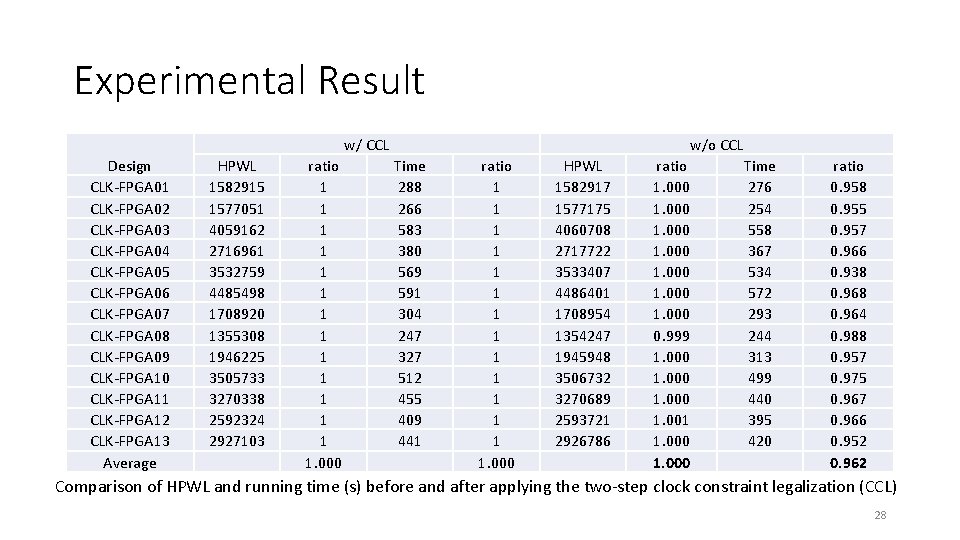
Experimental Result w/ CCL Design CLK-FPGA 01 CLK-FPGA 02 CLK-FPGA 03 CLK-FPGA 04 CLK-FPGA 05 CLK-FPGA 06 CLK-FPGA 07 CLK-FPGA 08 CLK-FPGA 09 CLK-FPGA 10 CLK-FPGA 11 CLK-FPGA 12 CLK-FPGA 13 Average HPWL 1582915 1577051 4059162 2716961 3532759 4485498 1708920 1355308 1946225 3505733 3270338 2592324 2927103 ratio 1 1 1 1. 000 w/o CCL Time 288 266 583 380 569 591 304 247 327 512 455 409 441 ratio 1 1 1 1. 000 HPWL 1582917 1577175 4060708 2717722 3533407 4486401 1708954 1354247 1945948 3506732 3270689 2593721 2926786 ratio 1. 000 1. 000 0. 999 1. 000 1. 001 1. 000 Time 276 254 558 367 534 572 293 244 313 499 440 395 420 ratio 0. 958 0. 955 0. 957 0. 966 0. 938 0. 964 0. 988 0. 957 0. 975 0. 967 0. 966 0. 952 0. 962 Comparison of HPWL and running time (s) before and after applying the two-step clock constraint legalization (CCL) 28
Experimental Result Ripple. FPGA[1] This work WL ratio Design FPGA 01 350060 1 350802 1. 002 FPGA 02 635044 1 634700 0. 999 FPGA 03 3251264 1 3251721 1. 000 FPGA 04 5492214 1 5411107 0. 985 FPGA 05 9909270 1 9911182 1. 000 FPGA 06 6144522 1 6143973 1. 000 FPGA 07 9593240 1 9520252 0. 992 FPGA 08 8087931 1 8036647 0. 994 FPGA 09 12062928 1 12123865 1. 005 FPGA 10 6972278 1 7020054 1. 007 FPGA 11 10918250 1 10462601 0. 958 FPGA 12 7239553 1 7605996 1. 051 Average 1 0. 999 Routed wirelength comparison between different routing congestion estimation models. [1] Ripple. FPGA: A routability driven placement for large-scale heterogeneous FPGAs. ICCAD 2016 29
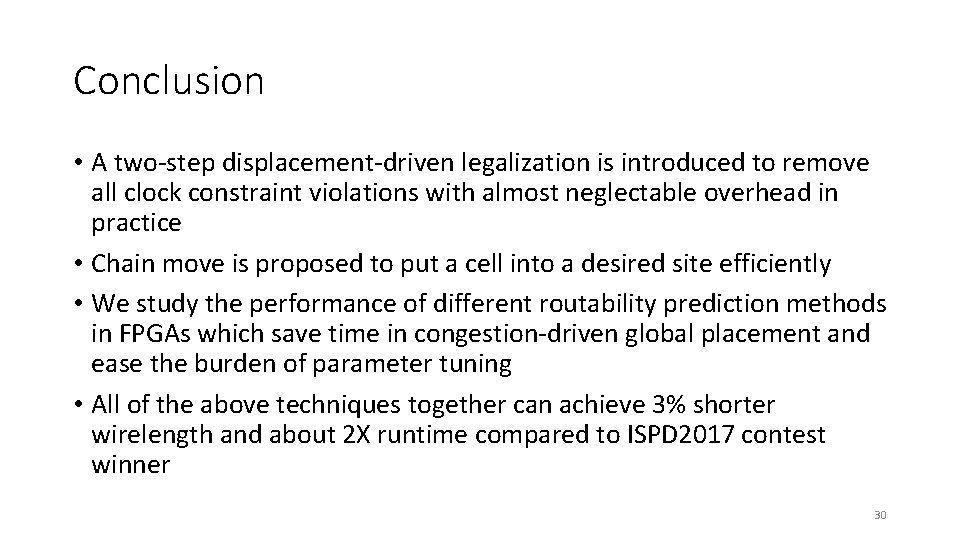
Conclusion • A two-step displacement-driven legalization is introduced to remove all clock constraint violations with almost neglectable overhead in practice • Chain move is proposed to put a cell into a desired site efficiently • We study the performance of different routability prediction methods in FPGAs which save time in congestion-driven global placement and ease the burden of parameter tuning • All of the above techniques together can achieve 3% shorter wirelength and about 2 X runtime compared to ISPD 2017 contest winner 30
Thanks 31