
Clock and Power 6 375 Complex Digital Systems


















- Slides: 40
Clock and Power 6. 375 Complex Digital Systems Krste Asanovic March 7, 2007
Digital System Timing Conventions • All digital systems need a convention about when a receiver can sample an incoming data value – synchronous systems use a common clock – asynchronous systems encode “data ready” signals alongside, or encoded within, data signals • Also need convention for when it’s safe to send another value – synchronous systems, on next clock edge (after hold time) – asynchronous systems, acknowledge signal from receiver Data Clock Synchronous Data Ready Acknowledge Ack. Asynchronous 6. 375 Spring 2007 • L 12 Clock and Power • 2
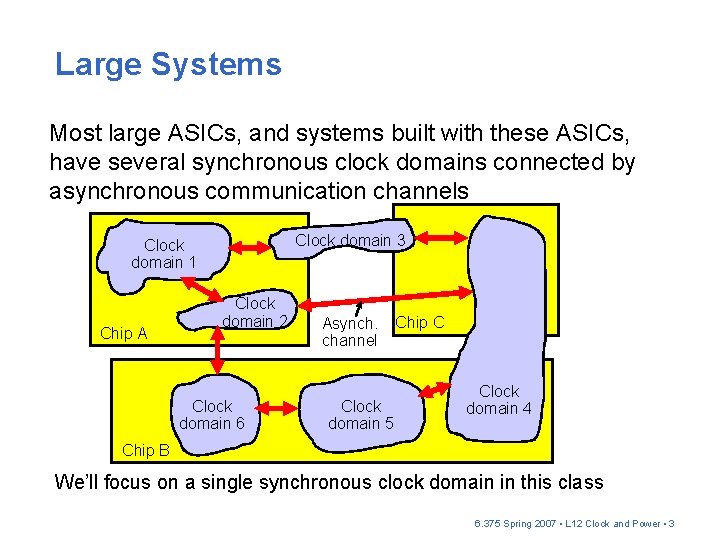
Large Systems Most large ASICs, and systems built with these ASICs, have several synchronous clock domains connected by asynchronous communication channels Clock domain 3 Clock domain 1 Chip A Clock domain 2 Clock domain 6 Asynch. channel Clock domain 5 Chip C Clock domain 4 Chip B We’ll focus on a single synchronous clock domain in this class 6. 375 Spring 2007 • L 12 Clock and Power • 3
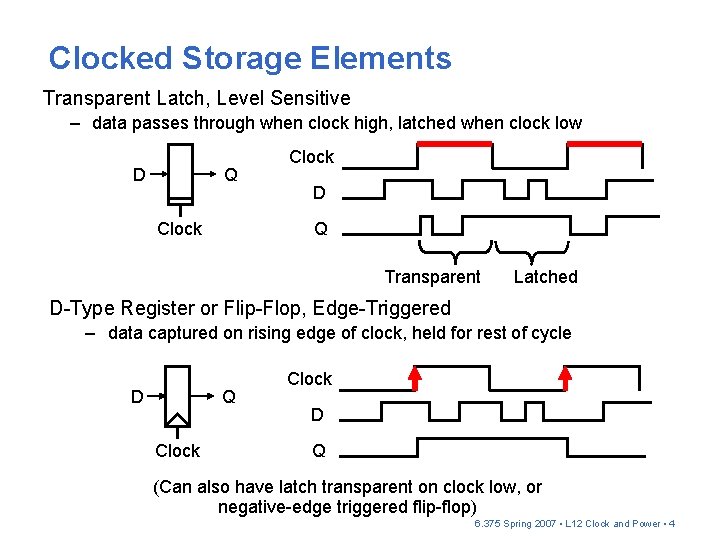
Clocked Storage Elements Transparent Latch, Level Sensitive – data passes through when clock high, latched when clock low D Q Clock D Q Transparent Latched D-Type Register or Flip-Flop, Edge-Triggered – data captured on rising edge of clock, held for rest of cycle D Q Clock D Q (Can also have latch transparent on clock low, or negative-edge triggered flip-flop) 6. 375 Spring 2007 • L 12 Clock and Power • 4
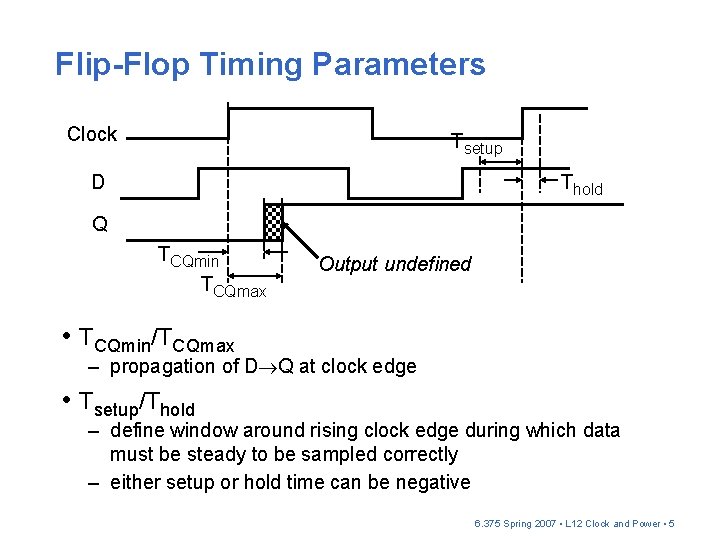
Flip-Flop Timing Parameters Clock Tsetup D Thold Q TCQmin TCQmax Output undefined • TCQmin/TCQmax – propagation of D Q at clock edge • Tsetup/Thold – define window around rising clock edge during which data must be steady to be sampled correctly – either setup or hold time can be negative 6. 375 Spring 2007 • L 12 Clock and Power • 5
Edge-Triggered Timing Constraints TPmin/TPmax Combinational Logic CLK Single clock with edge-triggered registers (common in stdcell ASICs) • Slow path timing constraint Tcycle TCQmax + TPmax + Tsetup – can always work around slow path by using slower clock • Fast path timing constraint TCQmin + TPmin Thold – bad fast path cannot be fixed without redesign! – might have to add delay into paths to satisfy hold time 6. 375 Spring 2007 • L 12 Clock and Power • 6
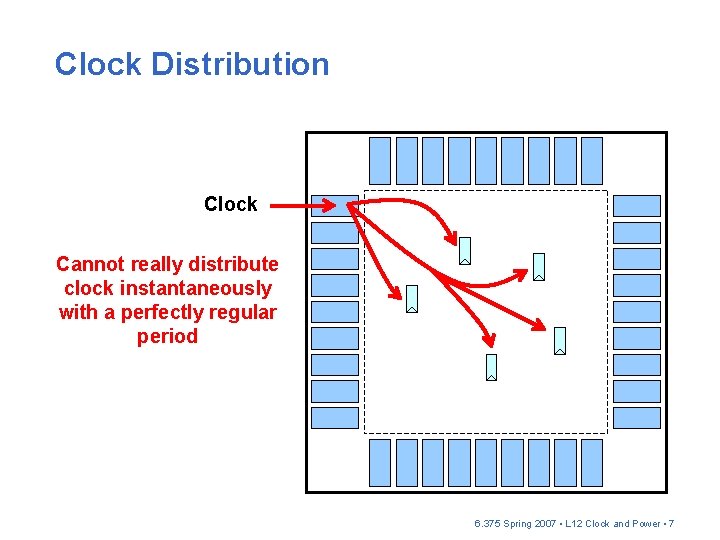
Clock Distribution Clock Cannot really distribute clock instantaneously with a perfectly regular period 6. 375 Spring 2007 • L 12 Clock and Power • 7
Clock Skew: Spatial Clock Variation Clock Skew Difference in clock arrival time at two spatially distinct points B A A Compressed timing path B Skew 6. 375 Spring 2007 • L 12 Clock and Power • 8
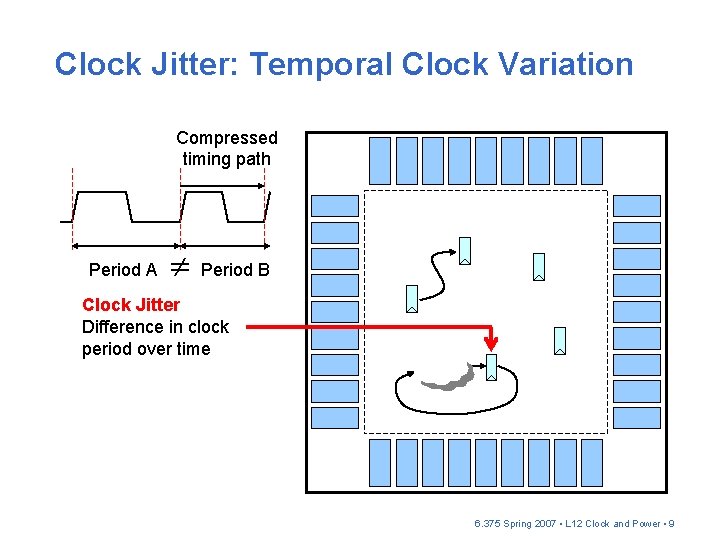
Clock Jitter: Temporal Clock Variation Compressed timing path Period A Period B Clock Jitter Difference in clock period over time 6. 375 Spring 2007 • L 12 Clock and Power • 9
How do clock skew and jitter arise? Clock Distribution Network Central Clock Driver Variations in local clock load, local power supply, local gate length and threshold, local temperature Variations in trace length, metal width and height, coupling caps Local Clock Buffers 6. 375 Spring 2007 • L 12 Clock and Power • 10
Clock Distribution with Clock Grids Low skew but high power Grid feeds flops directly, no local buffers Clock driver tree spans height of chip Internal levels shorted together 6. 375 Spring 2007 • L 12 Clock and Power • 11
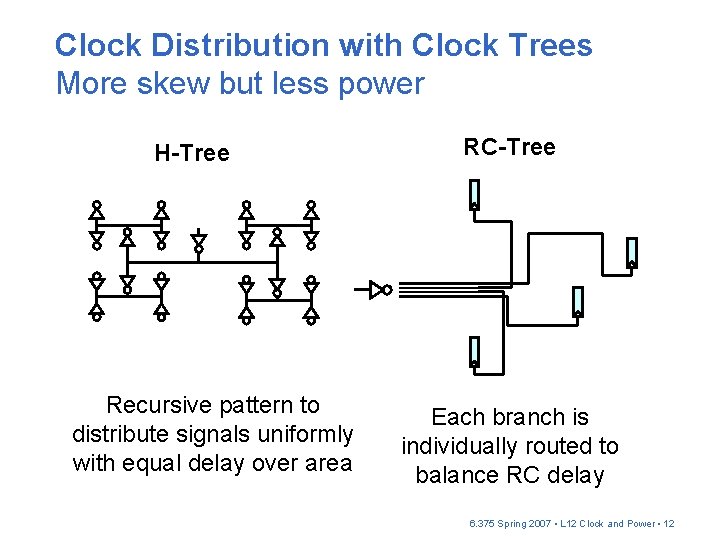
Clock Distribution with Clock Trees More skew but less power H-Tree Recursive pattern to distribute signals uniformly with equal delay over area RC-Tree Each branch is individually routed to balance RC delay 6. 375 Spring 2007 • L 12 Clock and Power • 12
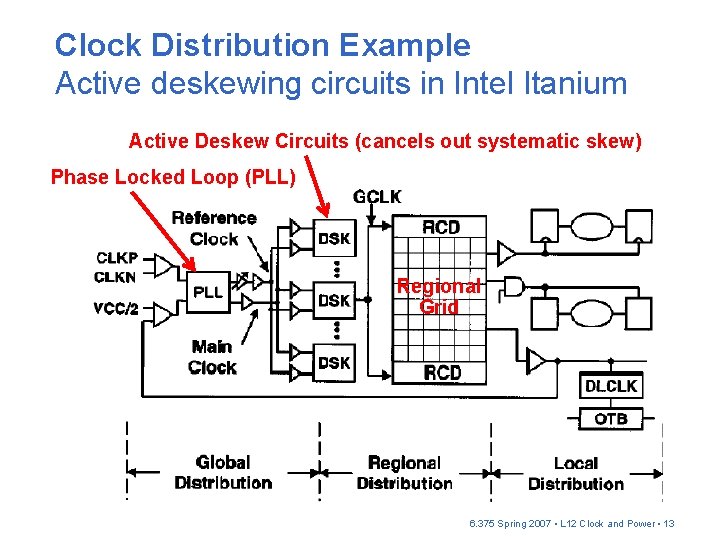
Clock Distribution Example Active deskewing circuits in Intel Itanium Active Deskew Circuits (cancels out systematic skew) Phase Locked Loop (PLL) Regional Grid 6. 375 Spring 2007 • L 12 Clock and Power • 13
Reducing Clock Distribution Problems • Use latch-based design – Time borrowing helps reduce impact of clock uncertainty – Timing analysis is more difficult – Rarely used in fully synthesized ASICs, but sometimes in datapaths of otherwise synthesized ASICs • Make logical partitioning match physical partitioning – Limits global communication where skew is usually the worst – Helps break distribution problem into smaller subproblems • Use globally asynchronous, locally synchronous design – Divides design into synchronous regions which communicate through asynchronous channels – Requires overhead for inter-domain communication • Use asynchronous design – Avoids clocks all together – Incurs its own forms of control overhead 6. 375 Spring 2007 • L 12 Clock and Power • 14
Clock Tree Synthesis for ASICs • Modern back-end tools include clock tree synthesis – – Creates balanced RC-trees Uses special clock buffer standard cells Can add clock shielding Can exploit useful clock skew • Automatic clock tree generation still results in significantly worse clock uncertainties as compare to hand-crafted custom clock trees – Modern high-performance processors have clock distribution with <10 ps skew at >4 GHz (250 ps cycle time) 6. 375 Spring 2007 • L 12 Clock and Power • 15
Example of clock tree synthesis using commercial ASIC back-end tools 6. 375 Spring 2007 • L 12 Clock and Power • 16
Example of clock tree synthesis using commercial ASIC back-end tools 6. 375 Spring 2007 • L 12 Clock and Power • 17
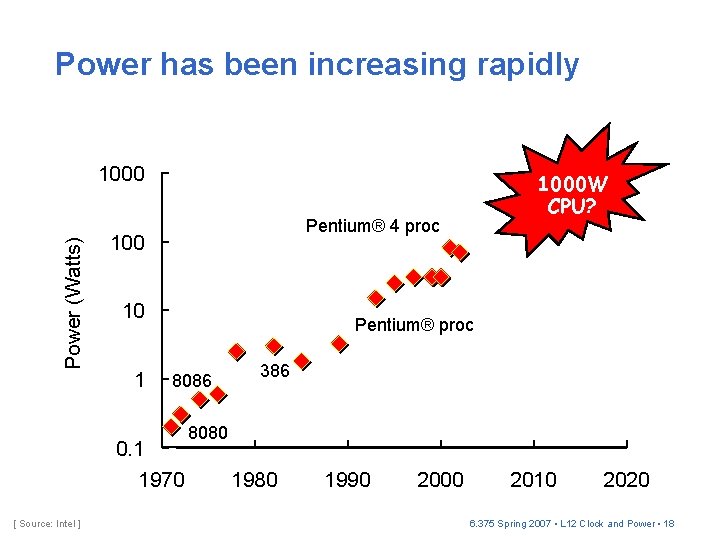
Power has been increasing rapidly Power (Watts) 1000 Pentium® 4 proc 100 10 1 Pentium® proc 8086 0. 1 1970 [ Source: Intel ] 1000 W CPU? 386 8080 1990 2000 2010 2020 6. 375 Spring 2007 • L 12 Clock and Power • 18
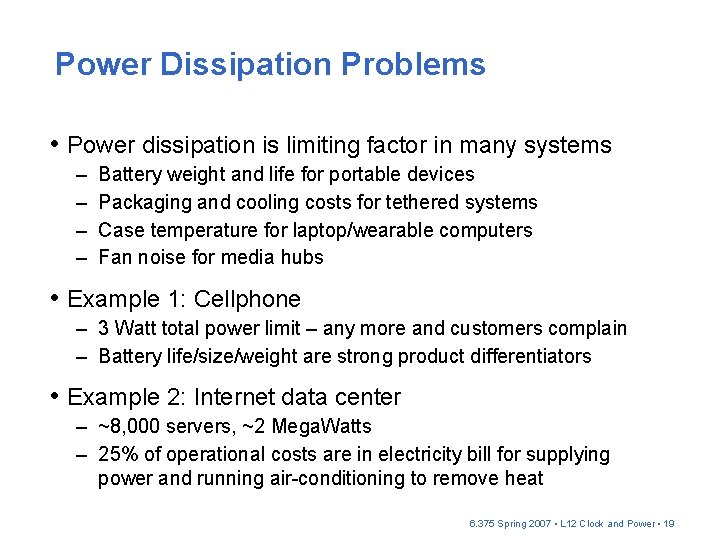
Power Dissipation Problems • Power dissipation is limiting factor in many systems – – Battery weight and life for portable devices Packaging and cooling costs for tethered systems Case temperature for laptop/wearable computers Fan noise for media hubs • Example 1: Cellphone – 3 Watt total power limit – any more and customers complain – Battery life/size/weight are strong product differentiators • Example 2: Internet data center – ~8, 000 servers, ~2 Mega. Watts – 25% of operational costs are in electricity bill for supplying power and running air-conditioning to remove heat 6. 375 Spring 2007 • L 12 Clock and Power • 19
Simple RC model can also yield intuition on energy consumption of inverter Reff Vout Vin = “ 0” Cg Reff Cd CL • During 0 1 transition, energy CVDD 2 removed from power supply • After transition, 1/2 CVDD 2 stored in capacitor, the other 1/2 CVDD 2 was dissipated as heat in pullup resistance • The 1/2 CVDD 2 energy stored in capacitor is dissipated in the pulldown resistance on next 1 0 transition 6. 375 Spring 2007 • L 12 Clock and Power • 20
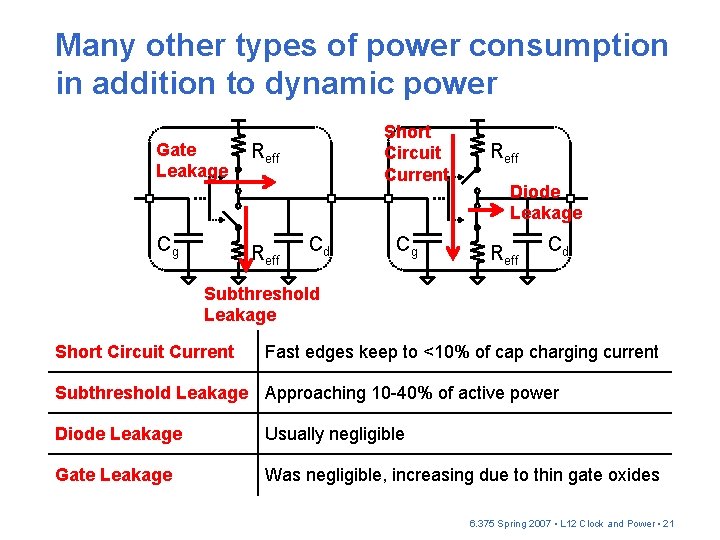
Many other types of power consumption in addition to dynamic power Gate Leakage Cg Short Circuit Current Reff Cd Cg Reff Diode Leakage Reff Cd Subthreshold Leakage Short Circuit Current Fast edges keep to <10% of cap charging current Subthreshold Leakage Approaching 10 -40% of active power Diode Leakage Usually negligible Gate Leakage Was negligible, increasing due to thin gate oxides 6. 375 Spring 2007 • L 12 Clock and Power • 21
Dynamic and Static power Reff Cg Reff Cd Dynamic Power Switching power used to charge up load capacitance Static Power Subthreshold leakage power when transistor is “off” Pdynamic = α f (1/2) C VDD 2 Pstatic = VDD Ioff Activity Factor Clock Frequency (transitions/cycle) 6. 375 Spring 2007 • L 12 Clock and Power • 22
Reducing Dynamic Power (1) Pdynamic = α f (1/2) C VDD 2 Reduce Activity – – Clock gating so clock node of inactive logic doesn’t switch Data gating so data nodes of inactive logic doesn’t switch Bus encodings to minimize transitions Balance logic paths to avoid glitches during settling Reduce Frequency – Doesn’t save energy, just reduces rate at which it is consumed – Lower power means less heat dissipation but must run longer 6. 375 Spring 2007 • L 12 Clock and Power • 23
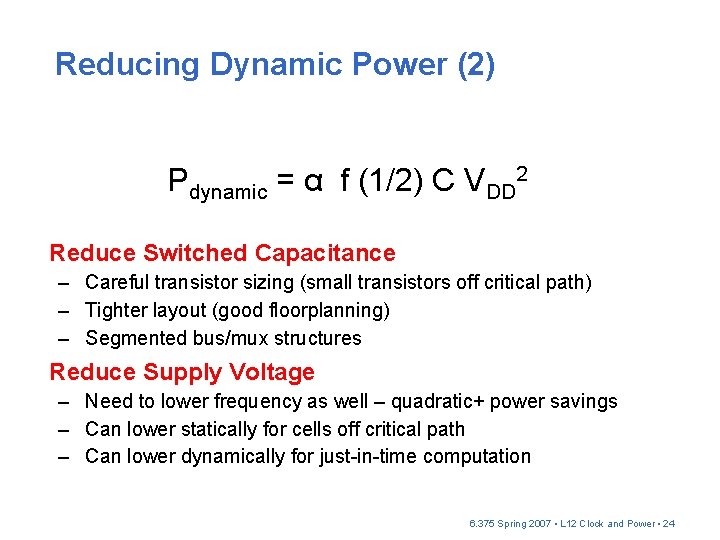
Reducing Dynamic Power (2) Pdynamic = α f (1/2) C VDD 2 Reduce Switched Capacitance – Careful transistor sizing (small transistors off critical path) – Tighter layout (good floorplanning) – Segmented bus/mux structures Reduce Supply Voltage – Need to lower frequency as well – quadratic+ power savings – Can lower statically for cells off critical path – Can lower dynamically for just-in-time computation 6. 375 Spring 2007 • L 12 Clock and Power • 24
Reducing Static Power Pstatic = VDD IOFF Reduce Supply Voltage – In addition to dynamic power reduction, reducing Vdd can help reduce static power Reduce Off Current – – Increase length of transistors off critical path Use high-Vt cells off critical path (extra Vt increases fab costs) Use stacked devices (complex gates) Use power gating (i. e. switch off power supply with large transistor) 6. 375 Spring 2007 • L 12 Clock and Power • 25
Reducing activity with clock gating • • Don’t clock flip-flop if not needed Avoids transitioning downstream logic Enable adds control logic complexity Pentium-4 has hundreds of gated clock domains Global Clock Enable Latch (transparent on clock low) Gated Local Clock D Q Clock Enable Latched Enable Gated Clock 6. 375 Spring 2007 • L 12 Clock and Power • 26
Reducing activity with data gating A B Shifter infrequently used A B Shifter Adder 1 0 Shift/Add Select Shifter Adder 1 0 Could use transparent latch instead of AND gate to reduce number of transitions, but would be bigger and slower. 6. 375 Spring 2007 • L 12 Clock and Power • 27
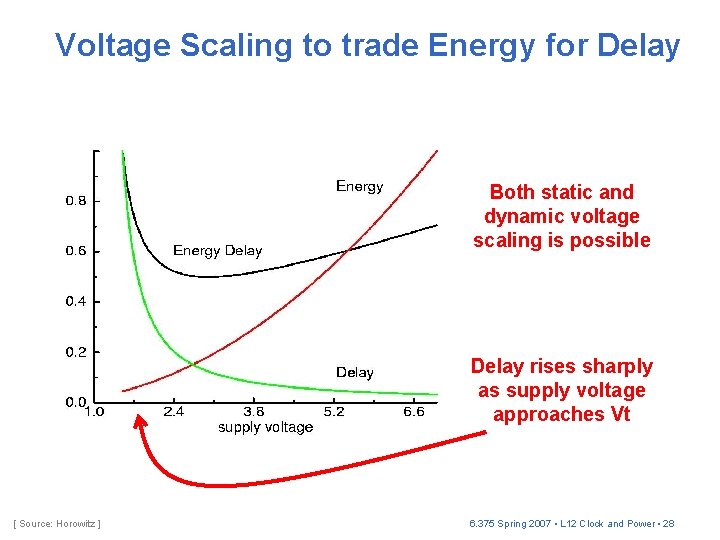
Voltage Scaling to trade Energy for Delay Both static and dynamic voltage scaling is possible Delay rises sharply as supply voltage approaches Vt [ Source: Horowitz ] 6. 375 Spring 2007 • L 12 Clock and Power • 28
Parallelism Reduces Energy 8 -bit adder/compare – 40 MHz at 5 V, area = 530 km 2 – Base power Pref Two parallel interleaved adder/cmp units – 20 MHz at 2. 9 V, area = 1, 800 km 2 (3. 4 x) – Power = 0. 36 Pref One pipelined adder/cmp unit – 40 MHz at 2. 9 V, area = 690 km 2 (1. 3 x) – Power = 0. 39 Pref Pipelined and parallel – 20 MHz at 2. 0 V, area = 1, 961 km 2 (3. 7 x) – Power = 0. 2 Pref Chandrakasan et. al, IEEE JSSC 27(4), April 1992 + + + + + 6. 375 Spring 2007 • L 12 Clock and Power • 29
Voltage Scaling Example Vdd [ STC 1 32 -bit RISC Processor + SRAM in TSMC 180 nm ASIC process ] 6. 375 Spring 2007 • L 12 Clock and Power • 30
Reducing Power in ASIC Designs (1) • Minimize activity – Automatic clock gating is possible if tools can infer gating from HDL – Partition designs so minimal number of components activated to perform each operation • Use lowest voltage and slowest frequency necessary to reach target performance – Use pipelined and parallel architectures if possible 6. 375 Spring 2007 • L 12 Clock and Power • 31
Reducing Power in ASIC Designs (2) • Reducing switched capacitance – Design efficient RTL! Biggest savings come from picking better hardware algorithms to reduce power and area – Floorplan units to reduce length of power-hungry global wires • Optimizing for static power – Reduce amount of logic required for function, multiplex units – Partition design such that components can be power-gated or have independent voltage supplies – Modern standard cell libraries include low-power cells, high-VT cells, and low-VT cells – tools can automatically replace noncritical cells to optimize for static power 6. 375 Spring 2007 • L 12 Clock and Power • 32
Power Distribution 6. 375 Spring 2007 • L 12 Clock and Power • 33
Power Distribution Possible IR drop across power network VDD Reff Cg GND Reff Cd Reff Cg Reff Cd GND 6. 375 Spring 2007 • L 12 Clock and Power • 34
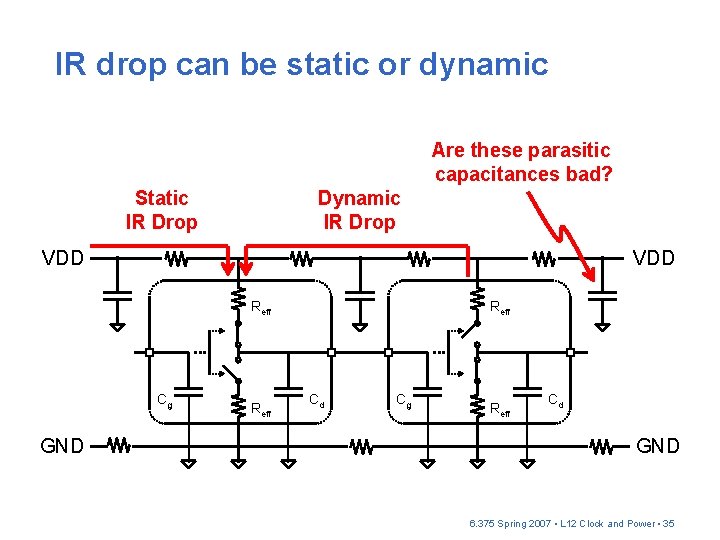
IR drop can be static or dynamic Are these parasitic capacitances bad? Static IR Drop Dynamic IR Drop VDD Reff Cg GND Reff Cd Cg Reff Cd GND 6. 375 Spring 2007 • L 12 Clock and Power • 35
Power Distribution: Custom Approach Carefully tailor power network G Routed power distribution on two stacked layers of metal (one for VDD, one for GND). OK for lowcost, low-power designs with few layers of metal. A V G B V V G G V G V G V V G G V G V Power Grid. Interconnected vertical and horizontal power bars. Common on most high-performance designs. Often well over half of total metal on upper thicker layers used for VDD/GND. Dedicated VDD/GND planes. Very expensive. Only used on Alpha 21264. Simplified circuit analysis. Dropped on subsequent Alphas. G 6. 375 Spring 2007 • L 12 Clock and Power • 36
Power Distribution: ASIC Approach Strapping and rings for standard cells 6. 375 Spring 2007 • L 12 Clock and Power • 37
Power Distribution: ASIC Approach Power rings partition the power problem Early physical partitioning and prototyping is essential Can use special filler cells to help add decoupling cap 6. 375 Spring 2007 • L 12 Clock and Power • 38
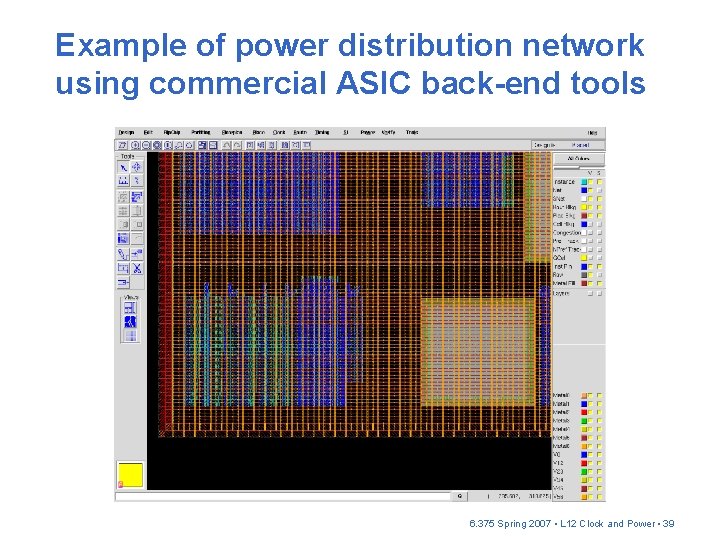
Example of power distribution network using commercial ASIC back-end tools 6. 375 Spring 2007 • L 12 Clock and Power • 39
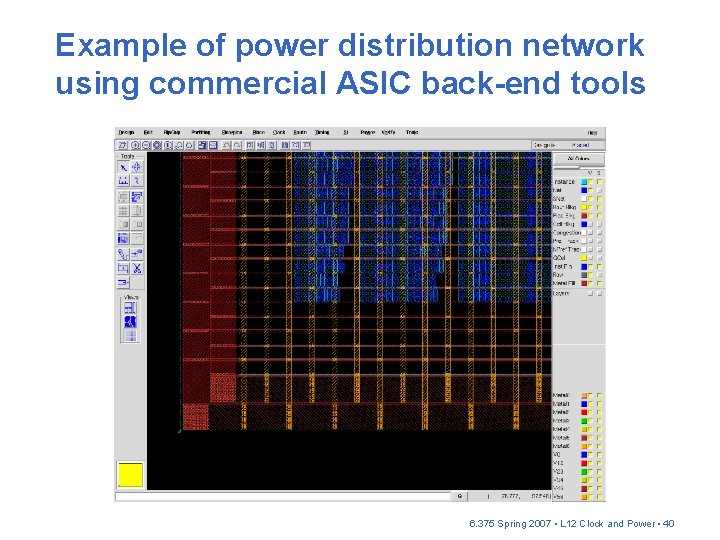
Example of power distribution network using commercial ASIC back-end tools 6. 375 Spring 2007 • L 12 Clock and Power • 40