
Clinical use of spermatid Introduction Spermiogenesis block Prognostic
Clinical use of spermatid �Introduction �Spermiogenesis block �Prognostic factors of spermatid conception �Potential health hazards �Practical recommendation
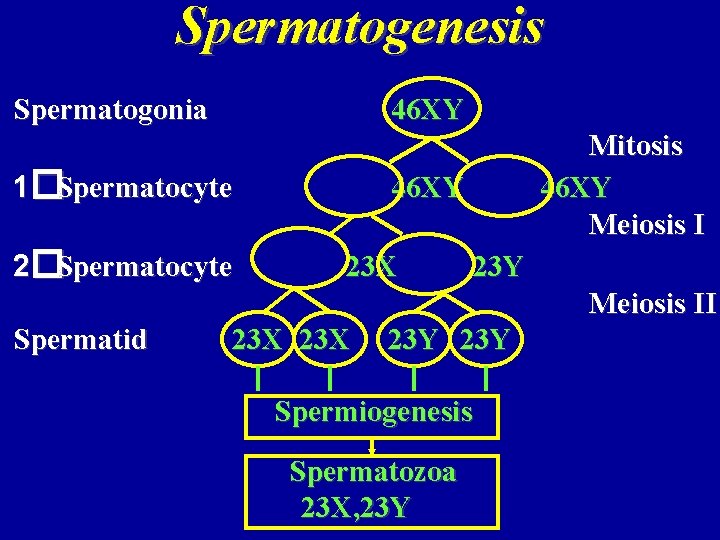
Spermatogenesis Spermatogonia 46 XY 1�Spermatocyte 2�Spermatocyte Mitosis 46 XY Meiosis I 46 XY 23 X 23 Y Meiosis II Spermatid 23 X 23 Y Spermiogenesis Spermatozoa 23 X, 23 Y
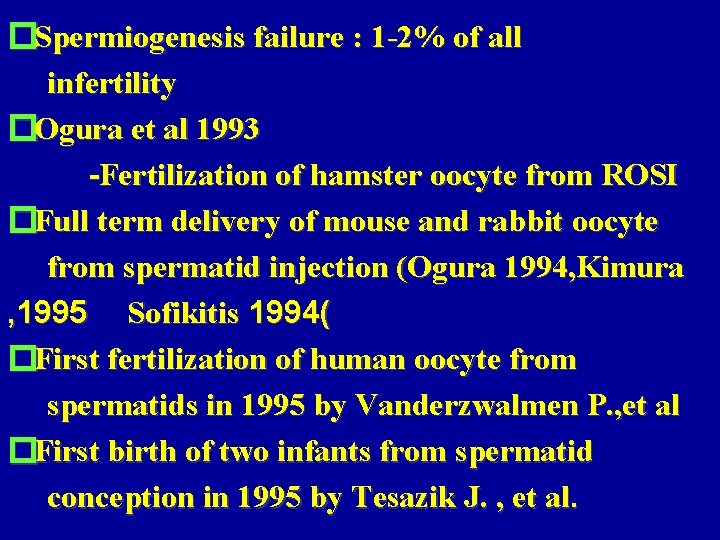
�Spermiogenesis failure : 1 -2% of all infertility �Ogura et al 1993 -Fertilization of hamster oocyte from ROSI �Full term delivery of mouse and rabbit oocyte from spermatid injection (Ogura 1994, Kimura , 1995 Sofikitis 1994( �First fertilization of human oocyte from spermatids in 1995 by Vanderzwalmen P. , et al �First birth of two infants from spermatid conception in 1995 by Tesazik J. , et al.
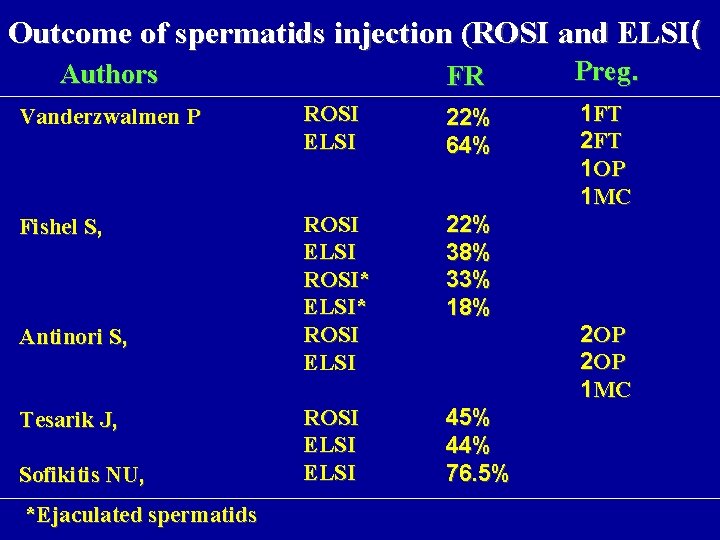
Outcome of spermatids injection (ROSI and ELSI( Authors FR Preg. 1 FT 2 FT 1 OP 1 MC Vanderzwalmen P ROSI ELSI 22% 64% Fishel S, ROSI ELSI ROSI* ELSI* ROSI ELSI 22% 38% 33% 18% ROSI ELSI 45% 44% 76. 5% Antinori S, Tesarik J, Sofikitis NU, *Ejaculated spermatids 2 OP 1 MC
Spermatid conceptions � 3 babies from ROSI � 9 babies from ELSI � Highly variable and unpredictable outcomes of spermatid conception � All nuclear and cytoplasmic modification may not fully development � Possible health hazards
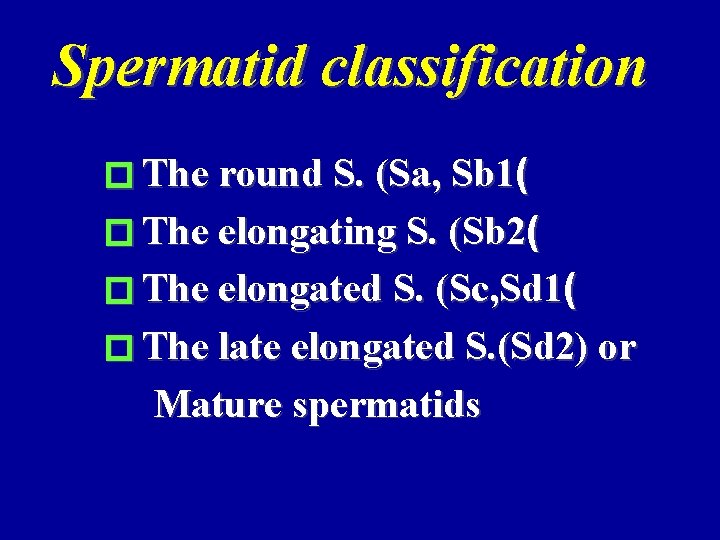
Spermatid classification � The round S. (Sa, Sb 1( � The elongating S. (Sb 2( � The elongated S. (Sc, Sd 1( � The late elongated S. (Sd 2) or Mature spermatids
Spermiogenesis block �Aetiologic factors �Genetic factors (Mouse model( -White spotting locus (encoding c-kit receptor( -Sl locus (encoding c-kit ligand( -Retinoic acid receptor a gene - Retinoic X receptor b gene
�Non-genetic factors -Radio and chemotherapy -Long-term estrogen therapy -Nutrition -Heat -Infections -Endocrinopathies -Cryptorchidism -Idiopathic
� Ejaculated spermatids from spermiogenesis arrest patients -Not related to serum FSH -Abnormal relationship between spermatids and Sertoli cells t Priming Sertoli cells with FSH
�Spermiogenesis failure -Complete : < round spermatids -Incomplete : > elongated spermatids.

�Round spermatids in ejaculate and testicular biopsy from patients undergoing a spermatid conception attempt. - 1/2 - Round spermatid - 1/2 - Elongated spermatid or no spematid

66 patients with complete spermiogenesis failure Ejaculate Biopsy No (%) of patients + + - + + 30(45) 27(41) 9(14) )Tesarik J. , et al. Human Reproduction 1998 ; 13 Suppl 3 : 89 -107(
-A few foci produced ROS - ROS production has a cyclic character - Prematurely released spermatocytes develop into spermatids - Spermatids from biopsy have a higher biologic quality, fertilizing ability
Prognostic factors of spermatid conception �Complete and incomplete spermiogenesis failure �Genetic anomalies �Epigenic disorders �Oocyte-activating factor
Complete and incomplete spermiogenesis failure. Amer M. , etal (Lancet 1997; 350 (9071) : 116( � 59 cases � 2 Ongoing clinical pregnancies - from 3 ELSI � 4 Biochemical pregnancies - from ROSI �Incomplete spermiogenesis failure is better
�Fertilization and cleavage rates in complete spermiogenesis failure �Factors at implantation and post-implantation period.
Genetic anomalies. �Human spermatogenic disorder -YRRM 1 , YRRM 2 , DA 2 genes : at long arm Y, AZF region -DAZLA : at chromosome 3 -Polygenic control �Affecting sperm differentiation and function �Not affecting fertilization, embryonic and fetal development
Epigenic disorders. �Nuclear protein �Centriole
Nuclear protein �Nuclear condensation: spermatid spermatozoa -Histones, Protamines �Nuclear decondensation: After fertilization -Oocyte cytoplasmic factor : S-S bond reduction -Histones, Protamines
�May alter the normal sequence of early post-fertilization chromatin functions �Rapid appearance of PN after ROSI and ROSNI 10>) hours( �Abnormal pronuclear development -Persistence of a very small dense nucleus -Prolong appearance of a single syngamic nucleus
Centriole �Spermatids : -Proximal and distal centrioles -Distal centriole disappears in late elongated spermatids. �Microtubule-organizing center(MTOC( -Zygote microtubules -Mitotic spindle
�Mature sperm cell : 1 centriole associated with MTOC �Distal centriole of spermatid -May associate with MTOC -Multipolar mitotic spindle -Chromosomal abnormalities
Oocyte activating factor �Sperm-induced activation of human oocytes. -Ca 2+ spiking or oscillations -Dependent on the oocyte-activating factor in cytoplasm of sperm -Oscillin
�Sousa M. , et al. (Mol. Hum. Reprod . (853 -7 : (11)2 ; 1996 -Ca 2+ oscillation occurs in ROSI but not after the injection of 1�or 2� spermatocyte or PMN -Spermatids from men who produced normal mature sperm
Oocyte activating factor (Cont(. �Tesarik J. , et al. (Hum Repecd 1998; B supple 3: 89 -107( - Spermatids from men with complete spermiogenesis failure 6 in 36 oocytes (17%) showed Ca 2+ oscillation at 30 -60 min 2 - in 36 oocytes (6%) showed Ca 2+oscillation at 2 -3 hr.
Oocyte activating factor (Cont(. �Oocyte activating factor may be deficient � Fertilization , implanlation, abortion �Quality of Ca 2+ signal in fertilized oocytes influences developmental process.
Potential health hazards �Transmission of infertility genes �Genomic imprinting abnormalities - Uncertainty of whether the process is actually completed - IGF 2, p 57 KIP 2, H 19, SNRPN, PEG 1/MEST - Wilms’tumor, Adrenocortical CA , . Rhabdomyosarcoma , Beckwith-Wiedemann syndrome, Prader-Willi syndome - No available method to detect
Practical recommendation �Preparation of testicular suspension �Identification of spermatids �Quality assurance �Medical counseling
Preparation of testicular cell suspension �Tissue dissociation -Mechanical : 2 glass slides or fine needle -Enzymatic digestion : collagenase type IV Erythrocyte lysing buffer treatment �Separation of different cell -Base on cell size or density -Centrifugal elutriation technique )Blanchard et al. 1991(
Identification of round spermatids �Diameter : 6. 5 -8 mm, equal to RBC and small lymphocyte �Clearly visible nucleus. �Acrosomal structure : bright spot , small protusion -not observed in golgi phase spermatid � 3 dimensionally round cell -Sertoli cell nucleus : flat, transparent , prominent central nucleolus
Quality of spermatids �Viability �Genomically abnormality -No reliable method except staining or destroying the cells. -No lysis after aspiration in micropipette -Spermatid in vitro culture

Quality assurance �Recognition of living round spermatids -Skill �Injection technique �Timing of PN development -More frequent inspection �Frequent development of a large syngamy nucleus
� Spermatid and spermatocyte cryopreservation ROSI from frozen-thawed specimen pregnancy -Avoid the need for a new surgical intervention -Progression from maturation arrest to Sertoli-cell only syndrome -Preservation the individual’s reproductive potential.
Medical counseling �Take-home-baby rate 5 -10% in incomplete spermiogenesis failure �Take-home-baby rate 1 -5% in -Complete spermiogenesis failure -Wife’s age approaches 40 years. �Potential health hazard �Success rate are likely to improve in the near future
- Slides: 34