
Clinical Toxicology Toxicity of Nonsteroidal AntiInflammatory Drugs NSAIDs

- Slides: 41
Clinical Toxicology Toxicity of Nonsteroidal Anti-Inflammatory Drugs (NSAIDs) Lec. 5 5 th Year 2019 -2020 Lecturer Rua Abbas Al-Hamdy University of Mustansiriyah/College of Pharmacy Department of Pharmacology & Toxicology
Objectives of this lecture: At the end of this lecture, you would be able to identify: § pharmacologic actions, § pharmacokinetics & toxicokinetics, & § the pathophysiological effects of nonsteroidal antiinflammatory drugs (NSAIDs), & § toxic manifestations associated with these drugs, & the suitable management for intoxication.
Nonsteroidal anti-inflammatory drugs: § Nonsteroidal anti-inflammatory drugs (NSAIDs) are considered among the most commonly used & prescribed medications in the world. § NSAIDs comprise a class of xenobiotics with analgesic, antipyretic, & anti-inflammatory properties. § Most of the beneficial effects of NSAIDs result from the inhibition of cyclooxygenase (COX) enzyme that enables the synthesis of prostaglandins, which in turn mediate inflammation & fever.
§ In addition to the benefits of NSAIDs, some deleterious & life-threatening effects are associated with both their therapeutic use & overdose. § The term NSAID used in this lecture does not refer to salicylates, which are unique members of the NSAID class & will be covered later in another lecture.
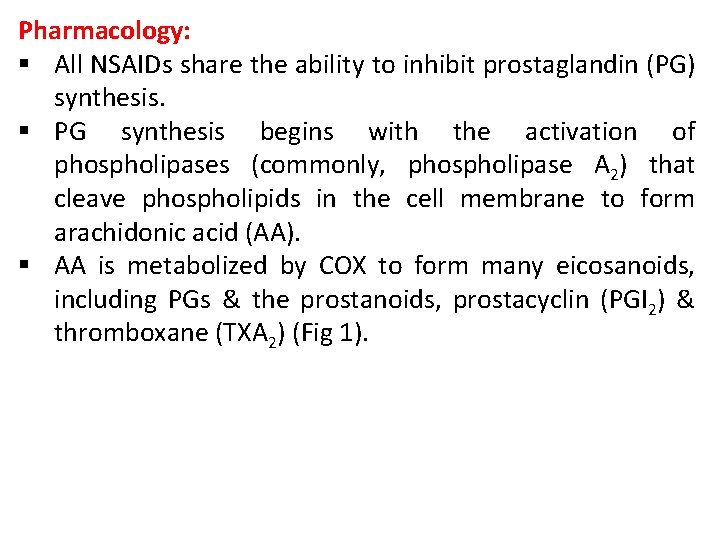
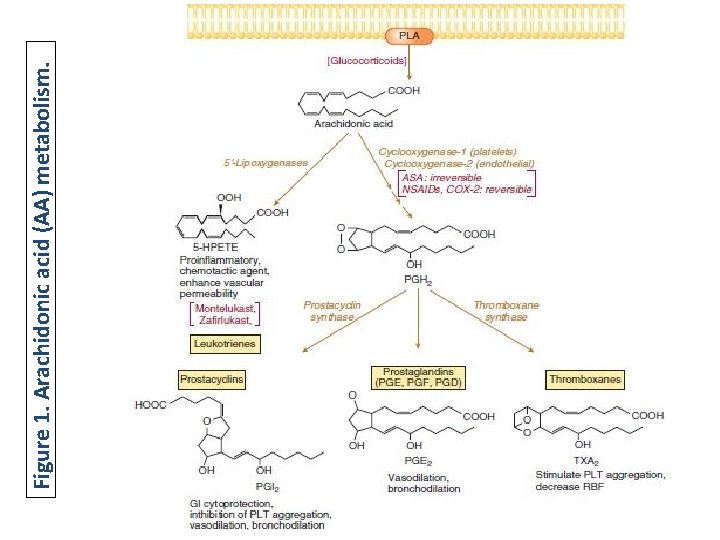
Pharmacology: § All NSAIDs share the ability to inhibit prostaglandin (PG) synthesis. § PG synthesis begins with the activation of phospholipases (commonly, phospholipase A 2) that cleave phospholipids in the cell membrane to form arachidonic acid (AA). § AA is metabolized by COX to form many eicosanoids, including PGs & the prostanoids, prostacyclin (PGI 2) & thromboxane (TXA 2) (Fig 1).
Figure 1. Arachidonic acid (AA) metabolism.
§ The COX enzyme responsible for PG production exists in two isoforms termed COX-1 & COX-2. • COX-1 is constitutively expressed by virtually all cells throughout the body but is the only isoform found within platelets. This enzyme produces eicosanoids that govern “housekeeping” functions, including vascular homeostasis , gastric cytoprotection, & renal blood flow. • COX-2, on the other hand, is rapidly induced (within 1 to 3 hours) in inflammatory tissue producing PGs involved in the inflammatory response.
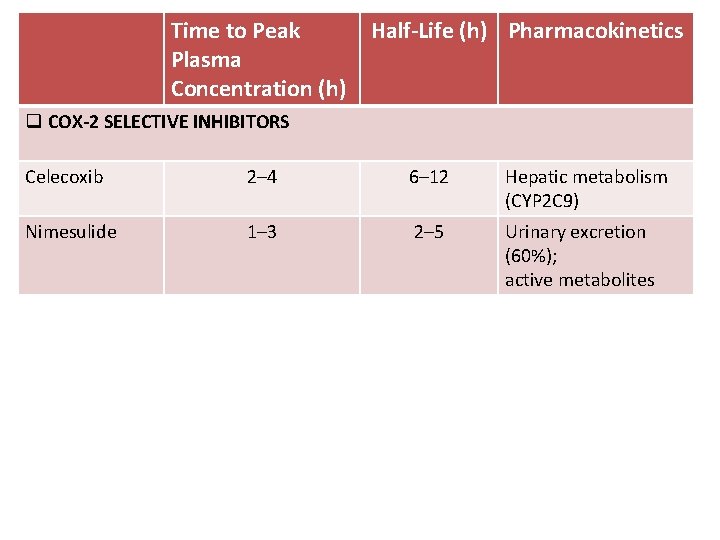
§ Some NSAIDs (eg, meloxicam, & nimesulide) preferentially inhibit COX-2 over COX-1; others were specifically designed to selectively inhibit COX-2 (eg, celecoxib). § COX-2 inhibitors have the ability to inhibit endothelialderived PGI 2, but combined with their relative inability to inhibit platelet-activating TXA 2 (a predominantly COX 1 effect), they may shift the balance toward thrombus formation. Many of the selective COX-2 inhibitors ( eg, valdecoxib & rofecoxib) were removed from the market because of their increased risk of adverse cardiovascular events.
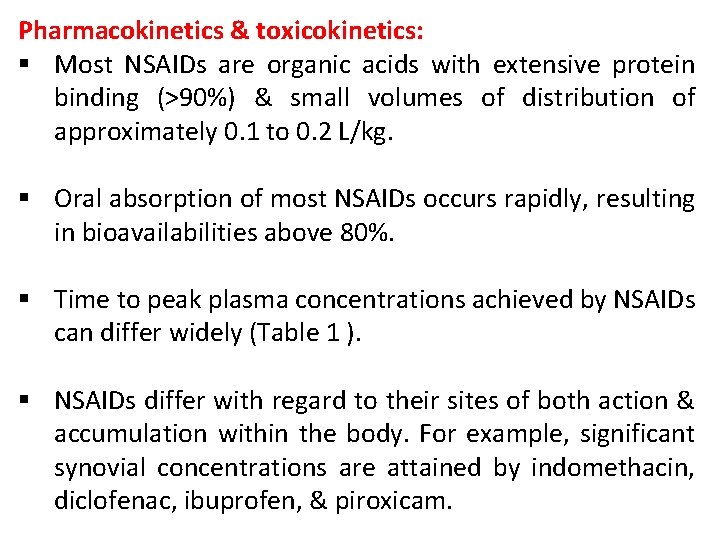
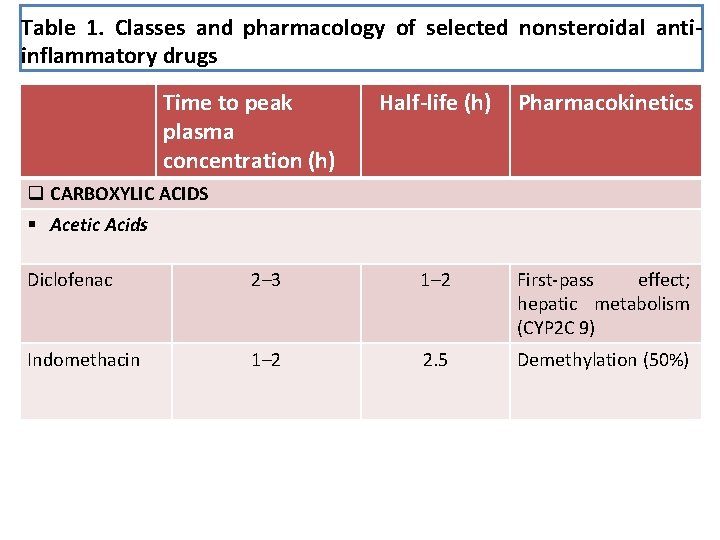
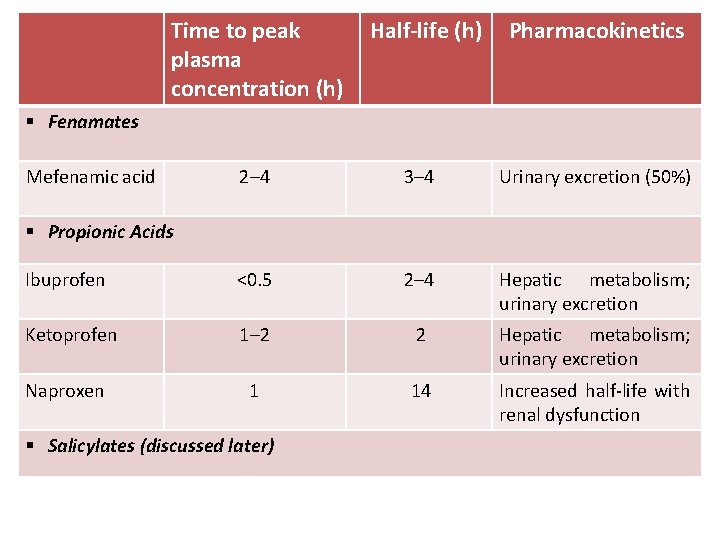
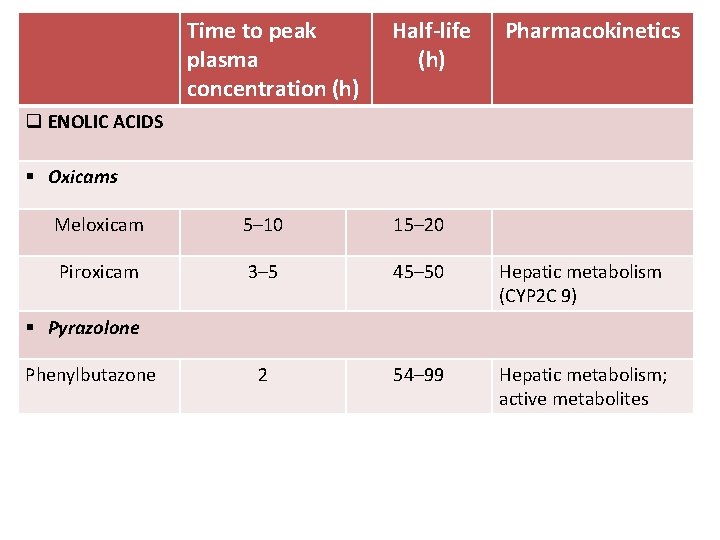
Pharmacokinetics & toxicokinetics: § Most NSAIDs are organic acids with extensive protein binding (>90%) & small volumes of distribution of approximately 0. 1 to 0. 2 L/kg. § Oral absorption of most NSAIDs occurs rapidly, resulting in bioavailabilities above 80%. § Time to peak plasma concentrations achieved by NSAIDs can differ widely (Table 1 ). § NSAIDs differ with regard to their sites of both action & accumulation within the body. For example, significant synovial concentrations are attained by indomethacin, diclofenac, ibuprofen, & piroxicam.
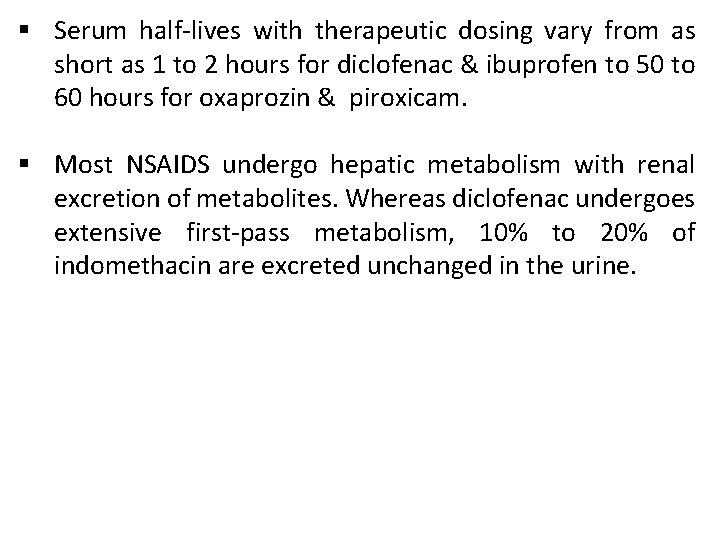
§ Serum half-lives with therapeutic dosing vary from as short as 1 to 2 hours for diclofenac & ibuprofen to 50 to 60 hours for oxaprozin & piroxicam. § Most NSAIDS undergo hepatic metabolism with renal excretion of metabolites. Whereas diclofenac undergoes extensive first-pass metabolism, 10% to 20% of indomethacin are excreted unchanged in the urine.
Table 1. Classes and pharmacology of selected nonsteroidal antiinflammatory drugs Time to peak plasma concentration (h) Half-life (h) Pharmacokinetics q CARBOXYLIC ACIDS § Acetic Acids Diclofenac 2– 3 1– 2 First-pass effect; hepatic metabolism (CYP 2 C 9) Indomethacin 1– 2 2. 5 Demethylation (50%)
Time to peak plasma concentration (h) Half-life (h) Pharmacokinetics § Fenamates Mefenamic acid 2– 4 3– 4 Urinary excretion (50%) Ibuprofen <0. 5 2– 4 Hepatic metabolism; urinary excretion Ketoprofen 1– 2 2 Hepatic metabolism; urinary excretion 1 14 Increased half-life with renal dysfunction § Propionic Acids Naproxen § Salicylates (discussed later)
Time to peak plasma concentration (h) Half-life (h) Pharmacokinetics q ENOLIC ACIDS § Oxicams Meloxicam 5– 10 15– 20 Piroxicam 3– 5 45– 50 Hepatic metabolism (CYP 2 C 9) 2 54– 99 Hepatic metabolism; active metabolites § Pyrazolone Phenylbutazone
Time to Peak Plasma Concentration (h) Half-Life (h) Pharmacokinetics q COX-2 SELECTIVE INHIBITORS Celecoxib 2– 4 6– 12 Hepatic metabolism (CYP 2 C 9) Nimesulide 1– 3 2– 5 Urinary excretion (60%); active metabolites
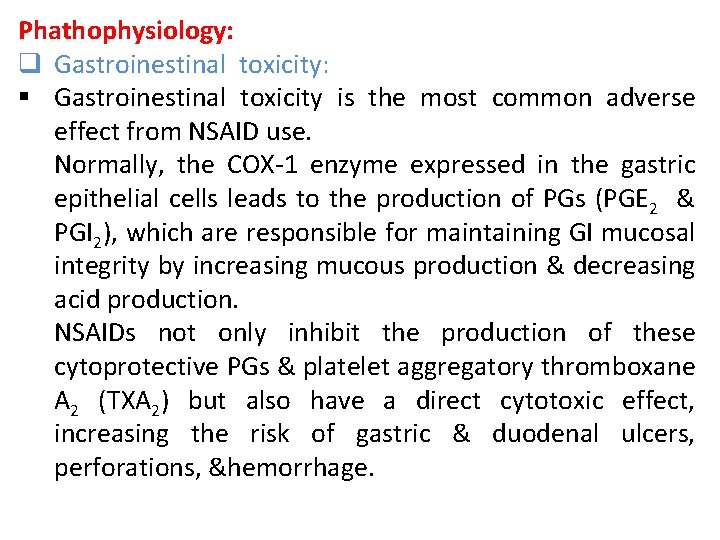
Phathophysiology: q Gastroinestinal toxicity: § Gastroinestinal toxicity is the most common adverse effect from NSAID use. Normally, the COX-1 enzyme expressed in the gastric epithelial cells leads to the production of PGs (PGE 2 & PGI 2), which are responsible for maintaining GI mucosal integrity by increasing mucous production & decreasing acid production. NSAIDs not only inhibit the production of these cytoprotective PGs & platelet aggregatory thromboxane A 2 (TXA 2) but also have a direct cytotoxic effect, increasing the risk of gastric & duodenal ulcers, perforations, &hemorrhage.
§ Selective COX-2 inhibitors decrease the incidence of significant GI toxicity compared with some nonselective NSAIDs.
q Effects on the kidney: § Locally, the kidney produces homeostatic PGs largely via COX-1, including PGI 2 , PGE 2 , & PGD 2, which cause renal vasodilation & maintain renal blood flow & function. § Patients with volume contraction (dehydration) or poor cardiac output (congestive heart failure) have elevated concentrations of renal vasoconstrictor substances from stimulation of both the renin–angiotensin–aldosterone axis & the sympathetic nervous system.
In these patients, NSAIDs inhibit the synthesis of the compensatory vasodilatory PGs, resulting in unopposed renal vasoconstriction & causing decreased renal blood flow & glomerular filtration rate (GFR). This effect may possibly lead possibly acute renal failure, particularly in elderly individuals. This vasoconstrictive effect appears to be reversible upon discontinuation of therapy.
q The antiplatelet activity of NSAIDs: § Normal platelet function depends partly on endothelialderived PGI 2 , which blocks platelet activation & causes vasodilation, allowing blood to flow freely within vessels. § On the other hand, TXA 2 , a potent platelet stimulator & vasoconstrictor, that is synthesize & released at the site of vascular injury
§ The antiplatelet activity of NSAIDs stems from their ability to inhibit COX-1 which is necessary for plateletstimulating TXA 2 synthesis. § Some in vitro evidence suggests that PGI 2 synthesis is largely dependent on COX-2. Inhibiting the antiaggregatory PGI 2 may counter the antiplatelet effect, creating a prothrombotic environment. This is the predominant theory of how selective COX-2 inhibitors increase the risk of adverse cardiovascular events.
q Effect on uterine activity & ductus arteriosus: § Exogenous administration of PGF 2 α &PGE 2 has been used to induce uterine activity, & indomethacin has been used successfully as a tocolytic agent blunting PGmediated uterine stimulation. § However, a major clinical drawback in using NSAIDs as a tocolytic agent is the potential to cause premature constriction or closure of the ductus arteriosus in utero. Vasodilatory PGs are required to keep the fetal ductus arteriosus open & patent, & inhibiting these PGs has been shown to cause fetal ductal constriction, leading to pulmonary hypertension & persistent fetal circulation after birth.
Clinical manifestations of toxicity: § Most nonselective NSAIDs behave similarly in overdose, although much of the medical literature specifically describes ibuprofen. § Regardless of the particular NSAID ingested, symptoms, if they develop, typically manifest within 4 hours after ingestion. § Initial clinical manifestations are usually mild & predominantly include gastrointestinal symptoms such as nausea, vomiting, abdominal pain, or neurologic symptoms such as drowsiness, headache, tinnitus, blurred vision, & dizziness.
§ More moderate & severe findings are rare & include coma, seizures, central nervous system (CNS) depression, metabolic acidosis, hypotension, electrolyte imbalances, cardiac dysrhythmias, & acute oliguric renal failure. § Massive NSAID ingestions may lead to multisystem organ failure & death.
q Neurologic effects: § The neurologic effects of NSAID use vary from the mild drowsiness, headache, & dizziness with therapeutic dosing to the more life-threatening CNS depression, coma, & seizures in overdose. The mechanism associated with the depressed level of consciousness is unknown; however, several animal studies suggest a relationship with opioid receptors. § Muscle twitching & generalized tonic-clonic seizures are described with mefenamic acid overdose & usually occur within 7 hours after ingestion. Seizures are also associated with ibuprofen overdose.
q Renal & electrolyte effects: § Both acute overdose & chronic therapeutic dosing of NSAIDs may have deleterious effects of renal function, most of which are reversible but in rare cases permanent. § These include: • sodium retention & edema, • hyperkalemia, • acute renal failure, • membranous nephropathy, • nephrotic syndrome, • interstitial nephritis, & • renal papillary necrosis.
§ General risk factors for NSAID-induced renal dysfunction include: • congestive heart failure, • volume depletion, • diabetes mellitus, • underlying renal disease, • systemic lupus erythematosus, • cirrhosis, • diuretic therapy, & • advanced age.
§ Acute tubulointerstitial nephritis (ATIN) is one of the more common forms of NSAID-induced renal impairment, & it may occur with short-term therapeutic dosing. § Analgesic abuse nephropathy is a condition whose pathogenesis is not well defined, but it develops from excessive, chronic therapeutic consumption of NSAIDs. This results in acute renal failure manifested by renal papillary necrosis, often requiring hemodialysis.
§ Anion gap metabolic acidosis, with & without acute renal failure, complicates many acute, massive ibuprofen ingestions & may be profound. The cause of the acidosis in this setting is most likely multifactorial, involving: • elevated lactate concentrations from profound hypotension & tissue hypoperfusion, • as well as the accumulation of ibuprofen & its two major metabolites, all weak acids. § An elevated anion gap metabolic acidosis with elevated lactate concentrations is also described after naproxen overdose, suggesting this to be a class effect given that all NSAIDs are acid derivatives.
q Gastrointestinal effects: § Acute NSAID overdoses are reported to cause bloody emesis, fecal occult blood, & severe, life-threatening GI hemorrhage. § NSAID-induced hepatotoxicity is a well known adverse effect that has prompted the removal of several NSAIDs from the market. § NSAID-induced hepatotoxicity is an idiosyncratic reaction primarily causing hepatocellular injury & does not depend on the chemical class. Diclofenac & sulindac are most commonly implicated.
q Immunologic & dermatologic effects: § Evidence for anaphylactic reactions includes the presence of NSAID-specific Ig. E, & positive wheal-&-flare skin reactions. § The proposed mechanism of NSAID-induced anaphylactoid reactions involves the inhibition of COX-1, which not only inhibits the production of PGE 2 (which causes bronchodilation) but also shunts the AA metabolism to increased production of bronchoconstricting leukotriens. § Selective COX-2 inhibitors cause similar clinical reactions but with an unclear mechanism.
q Hematologic effects: § As a class, NSAIDs are frequently implicated as a cause of thrombocytopenia & are reported to have caused adverse effects on most other cell lines & function, including agranulocytosis, aplastic anemia, & hemolytic anemia. § The ability of a particular type of NSAID to inhibit platelet aggregation & affect bleeding time depends on the dose & half-life because NSAIDs reversibly inhibit COX. § However, aspirin irreversibly inhibits COX, & typically doubles the bleeding time within 12 hours, returning to normal within 24 to 48 hours
q Cardiovascular effects: Although no evidence supports a direct cardiotoxic effect of NSAIDs or their metabolites, acute & massive NSAID overdoses may be complicated by persistent, severe hypotension; myocardial ischemia; & dysrhythmias. However, these effects are reported only in severely ill patients with acid–base abnormalities & multisystem organ involvement.
Diagnostic testing: § Laboratory measurements, including complete blood count, serum electrolytes, blood urea nitrogen, & creatinine should be obtained for all symptomatic patients, & patients with intentional ingestion. § For patients presenting with significant neurologic effects, such as CNS depression, further evaluation of acid–base & ventilatory status by blood gas, hepatic aminotransferases, & prothrombin time should be obtained.
§ An acetaminophen concentration should always be determined in patients with intentional ingestions & in patients presenting with an unclear history because many people mistake acetaminophen for NSAIDs because of confusing labeling & packaging or unawareness that they are completely different types of analgesics. For similar reasons, one may also consider obtaining a salicylate concentration.
Management: § Most asymptomatic patients with intentional overdose & those with normal vital signs require observation for 4 to 6 hours & a serum acetaminophen concentration before being medically cleared. § Children with ibuprofen ingestions of less than 100 mg/kg can be observed at home, but those who ingest greater than 400 mg/kg are at high risk for toxicity & require medical evaluation.
§ GI decontamination with activated charcoal (AC) should be considered for: • an asymptomatic patient with the potential for a large ingestion, • symptomatic patients, & • children with a history of ibuprofen ingestion greater than 400 mg/kg. § Multiple-dose AC may be useful for patients with massive overdoses of sustained-release preparations.
§ Patients who develop severe, life-threatening manifestations usually present with lethargy or unresponsiveness. • Aggressive, supportive care is indicated in these patients, including stabilization of the airway & intravenous (IV) fluid therapy. • An early electrocardiogram is essential to detect any significant electrolyte abnormalities or conduction disturbances. • Electrolyte imbalances should be corrected & sodium bicarbonate therapy considered for severe metabolic acidosis.
• Hypotension should be treated initially with IV fluid therapy followed by direct-acting vasopressors if necessary. • Electrocardiograms should be monitored for the development of any life-threatening electrolyte imbalances or cardiac conduction abnormalities.
§ Given their high protein binding, NSAIDs do not appear to be amenable to extracorporeal removal methods; however, in cases of persistent metabolic acidosis or renal failure, hemodialysis or continuous renal replacement therapies may be useful to correct the acid –base status. § Patients with seizures, which are characteristic of mefenamic acid overdose, should be treated with IV benzodiazepines.
§ The most common adverse effect of therapeutic NSAID use is dyspepsia, & the most serious GI effect is ulcer formation, which has the potential for perforation & hemorrhage. Most patients with dyspepsia do not have ulcers. To help prevent the development of ulcers, concomitant use of misoprostol (a PGE 1 analog), an H 2 -blocker, or a proton pump inhibitor (PPI) is often used; however, PPIs may be superior for both preventing & healing gastroduodenal ulcers resulting from chronic NSAID therapy.