
Clinical Skills Competencies for New Graduate RNs A
- Slides: 1
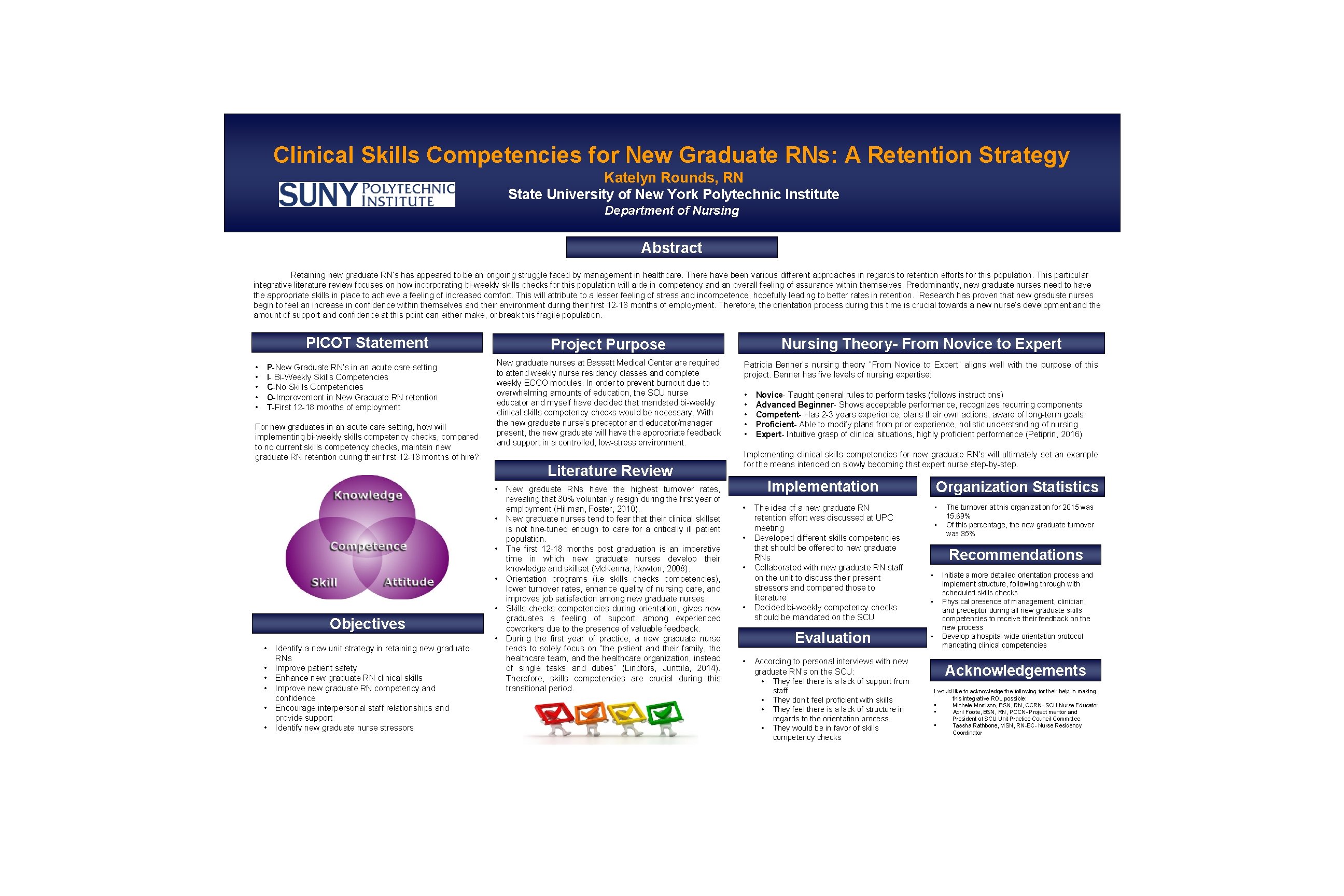
Clinical Skills Competencies for New Graduate RNs: A Retention Strategy Katelyn Rounds, RN State University of New York Polytechnic Institute Department of Nursing Abstract Retaining new graduate RN’s has appeared to be an ongoing struggle faced by management in healthcare. There have been various different approaches in regards to retention efforts for this population. This particular integrative literature review focuses on how incorporating bi-weekly skills checks for this population will aide in competency and an overall feeling of assurance within themselves. Predominantly, new graduate nurses need to have the appropriate skills in place to achieve a feeling of increased comfort. This will attribute to a lesser feeling of stress and incompetence, hopefully leading to better rates in retention. Research has proven that new graduate nurses begin to feel an increase in confidence within themselves and their environment during their first 12 -18 months of employment. Therefore, the orientation process during this time is crucial towards a new nurse’s development and the amount of support and confidence at this point can either make, or break this fragile population. PICOT Statement • • • P-New Graduate RN’s in an acute care setting I- Bi-Weekly Skills Competencies C-No Skills Competencies O-Improvement in New Graduate RN retention T-First 12 -18 months of employment For new graduates in an acute care setting, how will implementing bi-weekly skills competency checks, compared to no current skills competency checks, maintain new graduate RN retention during their first 12 -18 months of hire? Project Purpose Nursing Theory- From Novice to Expert New graduate nurses at Bassett Medical Center are required to attend weekly nurse residency classes and complete weekly ECCO modules. In order to prevent burnout due to overwhelming amounts of education, the SCU nurse educator and myself have decided that mandated bi-weekly clinical skills competency checks would be necessary. With the new graduate nurse’s preceptor and educator/manager present, the new graduate will have the appropriate feedback and support in a controlled, low-stress environment. Patricia Benner’s nursing theory ”From Novice to Expert” aligns well with the purpose of this project. Benner has five levels of nursing expertise: Literature Review • • • Objectives • • Identify a new unit strategy in retaining new graduate RNs Improve patient safety Enhance new graduate RN clinical skills Improve new graduate RN competency and confidence Encourage interpersonal staff relationships and provide support Identify new graduate nurse stressors New graduate RNs have the highest turnover rates, revealing that 30% voluntarily resign during the first year of employment (Hillman, Foster, 2010). New graduate nurses tend to fear that their clinical skillset is not fine-tuned enough to care for a critically ill patient population. The first 12 -18 months post graduation is an imperative time in which new graduate nurses develop their knowledge and skillset (Mc. Kenna, Newton, 2008). Orientation programs (i. e skills checks competencies), lower turnover rates, enhance quality of nursing care, and improves job satisfaction among new graduate nurses. Skills checks competencies during orientation, gives new graduates a feeling of support among experienced coworkers due to the presence of valuable feedback. During the first year of practice, a new graduate nurse tends to solely focus on “the patient and their family, the healthcare team, and the healthcare organization, instead of single tasks and duties” (Lindfors, Junttila, 2014). Therefore, skills competencies are crucial during this transitional period. • • • Novice- Taught general rules to perform tasks (follows instructions) Advanced Beginner- Shows acceptable performance, recognizes recurring components Competent- Has 2 -3 years experience, plans their own actions, aware of long-term goals Proficient- Able to modify plans from prior experience, holistic understanding of nursing Expert- Intuitive grasp of clinical situations, highly proficient performance (Petiprin, 2016) Implementing clinical skills competencies for new graduate RN’s will ultimately set an example for the means intended on slowly becoming that expert nurse step-by-step. Implementation • • The idea of a new graduate RN retention effort was discussed at UPC meeting Developed different skills competencies that should be offered to new graduate RNs Collaborated with new graduate RN staff on the unit to discuss their present stressors and compared those to literature Decided bi-weekly competency checks should be mandated on the SCU Evaluation • According to personal interviews with new graduate RN’s on the SCU: • They feel there is a lack of support from • • • staff They don’t feel proficient with skills They feel there is a lack of structure in regards to the orientation process They would be in favor of skills competency checks Organization Statistics • • The turnover at this organization for 2015 was 15. 69% Of this percentage, the new graduate turnover was 35% Recommendations • • • Initiate a more detailed orientation process and implement structure, following through with scheduled skills checks Physical presence of management, clinician, and preceptor during all new graduate skills competencies to receive their feedback on the new process Develop a hospital-wide orientation protocol mandating clinical competencies Acknowledgements I would like to acknowledge the following for their help in making this integrative ROL possible: • Michele Morrison, BSN, RN, CCRN- SCU Nurse Educator • April Foote, BSN, RN, PCCN- Project mentor and President of SCU Unit Practice Council Committee • Tassha Rathbone, MSN, RN-BC- Nurse Residency Coordinator