
Clinical Skills Clinical skills assessment framework 1 gathers
- Slides: 10
Clinical Skills
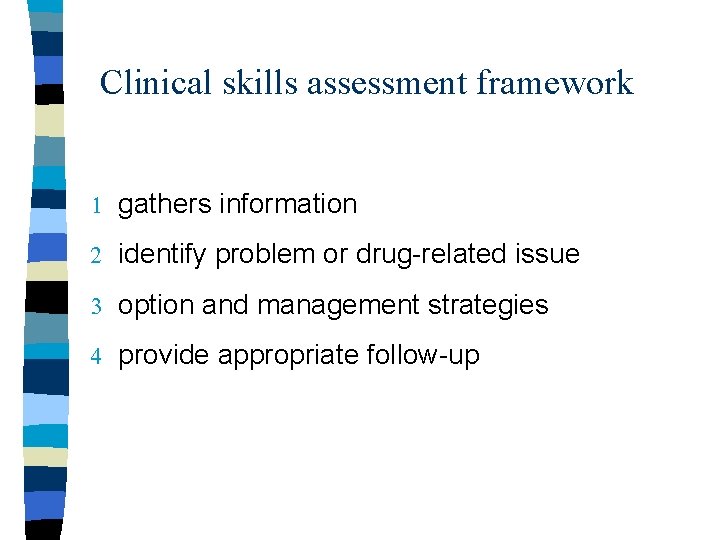
Clinical skills assessment framework 1 gathers information 2 identify problem or drug-related issue 3 option and management strategies 4 provide appropriate follow-up
Gathering Information n Opening n Systematic but flexible approach n Begin with open ended questions n Use close ended questions to narrow down n Cast your net wide n Stay organized, aware of time
Identifying Patient’s Needs Differentiate between: n patient’s needs and wants n caregiver’s needs and wants n health care provider’s needs and wants Establish urgency of situation - do not expect to solve all problems now!
Identify Management Options n Use references to confirm knowledge base n Identify all relevant options, including status quo n Identify pros and cons for each option objectively, so patient can make own, informed decision n Refer to patient’s specific circumstances
Communicate/Negotiate n Be clear as to what YOU think is the best option and WHY n Do not pressure, but educate n Apply your therapeutic knowledge n Use persuasive communications techniques where appropriate
Implementing Plan/Follow-Up By the end of the interview, there should be a decision of some sort. If the Rx is appropriate, counsel on it. If the Rx is inappropriate, clearly explain to patient why, what you will do and how it will be done. Do not let interview digress into a “chitchat”
II. Physical Evaluation n Observe patient’s affect n Note physical changes (e. g. tremor, shortness of breath, sweating, tics) n Confirm laboratory tests (e. g. blood pressure, glucometer, peak flow meter)
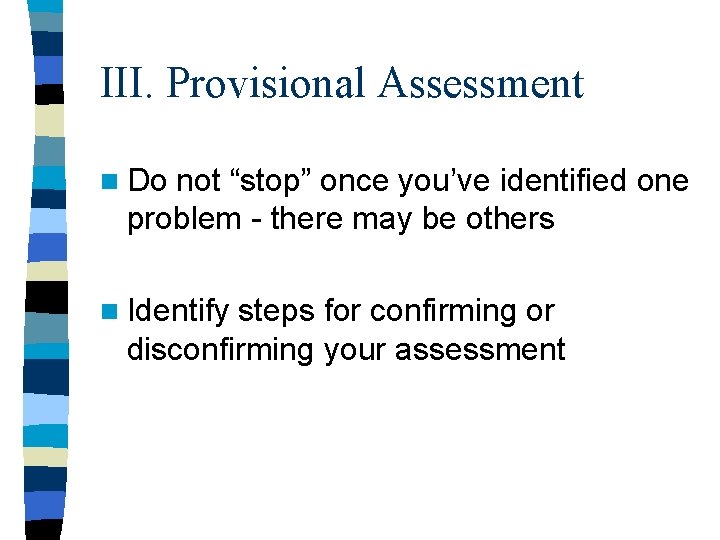
III. Provisional Assessment n Do not “stop” once you’ve identified one problem - there may be others n Identify steps for confirming or disconfirming your assessment
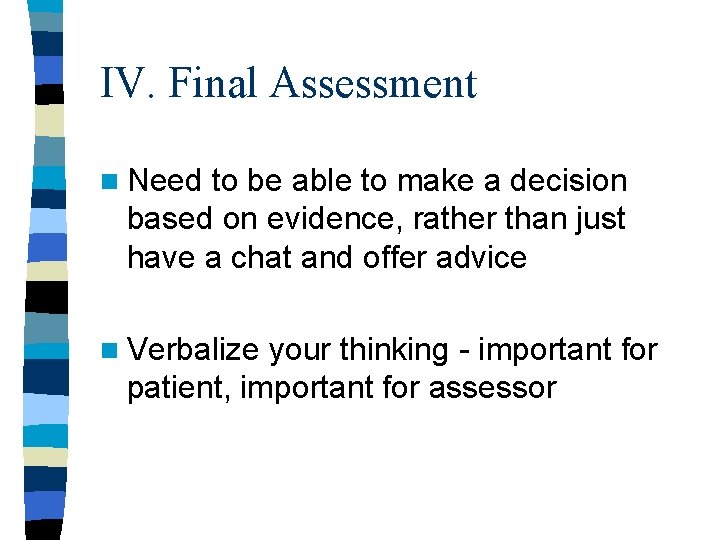
IV. Final Assessment n Need to be able to make a decision based on evidence, rather than just have a chat and offer advice n Verbalize your thinking - important for patient, important for assessor