
Clinical Shadow Program Methods in Medical Image Analysis
- Slides: 10
Clinical Shadow Program Methods in Medical Image Analysis - Spring 2019 16 -725 (CMU RI) : Bio. E 2630 (Pitt) Dr. John Galeotti The content of these slides by John Galeotti, © 2012 -2019 Carnegie Mellon University (CMU), was made possible in part by NIH NLM contract# HHSN 276201000580 P, and is licensed under a Creative Commons Attribution 3. 0 Unported License. To view a copy of this license, visit http: //creativecommons. org/licenses/by/3. 0/ or send a letter to Creative Commons, 171 2 nd Street, Suite 300, San Francisco, California, 94105, USA. Permissions beyond the scope of this license may be available either from CMU or by emailing itk@galeotti. net. The most recent version of these slides may be accessed online via http: //itk. galeotti. net/
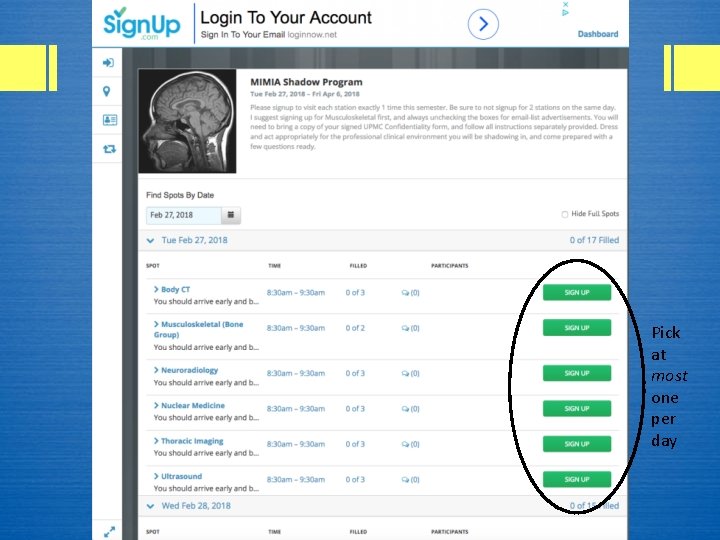
Pick at most one per day
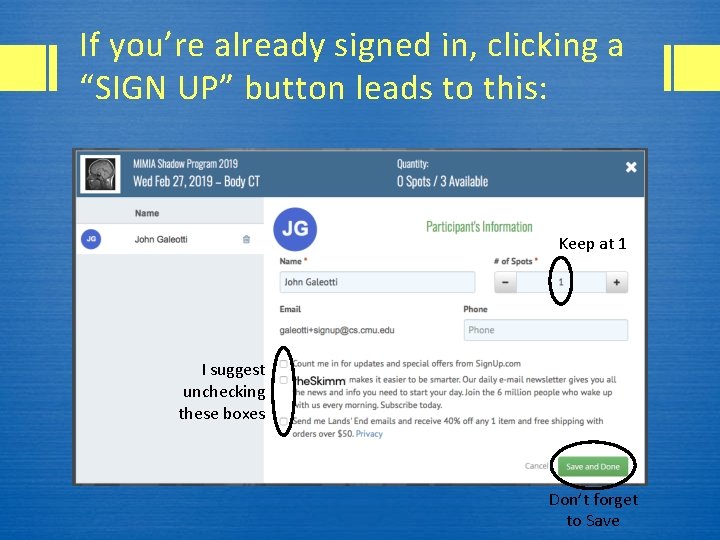
If you’re already signed in, clicking a “SIGN UP” button leads to this: Keep at 1 I suggest unchecking these boxes Don’t forget to Save
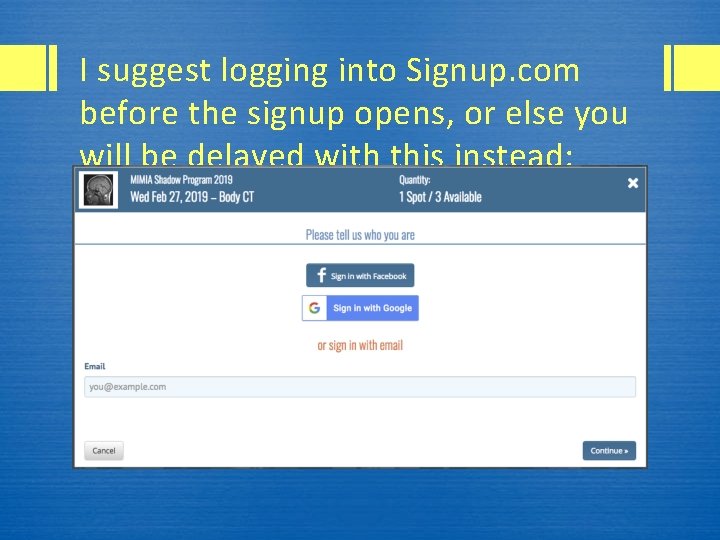
I suggest logging into Signup. com before the signup opens, or else you will be delayed with this instead:
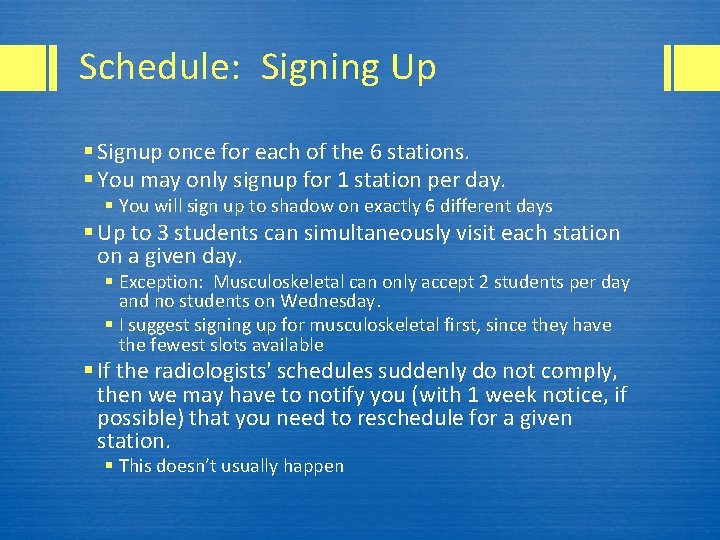
Schedule: Signing Up § Signup once for each of the 6 stations. § You may only signup for 1 station per day. § You will sign up to shadow on exactly 6 different days § Up to 3 students can simultaneously visit each station on a given day. § Exception: Musculoskeletal can only accept 2 students per day and no students on Wednesday. § I suggest signing up for musculoskeletal first, since they have the fewest slots available § If the radiologists' schedules suddenly do not comply, then we may have to notify you (with 1 week notice, if possible) that you need to reschedule for a given station. § This doesn’t usually happen
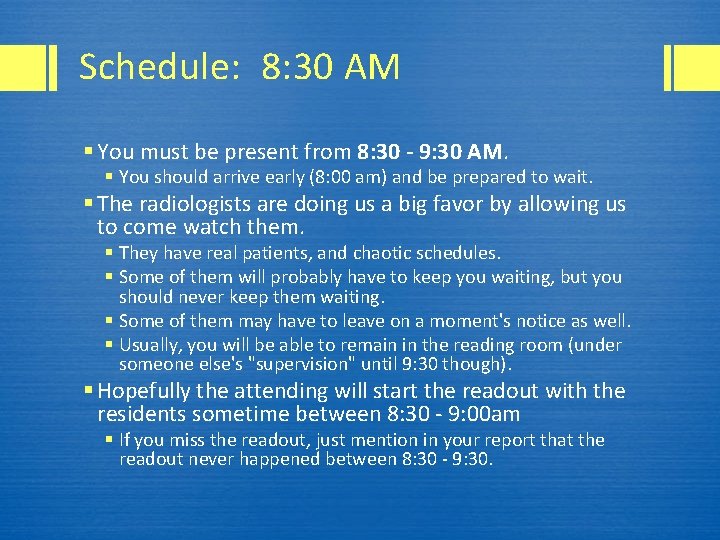
Schedule: 8: 30 AM § You must be present from 8: 30 - 9: 30 AM. § You should arrive early (8: 00 am) and be prepared to wait. § The radiologists are doing us a big favor by allowing us to come watch them. § They have real patients, and chaotic schedules. § Some of them will probably have to keep you waiting, but you should never keep them waiting. § Some of them may have to leave on a moment's notice as well. § Usually, you will be able to remain in the reading room (under someone else's "supervision" until 9: 30 though). § Hopefully the attending will start the readout with the residents sometime between 8: 30 - 9: 00 am § If you miss the readout, just mention in your report that the readout never happened between 8: 30 - 9: 30.
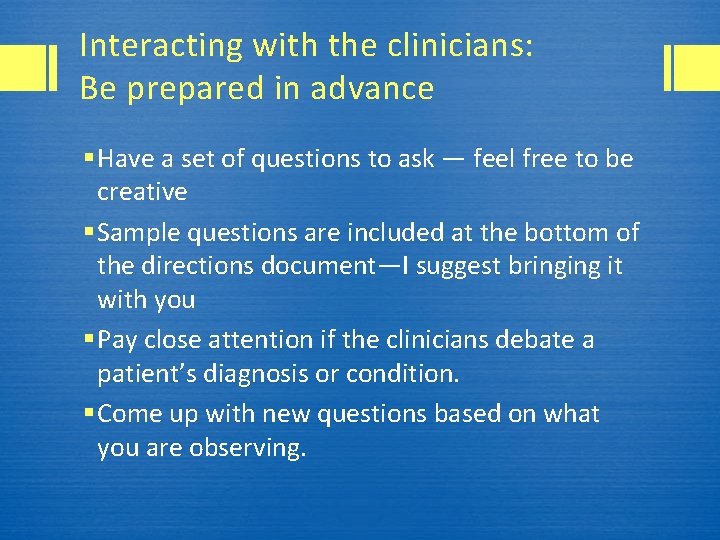
Interacting with the clinicians: Be prepared in advance § Have a set of questions to ask — feel free to be creative § Sample questions are included at the bottom of the directions document—I suggest bringing it with you § Pay close attention if the clinicians debate a patient’s diagnosis or condition. § Come up with new questions based on what you are observing.
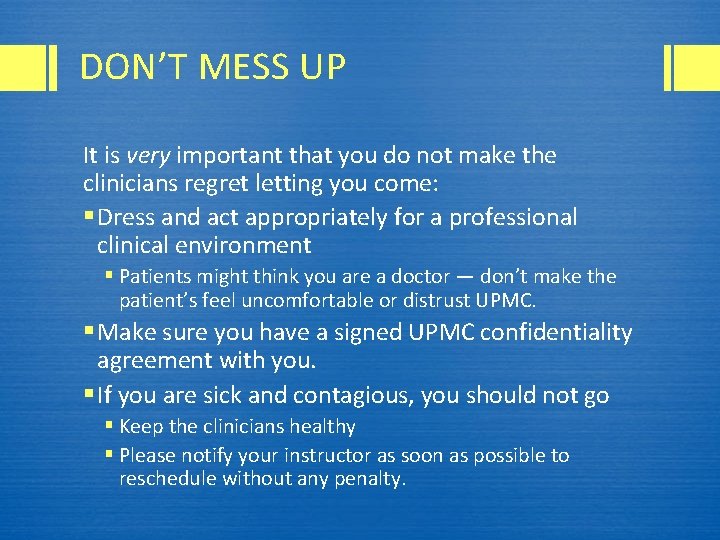
DON’T MESS UP It is very important that you do not make the clinicians regret letting you come: § Dress and act appropriately for a professional clinical environment § Patients might think you are a doctor — don’t make the patient’s feel uncomfortable or distrust UPMC. § Make sure you have a signed UPMC confidentiality agreement with you. § If you are sick and contagious, you should not go § Keep the clinicians healthy § Please notify your instructor as soon as possible to reschedule without any penalty.
DON’T MESS UP (continued) § The first time you miss a station for which you are scheduled (without good reason), you may contact your instructor to reschedule for 50% credit for that station. § If you do not show up a second time, you will be removed from the Shadow Program, get a 0 for all subsequent stations, and your instructor will be very unhappy with you.
Follow-up assignment (once for each station) After visiting each station, send an email to your TA and your instructor with the following information: § Your name § The date of your visit § Which station you visited § Your short report (≥ 100 words) about your visit: § What did you learn? § What role you see (either at present, or that you could see in the future) for computer analysis, visualization, or robotics/engineering in this branch of radiology?