
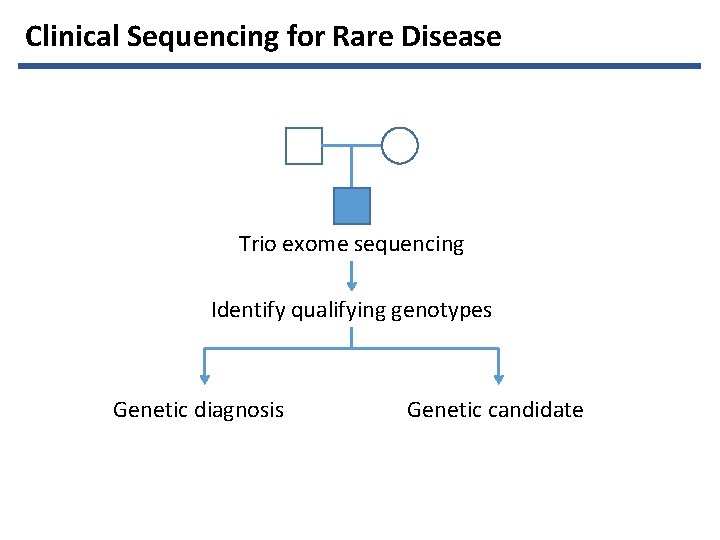
Clinical Sequencing for Rare Disease Trio exome sequencing
- Slides: 17
Clinical Sequencing for Rare Disease Trio exome sequencing Identify qualifying genotypes Genetic diagnosis Genetic candidate
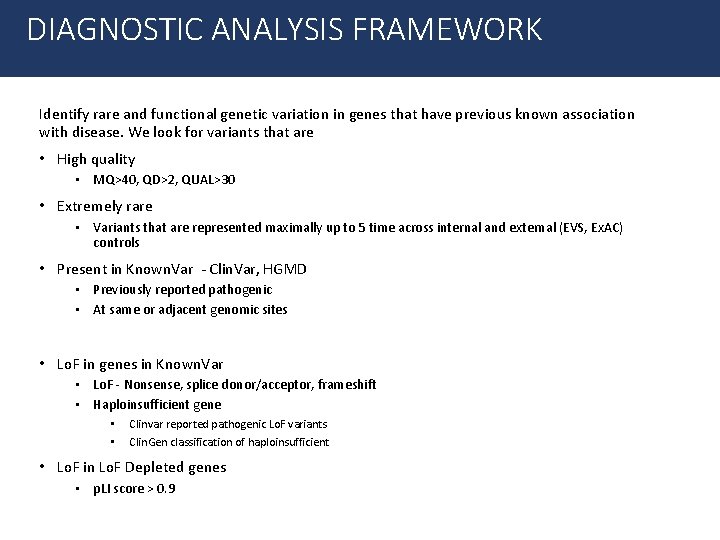
DIAGNOSTIC ANALYSIS FRAMEWORK Identify rare and functional genetic variation in genes that have previous known association with disease. We look for variants that are • High quality • MQ>40, QD>2, QUAL>30 • Extremely rare • Variants that are represented maximally up to 5 time across internal and external (EVS, Ex. AC) controls • Present in Known. Var - Clin. Var, HGMD • Previously reported pathogenic • At same or adjacent genomic sites • Lo. F in genes in Known. Var • Lo. F - Nonsense, splice donor/acceptor, frameshift • Haploinsufficient gene • • Clinvar reported pathogenic Lo. F variants Clin. Gen classification of haploinsufficient • Lo. F in Lo. F Depleted genes • p. LI score > 0. 9
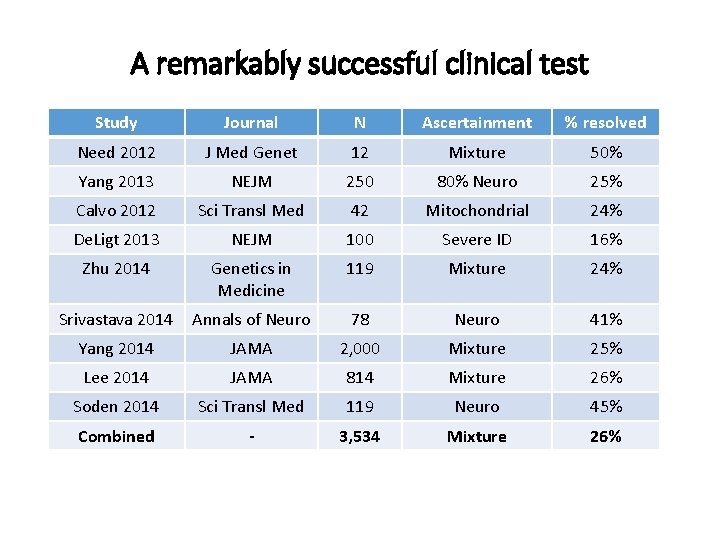
A remarkably successful clinical test Study Journal N Ascertainment % resolved Need 2012 J Med Genet 12 Mixture 50% Yang 2013 NEJM 250 80% Neuro 25% Calvo 2012 Sci Transl Med 42 Mitochondrial 24% De. Ligt 2013 NEJM 100 Severe ID 16% Zhu 2014 Genetics in Medicine 119 Mixture 24% Srivastava 2014 Annals of Neuro 78 Neuro 41% Yang 2014 JAMA 2, 000 Mixture 25% Lee 2014 JAMA 814 Mixture 26% Soden 2014 Sci Transl Med 119 Neuro 45% Combined - 3, 534 Mixture 26%
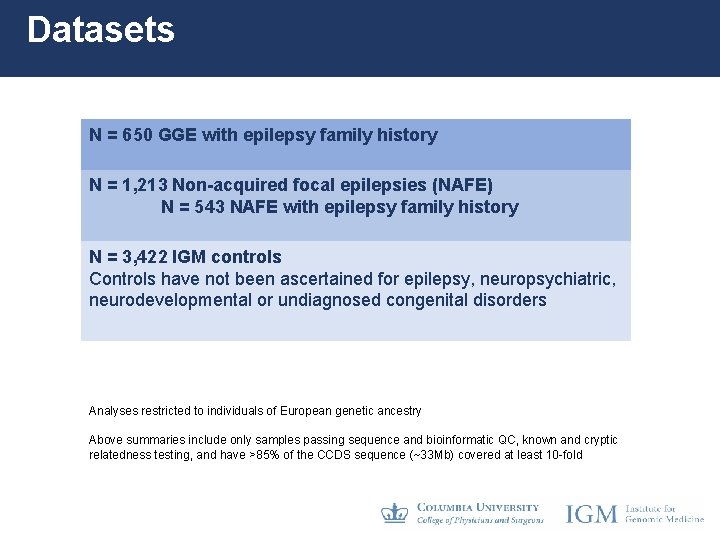
Datasets N = 650 GGE with epilepsy family history N = 1, 213 Non-acquired focal epilepsies (NAFE) N = 543 NAFE with epilepsy family history N = 3, 422 IGM controls Controls have not been ascertained for epilepsy, neuropsychiatric, neurodevelopmental or undiagnosed congenital disorders Analyses restricted to individuals of European genetic ancestry Above summaries include only samples passing sequence and bioinformatic QC, known and cryptic relatedness testing, and have >85% of the CCDS sequence (~33 Mb) covered at least 10 -fold
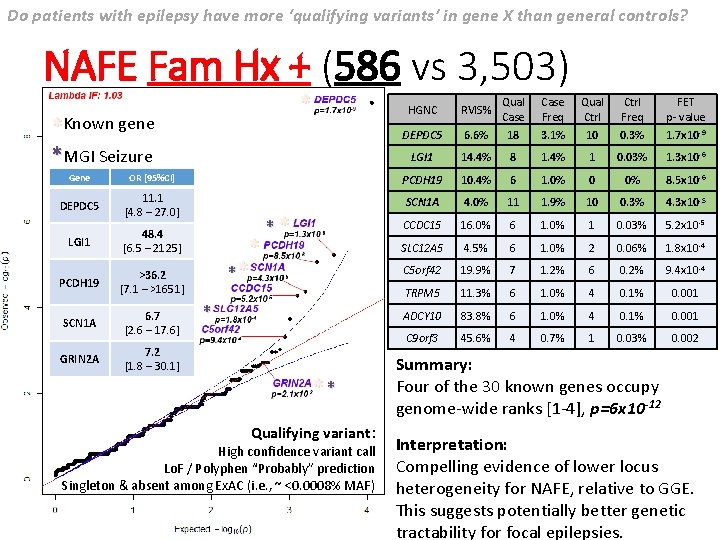
Do patients with epilepsy have more ‘qualifying variants’ in gene X than general controls? NAFE Fam Hx + (586 vs 3, 503) * *Known gene *MGI Seizure HGNC RVIS% Qual Case Freq Qual Ctrl Freq FET p- value DEPDC 5 6. 6% 18 3. 1% 10 0. 3% 1. 7 x 10 -9 LGI 1 14. 4% 8 1. 4% 1 0. 03% 1. 3 x 10 -6 Gene OR [95%CI] PCDH 19 10. 4% 6 1. 0% 0 0% 8. 5 x 10 -6 DEPDC 5 11. 1 [4. 8 – 27. 0] SCN 1 A 4. 0% 11 1. 9% 10 0. 3% 4. 3 x 10 -5 CCDC 15 16. 0% 6 1. 0% 1 0. 03% 5. 2 x 10 -5 LGI 1 48. 4 [6. 5 – 2125] SLC 12 A 5 4. 5% 6 1. 0% 2 0. 06% 1. 8 x 10 -4 PCDH 19 >36. 2 [7. 1 – >1651] C 5 orf 42 19. 9% 7 1. 2% 6 0. 2% 9. 4 x 10 -4 TRPM 5 11. 3% 6 1. 0% 4 0. 1% 0. 001 SCN 1 A 6. 7 [2. 6 – 17. 6] ADCY 10 83. 8% 6 1. 0% 4 0. 1% 0. 001 C 9 orf 3 45. 6% 4 0. 7% 1 0. 03% 0. 002 GRIN 2 A 7. 2 [1. 8 – 30. 1] * ** ** Qualifying variant: High confidence variant call Lo. F / Polyphen “Probably” prediction Singleton & absent among Ex. AC (i. e. , ~ <0. 0008% MAF) Summary: Four of the 30 known genes occupy genome-wide ranks [1 -4], p=6 x 10 -12 Interpretation: Compelling evidence of lower locus heterogeneity for NAFE, relative to GGE. This suggests potentially better genetic tractability for focal epilepsies.
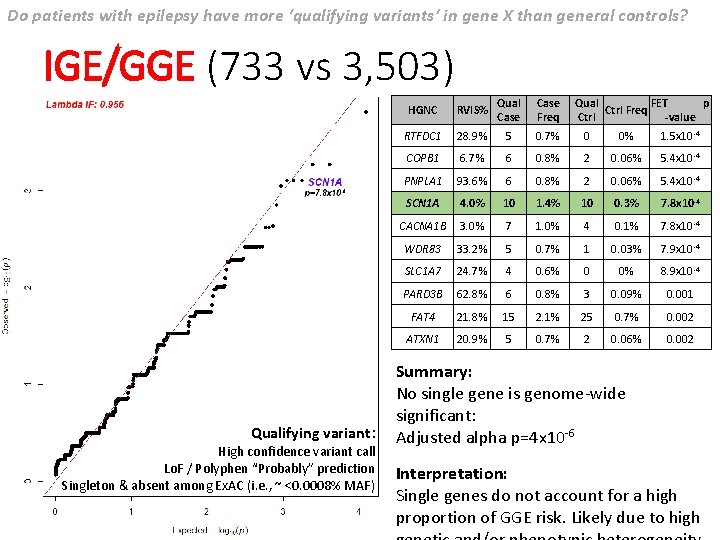
Do patients with epilepsy have more ‘qualifying variants’ in gene X than general controls? IGE/GGE (733 vs 3, 503) Qualifying variant: High confidence variant call Lo. F / Polyphen “Probably” prediction Singleton & absent among Ex. AC (i. e. , ~ <0. 0008% MAF) HGNC RVIS% Qual Case Freq Qual FET p Ctrl Freq Ctrl -value RTFDC 1 28. 9% 5 0. 7% 0 0% 1. 5 x 10 -4 COPB 1 6. 7% 6 0. 8% 2 0. 06% 5. 4 x 10 -4 PNPLA 1 93. 6% 6 0. 8% 2 0. 06% 5. 4 x 10 -4 SCN 1 A 4. 0% 10 1. 4% 10 0. 3% 7. 8 x 10 -4 CACNA 1 B 3. 0% 7 1. 0% 4 0. 1% 7. 8 x 10 -4 WDR 83 33. 2% 5 0. 7% 1 0. 03% 7. 9 x 10 -4 SLC 1 A 7 24. 7% 4 0. 6% 0 0% 8. 9 x 10 -4 PARD 3 B 62. 8% 6 0. 8% 3 0. 09% 0. 001 FAT 4 21. 8% 15 2. 1% 25 0. 7% 0. 002 ATXN 1 20. 9% 5 0. 7% 2 0. 06% 0. 002 Summary: No single gene is genome-wide significant: Adjusted alpha p=4 x 10 -6 Interpretation: Single genes do not account for a high proportion of GGE risk. Likely due to high
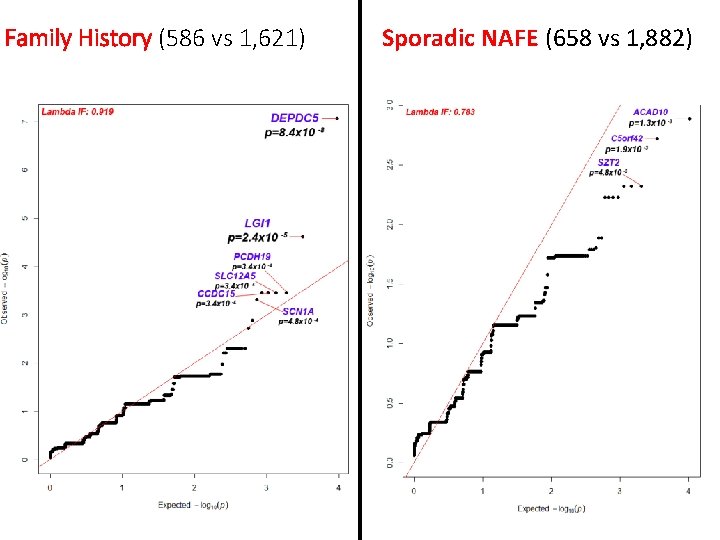
Family History (586 vs 1, 621) Sporadic NAFE (658 vs 1, 882)
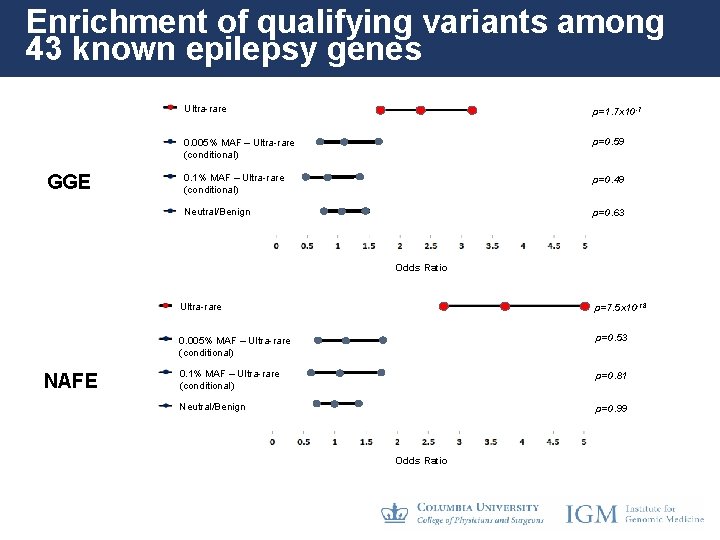
Enrichment of qualifying variants among 43 known epilepsy genes GGE Ultra-rare p=1. 7 x 10 -7 0. 005% MAF – Ultra-rare (conditional) p=0. 59 0. 1% MAF – Ultra-rare (conditional) p=0. 49 Neutral/Benign p=0. 63 Odds Ratio NAFE Ultra-rare p=7. 5 x 10 -18 0. 005% MAF – Ultra-rare (conditional) p=0. 53 0. 1% MAF – Ultra-rare (conditional) p=0. 81 Neutral/Benign p=0. 99 Odds Ratio
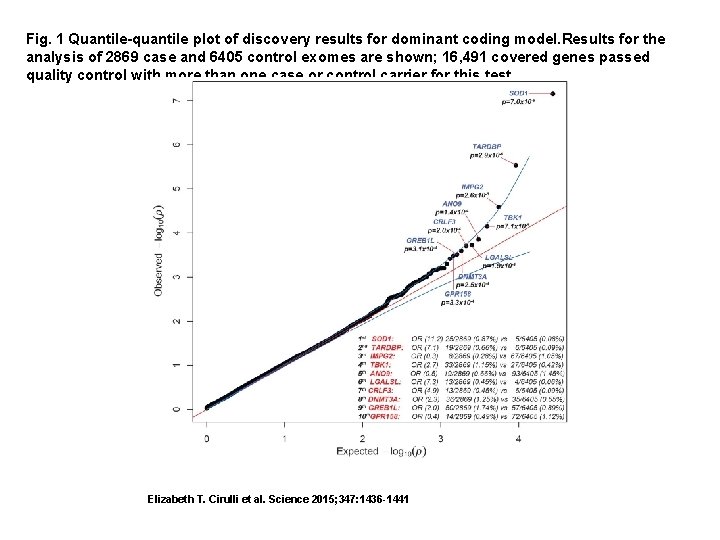
Fig. 1 Quantile-quantile plot of discovery results for dominant coding model. Results for the analysis of 2869 case and 6405 control exomes are shown; 16, 491 covered genes passed quality control with more than one case or control carrier for this test. Elizabeth T. Cirulli et al. Science 2015; 347: 1436 -1441
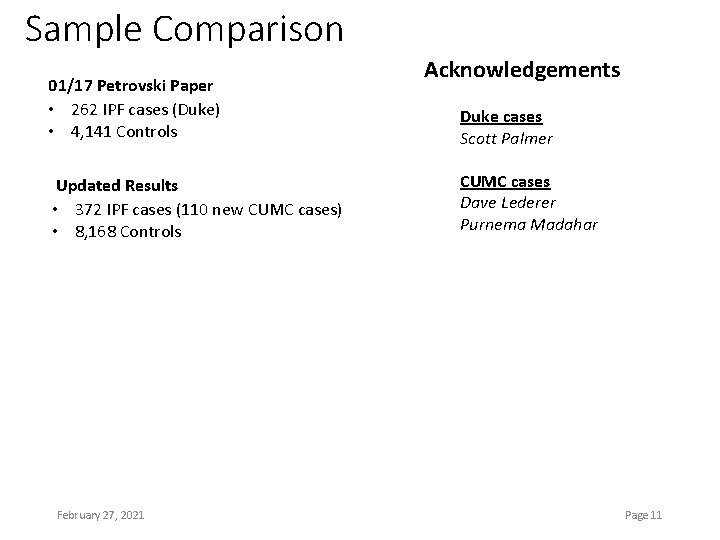
Sample Comparison 01/17 Petrovski Paper • 262 IPF cases (Duke) • 4, 141 Controls Updated Results • 372 IPF cases (110 new CUMC cases) • 8, 168 Controls February 27, 2021 Acknowledgements Duke cases Scott Palmer CUMC cases Dave Lederer Purnema Madahar Page 11
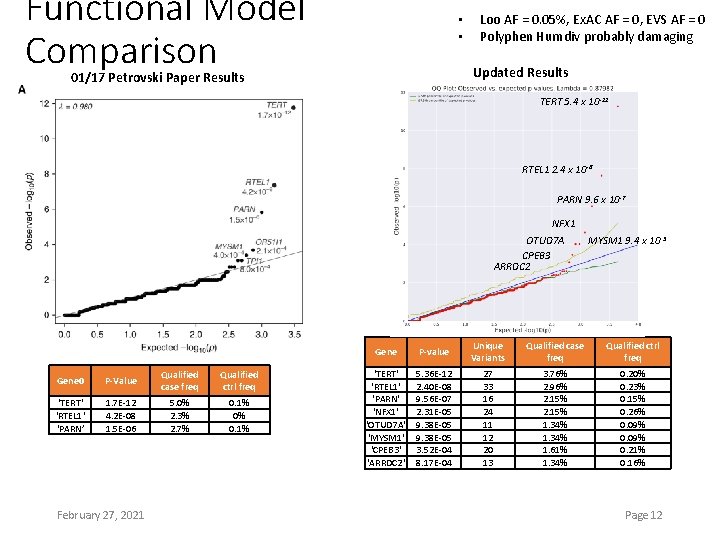
Functional Model Comparison • • Loo AF = 0. 05%, Ex. AC AF = 0, EVS AF = 0 Polyphen Humdiv probably damaging Updated Results 01/17 Petrovski Paper Results TERT 5. 4 x 10 -12 RTEL 1 2. 4 x 10 -8 PARN 9. 6 x 10 -7 NFX 1 OTUD 7 A CPEB 3 ARRDC 2 Gene 0 P-Value Qualified case freq Qualified ctrl freq ‘TERT' 'RTEL 1' ‘PARN’ 1. 7 E-12 4. 2 E-08 1. 5 E-06 5. 0% 2. 3% 2. 7% 0. 1% 0% 0. 1% February 27, 2021 MYSM 1 9. 4 x 10 -5 Gene P-value Unique Variants Qualified case freq Qualified ctrl freq 'TERT' 'RTEL 1' 'PARN' 'NFX 1' 'OTUD 7 A' 'MYSM 1' 'CPEB 3' 'ARRDC 2' 5. 36 E-12 2. 40 E-08 9. 56 E-07 2. 31 E-05 9. 38 E-05 3. 52 E-04 8. 17 E-04 27 33 16 24 11 12 20 13 3. 76% 2. 96% 2. 15% 1. 34% 1. 61% 1. 34% 0. 20% 0. 23% 0. 15% 0. 26% 0. 09% 0. 21% 0. 16% Page 12
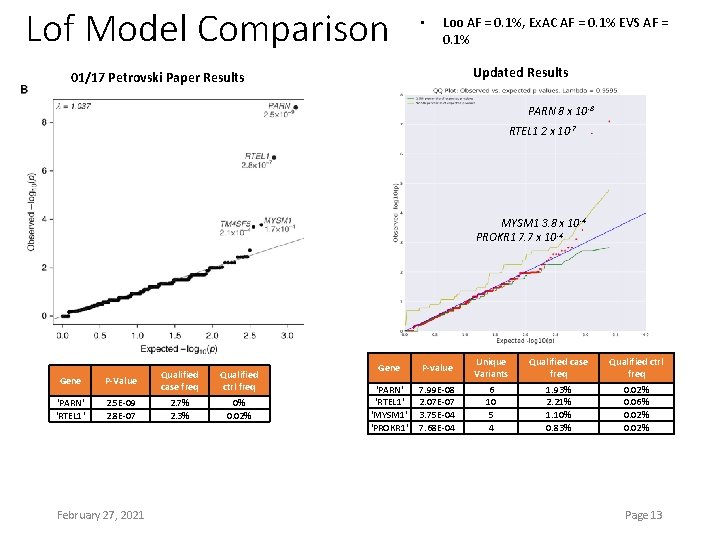
Lof Model Comparison • Loo AF = 0. 1%, Ex. AC AF = 0. 1% EVS AF = 0. 1% Updated Results 01/17 Petrovski Paper Results PARN 8 x 10 -8 RTEL 1 2 x 10 -7 MYSM 1 3. 8 x 10 -4 PROKR 1 7. 7 x 10 -4 Gene P-Value Qualified case freq 'PARN' 'RTEL 1' 2. 5 E-09 2. 8 E-07 2. 7% 2. 3% February 27, 2021 Qualified ctrl freq 0% 0. 02% Gene P-value Unique Variants Qualified case freq Qualified ctrl freq ‘PARN' ‘RTEL 1' 'MYSM 1' 'PROKR 1' 7. 99 E-08 2. 07 E-07 3. 75 E-04 7. 68 E-04 6 10 5 4 1. 93% 2. 21% 1. 10% 0. 83% 0. 02% 0. 06% 0. 02% Page 13
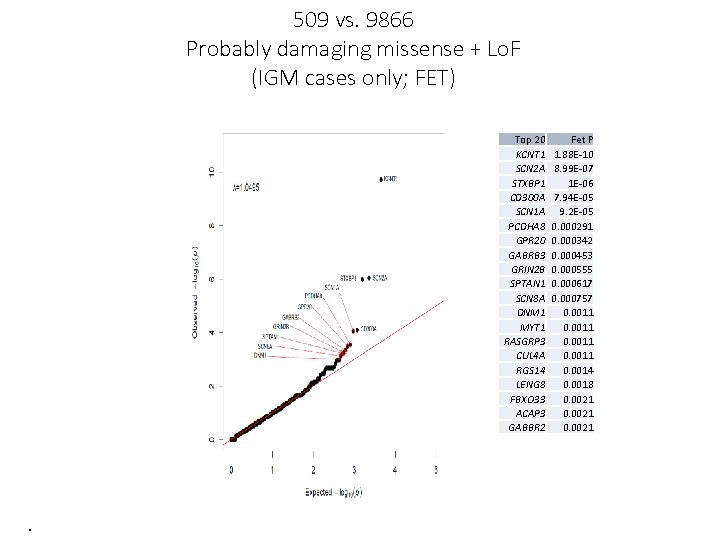
509 vs. 9866 Probably damaging missense + Lo. F (IGM cases only; FET) Top 20 KCNT 1 SCN 2 A STXBP 1 CD 300 A SCN 1 A PCDHA 8 GPR 20 GABRB 3 GRIN 2 B SPTAN 1 SCN 8 A DNM 1 MYT 1 RASGRP 3 CUL 4 A RGS 14 LENG 8 FBXO 33 ACAP 3 GABBR 2 . Fet P 1. 88 E-10 8. 99 E-07 1 E-06 7. 94 E-05 9. 2 E-05 0. 000291 0. 000342 0. 000453 0. 000555 0. 000617 0. 000757 0. 0011 0. 0014 0. 0018 0. 0021
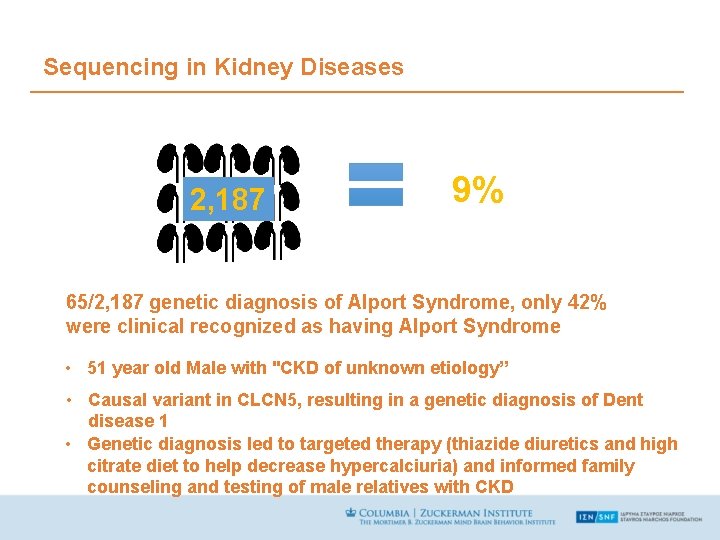
Sequencing in Kidney Diseases 2, 187 9% 65/2, 187 genetic diagnosis of Alport Syndrome, only 42% were clinical recognized as having Alport Syndrome • 51 year old Male with "CKD of unknown etiology” • Causal variant in CLCN 5, resulting in a genetic diagnosis of Dent disease 1 • Genetic diagnosis led to targeted therapy (thiazide diuretics and high citrate diet to help decrease hypercalciuria) and informed family counseling and testing of male relatives with CKD
Sequencing in Liver Diseases • Example: Physician Participation taking care of this 14. 5 year old male in with this high liverstudy enzymes • patient: Clinicallycredited diagnosed Non-Alcoholic Fatty Liverthat Disease was “I with had for a feeling saving his (NAFLD) after biopsy I • life was by missing the committee something Genetics revealed a diagnosis of Wilson Disease with overseeing this kid the butresearch I didn’t • Patient immediately treated with D-penicillamine know studywhat more to do…”
What does it all mean? • Missing heritability • Architecture (rare and common variation not part of a continuum? ) • Implications for disease biology ? • Open questions • What modifies the large effect mutations? • What is the explanation for the widespread signals throughout the genome?