
CLINICAL RESPONSE TO Introduction Establishing the ground rules
CLINICAL RESPONSE TO
Introduction Establishing the ground rules
Group Activity 1 Contribute to a list of rules that will be displayed in the room throughout the day. 3
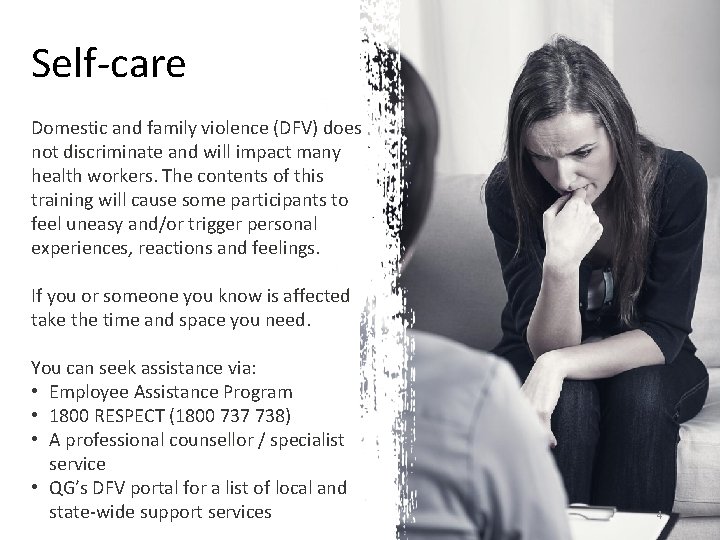
Self-care Domestic and family violence (DFV) does not discriminate and will impact many health workers. The contents of this training will cause some participants to feel uneasy and/or trigger personal experiences, reactions and feelings. If you or someone you know is affected take the time and space you need. You can seek assistance via: • Employee Assistance Program • 1800 RESPECT (1800 737 738) • A professional counsellor / specialist service • QG’s DFV portal for a list of local and state-wide support services 4
Supporting an employee experiencing DFV Everyone deserves to be safe and supported in the workplace

Reflective practice Responding appropriately and effectively in diverse contexts often means addressing one’s own attitudes, knowledge and actions as a learning process.
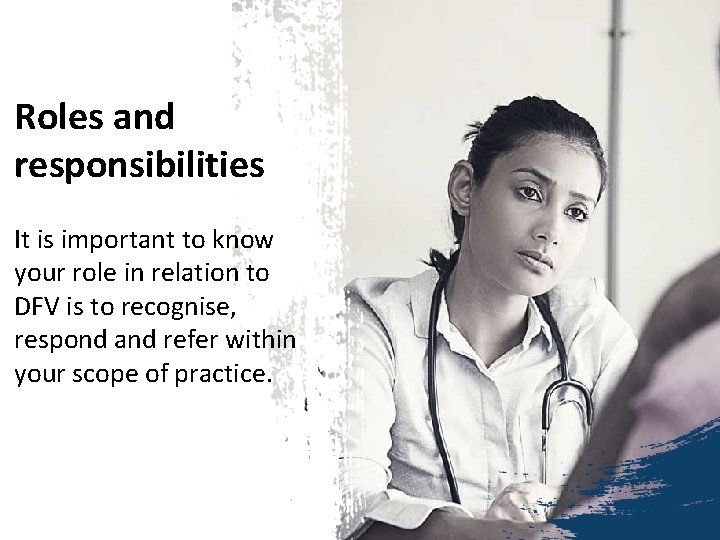
Roles and responsibilities It is important to know your role in relation to DFV is to recognise, respond and refer within your scope of practice.

Group Activity 2 Several definitions of DFV exist. Develop your own definition of DFV. 8
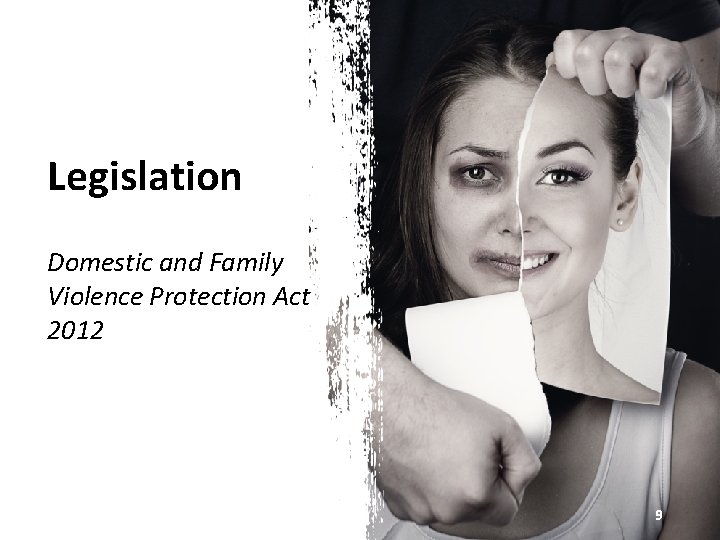
Legislation Domestic and Family Violence Protection Act 2012 9
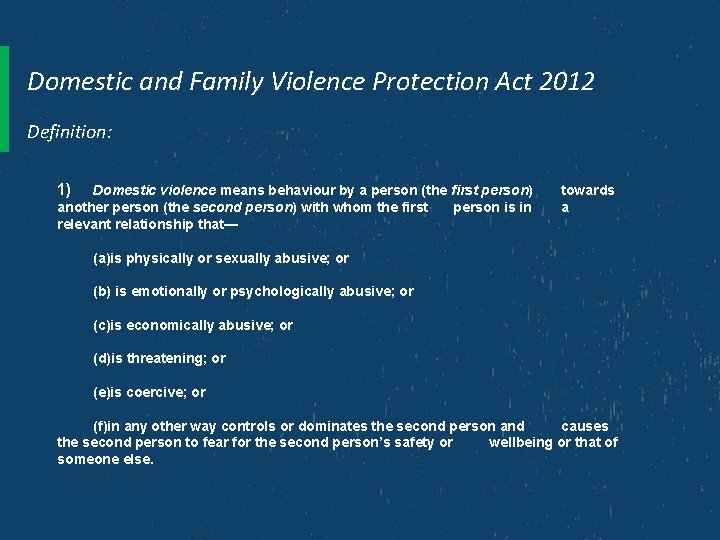
Domestic and Family Violence Protection Act 2012 Definition: 1) Domestic violence means behaviour by a person (the first person) another person (the second person) with whom the first person is in relevant relationship that— towards a (a)is physically or sexually abusive; or (b) is emotionally or psychologically abusive; or (c)is economically abusive; or (d)is threatening; or (e)is coercive; or (f)in any other way controls or dominates the second person and causes the second person to fear for the second person’s safety or wellbeing or that of someone else.
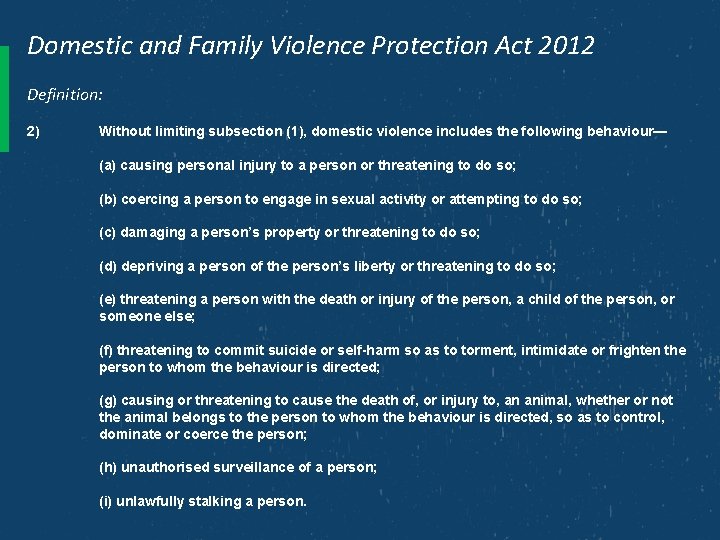
Domestic and Family Violence Protection Act 2012 Definition: 2) Without limiting subsection (1), domestic violence includes the following behaviour— (a) causing personal injury to a person or threatening to do so; (b) coercing a person to engage in sexual activity or attempting to do so; (c) damaging a person’s property or threatening to do so; (d) depriving a person of the person’s liberty or threatening to do so; (e) threatening a person with the death or injury of the person, a child of the person, or someone else; (f) threatening to commit suicide or self-harm so as to torment, intimidate or frighten the person to whom the behaviour is directed; (g) causing or threatening to cause the death of, or injury to, an animal, whether or not the animal belongs to the person to whom the behaviour is directed, so as to control, dominate or coerce the person; (h) unauthorised surveillance of a person; (i) unlawfully stalking a person.
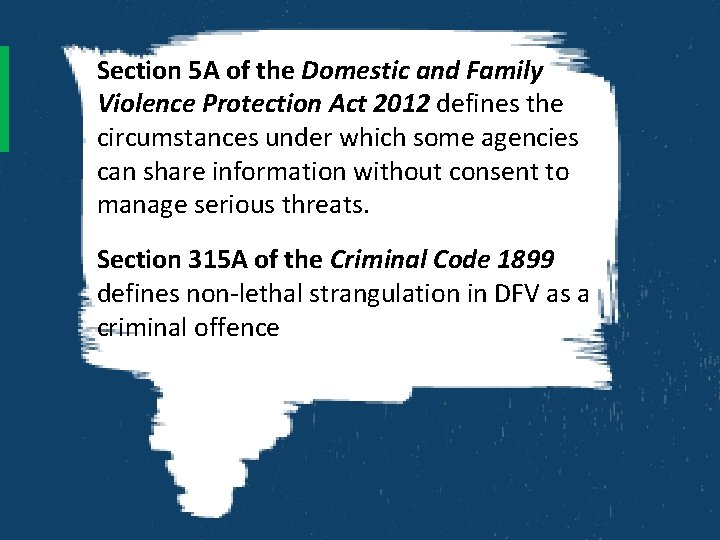
Section 5 A of the Domestic and Family Violence Protection Act 2012 defines the circumstances under which some agencies can share information without consent to manage serious threats. Section 315 A of the Criminal Code 1899 defines non-lethal strangulation in DFV as a criminal offence

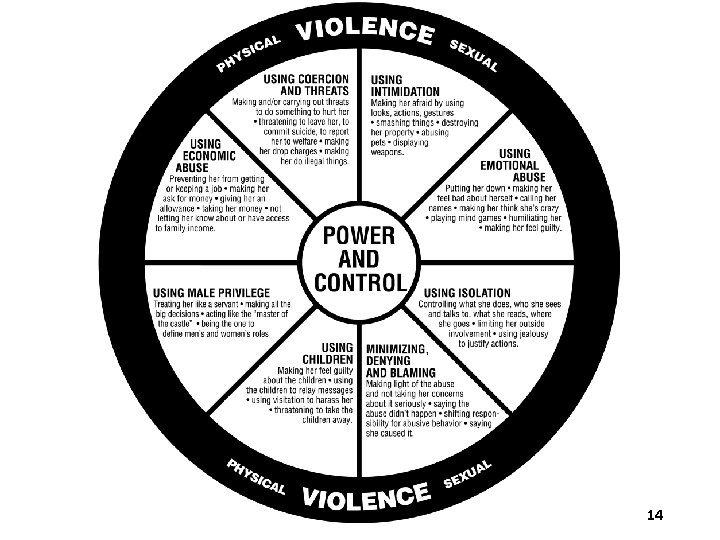
Duluth Model The Duluth model underpins our knowledge of perpetrator behaviours.
14
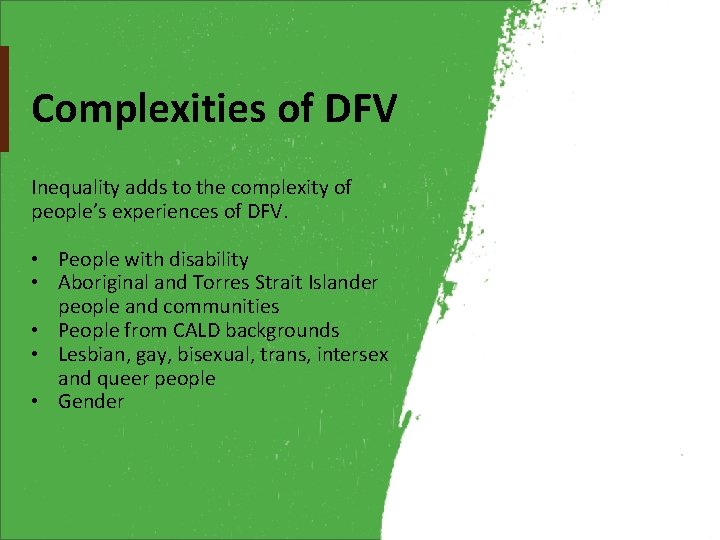
Complexities of DFV Inequality adds to the complexity of people’s experiences of DFV. • People with disability • Aboriginal and Torres Strait Islander people and communities • People from CALD backgrounds • Lesbian, gay, bisexual, trans, intersex and queer people • Gender
Group Activity 3 Identify how inequality impacts people’s vulnerability to and experience of violence, and their access to supports. 16
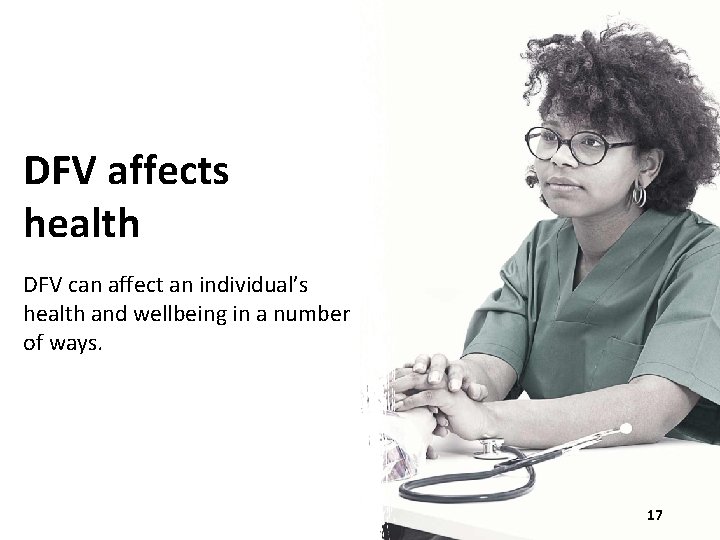
DFV affects health DFV can affect an individual’s health and wellbeing in a number of ways. 17
Group Activity 4 Identify what some of the health impacts of DFV might be. 18
NON-LETHAL STRANGULATION in DFV Non-lethal strangulation in DFV: is a stand-alone criminal offence in Queensland Is a significant indicator of a dangerous escalation in violence Is a risk factor for domestic homicide Has cumulative health impacts May cause serious injuries to the structures in the neck that are not visible to the eye, and for which there may be delayed and/or generalised symptoms 19
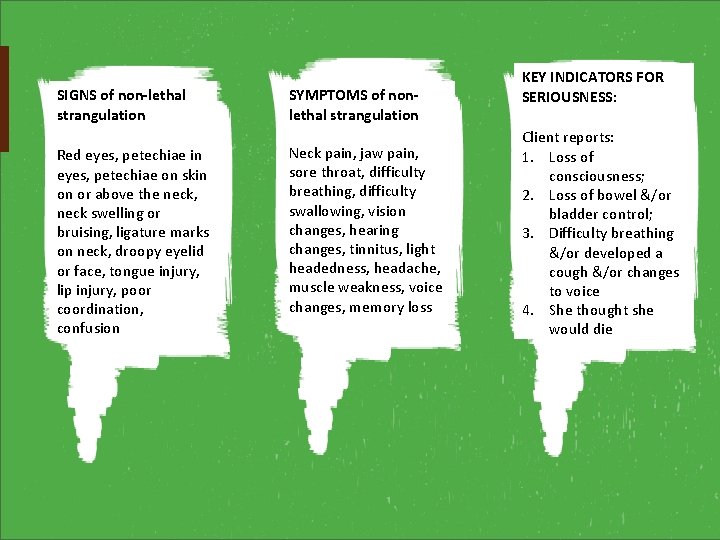
SIGNS of non-lethal strangulation Red eyes, petechiae in eyes, petechiae on skin on or above the neck, neck swelling or bruising, ligature marks on neck, droopy eyelid or face, tongue injury, lip injury, poor coordination, confusion SYMPTOMS of nonlethal strangulation Neck pain, jaw pain, sore throat, difficulty breathing, difficulty swallowing, vision changes, hearing changes, tinnitus, light headedness, headache, muscle weakness, voice changes, memory loss KEY INDICATORS FOR SERIOUSNESS: Client reports: 1. Loss of consciousness; 2. Loss of bowel &/or bladder control; 3. Difficulty breathing &/or developed a cough &/or changes to voice 4. She thought she would die
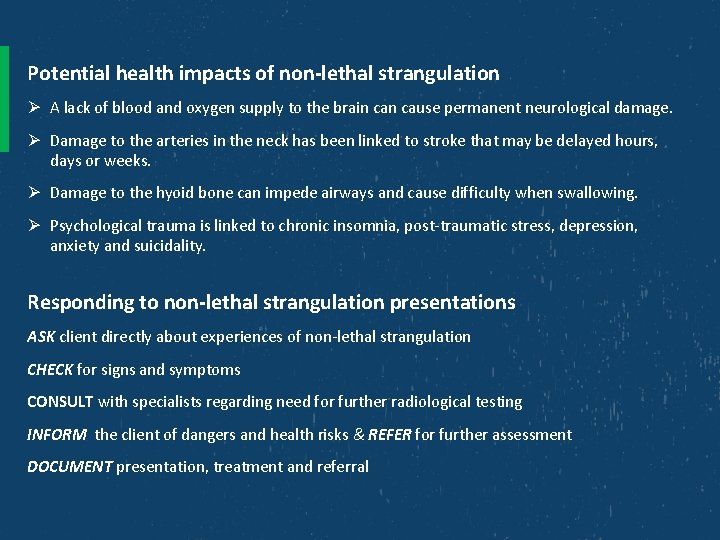
Potential health impacts of non-lethal strangulation Ø A lack of blood and oxygen supply to the brain cause permanent neurological damage. Ø Damage to the arteries in the neck has been linked to stroke that may be delayed hours, days or weeks. Ø Damage to the hyoid bone can impede airways and cause difficulty when swallowing. Ø Psychological trauma is linked to chronic insomnia, post-traumatic stress, depression, anxiety and suicidality. Responding to non-lethal strangulation presentations ASK client directly about experiences of non-lethal strangulation CHECK for signs and symptoms CONSULT with specialists regarding need for further radiological testing INFORM the client of dangers and health risks & REFER for further assessment DOCUMENT presentation, treatment and referral
“Why does she stay in the relationship? ” There are many valid reasons why women do not leave violent relationships. Women experiencing DFV require understanding and continuing support from clinicians without pressure for a specific course of action. NEVER ASK “Why don’t you just leave? ”
Group Activity 5 Discuss and list how inequality and complexity can impact on women’s capacity to leave abusive relationships. 23
Understanding power, vulnerability and DFV People who have less power are more likely to experience DFV. Understanding the interplay of power, vulnerability and violence is key to understanding how and why DFV is able to continue in our homes and communities. Consider how power and vulnerability impact on the experiences of the person/people in the video
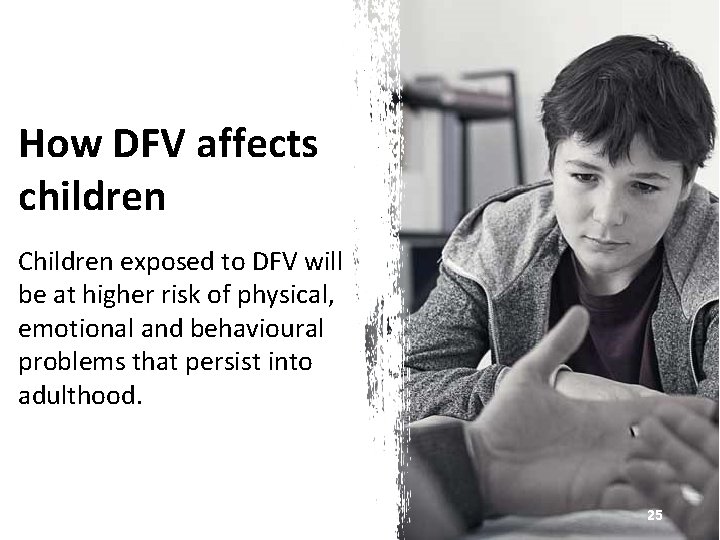
How DFV affects children Children exposed to DFV will be at higher risk of physical, emotional and behavioural problems that persist into adulthood. 25
High risk population groups Some people face barriers to accessing information, services, supports and legal protections. These barriers put them at a greater risk of experiencing domestic and family violence. They may need additional support or a different approach. DO NOT use partners, other family members, children or carers as interpreters
Perpetrator risk factors and clinical response Perpetrators of DFV come from all socio-economic, cultural and social groups. 27
Principles of sensitive practice Sensitive practice is an approach to engaging with clients in a way that increases their feelings of safety, respect and control.
Group Activity 7 How would you feel about sharing personal matters? What do you consider to be possible barriers to disclosure? 29
Six steps to sensitive inquiry
Step 1 – Identification DFV can be identified through: • client disclosure • recognising indicators • recognising risk factors • outine screening

Group Activity 8 Identify risk factors and indicators of DFV. 32

Step 2 – Supportive response An initial supportive response will assist in building rapport between the health professional and the client. Provide a supportive environment for victims to share information.
Group Activity 9 Role play how you would sensitively inquire about DFV. 34
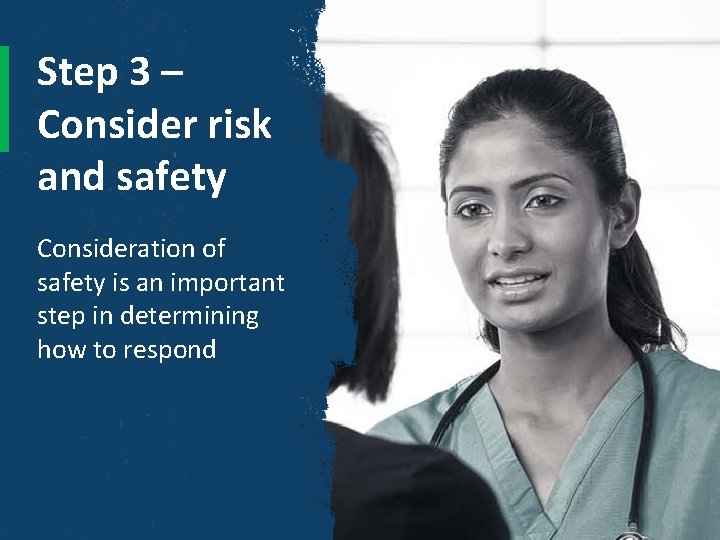
Step 3 – Consider risk and safety Consideration of safety is an important step in determining how to respond
Group Activity 10 Scenario based activity 36
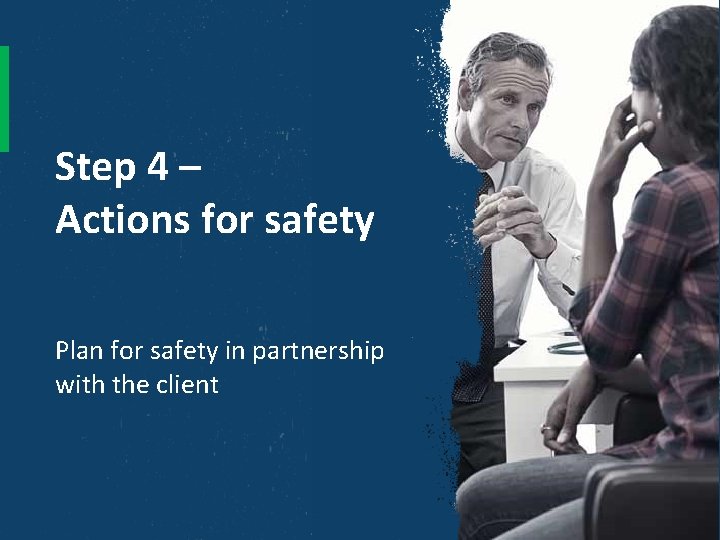
Step 4 – Actions for safety Plan for safety in partnership with the client
Group Activity 11 Develop an emergency plan and role play activity 38
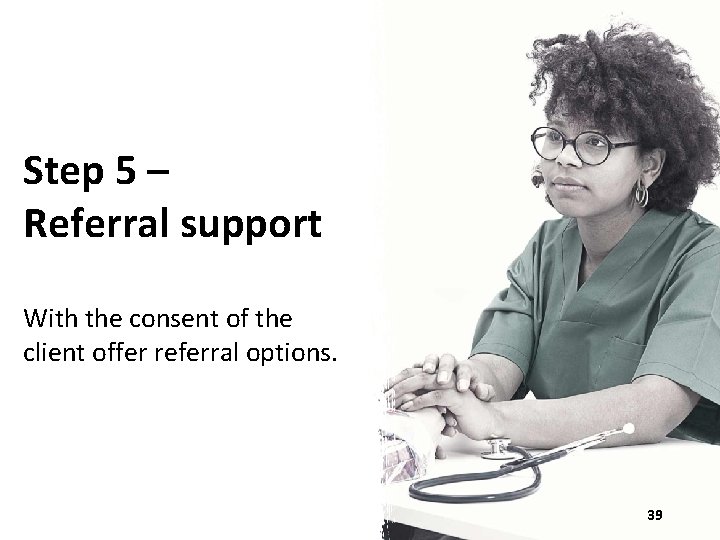
Step 5 – Referral support With the consent of the client offer referral options. 39
Step 6 – Documentation/ reporting Documentation of relevant information especially about physical injuries is important for ongoing care and for legal purposes. 40
Group Activity 12 How would you document a disclosure in the clients clinical record? 41

Conclusion Next steps
- Slides: 42