
CLINICAL REPERTORIES DR SUMAN SANKAR A S M

- Slides: 17
CLINICAL REPERTORIES DR. SUMAN SANKAR. A. S, M. D. (Hom) Professor, Department of Repertory Sarada Krishna Homoeopathic Medical College Kulasekharam
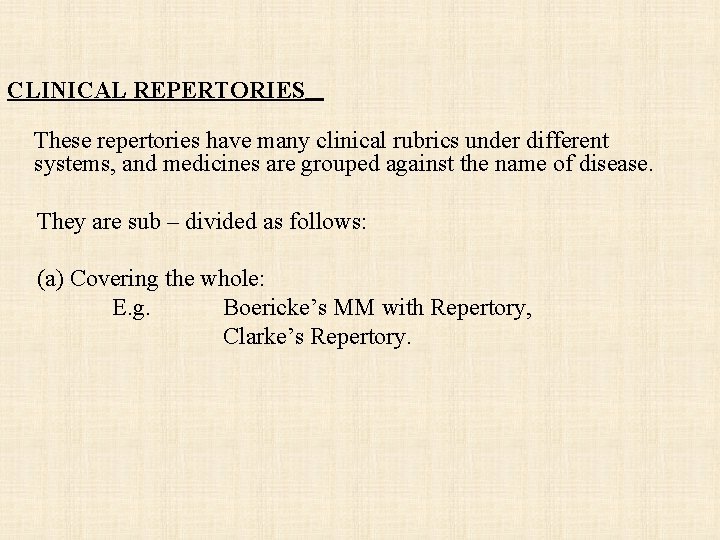
CLINICAL REPERTORIES These repertories have many clinical rubrics under different systems, and medicines are grouped against the name of disease. They are sub – divided as follows: (a) Covering the whole: E. g. Boericke’s MM with Repertory, Clarke’s Repertory.
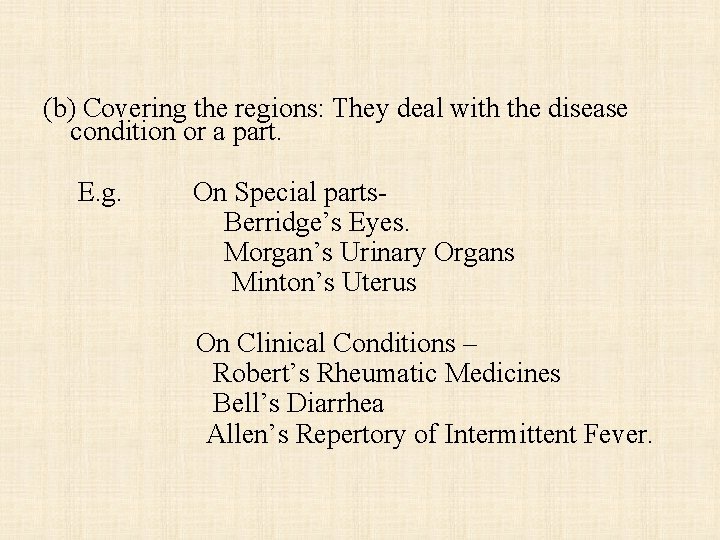
(b) Covering the regions: They deal with the disease condition or a part. E. g. On Special parts. Berridge’s Eyes. Morgan’s Urinary Organs Minton’s Uterus On Clinical Conditions – Robert’s Rheumatic Medicines Bell’s Diarrhea Allen’s Repertory of Intermittent Fever.
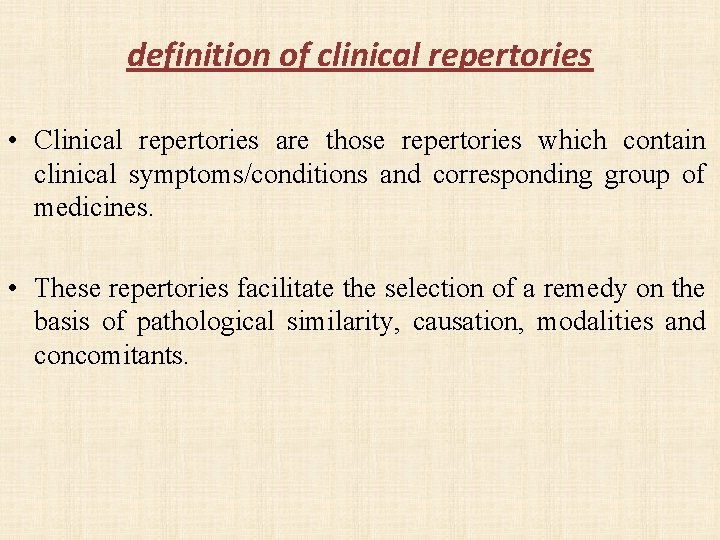
definition of clinical repertories • Clinical repertories are those repertories which contain clinical symptoms/conditions and corresponding group of medicines. • These repertories facilitate the selection of a remedy on the basis of pathological similarity, causation, modalities and concomitants.
• They are not commonly used for the purpose of repertorization. However, these repertories can be used for repertorization of cases where clinical conditions mask the characteristics of the patient. • In such cases the physician finds the prominent common symptoms with a few modalities and concomitants. These cases need the help of clinical repertories for selecting the simillimum
origin of concept of clinical repertories • In spite of emphasis on individualization and prescription based on characteristic expressions, the emergence of clinical repertories could not be prevented in homoeopathic practice as early as Hahnemann’s time. • The grouping of the medicines according to the name of diseases, though discouraged by many stalwarts has given birth to clinical repertories.
• The greatest modern exponent of this practice is the late Dr J. Crompton Burnett, who has brought once more to light the vast therapeutic treasures which had been allowed to lie forgotten in the works of the great masters. • The use of nosological correspondence is one method bymeans of which a similar, if not the most similar, remedy may be discovered.
• All ways of finding indications are open to practitioners and the clinical avenue is one of them. • J. H. Clarke has described it like this, “Certain diseases come to have certain remedies assigned to them and all the patients who are found to be suffering from any given disease must be dosed with one of the remedies credited to it. ” • Master Hahnemann was certainly not happy with such kind of practice; he described it as, “Treating the names of the diseases with names of therapeutic actions”.
• Such a kind of practice was much favoured by Dr J. Crompton Burnett. • He expresses it as, “The fact is we need any and every way of finding the right remedy; the simple simile, the simple symptomatic similimum and the farthest reach of all – the pathologica similimum, and I maintain that we are still within the lines of Homoeopathy that is an expansive, progressive, science. ”
• As early as in 1869 Bell’s diarrhea and in 1873 Berridge’s Eye, two very useful clinical regional repertories were published. • Though the concept of such practice was conceived by Burnett he could not compile separate repertory for that purpose and hence the credit for authoring the first useful Clinical Repertory goes to J. H. Clarke.
• Though many Clinical Repertoires are available these days, tow of them are well known as General Clinical Repertory. They are – A Clinical Repertory by J. H. Clarke and Materia Medica with Repertory by O. E. Boericke. • There are many useful Regional Clinical Repertories which help the practitioners to find a similar remedy.
scope and limitation Though clinical repertories have not been put to their fullest utility, these can be very useful too if the scope and limitations are properly understood and implemented in practice.
scope • Clinical repertories can be used in the study of homoeopathic therapeutics as well as materia medica. • They help to repertorize the following types of cases: – Cases lacking in mental generals and physical generals but rich in common symptoms. – Cases with clinical diagnosis. – Short cases with a few symptoms.
• They are used as quick reference books at the bedside. • Clinical repertories contain some rubrics, which are not found in other general repertories; therefore they can become a good companion in the study of such rubrics.
• Clinical repertories help us to find the most appropriate palliative medicine in incurable cases. • Regional repertories help in finding out the simillimum in a specific clinical condition.
limitation • Clinical repertories are based on nosological terms and clinical symptoms, which are the result of clinical observations hence their use is limited to particular type of cases. They are mainly used for reference work.
THANK YOU