
Clinical reasoning tests Mitra Amini MD MPH Professor



- Slides: 23
Clinical reasoning tests Mitra Amini MD MPH Professor of SUMS
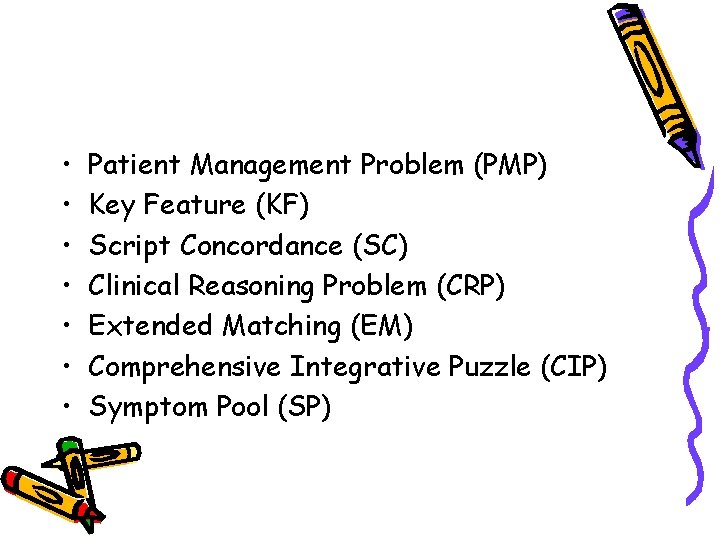
• • Patient Management Problem (PMP) Key Feature (KF) Script Concordance (SC) Clinical Reasoning Problem (CRP) Extended Matching (EM) Comprehensive Integrative Puzzle (CIP) Symptom Pool (SP)
Script Concordance tests
Script Concordance • According to script theory, clinicians mobilize networks of organized knowledge, called "scripts", to process information and progress toward solutions to clinical problems.
• For example an ear, nose and throat specialist working with an outpatient suffering from vertigo is focusing on his or her knowledge of vertigoinducing illnesses. As soon as a new patient comes into the room, complaining of a cervical mass for instance, the vertigo knowledge is "washed out" and networks of knowledge related to cervical masses are called to mind with direct questions to ask, physical exams to do or investigation/treatment options to decide on.
• These knowledge networks are acquired during clinical training and refined with each clinical encounter. They are specifically adapted to the tasks clinicians commonly perform.
• Health professionals progress toward solutions to clinical problems with hypotheses (or management options) and their related knowledge networks (scripts) in mind. They actively use them to constantly make judgments on the effect that each new piece of information has on the status of the hypothesis or option
• Script concordance testing (SCT) is based on the principle that the multiple judgments made in these clinical reasoning processes can be probed and their concordance with those of a panel of reference experts can be measured. This provides a tool for assessing clinical reasoning
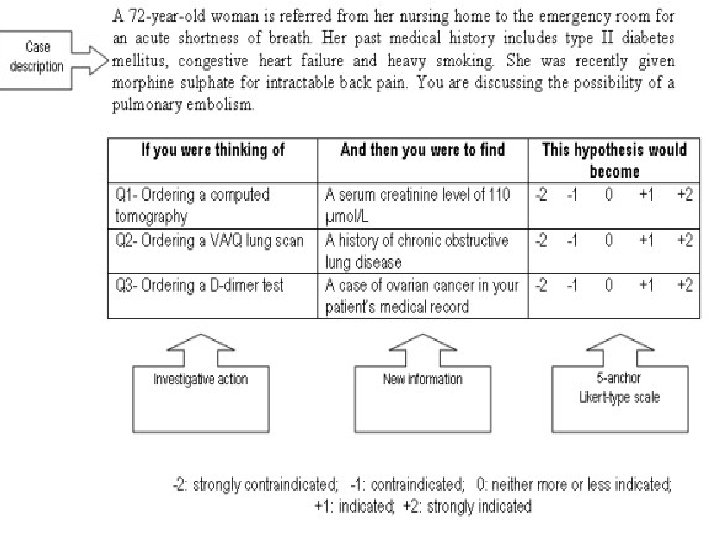
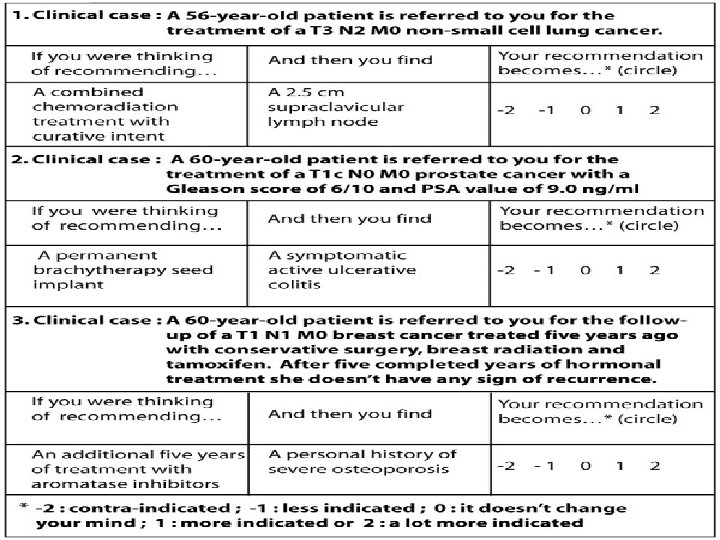
• Scenarios are followed by a series of questions, presented in three parts. • The first part ("if you were thinking of") contains a relevant diagnostic or management option. • The second part ("and then you were to find") presents a new clinical finding, such as a physical sign, a pre-existing condition, an imaging study or a laboratory test result.
• The third part ("this option would become") is a five-point Likert scale that captures examinees' decisions. • The task for examinees is to decide what effect the new finding has on the status of the option, in direction (positive, negative or neutral) and intensity. This effect is captured with a Likert scale because script theory assumes that clinical reasoning is composed of a series of qualitative judgments