
Clinical Pressure Pain Threshold Testing in Neck Pain

- Slides: 7
Clinical Pressure Pain Threshold Testing in Neck Pain: Comparing Protocols, Responsiveness, and Association With Psychological Variables by David M. Walton, Lenerdene Levesque, Martin Payne, and Julie Schick ptjournal Volume 94(6): 827 -837 May 31, 2014 © 2014 American Physical Therapy Association
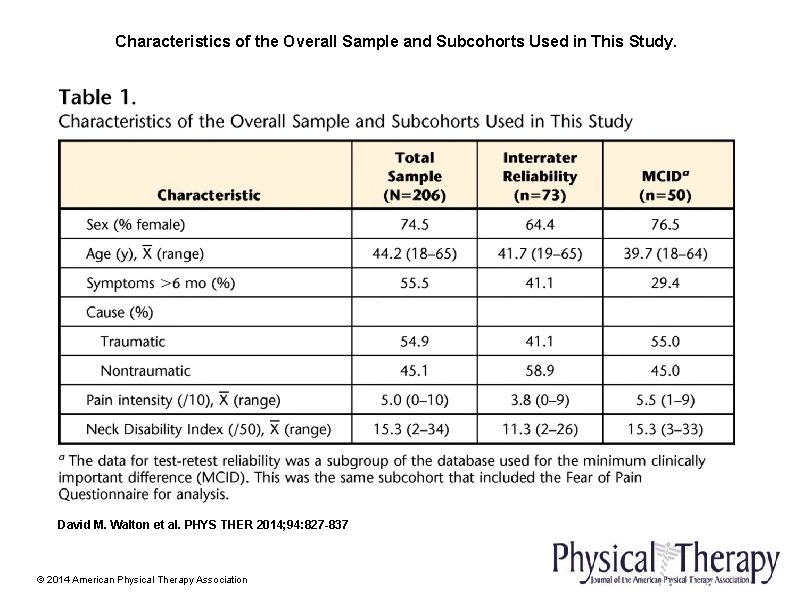
Characteristics of the Overall Sample and Subcohorts Used in This Study. David M. Walton et al. PHYS THER 2014; 94: 827 -837 © 2014 American Physical Therapy Association
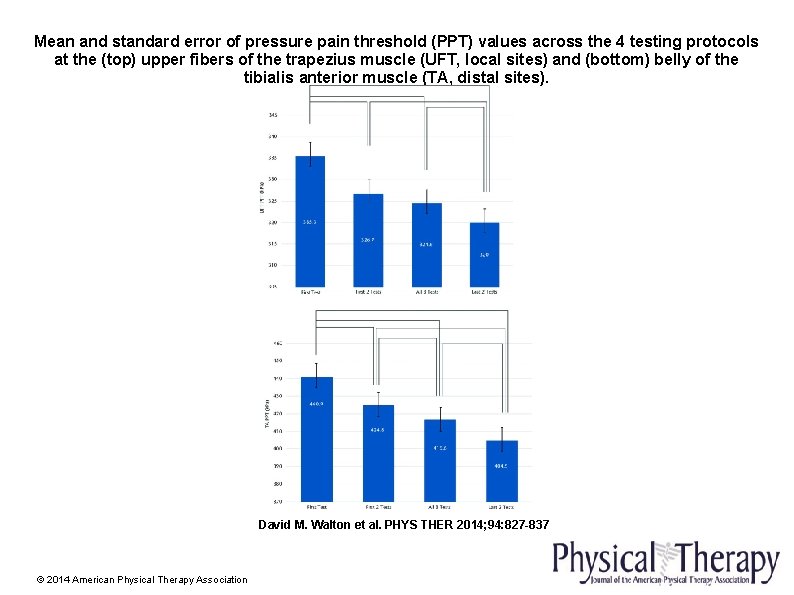
Mean and standard error of pressure pain threshold (PPT) values across the 4 testing protocols at the (top) upper fibers of the trapezius muscle (UFT, local sites) and (bottom) belly of the tibialis anterior muscle (TA, distal sites). David M. Walton et al. PHYS THER 2014; 94: 827 -837 © 2014 American Physical Therapy Association
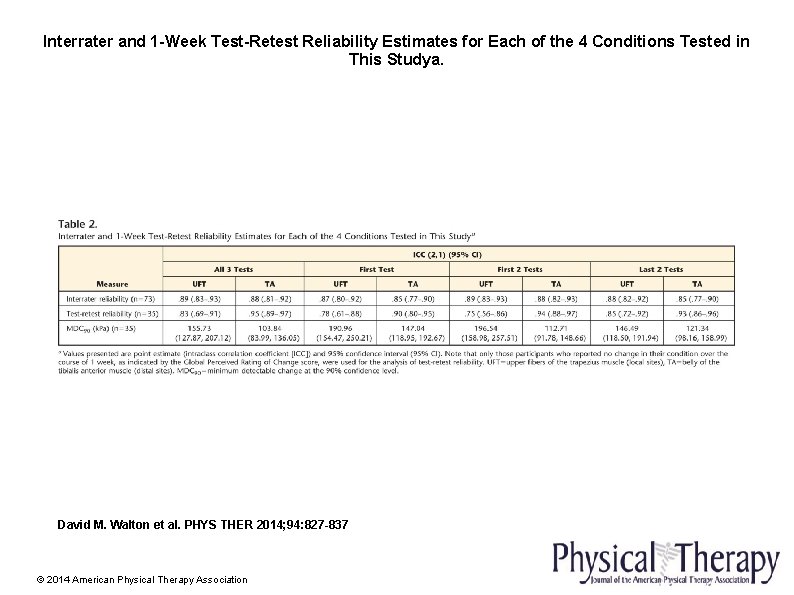
Interrater and 1 -Week Test-Retest Reliability Estimates for Each of the 4 Conditions Tested in This Studya. David M. Walton et al. PHYS THER 2014; 94: 827 -837 © 2014 American Physical Therapy Association
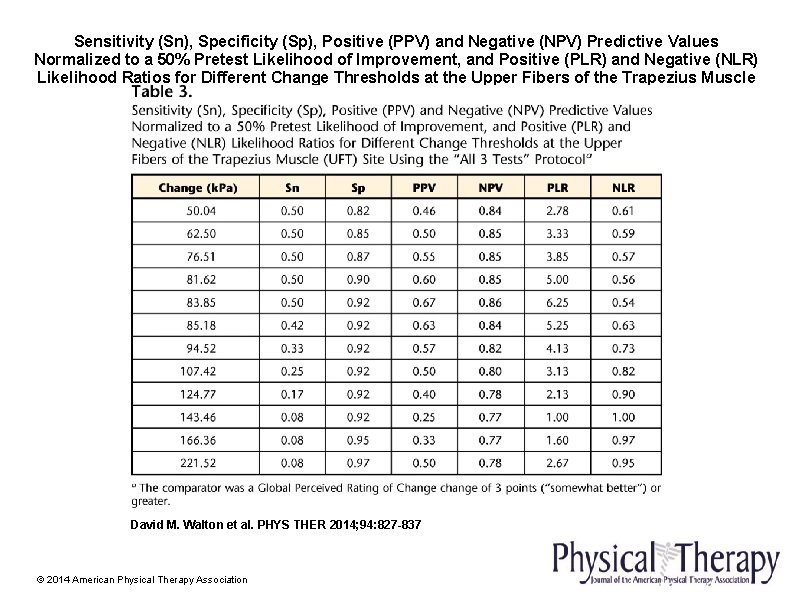
Sensitivity (Sn), Specificity (Sp), Positive (PPV) and Negative (NPV) Predictive Values Normalized to a 50% Pretest Likelihood of Improvement, and Positive (PLR) and Negative (NLR) Likelihood Ratios for Different Change Thresholds at the Upper Fibers of the Trapezius Muscle (UFT) Site Using the “All 3 Tests” Protocola. David M. Walton et al. PHYS THER 2014; 94: 827 -837 © 2014 American Physical Therapy Association
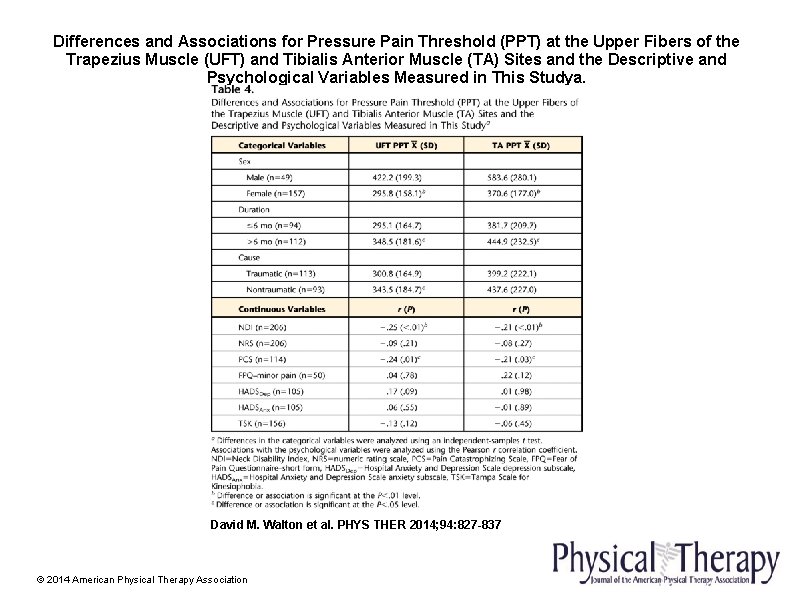
Differences and Associations for Pressure Pain Threshold (PPT) at the Upper Fibers of the Trapezius Muscle (UFT) and Tibialis Anterior Muscle (TA) Sites and the Descriptive and Psychological Variables Measured in This Studya. David M. Walton et al. PHYS THER 2014; 94: 827 -837 © 2014 American Physical Therapy Association
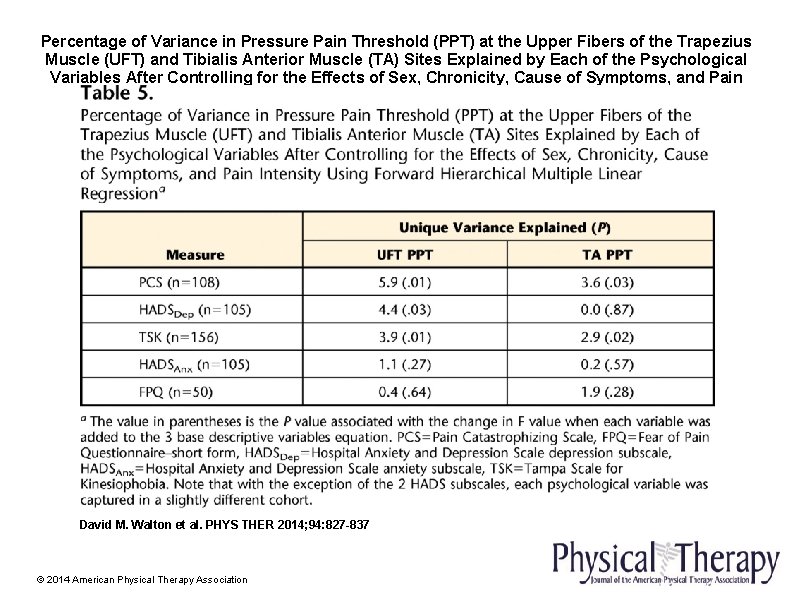
Percentage of Variance in Pressure Pain Threshold (PPT) at the Upper Fibers of the Trapezius Muscle (UFT) and Tibialis Anterior Muscle (TA) Sites Explained by Each of the Psychological Variables After Controlling for the Effects of Sex, Chronicity, Cause of Symptoms, and Pain Intensity Using Forward Hierarchical Multiple Linear Regressiona. David M. Walton et al. PHYS THER 2014; 94: 827 -837 © 2014 American Physical Therapy Association