
Clinical Pharmacy Students Physical Chemistry Chemical Equilibrium List
Clinical Pharmacy Students (Physical Chemistry) Chemical Equilibrium
List of content 1. Introduction 2. The law of mass action Relationships between chemical equations and the expressions of equilibrium constants Expression and Values of Equilibrium Constant Using Partial Pressures 3. predicting the direction of net reaction [The Reaction Quotient (Q)] 4. Le Châtelier’s Principle.
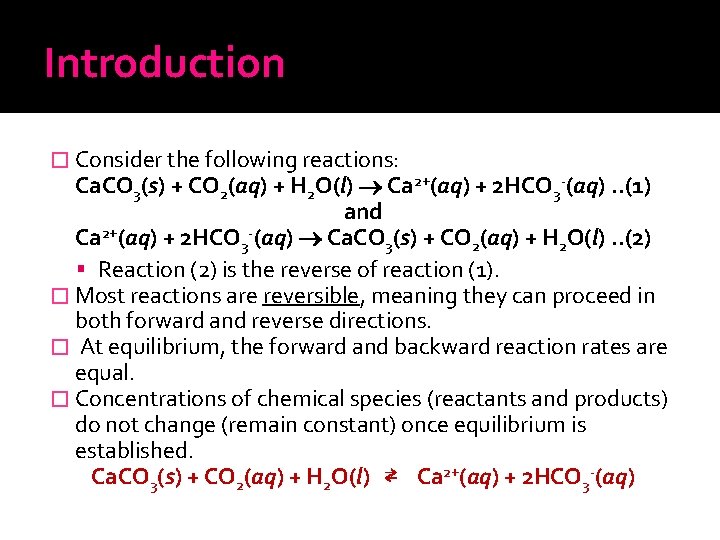
Introduction � Consider the following reactions: Ca. CO 3(s) + CO 2(aq) + H 2 O(l) Ca 2+(aq) + 2 HCO 3 -(aq). . (1) and Ca 2+(aq) + 2 HCO 3 -(aq) Ca. CO 3(s) + CO 2(aq) + H 2 O(l). . (2) Reaction (2) is the reverse of reaction (1). � Most reactions are reversible, meaning they can proceed in both forward and reverse directions. � At equilibrium, the forward and backward reaction rates are equal. � Concentrations of chemical species (reactants and products) do not change (remain constant) once equilibrium is established. Ca. CO 3(s) + CO 2(aq) + H 2 O(l) ⇄ Ca 2+(aq) + 2 HCO 3 -(aq)
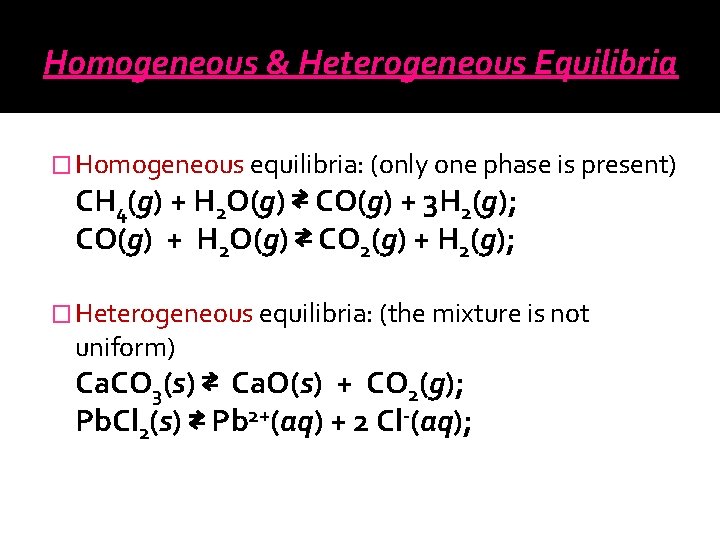
Homogeneous & Heterogeneous Equilibria � Homogeneous equilibria: (only one phase is present) CH 4(g) + H 2 O(g) ⇄ CO(g) + 3 H 2(g); CO(g) + H 2 O(g) ⇄ CO 2(g) + H 2(g); � Heterogeneous equilibria: (the mixture is not uniform) Ca. CO 3(s) ⇄ Ca. O(s) + CO 2(g); Pb. Cl 2(s) ⇄ Pb 2+(aq) + 2 Cl-(aq);
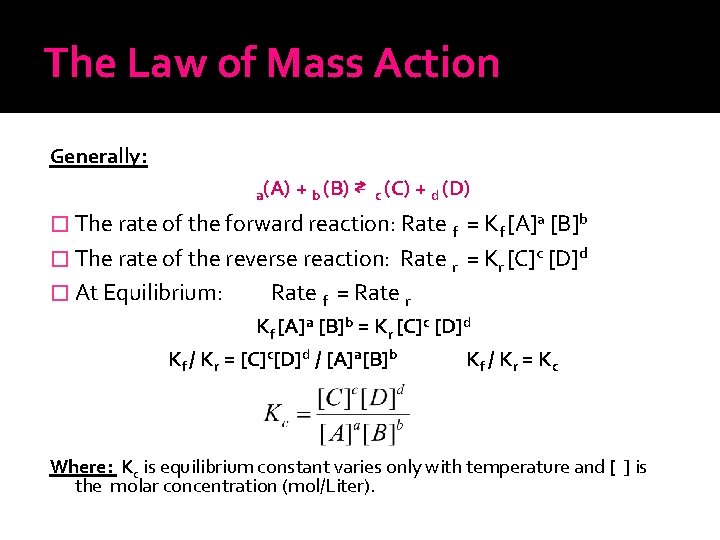
The Law of Mass Action Generally: a(A) + b (B) ⇄ c (C) + d (D) � The rate of the forward reaction: Rate f = Kf [A]a [B]b � The rate of the reverse reaction: Rate r = Kr [C]c [D]d � At Equilibrium: Rate f = Rate r Kf [A]a [B]b = Kr [C]c [D]d Kf / Kr = [C]c[D]d / [A]a[B]b Kf / Kr = Kc Where: Kc is equilibrium constant varies only with temperature and [ ] is the molar concentration (mol/Liter).
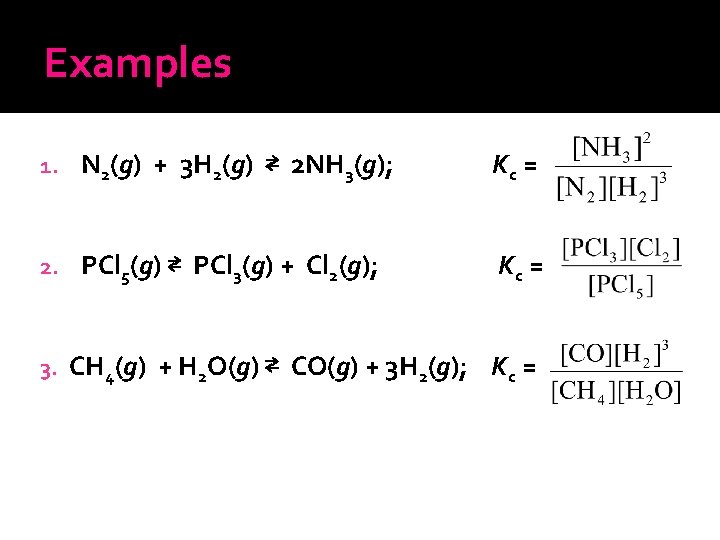
Examples 1. N 2(g) + 3 H 2(g) ⇄ 2 NH 3(g); Kc = 2. PCl 5(g) ⇄ PCl 3(g) + Cl 2(g); Kc = 3. CH 4(g) + H 2 O(g) ⇄ CO(g) + 3 H 2(g); Kc =
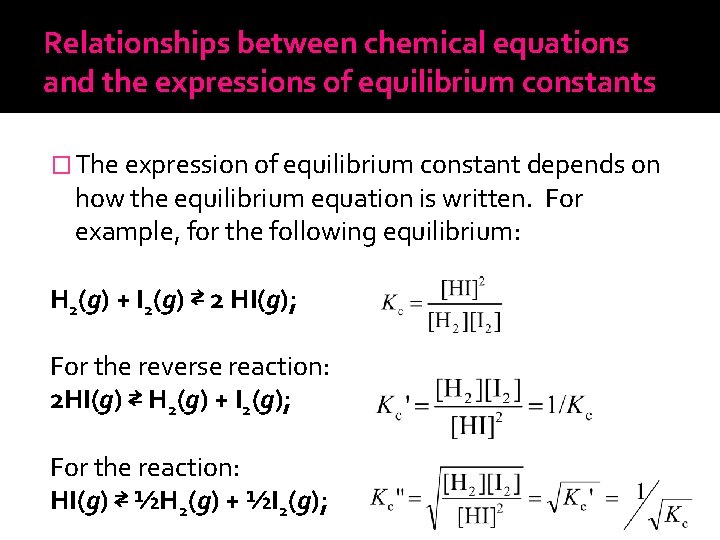
Relationships between chemical equations and the expressions of equilibrium constants � The expression of equilibrium constant depends on how the equilibrium equation is written. For example, for the following equilibrium: H 2(g) + I 2(g) ⇄ 2 HI(g); For the reverse reaction: 2 HI(g) ⇄ H 2(g) + I 2(g); For the reaction: HI(g) ⇄ ½H 2(g) + ½I 2(g);
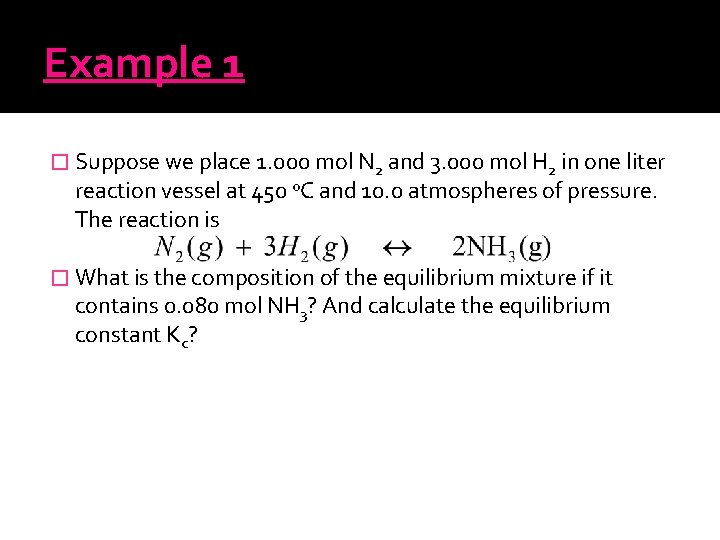
Example 1 � Suppose we place 1. 000 mol N 2 and 3. 000 mol H 2 in one liter reaction vessel at 450 o. C and 10. 0 atmospheres of pressure. The reaction is � What is the composition of the equilibrium mixture if it contains 0. 080 mol NH 3? And calculate the equilibrium constant Kc?
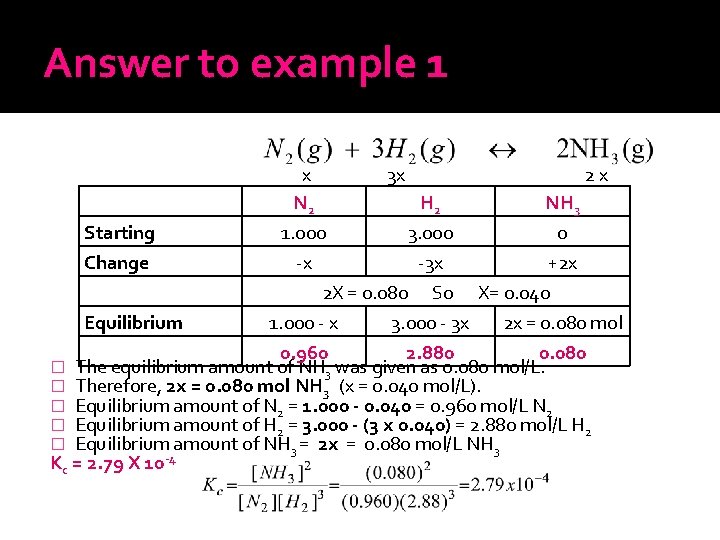
Answer to example 1 x 3 x N 2 H 2 Starting 1. 000 3. 000 Change -x -3 x 2 x NH 3 0 +2 x 2 X = 0. 080 So X= 0. 040 Equilibrium 1. 000 - x 3. 000 - 3 x 2 x = 0. 080 mol 0. 960 2. 880 0. 080 � The equilibrium amount of NH 3 was given as 0. 080 mol/L. � Therefore, 2 x = 0. 080 mol NH 3 (x = 0. 040 mol/L). � Equilibrium amount of N 2 = 1. 000 - 0. 040 = 0. 960 mol/L N 2 � Equilibrium amount of H 2 = 3. 000 - (3 x 0. 040) = 2. 880 mol/L H 2 � Equilibrium amount of NH 3 = 2 x = 0. 080 mol/L NH 3 Kc = 2. 79 X 10 -4
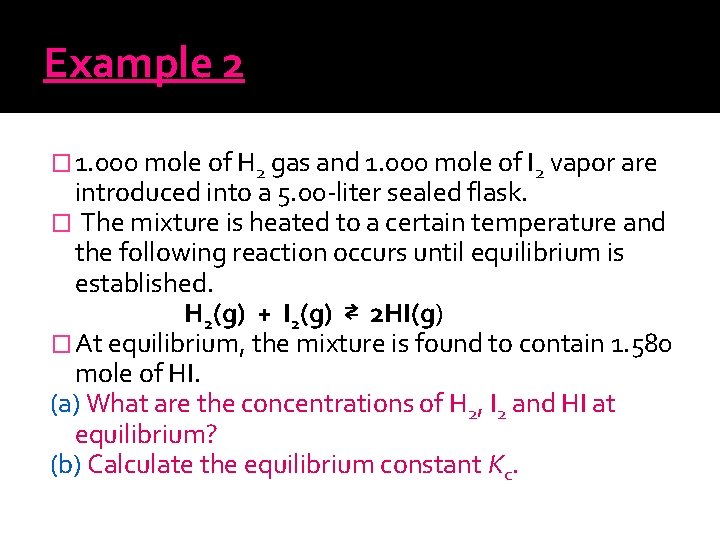
Example 2 � 1. 000 mole of H 2 gas and 1. 000 mole of I 2 vapor are introduced into a 5. 00 -liter sealed flask. � The mixture is heated to a certain temperature and the following reaction occurs until equilibrium is established. H 2(g) + I 2(g) ⇄ 2 HI(g) � At equilibrium, the mixture is found to contain 1. 580 mole of HI. (a) What are the concentrations of H 2, I 2 and HI at equilibrium? (b) Calculate the equilibrium constant Kc.
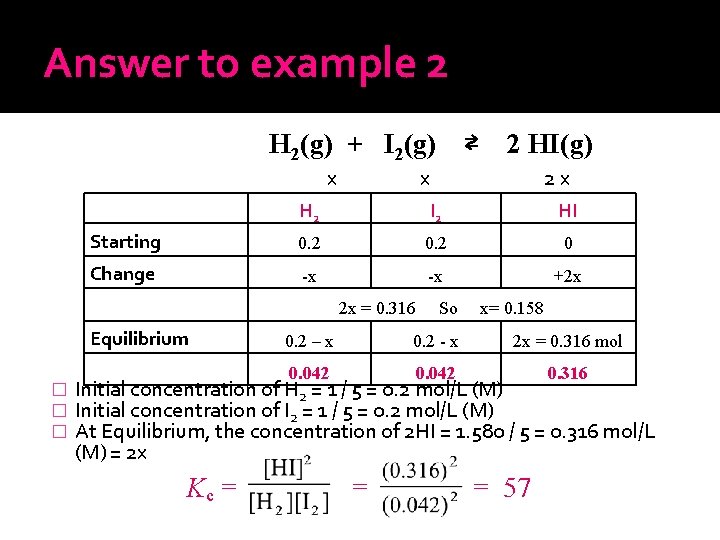
Answer to example 2 H 2(g) + I 2(g) ⇄ 2 HI(g) x H 2 I 2 HI Starting 0. 2 0 Change -x -x +2 x 2 x = 0. 316 Equilibrium � � � 2 x So x= 0. 158 0. 2 – x 0. 2 - x 2 x = 0. 316 mol 0. 042 0. 316 Initial concentration of H 2 = 1 / 5 = 0. 2 mol/L (M) Initial concentration of I 2 = 1 / 5 = 0. 2 mol/L (M) At Equilibrium, the concentration of 2 HI = 1. 580 / 5 = 0. 316 mol/L (M) = 2 x Kc = = = 57
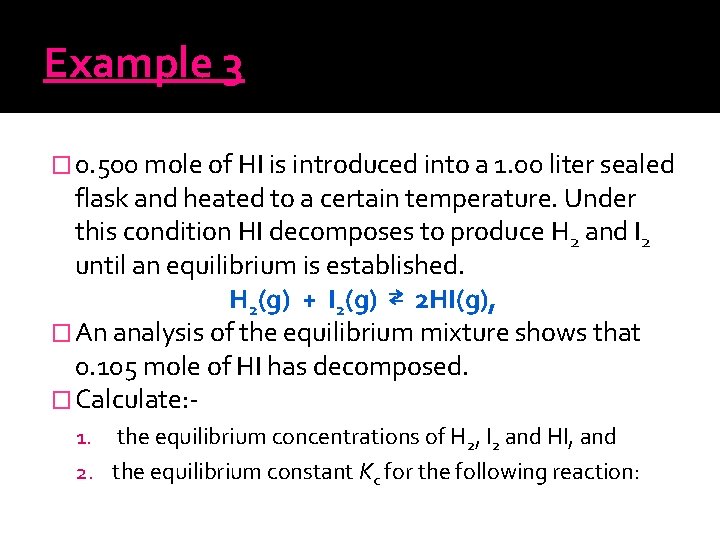
Example 3 � 0. 500 mole of HI is introduced into a 1. 00 liter sealed flask and heated to a certain temperature. Under this condition HI decomposes to produce H 2 and I 2 until an equilibrium is established. H 2(g) + I 2(g) ⇄ 2 HI(g), � An analysis of the equilibrium mixture shows that 0. 105 mole of HI has decomposed. � Calculate: 1. the equilibrium concentrations of H 2, I 2 and HI, and 2. the equilibrium constant Kc for the following reaction:
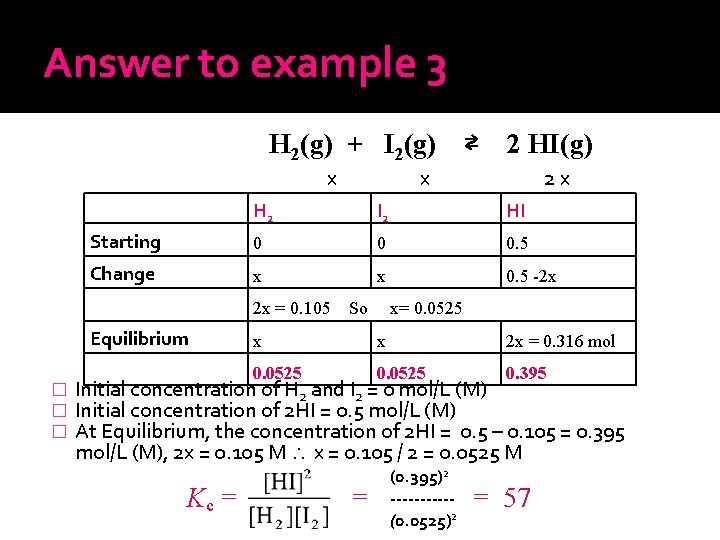
Answer to example 3 H 2(g) + I 2(g) ⇄ 2 HI(g) x H 2 I 2 HI Starting 0 0 0. 5 Change x x 0. 5 -2 x 2 x = 0. 105 So Equilibrium � � � 2 x x= 0. 0525 x x 2 x = 0. 316 mol 0. 0525 0. 395 Initial concentration of H 2 and I 2 = 0 mol/L (M) Initial concentration of 2 HI = 0. 5 mol/L (M) At Equilibrium, the concentration of 2 HI = 0. 5 – 0. 105 = 0. 395 mol/L (M), 2 x = 0. 105 M x = 0. 105 / 2 = 0. 0525 M Kc = = (0. 395)2 -----(0. 0525)2 = 57
Expression and Values of Equilibrium Constant Using Partial Pressures � For reactions involving gases, the partial pressure of the reactants and products are proportional to their molar concentrations. � The equilibrium constant expression for these reactions can therefore be written using partial pressures instead of concentration. � We will use the symbol, Kp, to donate equilibrium constants derived from partial pressure and Kc to indicate equilibrium constant derived from molar concentrations.
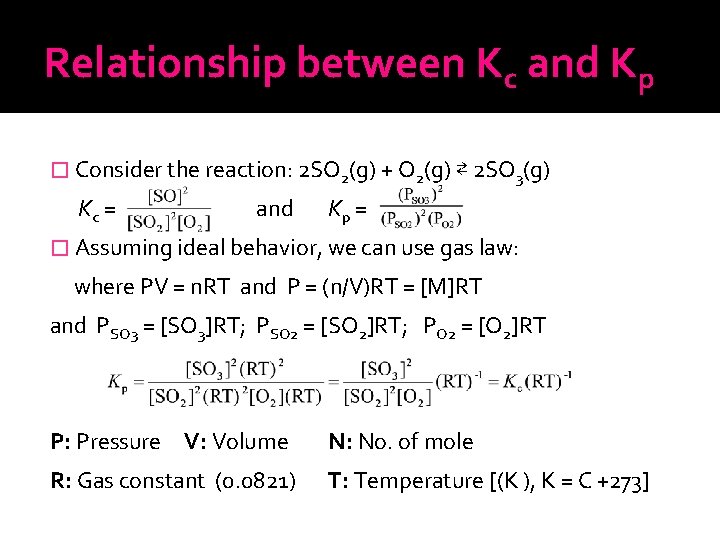
Relationship between Kc and Kp � Consider the reaction: 2 SO 2(g) + O 2(g) ⇄ 2 SO 3(g) Kc = and Kp = � Assuming ideal behavior, we can use gas law: where PV = n. RT and P = (n/V)RT = [M]RT and PSO 3 = [SO 3]RT; PSO 2 = [SO 2]RT; PO 2 = [O 2]RT P: Pressure V: Volume N: No. of mole R: Gas constant (0. 0821) T: Temperature [(K ), K = C +273]
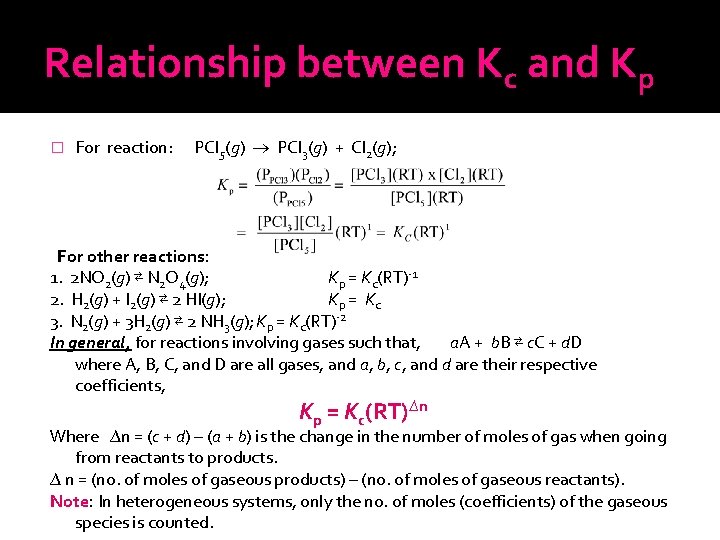
Relationship between Kc and Kp � For reaction: PCl 5(g) PCl 3(g) + Cl 2(g); For other reactions: 1. 2 NO 2(g) ⇄ N 2 O 4(g); Kp = Kc(RT)-1 2. H 2(g) + I 2(g) ⇄ 2 HI(g); Kp = Kc 3. N 2(g) + 3 H 2(g) ⇄ 2 NH 3(g); Kp = Kc(RT)-2 In general, for reactions involving gases such that, a. A + b. B ⇄ c. C + d. D where A, B, C, and D are all gases, and a, b, c, and d are their respective coefficients, Kp = Kc(RT)∆n Where ∆n = (c + d) – (a + b) is the change in the number of moles of gas when going from reactants to products. ∆ n = (no. of moles of gaseous products) – (no. of moles of gaseous reactants). Note: In heterogeneous systems, only the no. of moles (coefficients) of the gaseous species is counted.
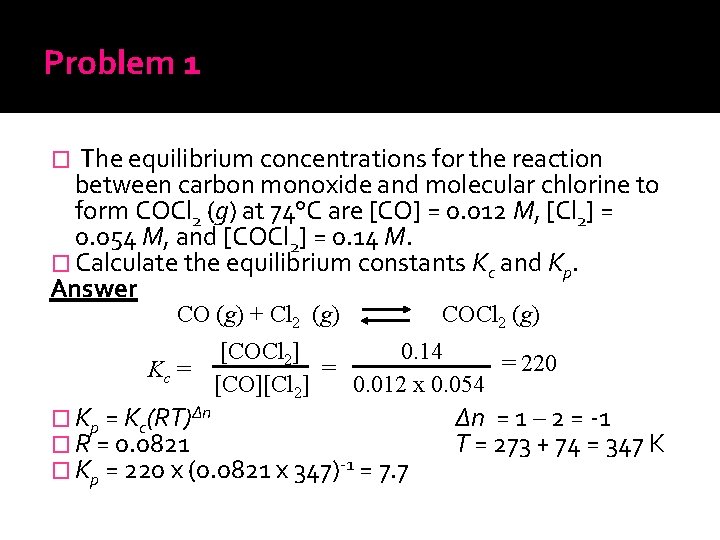
Problem 1 � The equilibrium concentrations for the reaction between carbon monoxide and molecular chlorine to form COCl 2 (g) at 74°C are [CO] = 0. 012 M, [Cl 2] = 0. 054 M, and [COCl 2] = 0. 14 M. � Calculate the equilibrium constants Kc and Kp. Answer CO (g) + Cl 2 (g) COCl 2 (g) 0. 14 [COCl 2] = 220 = Kc = 0. 012 x 0. 054 [CO][Cl 2] � Kp = Kc(RT)Δn Δn = 1 – 2 = -1 � R = 0. 0821 T = 273 + 74 = 347 K � Kp = 220 x (0. 0821 x 347)-1 = 7. 7
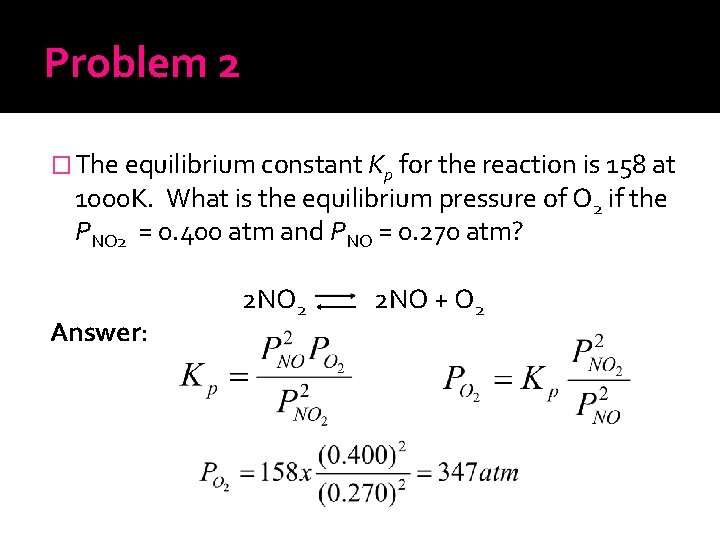
Problem 2 � The equilibrium constant Kp for the reaction is 158 at 1000 K. What is the equilibrium pressure of O 2 if the PNO 2 = 0. 400 atm and PNO = 0. 270 atm? Answer: 2 NO 2 2 NO + O 2
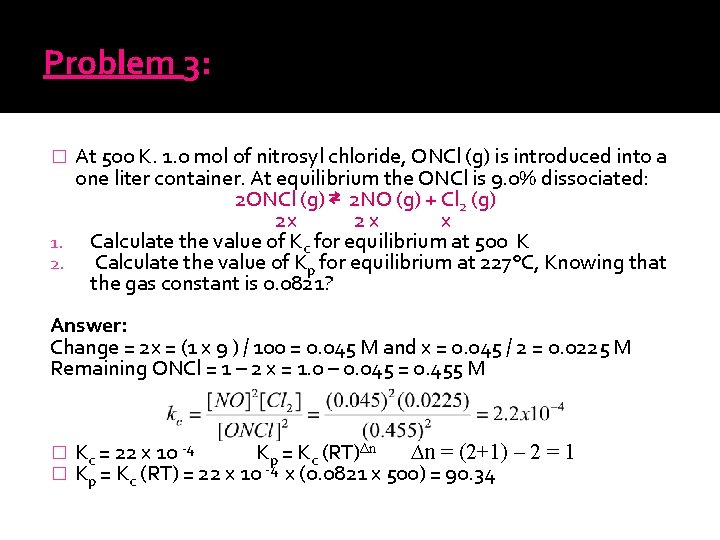
Problem 3: At 500 K. 1. 0 mol of nitrosyl chloride, ONCl (g) is introduced into a one liter container. At equilibrium the ONCl is 9. 0% dissociated: 2 ONCl (g) ⇄ 2 NO (g) + Cl 2 (g) 2 x 2 x x 1. Calculate the value of Kc for equilibrium at 500 K 2. Calculate the value of Kp for equilibrium at 227°C, Knowing that the gas constant is 0. 0821? � Answer: Change = 2 x = (1 x 9 ) / 100 = 0. 045 M and x = 0. 045 / 2 = 0. 0225 M Remaining ONCl = 1 – 2 x = 1. 0 – 0. 045 = 0. 455 M � � Kc = 22 x 10 -4 Kp = Kc (RT)∆n ∆n = (2+1) – 2 = 1 Kp = Kc (RT) = 22 x 10 -4 x (0. 0821 x 500) = 90. 34

Predicting the direction of net reaction The reaction quotient, Qc, is an expression that has the same form as the equilibrium-constant expression but whose concentrations are not necessarily at equilibrium. � For a reaction of known Kc value, the direction of net reaction can be predicted by calculating the reaction quotient, Qc. � a. A + b. B ⇄ c. C + d. D; Qc has the same expression as Kc , but Qc is calculated using concentrations that are not necessarily at � equilibrium. What does the reaction quotient tell us? o If Qc = Kc, the reaction is at equilibrium; o If Qc < Kc, the reaction is not at equilibrium and there’s a net forward reaction; o If Qc > Kc, the reaction is not at equilibrium and there’s a net reaction in the opposite direction.
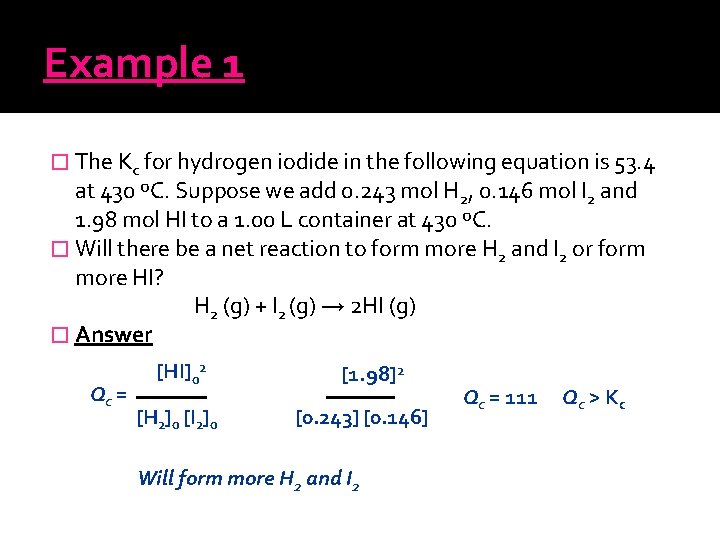
Example 1 � The Kc for hydrogen iodide in the following equation is 53. 4 at 430 ºC. Suppose we add 0. 243 mol H 2, 0. 146 mol I 2 and 1. 98 mol HI to a 1. 00 L container at 430 ºC. � Will there be a net reaction to form more H 2 and I 2 or form more HI? H 2 (g) + I 2 (g) → 2 HI (g) � Answer Qc = [HI]02 [H 2]0 [I 2]0 [1. 98]2 [0. 243] [0. 146] Will form more H 2 and I 2 Qc = 111 Qc > Kc
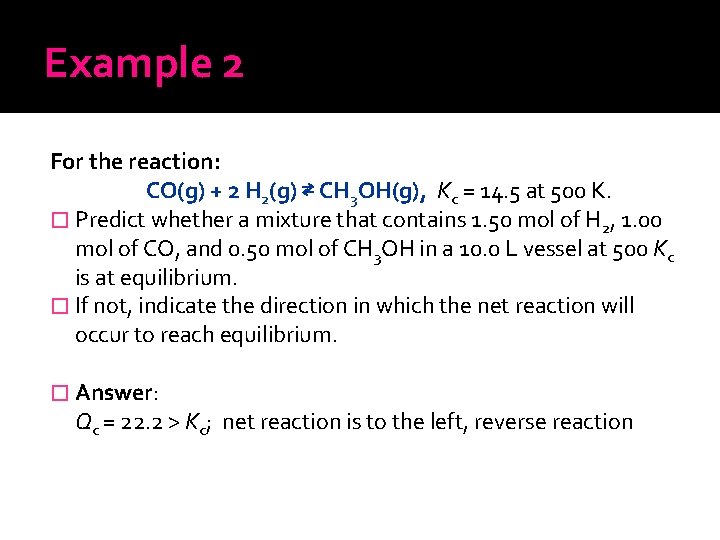
Example 2 For the reaction: CO(g) + 2 H 2(g) ⇄ CH 3 OH(g), Kc = 14. 5 at 500 K. � Predict whether a mixture that contains 1. 50 mol of H 2, 1. 00 mol of CO, and 0. 50 mol of CH 3 OH in a 10. 0 L vessel at 500 Kc is at equilibrium. � If not, indicate the direction in which the net reaction will occur to reach equilibrium. � Answer: Qc = 22. 2 > Kc; net reaction is to the left, reverse reaction
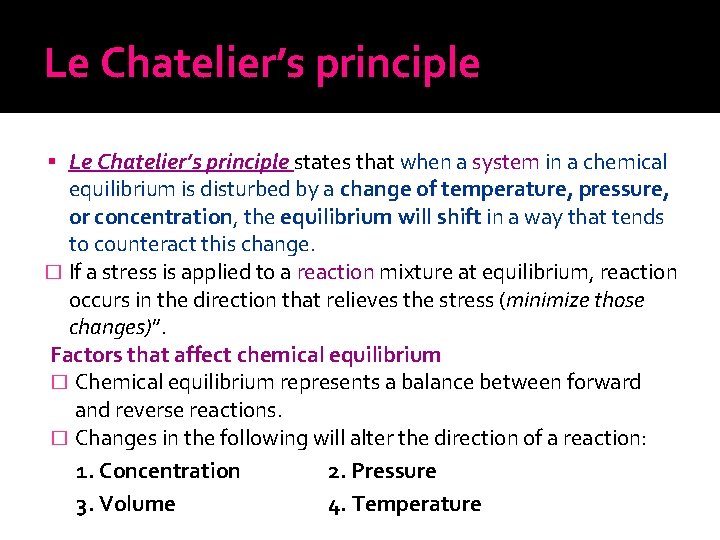
Le Chatelier’s principle states that when a system in a chemical equilibrium is disturbed by a change of temperature, pressure, or concentration, the equilibrium will shift in a way that tends to counteract this change. � If a stress is applied to a reaction mixture at equilibrium, reaction occurs in the direction that relieves the stress (minimize those changes)”. Factors that affect chemical equilibrium � Chemical equilibrium represents a balance between forward and reverse reactions. � Changes in the following will alter the direction of a reaction: 1. Concentration 2. Pressure 3. Volume 4. Temperature
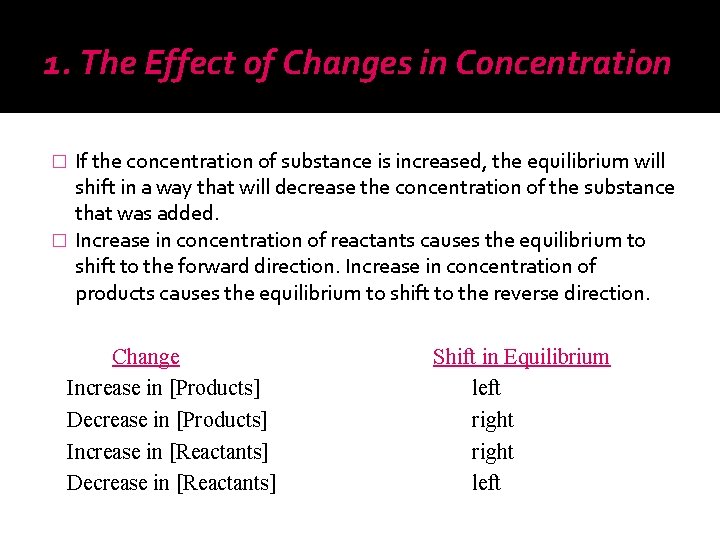
1. The Effect of Changes in Concentration If the concentration of substance is increased, the equilibrium will shift in a way that will decrease the concentration of the substance that was added. � Increase in concentration of reactants causes the equilibrium to shift to the forward direction. Increase in concentration of products causes the equilibrium to shift to the reverse direction. � Change Increase in [Products] Decrease in [Products] Increase in [Reactants] Decrease in [Reactants] Shift in Equilibrium left right left
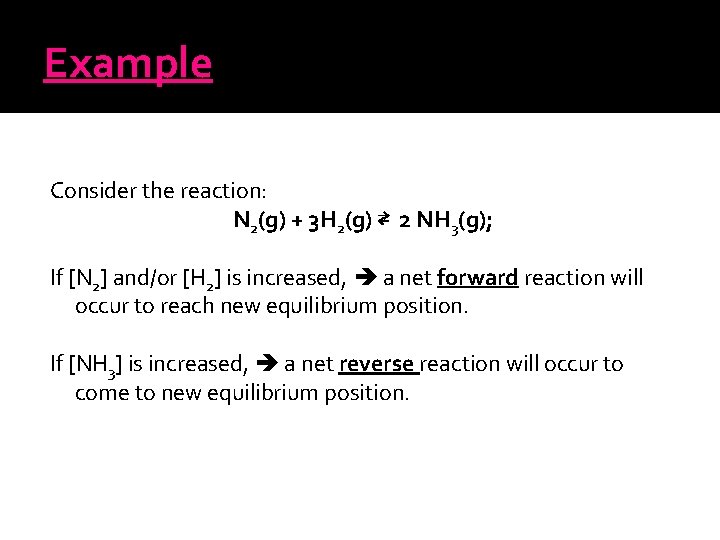
Example Consider the reaction: N 2(g) + 3 H 2(g) ⇄ 2 NH 3(g); If [N 2] and/or [H 2] is increased, a net forward reaction will occur to reach new equilibrium position. If [NH 3] is increased, a net reverse reaction will occur to come to new equilibrium position.
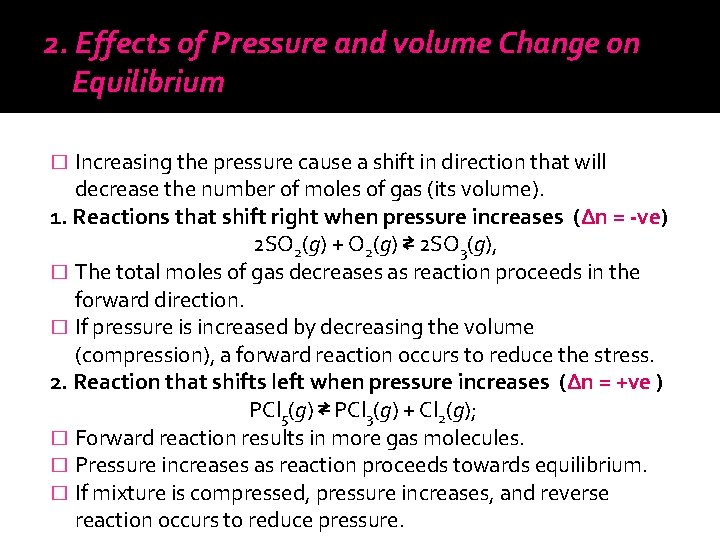
2. Effects of Pressure and volume Change on Equilibrium Increasing the pressure cause a shift in direction that will decrease the number of moles of gas (its volume). 1. Reactions that shift right when pressure increases (Δn = -ve) 2 SO 2(g) + O 2(g) ⇄ 2 SO 3(g), � The total moles of gas decreases as reaction proceeds in the forward direction. � If pressure is increased by decreasing the volume (compression), a forward reaction occurs to reduce the stress. 2. Reaction that shifts left when pressure increases (Δn = +ve ) PCl 5(g) ⇄ PCl 3(g) + Cl 2(g); � Forward reaction results in more gas molecules. � Pressure increases as reaction proceeds towards equilibrium. � If mixture is compressed, pressure increases, and reverse reaction occurs to reduce pressure. �
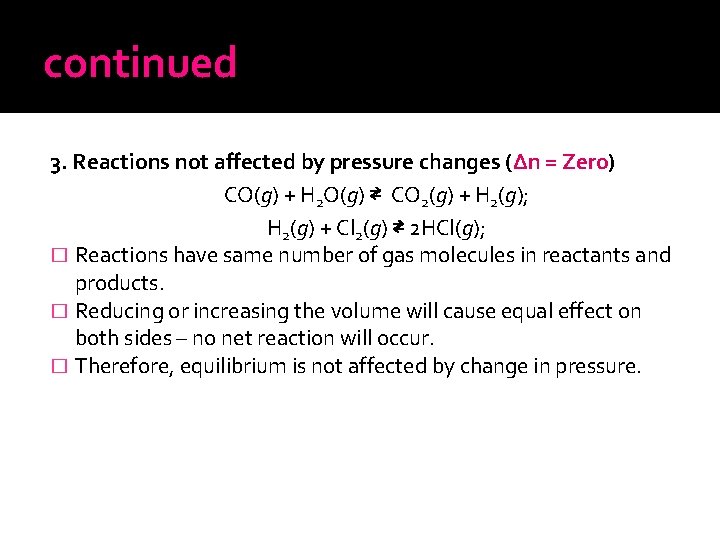
continued 3. Reactions not affected by pressure changes (Δn = Zero) CO(g) + H 2 O(g) ⇄ CO 2(g) + H 2(g); H 2(g) + Cl 2(g) ⇄ 2 HCl(g); � Reactions have same number of gas molecules in reactants and products. � Reducing or increasing the volume will cause equal effect on both sides – no net reaction will occur. � Therefore, equilibrium is not affected by change in pressure.
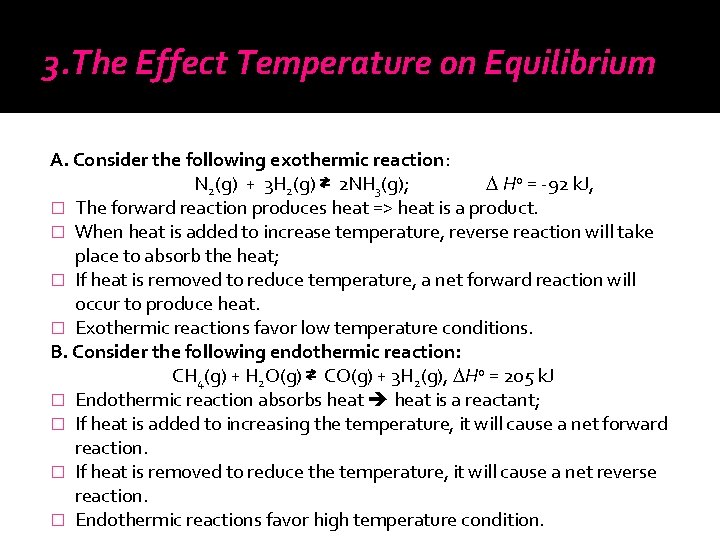
3. The Effect Temperature on Equilibrium A. Consider the following exothermic reaction: N 2(g) + 3 H 2(g) ⇄ 2 NH 3(g); Ho = -92 k. J, � The forward reaction produces heat => heat is a product. � When heat is added to increase temperature, reverse reaction will take place to absorb the heat; � If heat is removed to reduce temperature, a net forward reaction will occur to produce heat. � Exothermic reactions favor low temperature conditions. B. Consider the following endothermic reaction: CH 4(g) + H 2 O(g) ⇄ CO(g) + 3 H 2(g), Ho = 205 k. J � Endothermic reaction absorbs heat is a reactant; � If heat is added to increasing the temperature, it will cause a net forward reaction. � If heat is removed to reduce the temperature, it will cause a net reverse reaction. � Endothermic reactions favor high temperature condition.
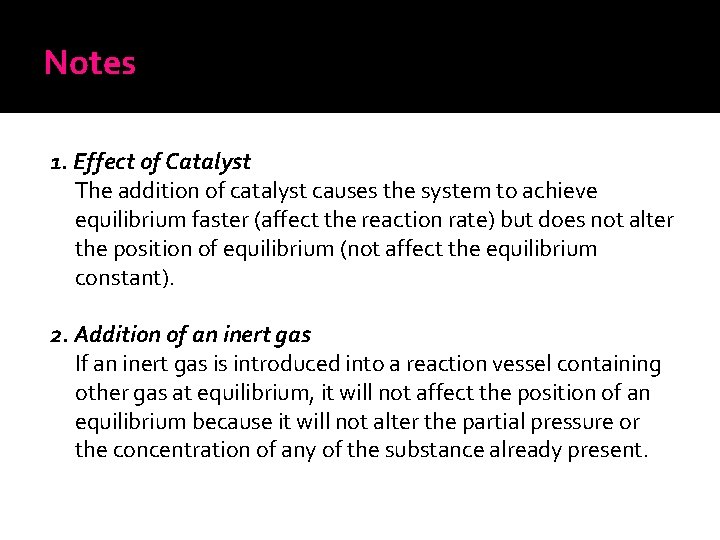
Notes 1. Effect of Catalyst The addition of catalyst causes the system to achieve equilibrium faster (affect the reaction rate) but does not alter the position of equilibrium (not affect the equilibrium constant). 2. Addition of an inert gas If an inert gas is introduced into a reaction vessel containing other gas at equilibrium, it will not affect the position of an equilibrium because it will not alter the partial pressure or the concentration of any of the substance already present.
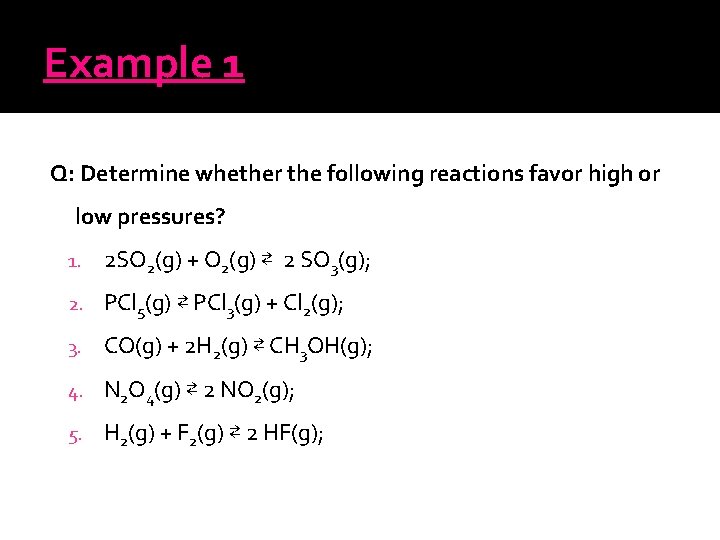
Example 1 Q: Determine whether the following reactions favor high or low pressures? 1. 2 SO 2(g) + O 2(g) ⇄ 2 SO 3(g); 2. PCl 5(g) ⇄ PCl 3(g) + Cl 2(g); 3. CO(g) + 2 H 2(g) ⇄ CH 3 OH(g); 4. N 2 O 4(g) ⇄ 2 NO 2(g); 5. H 2(g) + F 2(g) ⇄ 2 HF(g);
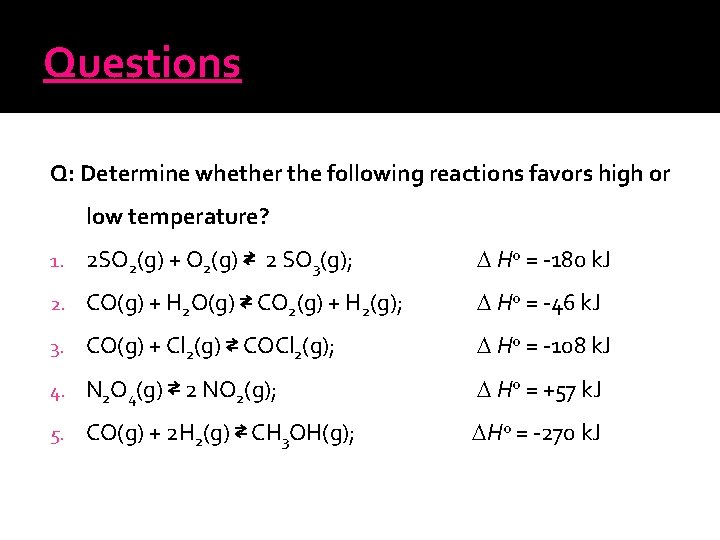
Questions Q: Determine whether the following reactions favors high or low temperature? 1. 2 SO 2(g) + O 2(g) ⇄ 2 SO 3(g); Ho = -180 k. J 2. CO(g) + H 2 O(g) ⇄ CO 2(g) + H 2(g); 3. CO(g) + Cl 2(g) ⇄ COCl 2(g); Ho = -108 k. J 4. N 2 O 4(g) ⇄ 2 NO 2(g); 5. CO(g) + 2 H 2(g) ⇄ CH 3 OH(g); Ho = -270 k. J Ho = -46 k. J Ho = +57 k. J
- Slides: 31