
Clinical Pharmacokinetics of Psychiatric Medications Kelan Thomas Pharm


- Slides: 56
Clinical Pharmacokinetics of Psychiatric Medications Kelan Thomas, Pharm. D, MS, BCPP Associate Professor of Pharmacy Practice Touro University California - College of Pharmacy October 24, 2018
Objectives Recognize pharmacokinetic parameters for Carbamazepine, Valproic Acid, Lithium and TCAs Consider various formulations and PK differences Calculate plasma levels and maintenance doses Consider evidence for therapeutic ranges Apply guidelines for therapeutic ranges Recommend appropriate therapeutic drug monitoring
Carbamazepine PK
Carbamazepine Pharmacokinetics Absorption Distribution Bioavailability (F) = 80%; extended-release 70% Salt form (S) = 1. 0 Peak concentration 4 - 6 h; extended-release 6 – 10 h Volume of distribution (Vd) ~ 1. 4 L/kg Clearance (Cl) Hepatic elimination, half-life (t 1/2) ~ 15 h (monotherapy) Estimated monotherapy Clearance = 0. 064 L/kg/h Obtain levels 12 hours post-dose (or morning trough)
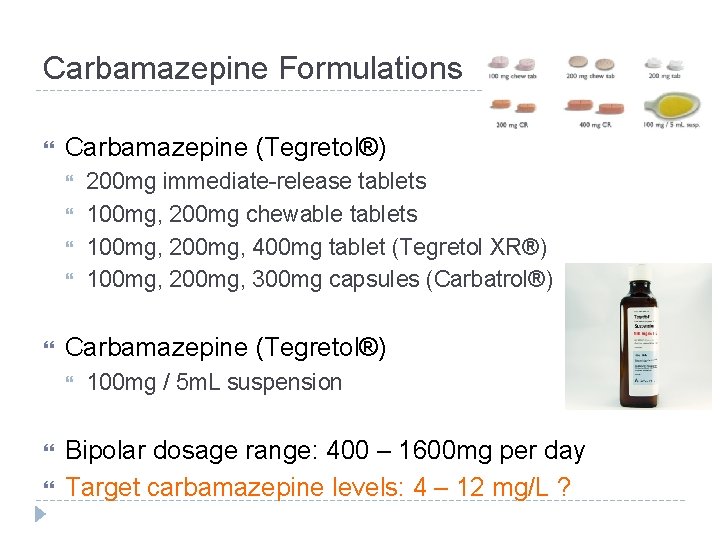
Carbamazepine Formulations Carbamazepine (Tegretol®) 200 mg immediate-release tablets 100 mg, 200 mg chewable tablets 100 mg, 200 mg, 400 mg tablet (Tegretol XR®) 100 mg, 200 mg, 300 mg capsules (Carbatrol®) 100 mg / 5 m. L suspension Bipolar dosage range: 400 – 1600 mg per day Target carbamazepine levels: 4 – 12 mg/L ?
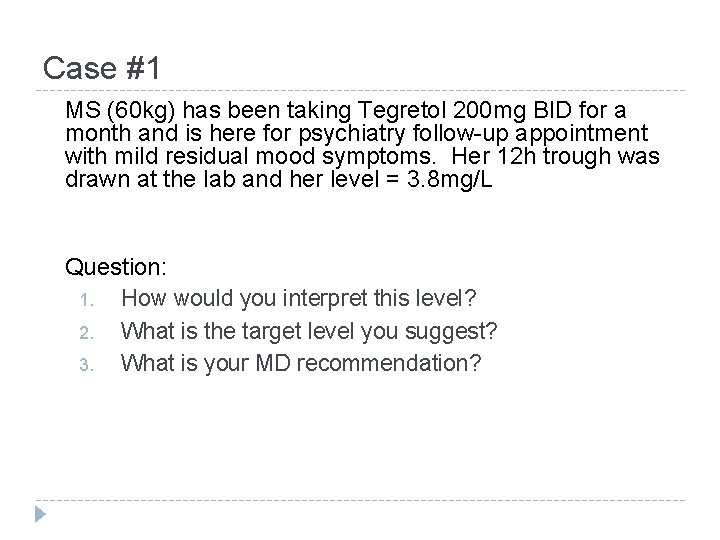
Case #1 MS (60 kg) has been taking Tegretol 200 mg BID for a month and is here for psychiatry follow-up appointment with mild residual mood symptoms. Her 12 h trough was drawn at the lab and her level = 3. 8 mg/L Question: 1. How would you interpret this level? 2. What is the target level you suggest? 3. What is your MD recommendation?
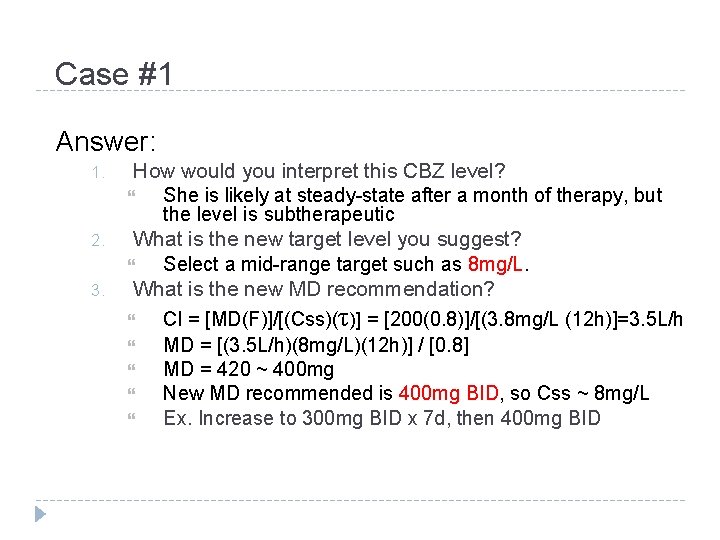
Case #1 Answer: 1. 2. 3. How would you interpret this CBZ level? She is likely at steady-state after a month of therapy, but the level is subtherapeutic What is the new target level you suggest? Select a mid-range target such as 8 mg/L. What is the new MD recommendation? Cl = [MD(F)]/[(Css)(τ)] = [200(0. 8)]/[(3. 8 mg/L (12 h)]=3. 5 L/h MD = [(3. 5 L/h)(8 mg/L)(12 h)] / [0. 8] MD = 420 ~ 400 mg New MD recommended is 400 mg BID, so Css ~ 8 mg/L Ex. Increase to 300 mg BID x 7 d, then 400 mg BID
Valproic Acid PK
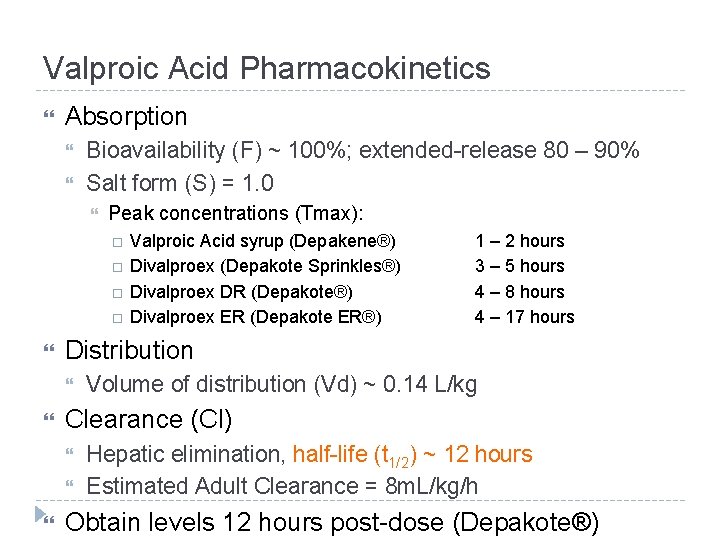
Valproic Acid Pharmacokinetics Absorption Bioavailability (F) ~ 100%; extended-release 80 – 90% Salt form (S) = 1. 0 Peak concentrations (Tmax): Volume of distribution (Vd) ~ 0. 14 L/kg Clearance (Cl) 1 – 2 hours 3 – 5 hours 4 – 8 hours 4 – 17 hours Distribution Valproic Acid syrup (Depakene®) Divalproex (Depakote Sprinkles®) Divalproex DR (Depakote®) Divalproex ER (Depakote ER®) Hepatic elimination, half-life (t 1/2) ~ 12 hours Estimated Adult Clearance = 8 m. L/kg/h Obtain levels 12 hours post-dose (Depakote®)
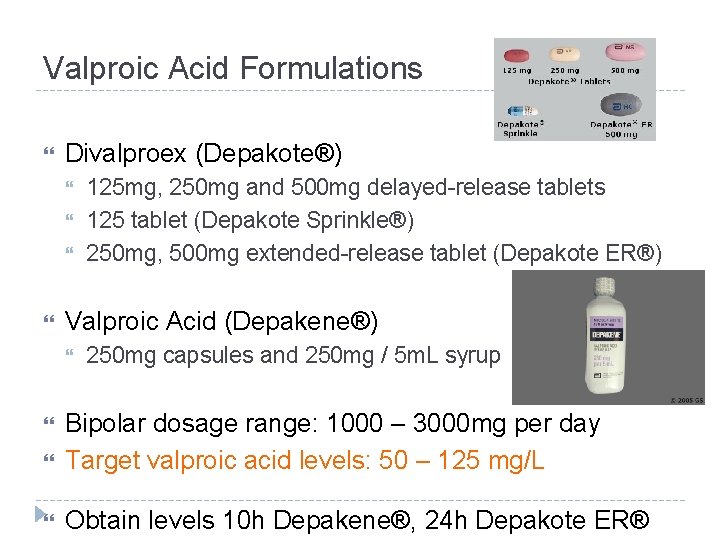
Valproic Acid Formulations Divalproex (Depakote®) 125 mg, 250 mg and 500 mg delayed-release tablets 125 tablet (Depakote Sprinkle®) 250 mg, 500 mg extended-release tablet (Depakote ER®) Valproic Acid (Depakene®) 250 mg capsules and 250 mg / 5 m. L syrup Bipolar dosage range: 1000 – 3000 mg per day Target valproic acid levels: 50 – 125 mg/L Obtain levels 10 h Depakene®, 24 h Depakote ER®
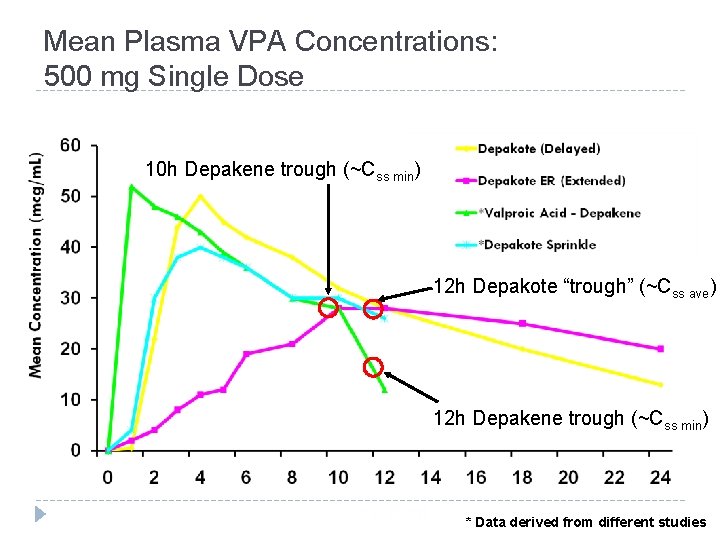
Mean Plasma VPA Concentrations: 500 mg Single Dose 10 h Depakene trough (~Css min) 12 h Depakote “trough” (~Css ave) 12 h Depakene trough (~Css min) * Data derived from different studies
Exercise 1 – Adjusting Maintenance Dose A bipolar patient was taking divalproex 500 mg BID for 3 days and the 12 h post -dose level is drawn with AM labs; VPA=67 mg/L. The psychiatrist wants to target 100 mg/L for manic Sx’s; what maintenance dose do you suggest to achieve this target at steady-state?
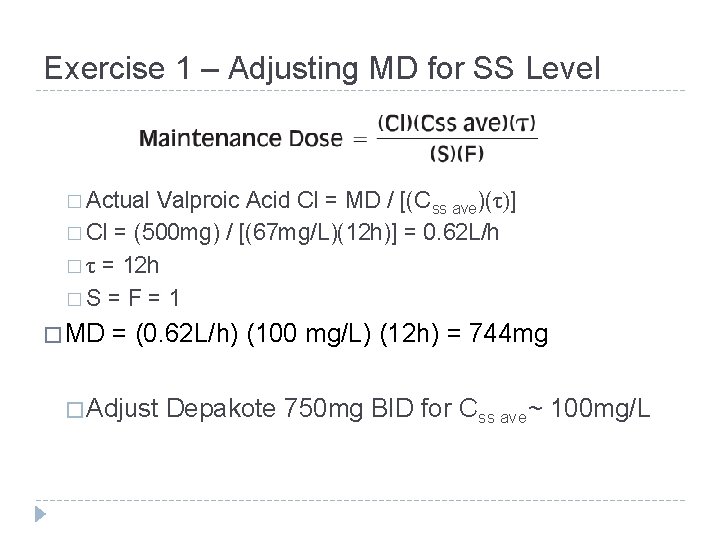
Exercise 1 – Adjusting MD for SS Level � Actual Valproic Acid Cl = MD / [(Css ave)(τ)] � Cl = (500 mg) / [(67 mg/L)(12 h)] = 0. 62 L/h � τ = 12 h � S = F = 1 � MD = (0. 62 L/h) (100 mg/L) (12 h) = 744 mg � Adjust Depakote 750 mg BID for Css ave~ 100 mg/L
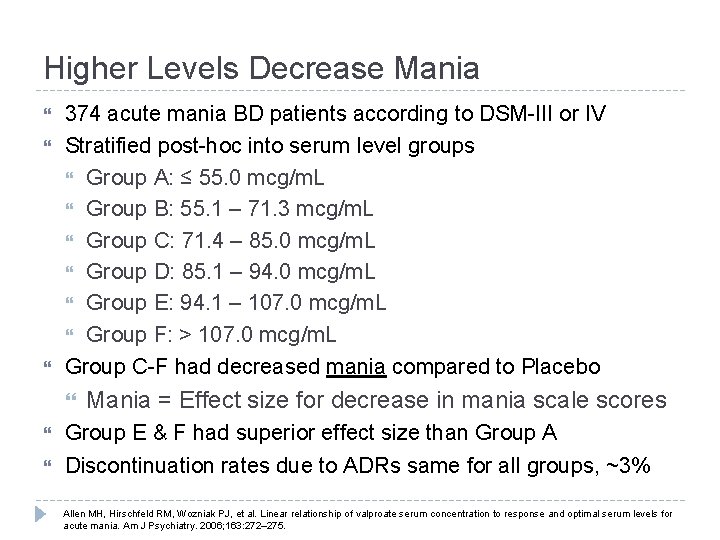
Higher Levels Decrease Mania 374 acute mania BD patients according to DSM-III or IV Stratified post-hoc into serum level groups Group A: ≤ 55. 0 mcg/m. L Group B: 55. 1 – 71. 3 mcg/m. L Group C: 71. 4 – 85. 0 mcg/m. L Group D: 85. 1 – 94. 0 mcg/m. L Group E: 94. 1 – 107. 0 mcg/m. L Group F: > 107. 0 mcg/m. L Group C-F had decreased mania compared to Placebo Mania = Effect size for decrease in mania scale scores Group E & F had superior effect size than Group A Discontinuation rates due to ADRs same for all groups, ~3% Allen MH, Hirschfeld RM, Wozniak PJ, et al. Linear relationship of valproate serum concentration to response and optimal serum levels for acute mania. Am J Psychiatry. 2006; 163: 272– 275.
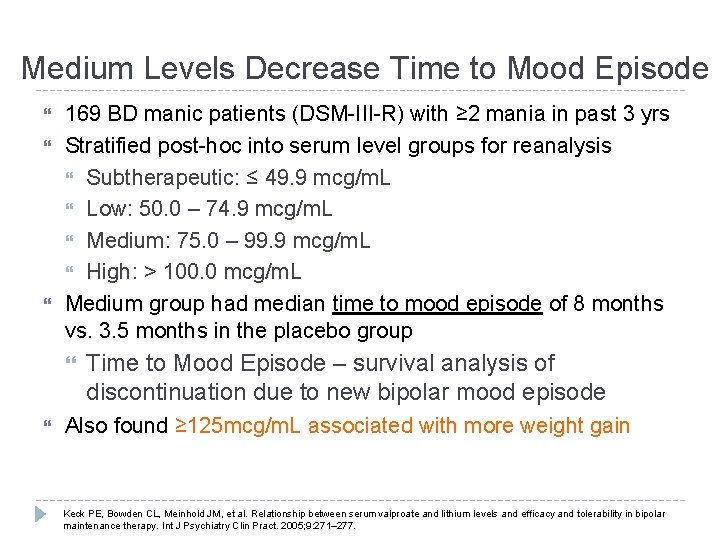
Medium Levels Decrease Time to Mood Episode 169 BD manic patients (DSM-III-R) with ≥ 2 mania in past 3 yrs Stratified post-hoc into serum level groups for reanalysis Subtherapeutic: ≤ 49. 9 mcg/m. L Low: 50. 0 – 74. 9 mcg/m. L Medium: 75. 0 – 99. 9 mcg/m. L High: > 100. 0 mcg/m. L Medium group had median time to mood episode of 8 months vs. 3. 5 months in the placebo group Time to Mood Episode – survival analysis of discontinuation due to new bipolar mood episode Also found ≥ 125 mcg/m. L associated with more weight gain Keck PE, Bowden CL, Meinhold JM, et al. Relationship between serum valproate and lithium levels and efficacy and tolerability in bipolar maintenance therapy. Int J Psychiatry Clin Pract. 2005; 9: 271– 277.
Valproic Acid Level RCT Results Author & Year N= Bowden 169 et al. 2000 [Keck et al. 2005] Target Level Groups Difference in Efficacy? Sub: <49. 9 mg/L Low: 50. 0 – 74. 9 mg/L Med: 75. 0 – 99. 9 mg/L High: >100. 0 mg/L Yes, Med > N/A, levels >125 mg/L placebo for time to associated w/weight discontinuation for gain mood episode survival analysis Allen 374 A: ≤ 55. 0 mcg/m. L et al. 2006 B: 55. 1 – 71. 3 mcg/m. L C: 71. 4 – 85. 0 mcg/m. L D: 85. 1 – 94. 0 mcg/m. L E: 94. 1 – 107. 0 mcg/m. L F: >107. 0 mcg/m. L Difference in ADRs? Yes, C - F > No, 3% mean placebo, with only discontinuation rate for E + F > A for ADR across all groups decreased mania rating scale scores
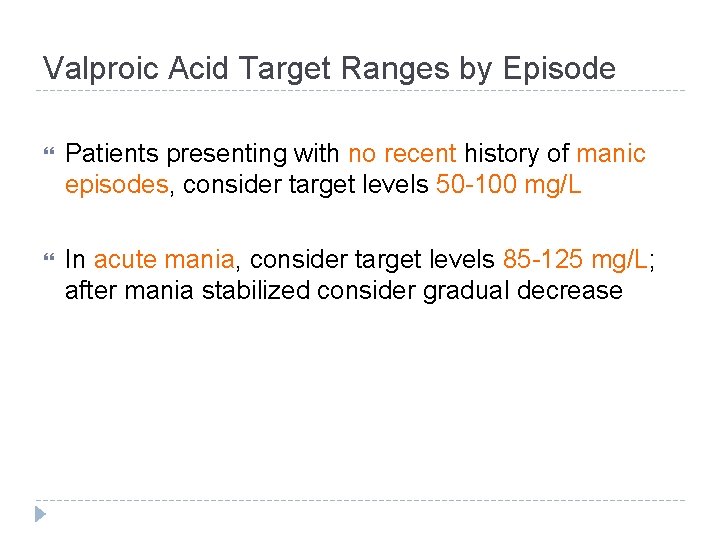
Valproic Acid Target Ranges by Episode Patients presenting with no recent history of manic episodes, consider target levels 50 -100 mg/L In acute mania, consider target levels 85 -125 mg/L; after mania stabilized consider gradual decrease
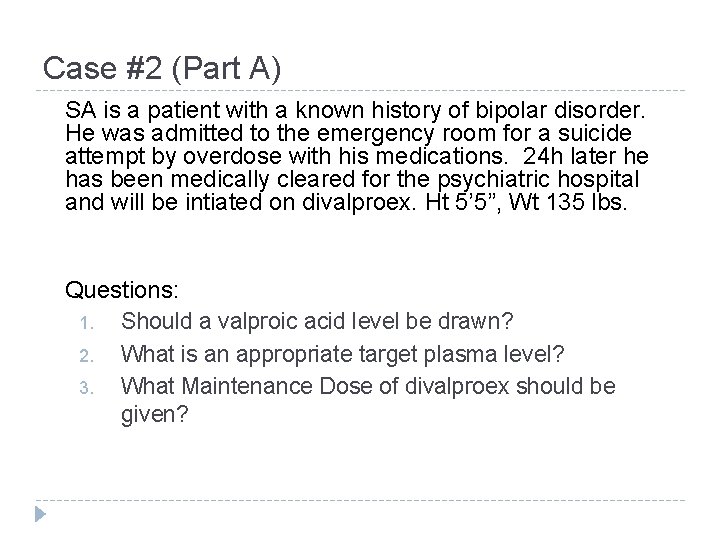
Case #2 (Part A) SA is a patient with a known history of bipolar disorder. He was admitted to the emergency room for a suicide attempt by overdose with his medications. 24 h later he has been medically cleared for the psychiatric hospital and will be intiated on divalproex. Ht 5’ 5”, Wt 135 lbs. Questions: 1. Should a valproic acid level be drawn? 2. What is an appropriate target plasma level? 3. What Maintenance Dose of divalproex should be given?
Case #2 (Part B) SA was given a prescription for divalproex 500 mg BID. After 2 weeks he returns to the clinic for a blood draw. The blood was drawn 12 hours post dose and the valproic acid level returned at 57 mg/L. Questions: 1. Why isn’t the patient at the level targeted? 2. How can you determine a patient-specific dose? 3. What is the new dose of divalproex for 85 mg/L? 4. When should the next valproic acid level be drawn?
Lithium PK
Lithium Pharmacokinetics Absorption Distribution Bioavailability (F) 100%; slow-release 60 – 90% Salt form (S) = 1. 0 Peak concentration 1 – 3 hours; slow-release 3 – 6 hours Volume of distribution (Vd) ~ 0. 7 L/kg Clearance (Cl) Renal elimination, half-life (t 1/2) ~ 24 hours Estimated lithium Clearance ~ 0. 25 x Cl. Cr In obese patient (TBW > IBWx 1. 2), use TBW for Cl. Cr Obtain levels 12 hours post-dose (AM blood draw)
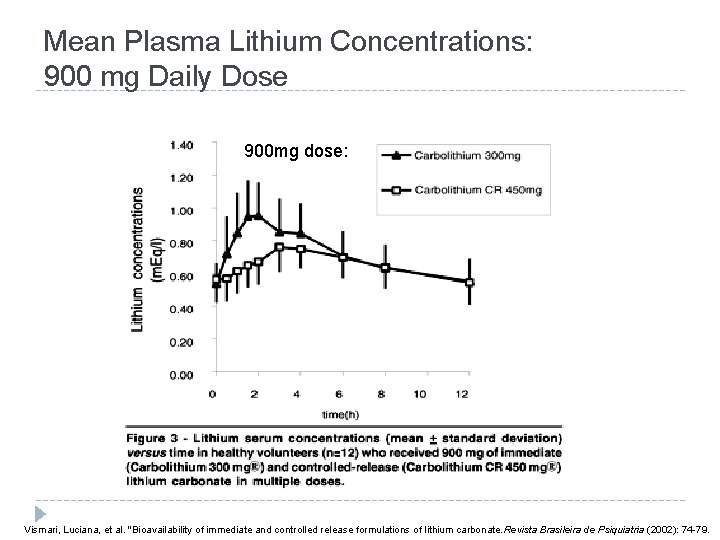
Lithium Formulations Lithium Carbonate [300 mg = 8. 12 m. Eq] Lithium Citrate [300 mg = 8. 0 m. Eq] 150 mg, 300 mg and 600 mg capsules 300 mg extended-release tablet (Lithobid®) 450 mg controlled-release tablet (Eskalith CR®) 300 mg / 5 m. L syrup Bipolar dosage range: 600 – 1800 mg per day Target lithium levels: 0. 5 – 1. 2 m. Eq/L (from APA) Bipolar Maintenance: 0. 6 -0. 8 m. Eq/L
Mean Plasma Lithium Concentrations: 900 mg Daily Dose 900 mg dose: Vismari, Luciana, et al. "Bioavailability of immediate and controlled release formulations of lithium carbonate. Revista Brasileira de Psiquiatria (2002): 74 -79.
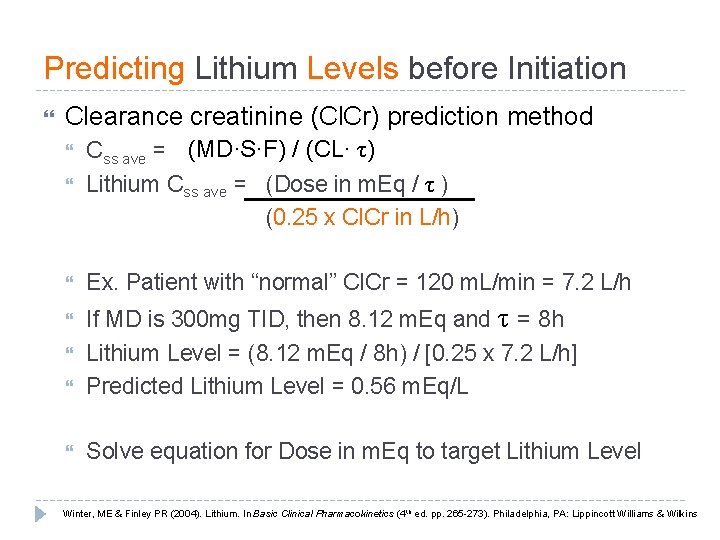
Predicting Lithium Levels before Initiation Clearance creatinine (Cl. Cr) prediction method Css ave = (MD∙S∙F) / (CL∙ τ) Lithium Css ave = (Dose in m. Eq / τ ) (0. 25 x Cl. Cr in L/h) Ex. Patient with “normal” Cl. Cr = 120 m. L/min = 7. 2 L/h If MD is 300 mg TID, then 8. 12 m. Eq and τ = 8 h Lithium Level = (8. 12 m. Eq / 8 h) / [0. 25 x 7. 2 L/h] Predicted Lithium Level = 0. 56 m. Eq/L Solve equation for Dose in m. Eq to target Lithium Level Winter, ME & Finley PR (2004). Lithium. In Basic Clinical Pharmacokinetics (4 th ed. pp. 265 -273). Philadelphia, PA: Lippincott Williams & Wilkins
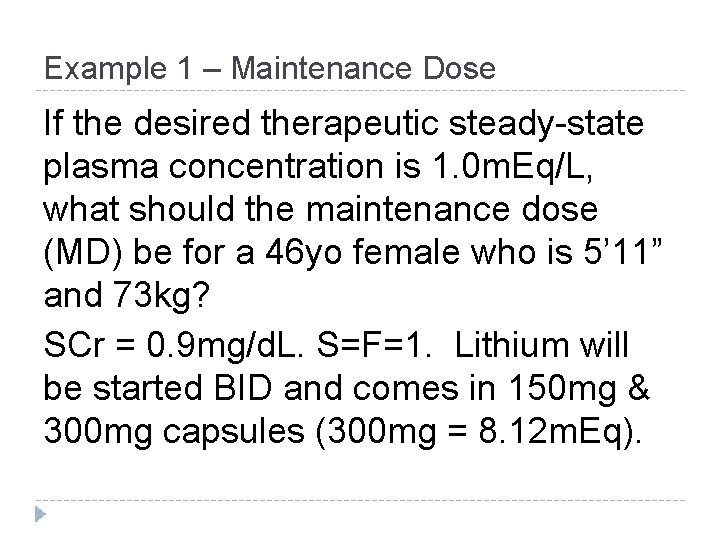
Example 1 – Maintenance Dose If the desired therapeutic steady-state plasma concentration is 1. 0 m. Eq/L, what should the maintenance dose (MD) be for a 46 yo female who is 5’ 11” and 73 kg? SCr = 0. 9 mg/d. L. S=F=1. Lithium will be started BID and comes in 150 mg & 300 mg capsules (300 mg = 8. 12 m. Eq).
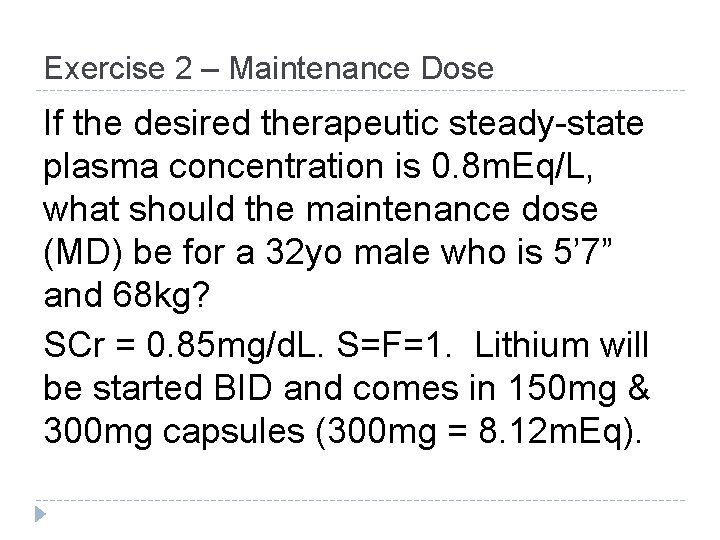
Exercise 2 – Maintenance Dose If the desired therapeutic steady-state plasma concentration is 0. 8 m. Eq/L, what should the maintenance dose (MD) be for a 32 yo male who is 5’ 7” and 68 kg? SCr = 0. 85 mg/d. L. S=F=1. Lithium will be started BID and comes in 150 mg & 300 mg capsules (300 mg = 8. 12 m. Eq).
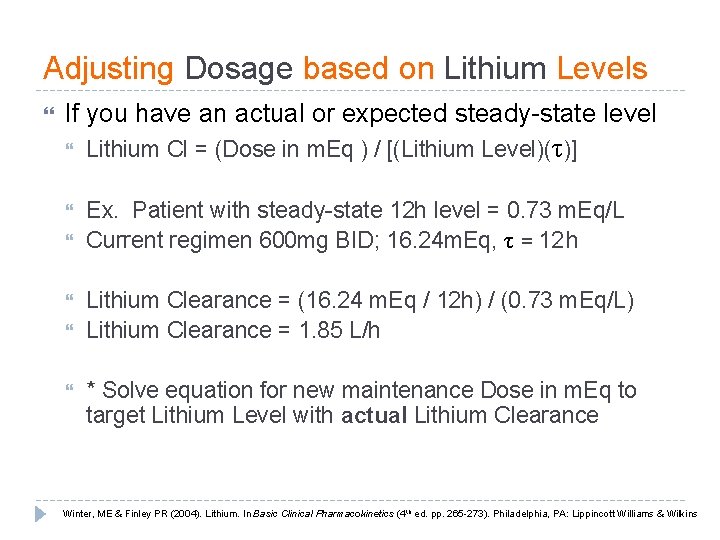
Adjusting Dosage based on Lithium Levels If you have an actual or expected steady-state level Lithium Cl = (Dose in m. Eq ) / [(Lithium Level)(τ)] Ex. Patient with steady-state 12 h level = 0. 73 m. Eq/L Current regimen 600 mg BID; 16. 24 m. Eq, τ = 12 h Lithium Clearance = (16. 24 m. Eq / 12 h) / (0. 73 m. Eq/L) Lithium Clearance = 1. 85 L/h * Solve equation for new maintenance Dose in m. Eq to target Lithium Level with actual Lithium Clearance Winter, ME & Finley PR (2004). Lithium. In Basic Clinical Pharmacokinetics (4 th ed. pp. 265 -273). Philadelphia, PA: Lippincott Williams & Wilkins
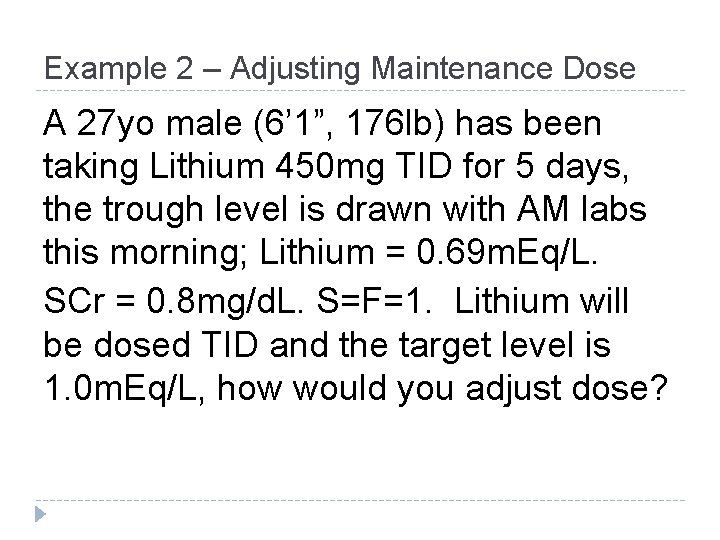
Example 2 – Adjusting Maintenance Dose A 27 yo male (6’ 1”, 176 lb) has been taking Lithium 450 mg TID for 5 days, the trough level is drawn with AM labs this morning; Lithium = 0. 69 m. Eq/L. SCr = 0. 8 mg/d. L. S=F=1. Lithium will be dosed TID and the target level is 1. 0 m. Eq/L, how would you adjust dose?
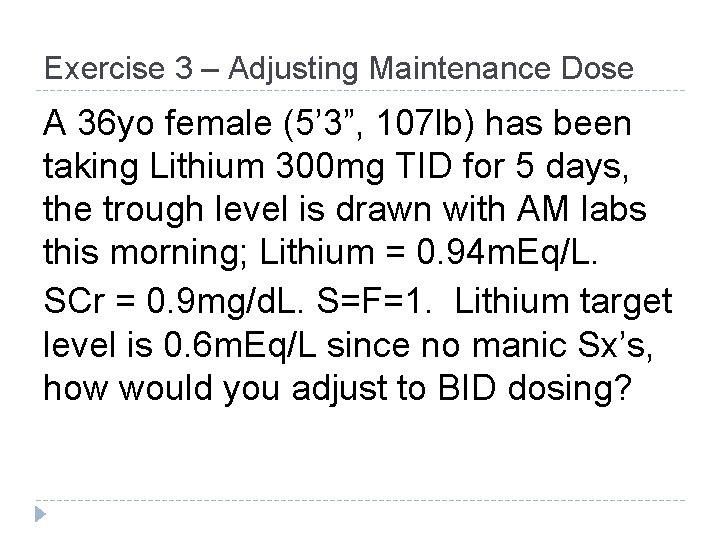
Exercise 3 – Adjusting Maintenance Dose A 36 yo female (5’ 3”, 107 lb) has been taking Lithium 300 mg TID for 5 days, the trough level is drawn with AM labs this morning; Lithium = 0. 94 m. Eq/L. SCr = 0. 9 mg/d. L. S=F=1. Lithium target level is 0. 6 m. Eq/L since no manic Sx’s, how would you adjust to BID dosing?
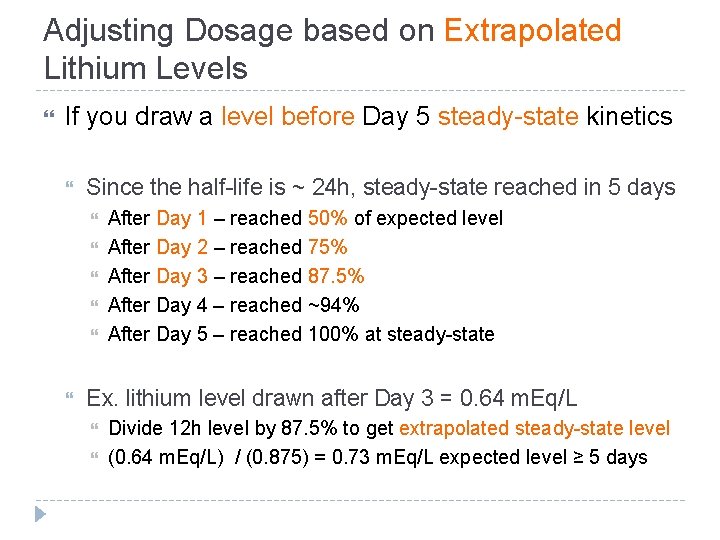
Adjusting Dosage based on Extrapolated Lithium Levels If you draw a level before Day 5 steady-state kinetics Since the half-life is ~ 24 h, steady-state reached in 5 days After Day 1 – reached 50% of expected level After Day 2 – reached 75% After Day 3 – reached 87. 5% After Day 4 – reached ~94% After Day 5 – reached 100% at steady-state Ex. lithium level drawn after Day 3 = 0. 64 m. Eq/L Divide 12 h level by 87. 5% to get extrapolated steady-state level (0. 64 m. Eq/L) / (0. 875) = 0. 73 m. Eq/L expected level ≥ 5 days
Example 3 – Interpret Level Before SS A bipolar patient has only been taking 300 mg BID for 2 days and the 12 h post -dose level is drawn with AM labs; Li=0. 25 m. Eq/L. The psychiatrist wants to target 0. 7 m. Eq/L, so asks you if she should increase dose to 900 mg BID, what’s your response?
Exercise 4 – Interpret Level Before SS A bipolar patient has only been taking 450 mg BID for 3 days and the 12 h post -dose level is drawn with AM labs; Li=0. 67 m. Eq/L. The psychiatrist wants to target 1. 0 m. Eq/L for mania; what maintenance dose do you suggest to achieve this level at steady-state?
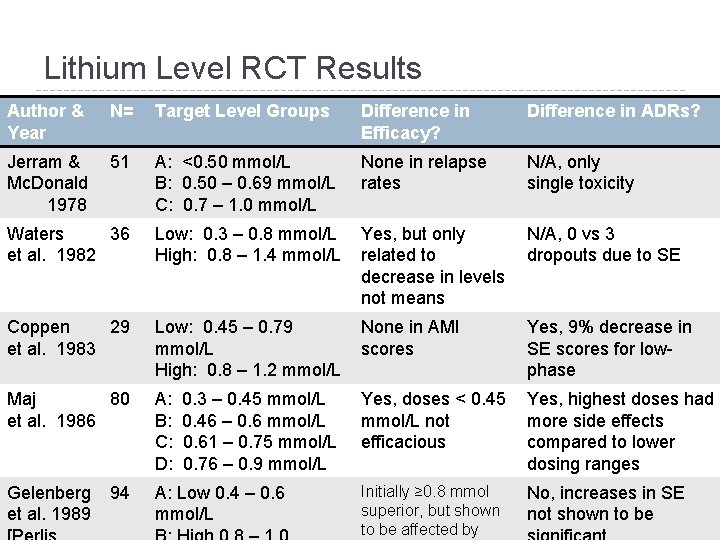
Relapse Rate Not Affected by Levels 80 patients with recurrent affective disorders (51 BD) who had been episode-free with lithium treatment at least 6 months, but average duration of Lithium >5 years Relapse defined as necessity for additional psychotropic medication (excluding BZDs) or admission to hospital Randomly assigned in an open fashion to 3 treatment groups and followed for 1 year A: <0. 50 mmol/L; 4/16 relapsed (2 manic, 2 depressed) B: 0. 50 – 0. 69 mmol/L; 3/19 relapsed (2 manic, 1 depressed) C: 0. 7 – 1. 0 mmol/L ; 3/16 relapsed (3 manic) No difference in relapse rate, 1/7 dropouts for toxicity Jerram TC, Mc. Donald R. Plasma lithium control with particular reference to minimum effective plasma levels. In: Johnson FN, Johnson S eds. Lithium in Medical Practice. Lancaster: MTP Press, 1978: 407– 413.
Target Lithium Levels? Even after 60+ years of clinical experience, there is still uncertainty and limited evidence for the most efficacious plasma level in long-term maintenance There are only a handful of randomized controlled trials investigating the optimal lithium levels in bipolar disorder Reanalysis of older data has called into question older target levels of 0. 6 – 1. 5 m. Eq/L and most clinical guidelines are using lower ranges
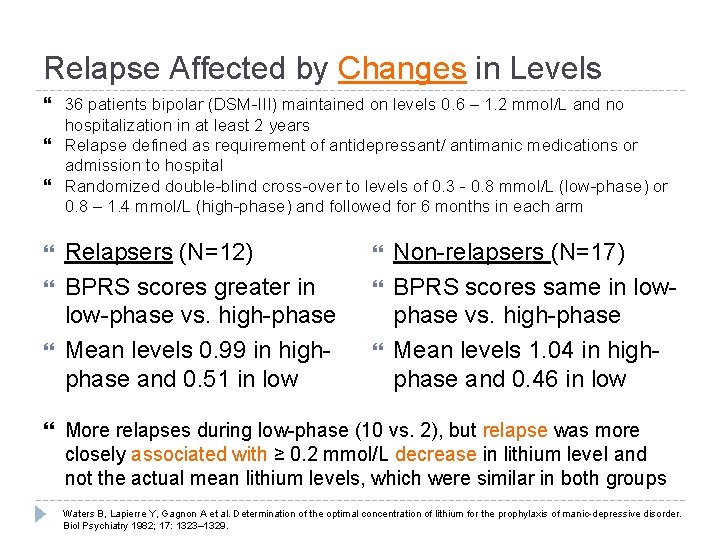
Relapse Affected by Changes in Levels 36 patients bipolar (DSM-III) maintained on levels 0. 6 – 1. 2 mmol/L and no hospitalization in at least 2 years Relapse defined as requirement of antidepressant/ antimanic medications or admission to hospital Randomized double-blind cross-over to levels of 0. 3 - 0. 8 mmol/L (low-phase) or 0. 8 – 1. 4 mmol/L (high-phase) and followed for 6 months in each arm Relapsers (N=12) BPRS scores greater in low-phase vs. high-phase Mean levels 0. 99 in highphase and 0. 51 in low Non-relapsers (N=17) BPRS scores same in lowphase vs. high-phase Mean levels 1. 04 in highphase and 0. 46 in low More relapses during low-phase (10 vs. 2), but relapse was more closely associated with ≥ 0. 2 mmol/L decrease in lithium level and not the actual mean lithium levels, which were similar in both groups Waters B, Lapierre Y, Gagnon A et al. Determination of the optimal concentration of lithium for the prophylaxis of manic-depressive disorder. Biol Psychiatry 1982; 17: 1323– 1329.
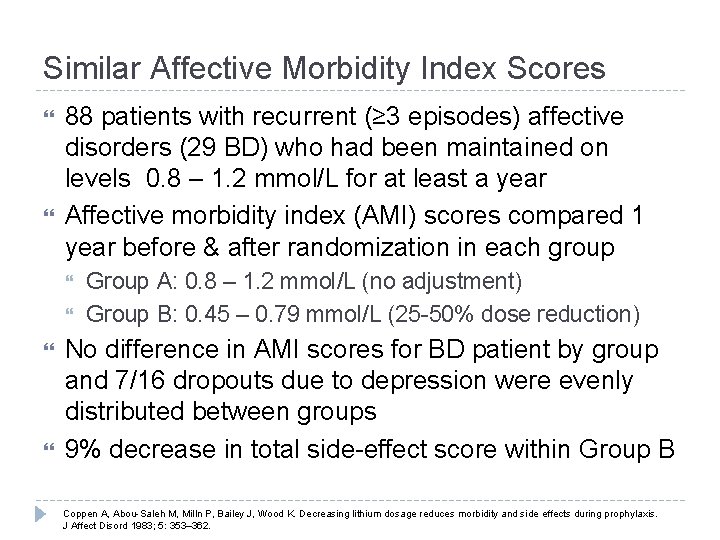
Similar Affective Morbidity Index Scores 88 patients with recurrent (≥ 3 episodes) affective disorders (29 BD) who had been maintained on levels 0. 8 – 1. 2 mmol/L for at least a year Affective morbidity index (AMI) scores compared 1 year before & after randomization in each group Group A: 0. 8 – 1. 2 mmol/L (no adjustment) Group B: 0. 45 – 0. 79 mmol/L (25 -50% dose reduction) No difference in AMI scores for BD patient by group and 7/16 dropouts due to depression were evenly distributed between groups 9% decrease in total side-effect score within Group B Coppen A, Abou-Saleh M, Milln P, Bailey J, Wood K. Decreasing lithium dosage reduces morbidity and side effects during prophylaxis. J Affect Disord 1983; 5: 353– 362.
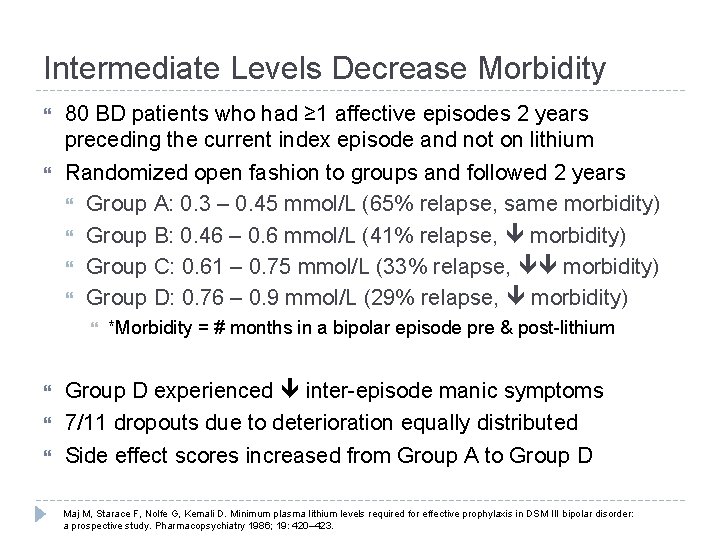
Intermediate Levels Decrease Morbidity 80 BD patients who had ≥ 1 affective episodes 2 years preceding the current index episode and not on lithium Randomized open fashion to groups and followed 2 years Group A: 0. 3 – 0. 45 mmol/L (65% relapse, same morbidity) Group B: 0. 46 – 0. 6 mmol/L (41% relapse, morbidity) Group C: 0. 61 – 0. 75 mmol/L (33% relapse, morbidity) Group D: 0. 76 – 0. 9 mmol/L (29% relapse, morbidity) *Morbidity = # months in a bipolar episode pre & post-lithium Group D experienced inter-episode manic symptoms 7/11 dropouts due to deterioration equally distributed Side effect scores increased from Group A to Group D Maj M, Starace F, Nolfe G, Kemali D. Minimum plasma lithium levels required for effective prophylaxis in DSM III bipolar disorder: a prospective study. Pharmacopsychiatry 1986; 19: 420– 423.
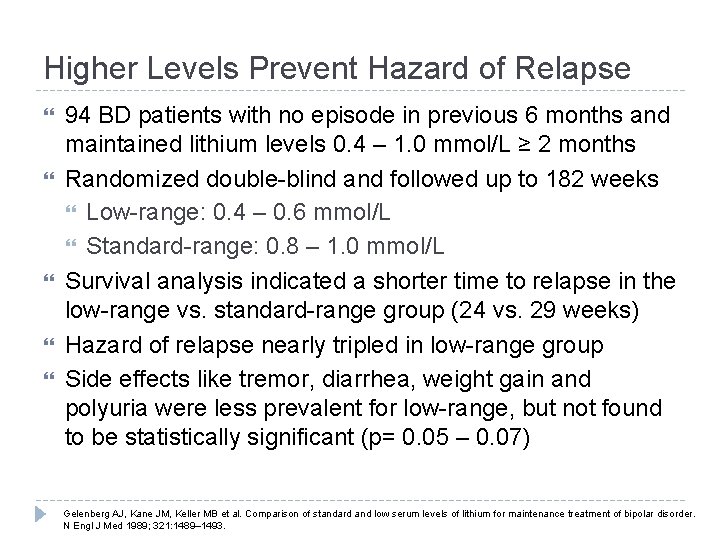
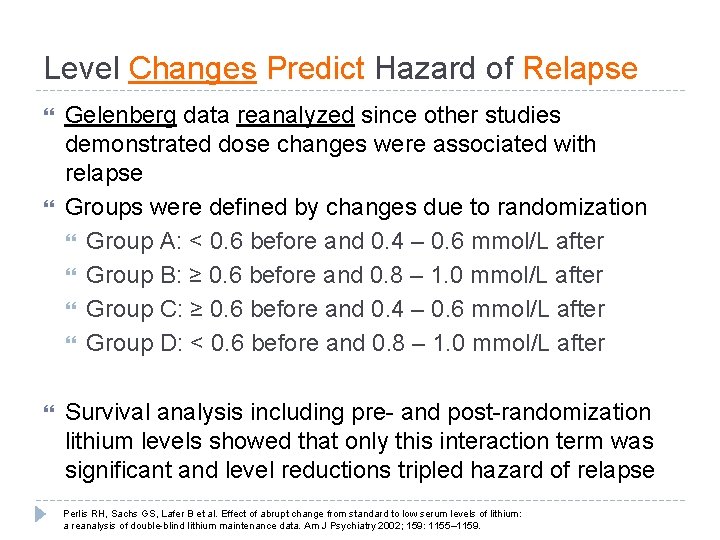
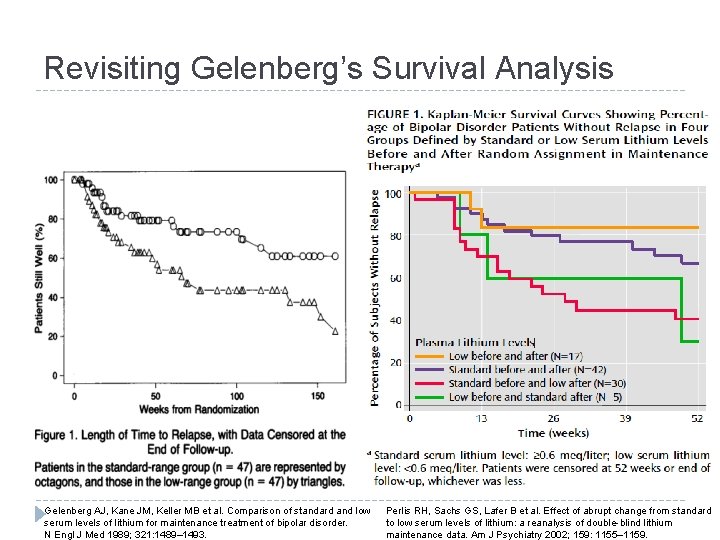
Higher Levels Prevent Hazard of Relapse 94 BD patients with no episode in previous 6 months and maintained lithium levels 0. 4 – 1. 0 mmol/L ≥ 2 months Randomized double-blind and followed up to 182 weeks Low-range: 0. 4 – 0. 6 mmol/L Standard-range: 0. 8 – 1. 0 mmol/L Survival analysis indicated a shorter time to relapse in the low-range vs. standard-range group (24 vs. 29 weeks) Hazard of relapse nearly tripled in low-range group Side effects like tremor, diarrhea, weight gain and polyuria were less prevalent for low-range, but not found to be statistically significant (p= 0. 05 – 0. 07) Gelenberg AJ, Kane JM, Keller MB et al. Comparison of standard and low serum levels of lithium for maintenance treatment of bipolar disorder. N Engl J Med 1989; 321: 1489– 1493.
Level Changes Predict Hazard of Relapse Gelenberg data reanalyzed since other studies demonstrated dose changes were associated with relapse Groups were defined by changes due to randomization Group A: < 0. 6 before and 0. 4 – 0. 6 mmol/L after Group B: ≥ 0. 6 before and 0. 8 – 1. 0 mmol/L after Group C: ≥ 0. 6 before and 0. 4 – 0. 6 mmol/L after Group D: < 0. 6 before and 0. 8 – 1. 0 mmol/L after Survival analysis including pre- and post-randomization lithium levels showed that only this interaction term was significant and level reductions tripled hazard of relapse Perlis RH, Sachs GS, Lafer B et al. Effect of abrupt change from standard to low serum levels of lithium: a reanalysis of double-blind lithium maintenance data. Am J Psychiatry 2002; 159: 1155– 1159.
Revisiting Gelenberg’s Survival Analysis Gelenberg AJ, Kane JM, Keller MB et al. Comparison of standard and low serum levels of lithium for maintenance treatment of bipolar disorder. N Engl J Med 1989; 321: 1489– 1493. Perlis RH, Sachs GS, Lafer B et al. Effect of abrupt change from standard to low serum levels of lithium: a reanalysis of double-blind lithium maintenance data. Am J Psychiatry 2002; 159: 1155– 1159.
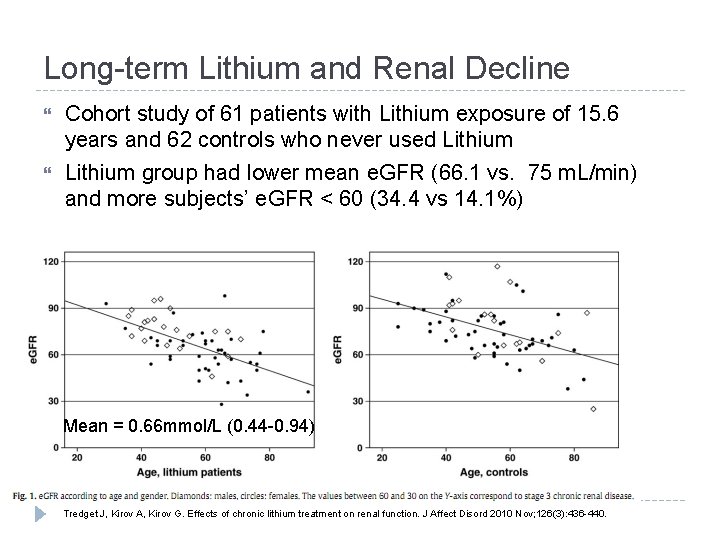
Long-term Lithium and Renal Decline Cohort study of 61 patients with Lithium exposure of 15. 6 years and 62 controls who never used Lithium group had lower mean e. GFR (66. 1 vs. 75 m. L/min) and more subjects’ e. GFR < 60 (34. 4 vs 14. 1%) Mean = 0. 66 mmol/L (0. 44 -0. 94) Tredget J, Kirov A, Kirov G. Effects of chronic lithium treatment on renal function. J Affect Disord 2010 Nov; 126(3): 436 -440.
Lithium Level RCT Results Author & Year N= Target Level Groups Difference in Efficacy? Difference in ADRs? Jerram & 51 Mc. Donald 1978 A: <0. 50 mmol/L B: 0. 50 – 0. 69 mmol/L C: 0. 7 – 1. 0 mmol/L None in relapse rates N/A, only single toxicity Waters 36 et al. 1982 Low: 0. 3 – 0. 8 mmol/L Yes, but only N/A, 0 vs 3 High: 0. 8 – 1. 4 mmol/L related to dropouts due to SE decrease in levels not means Coppen 29 et al. 1983 Low: 0. 45 – 0. 79 mmol/L High: 0. 8 – 1. 2 mmol/L None in AMI scores Maj 80 et al. 1986 A: 0. 3 – 0. 45 mmol/L B: 0. 46 – 0. 6 mmol/L C: 0. 61 – 0. 75 mmol/L D: 0. 76 – 0. 9 mmol/L Yes, doses < 0. 45 Yes, highest doses had mmol/L not more side effects efficacious compared to lower dosing ranges Gelenberg 94 et al. 1989 A: Low 0. 4 – 0. 6 mmol/L Initially ≥ 0. 8 mmol superior, but shown to be affected by Yes, 9% decrease in SE scores for lowphase No, increases in SE not shown to be
Lithium Target Ranges by Episode Patients presenting with no recent history of manic episodes, consider target levels 0. 5 – 0. 8 m. Eq/L In acute mania, consider target of 0. 8 – 1. 2 m. Eq/L; after stabilized may consider very gradual decrease Consider once daily dosing to improve polyuria and preserve renal function Bowen RC, Grof P, Grof E. Less frequent lithium administration and lower urine volume. Am J Psychiatry 1991; 148(2): 189 -192.
S. T. A. N. D. Up - Mnemonic for Toxicity Risks Salt – decreased intake promotes Lithium retention Thiazide diuretics ACE-inhibitors & ARBs NSAIDS Dehydration “S. T. A. N. D. ” makes Lithium levels go Up! Seek immediate medical attention for signs of toxicity: slurred speech, coarse tremor, confusion, loss of coordination or unsteady gait (pt feels drunk w/o Et. OH)
Case #3 (Part A) ME is a 36 yo female brought in by police on a 5150 hold for danger to self and others after cutting down a tree and damaging power lines. She appears to be in a manic episode and has a known Hx of bipolar disorder. She stopped taking Lithium about a month ago. Ht 5’ 2”, Wt 111 lbs, SCr=0. 9 mg/d. L Questions: 1. What is an appropriate target plasma Lithium level (Hint: use mid-range value)? 2. What dose do you recommend for initiation? 3. When should you draw a Lithium level?
Case #3 (Part B) ME was started on Lithium 450 mg BID. The psychiatrist ordered an AM level drawn after 3 days (12 h post-dose); Li = 0. 65 m. Eq/L. He wants to increase the dose to 450 mg TID now, but what is your recommendation? Questions: 1. Why isn’t the patient at the level targeted? 2. How can you determine a patient-specific dose? 3. What should be the new dose of Lithium? 4. When should the next Lithium level be drawn?
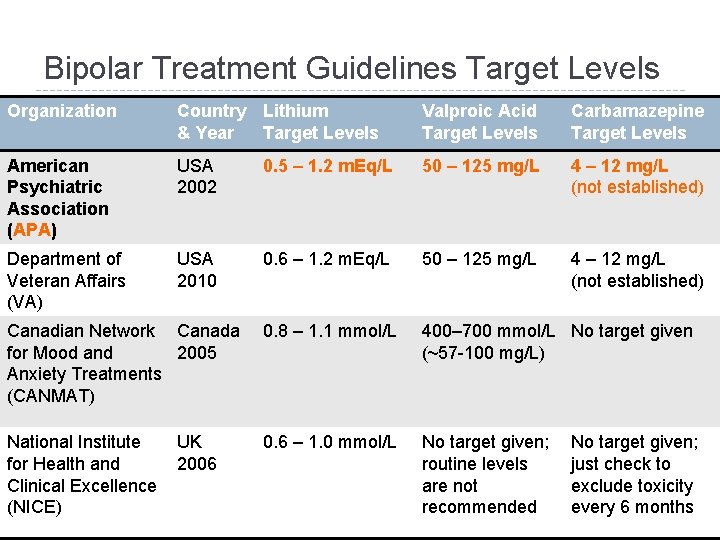
Bipolar Treatment Guidelines Target Levels Organization Country Lithium & Year Target Levels Valproic Acid Target Levels Carbamazepine Target Levels American Psychiatric Association (APA) USA 2002 0. 5 – 1. 2 m. Eq/L 50 – 125 mg/L 4 – 12 mg/L (not established) Department of Veteran Affairs (VA) USA 2010 0. 6 – 1. 2 m. Eq/L 50 – 125 mg/L 4 – 12 mg/L (not established) Canadian Network Canada 0. 8 – 1. 1 mmol/L for Mood and 2005 Anxiety Treatments (CANMAT) 400– 700 mmol/L No target given (~57 -100 mg/L) National Institute UK for Health and 2006 Clinical Excellence (NICE) No target given; routine levels are not recommended 0. 6 – 1. 0 mmol/L No target given; just check to exclude toxicity every 6 months
Tricyclic Antidepressant PK
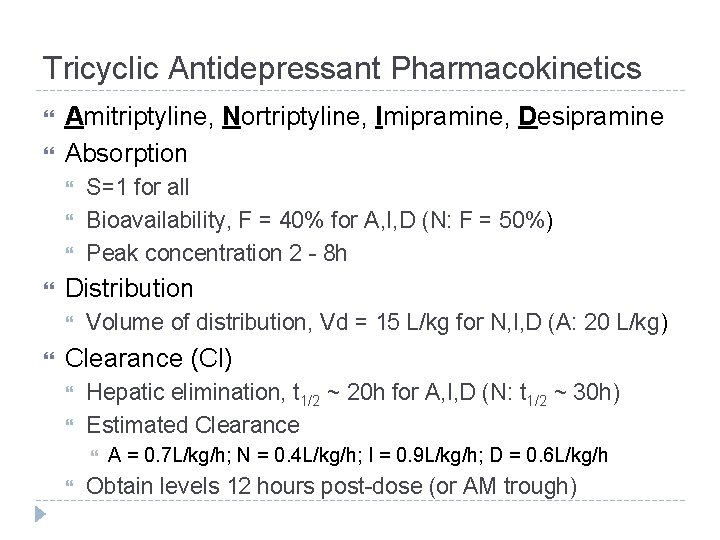
Tricyclic Antidepressant Pharmacokinetics Amitriptyline, Nortriptyline, Imipramine, Desipramine Absorption Distribution S=1 for all Bioavailability, F = 40% for A, I, D (N: F = 50%) Peak concentration 2 - 8 h Volume of distribution, Vd = 15 L/kg for N, I, D (A: 20 L/kg) Clearance (Cl) Hepatic elimination, t 1/2 ~ 20 h for A, I, D (N: t 1/2 ~ 30 h) Estimated Clearance A = 0. 7 L/kg/h; N = 0. 4 L/kg/h; I = 0. 9 L/kg/h; D = 0. 6 L/kg/h Obtain levels 12 hours post-dose (or AM trough)
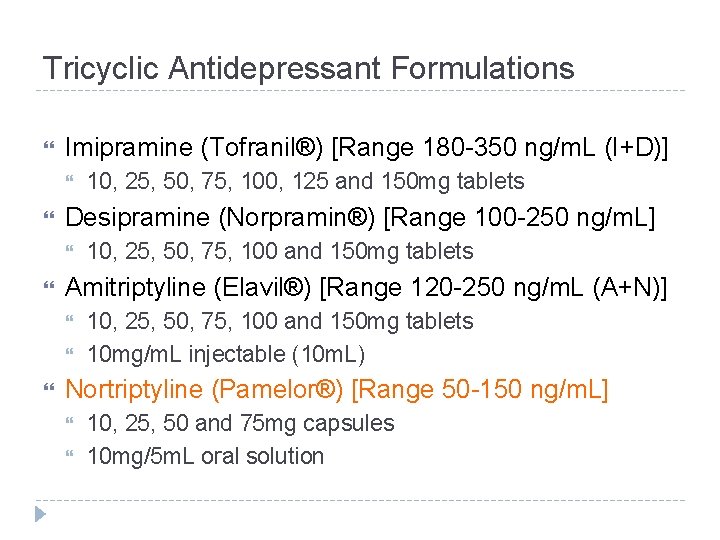
Tricyclic Antidepressant Formulations Imipramine (Tofranil®) [Range 180 -350 ng/m. L (I+D)] Desipramine (Norpramin®) [Range 100 -250 ng/m. L] 10, 25, 50, 75, 100 and 150 mg tablets Amitriptyline (Elavil®) [Range 120 -250 ng/m. L (A+N)] 10, 25, 50, 75, 100, 125 and 150 mg tablets 10, 25, 50, 75, 100 and 150 mg tablets 10 mg/m. L injectable (10 m. L) Nortriptyline (Pamelor®) [Range 50 -150 ng/m. L] 10, 25, 50 and 75 mg capsules 10 mg/5 m. L oral solution
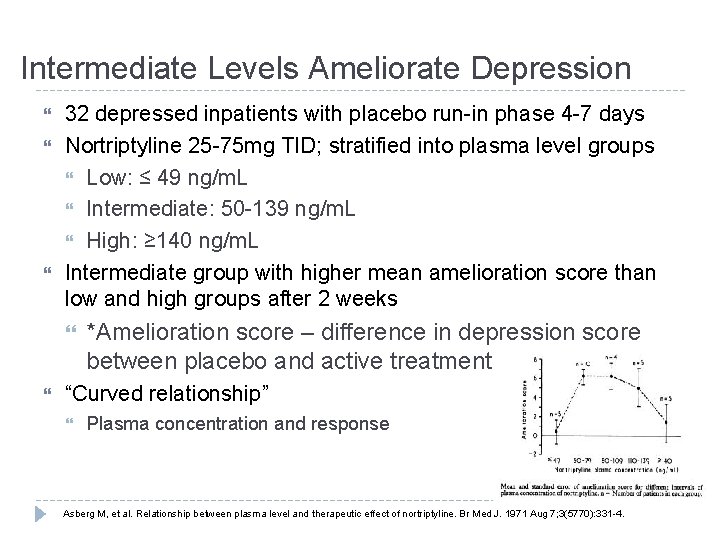
Intermediate Levels Ameliorate Depression 32 depressed inpatients with placebo run-in phase 4 -7 days Nortriptyline 25 -75 mg TID; stratified into plasma level groups Low: ≤ 49 ng/m. L Intermediate: 50 -139 ng/m. L High: ≥ 140 ng/m. L Intermediate group with higher mean amelioration score than low and high groups after 2 weeks *Amelioration score – difference in depression score between placebo and active treatment “Curved relationship” Plasma concentration and response Asberg M, et al. Relationship between plasma level and therapeutic effect of nortriptyline. Br Med J. 1971 Aug 7; 3(5770): 331 -4.
Case #4 MD (81 kg) has been taking Nortriptyline 50 mg TID for a week and is here for psychiatry follow-up appointment with residual depression symptoms. He has no complaints of side effects at this time. His morning trough was drawn at the lab and the level = 61 ng/m. L. Question: 1. How would you interpret this level? 2. What is the target level you suggest? 3. What is your MD recommendation?
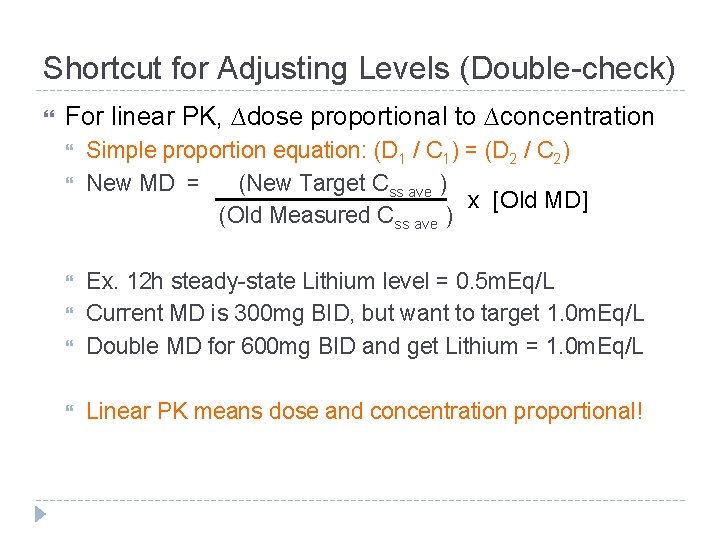
Shortcut for Adjusting Levels (Double-check) For linear PK, ∆dose proportional to ∆concentration Simple proportion equation: (D 1 / C 1) = (D 2 / C 2) New MD = (New Target Css ave ) x [Old MD] (Old Measured Css ave ) Ex. 12 h steady-state Lithium level = 0. 5 m. Eq/L Current MD is 300 mg BID, but want to target 1. 0 m. Eq/L Double MD for 600 mg BID and get Lithium = 1. 0 m. Eq/L Linear PK means dose and concentration proportional!
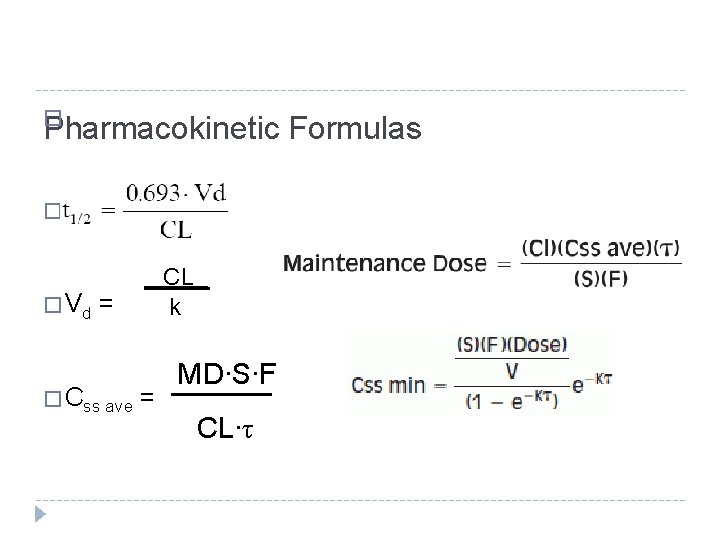
� Pharmacokinetic Formulas � � Vd = � Css ave = CL k MD∙S∙F CL∙τ
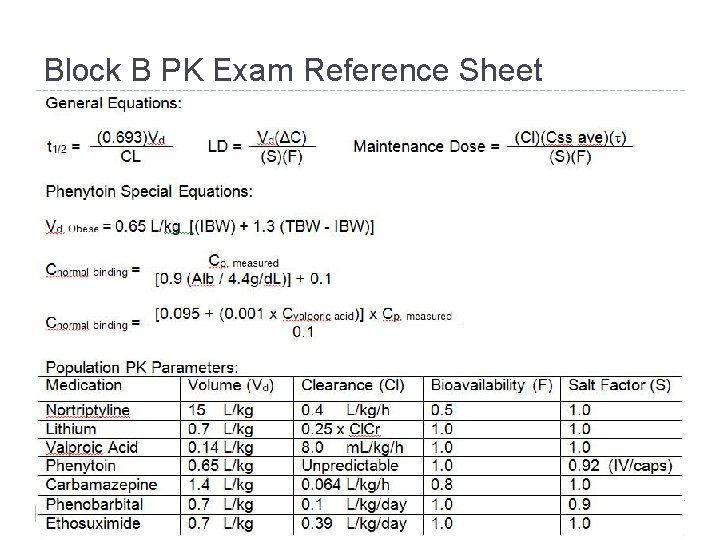
Block B PK Exam Reference Sheet
Questions?