
Clinical Pearls and Tools for Optimizing Breast Cancer
Clinical Pearls and Tools for Optimizing Breast Cancer Risk Assessment Anna Maria Storniolo, MD Professor of Clinical Medicine Division of Hematology/Oncology Director, Catherine Peachey Breast Cancer Prevention Program Indiana University School of Medicine Indianapolis, Indiana
Value of Risk Assessment § Improves overall quality of care § Encourages BC awareness § Enhances physician-patient relationship – Improves trust – Dispels misperceptions – Allays unwarranted fears § Provides basis for discussion of risk management 2

Estimating BC Risk: Gail Model 1 Features § Provides 5 -year and lifetime risk estimates based on – Age – Race – Age at first live birth or nulliparity – Number of first-degree relatives with a history of BC – Age at menarche – # of previous breast biopsies – Atypical hyperplasia 1. Coyne RL, Bevers T. In: Vogel VG, Bevers T, eds. Handbook of Breast Cancer Risk-Assessment. Sudbury, MA: Jones and Bartlett Publishers; 2003: 126 -145. 3

Gail Model: Advantages § An appropriate risk assessment tool for most women attending specialized clinics 1 § Identifies women who could benefit from preventive interventions; may assist in making clinical decisions 2 § Incorporates risk factors other than family history (eg, reproductive variables, atypical hyperplasia, history of breast biopsies)3 § Shows that BC risk increases with age and, therefore, may prompt discussion about the importance of BC screening 4 § Used to counsel and educate women, especially those who overestimate their BC risk 2 1. Euhus DM et al. Breast J. 2002; 8: 23 -27. 2. Gail MH, Costantino JP. J Natl Cancer Inst. 2001; 93: 334 -335 (editorial). 3. Domchek SM et al. J Clin Oncol. 2003; 21: 593 -601. 4. National Cancer Institute. Breast Cancer Risk Factors. Available at: http: //bcra. nci. nih. gov/brc/learnmore. htm. Accessed September 28, 2005. 4

Gail Model: Limitations § Modest discriminatory accuracy for individual women 1 § Not validated for black, Hispanic, and other ethnic groups 1 § May underestimate risk for women with demonstrated mutations of the BRCA 1 or BRCA 2 genes 1 § Only solicits family history involving first-degree relatives 2, 3 § May underestimate risk when family history is on father’s side 3 § Does not take into account age at which relatives developed BC 4 1. Gail M, Costantino JP. J Natl Cancer Inst. 2001; 93: 334 -335 (editorial). 2. Coyne RL, Bevers T. In: Vogel VG, Bevers T, eds. Handbook of Breast Cancer Risk-Assessment. Sudbury, MA: Jones and Bartlett Publishers; 2003: 126 -145. 3. Domchek SM et al. J Clin Oncol. 2003; 21: 593 -601. 4. Euhus DM et al. Breast J. 2002; 8: 23 -27. 5

Gail Model National Cancer Institute http: //bcra. nci. nih. gov/brc/questions. htm National Cancer Institute. Breast Cancer Risk Assessment Tool. Available at: http: //bcra. nci. nih. gov/brc/questions. htm. Accessed September 28, 2005. 6

Other Risk-Assessment Models § Claus 1 § Cuzick 2 § BRCAPRO 3 1. Claus EB et al. Cancer. 1994; 73: 643 -651. 2. Tyrer J et al. Stat Med. 2004; 23: 1111 -1130. 3. Euhus DM et al. J Natl Cancer Inst. 2002; 94: 844 -851. 7
Who Is at “Very High Risk”? § Personal history of BC 1 § BRCA 1 or BRCA 2 mutation carrier 1 § 2 or more 1 st-degree relatives with BC 2 § Lobular carcinoma in situ (LCIS)1 § Atypia and a 1 st-degree relative with BC 1 1. Hollingsworth AB et al. Am J Surg. 2004; 187: 349 -362. 2. Carpenter CL et al. Int J Cancer. 2003; 106: 96 -102. 8
Who Is at “High Risk”? § Atypia 1 § 5 -year Gail risk >1. 7%1 § 2 or more 2 nd-degree premenopausal affected relatives 1 § Combined estrogen-progesterone hormone therapy for more than 10 years 1 § Mammographically dense breasts 2 § Obesity 3 1. Hollingsworth AB et al. Am J Surg. 2004; 187: 349 -362. 2. Kerlikowske K et al. J Natl Cancer Inst. 2005; 97: 368 -374. 3. Davison D. In: Vogel VG, Bevers T. Handbook of Breast Cancer Risk-Assessment. Sudbury, MA: Jones and Bartlett Publishers; 2003: 10 -19. 9
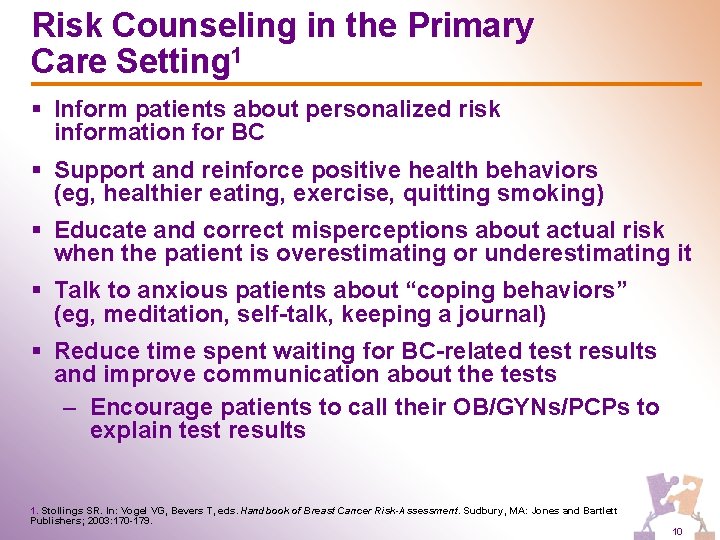
Risk Counseling in the Primary Care Setting 1 § Inform patients about personalized risk information for BC § Support and reinforce positive health behaviors (eg, healthier eating, exercise, quitting smoking) § Educate and correct misperceptions about actual risk when the patient is overestimating or underestimating it § Talk to anxious patients about “coping behaviors” (eg, meditation, self-talk, keeping a journal) § Reduce time spent waiting for BC-related test results and improve communication about the tests – Encourage patients to call their OB/GYNs/PCPs to explain test results 1. Stollings SR. In: Vogel VG, Bevers T, eds. Handbook of Breast Cancer Risk-Assessment. Sudbury, MA: Jones and Bartlett Publishers; 2003: 170 -179. 10
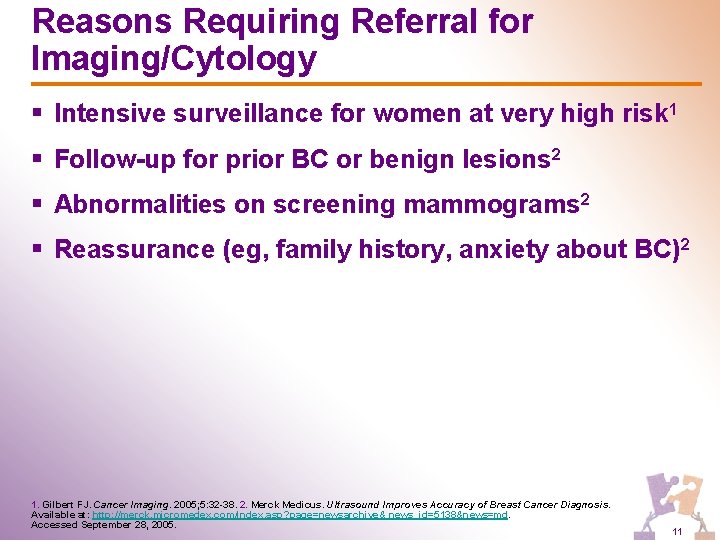
Reasons Requiring Referral for Imaging/Cytology § Intensive surveillance for women at very high risk 1 § Follow-up for prior BC or benign lesions 2 § Abnormalities on screening mammograms 2 § Reassurance (eg, family history, anxiety about BC)2 1. Gilbert FJ. Cancer Imaging. 2005; 5: 32 -38. 2. Merck Medicus. Ultrasound Improves Accuracy of Breast Cancer Diagnosis. Available at: http: //merck. micromedex. com/index. asp? page=newsarchive& news_id=5138&news=md. Accessed September 28, 2005. 11
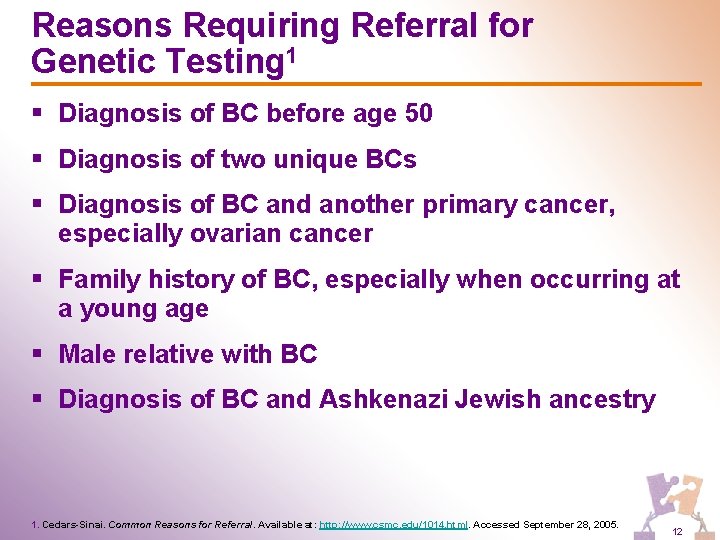
Reasons Requiring Referral for Genetic Testing 1 § Diagnosis of BC before age 50 § Diagnosis of two unique BCs § Diagnosis of BC and another primary cancer, especially ovarian cancer § Family history of BC, especially when occurring at a young age § Male relative with BC § Diagnosis of BC and Ashkenazi Jewish ancestry 1. Cedars-Sinai. Common Reasons for Referral. Available at: http: //www. csmc. edu/1014. html. Accessed September 28, 2005. 12
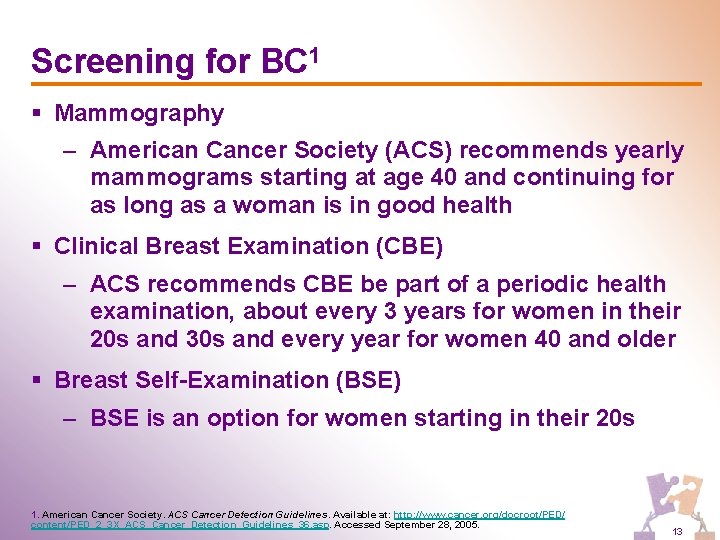
Screening for BC 1 § Mammography – American Cancer Society (ACS) recommends yearly mammograms starting at age 40 and continuing for as long as a woman is in good health § Clinical Breast Examination (CBE) – ACS recommends CBE be part of a periodic health examination, about every 3 years for women in their 20 s and 30 s and every year for women 40 and older § Breast Self-Examination (BSE) – BSE is an option for women starting in their 20 s 1. American Cancer Society. ACS Cancer Detection Guidelines. Available at: http: //www. cancer. org/docroot/PED/ content/PED_2_3 X_ACS_Cancer_Detection_Guidelines_36. asp. Accessed September 28, 2005. 13
BC Screening § Mammography screening in women aged 50 to 69 years demonstrated reduction of 20% to 35% in mortality from BC 1 § In 2002, ~40% of US women ≥ 40 years reported NOT having a mammography in the last year 2 1. Fletcher SW, Elmore JG. N Engl J Med. 2003; 348: 1672 -1680. 2. Smith RA et al. CA Cancer J Clin. 2004; 54: 41 -52. 14
Advice to All Women § Comply with mammography guidelines 1 § Maintain a healthy weight 2 § Get regular exercise 2 § Don’t rely on diet to reduce risk 2 § Consider other reasonable lifestyle modifications that may reduce risk – Reduce alcohol intake 2 – Avoid smoking 2 1. American Cancer Society. Can Breast Cancer Be Found Early? Available at: http: //www. cancer. org/docroot/CRI/content/CRI_2_4_3 X_Can_breast_cancer_be_found_early_5. asp. Accessed September 28, 2005. 2. Vogel VG. CA Cancer J Clin. 2000; 50: 156 -170. 15
Key Take-Away Messages § Screening for BC is an important part of risk assessment § The OB/GYN/PCP’s understanding of risk factors and use of risk assessment tools are necessary for BC disease-state awareness § The Gail risk-assessment model, though it has its limitations, is useful § Risk assessment for BC adds value to the OB/GYN/PCP practice, notably improving the overall quality of women’s healthcare 16
- Slides: 16