
Clinical Outcome and Healthcare Improvement Effects of Serving
- Slides: 1
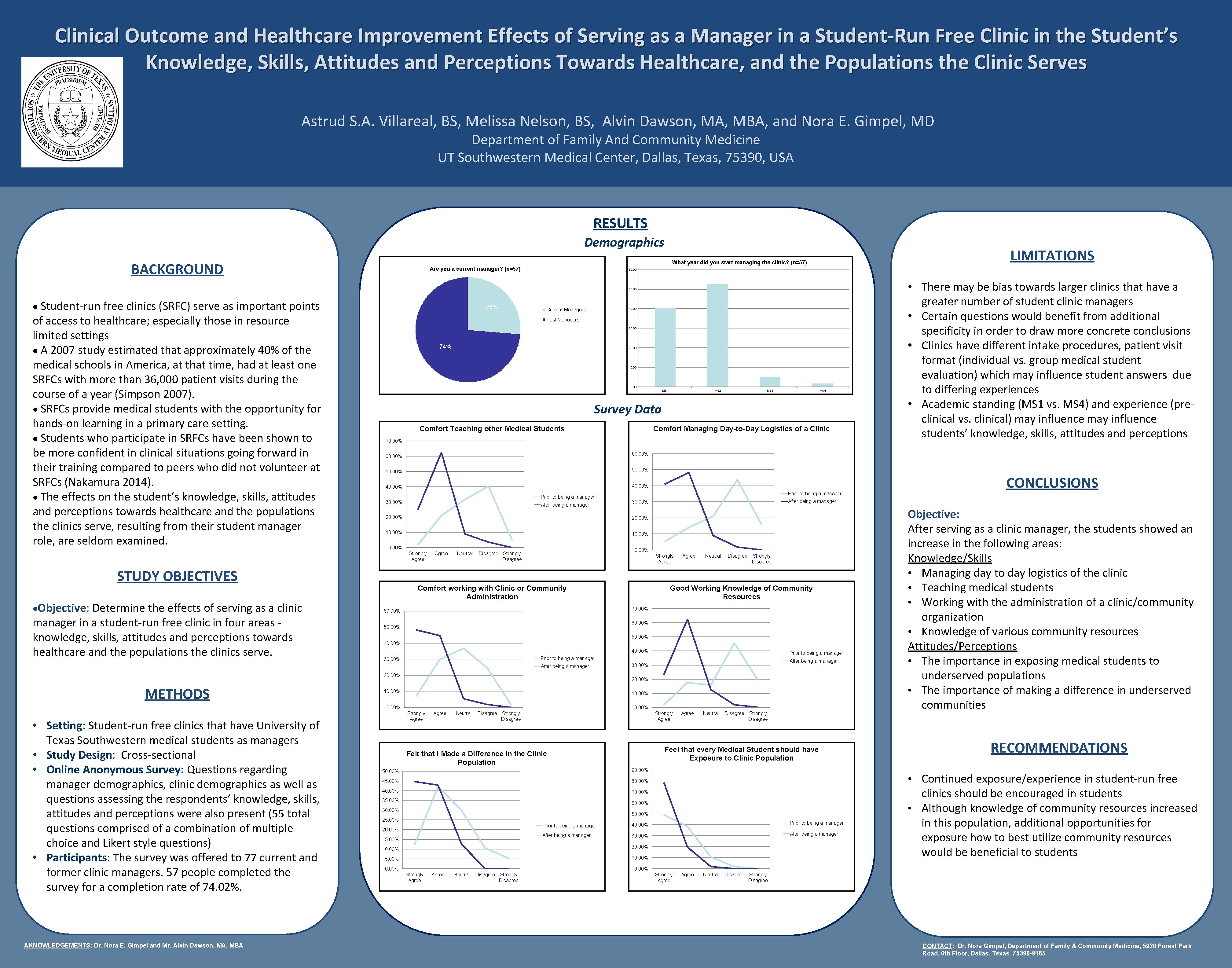
Clinical Outcome and Healthcare Improvement Effects of Serving as a Manager in a Student-Run Free Clinic in the Student’s Knowledge, Skills, Attitudes and Perceptions Towards Healthcare, and the Populations the Clinic Serves Astrud S. A. Villareal, BS, Melissa Nelson, BS, Alvin Dawson, MA, MBA, and Nora E. Gimpel, MD Department of Family And Community Medicine UT Southwestern Medical Center, Dallas, Texas, 75390, USA RESULTS Demographics LIMITATIONS What year did you start managing the clinic? (n=57) BACKGROUND Are you a current manager? (n=57) 60. 00 50. 00 · Student-run free clinics (SRFC) serve as important points of access to healthcare; especially those in resource limited settings · A 2007 study estimated that approximately 40% of the medical schools in America, at that time, had at least one SRFCs with more than 36, 000 patient visits during the course of a year (Simpson 2007). · SRFCs provide medical students with the opportunity for hands-on learning in a primary care setting. · Students who participate in SRFCs have been shown to be more confident in clinical situations going forward in their training compared to peers who did not volunteer at SRFCs (Nakamura 2014). · The effects on the student’s knowledge, skills, attitudes and perceptions towards healthcare and the populations the clinics serve, resulting from their student manager role, are seldom examined. 26% 30. 00 74% 20. 00 10. 00 MS 1 Comfort Teaching other Medical Students AKNOWLEDGEMENTS: Dr. Nora E. Gimpel and Mr. Alvin Dawson, MA, MBA MS 4 Comfort Managing Day-to-Day Logistics of a Clinic 60. 00% 50. 00% 40. 00% Prior to being a manager 30. 00% After being a manager Prior to being a manager 20. 00% 10. 00% Agree Neutral 0. 00% Disagree Strongly Agree Comfort working with Clinic or Community Administration Agree Neutral Disagree Strongly Disagree Good Working Knowledge of Community Resources 70. 00% 60. 00% 50. 00% 40. 00% Prior to being a manager 30. 00% After being a manager 30. 00% 20. 00% 10. 00% Strongly Agree Neutral Disagree Strongly Agree Strongly Disagree 50. 00% 90. 00% 45. 00% 80. 00% 40. 00% 70. 00% 35. 00% Agree Neutral Disagree Strongly Disagree Feel that every Medical Student should have Exposure to Clinic Population Felt that I Made a Difference in the Clinic Population 50. 00% 25. 00% 20. 00% 15. 00% Prior to being a manager 40. 00% Prior to being a manager After being a manager 30. 00% After being a manager 10. 00% 20. 00% 5. 00% 10. 00% Strongly Agree Neutral Disagree Strongly Disagree Objective: After serving as a clinic manager, the students showed an increase in the following areas: Knowledge/Skills • Managing day to day logistics of the clinic • Teaching medical students • Working with the administration of a clinic/community organization • Knowledge of various community resources Attitudes/Perceptions • The importance in exposing medical students to underserved populations • The importance of making a difference in underserved communities RECOMMENDATIONS • Continued exposure/experience in student-run free 60. 00% 30. 00% CONCLUSIONS After being a manager 30. 00% 20. 00% • Setting: Student-run free clinics that have University of Texas Southwestern medical students as managers • Study Design: Cross-sectional • Online Anonymous Survey: Questions regarding manager demographics, clinic demographics as well as questions assessing the respondents’ knowledge, skills, attitudes and perceptions were also present (55 total questions comprised of a combination of multiple choice and Likert style questions) • Participants: The survey was offered to 77 current and former clinic managers. 57 people completed the survey for a completion rate of 74. 02%. MS 3 70. 00% After being a manager METHODS MS 2 Survey Data STUDY OBJECTIVES manager in a student-run free clinic in four areas knowledge, skills, attitudes and perceptions towards healthcare and the populations the clinics serve. 40. 00 Past Managers Strongly Agree ·Objective: Determine the effects of serving as a clinic Current Managers • There may be bias towards larger clinics that have a greater number of student clinic managers • Certain questions would benefit from additional specificity in order to draw more concrete conclusions • Clinics have different intake procedures, patient visit format (individual vs. group medical student evaluation) which may influence student answers due to differing experiences • Academic standing (MS 1 vs. MS 4) and experience (preclinical vs. clinical) may influence students’ knowledge, skills, attitudes and perceptions Strongly Agree Neutral clinics should be encouraged in students • Although knowledge of community resources increased in this population, additional opportunities for exposure how to best utilize community resources would be beneficial to students Disagree Strongly Disagree CONTACT: Dr. Nora Gimpel, Department of Family & Community Medicine, 5920 Forest Park Road, 6 th Floor, Dallas, Texas 75390 -9165