
CLINICAL NEUROPHYSIOLOGY University of Pittsburgh RESEARCH LABORATORY Refractoriness
CLINICAL NEUROPHYSIOLOGY University of Pittsburgh RESEARCH LABORATORY Refractoriness and Loudness Dependence in Human Middle and Long-Latency Auditory Evoked Potentials López-Caballero, F. , Coffman, B. , Farris, R. , Fishel, V. , Seebold, D. , Torrence, N. , Wang, Y. , Teichert, T. , Salisbury, D. F. Department of Psychiatry University of Pittsburgh School of Medicine
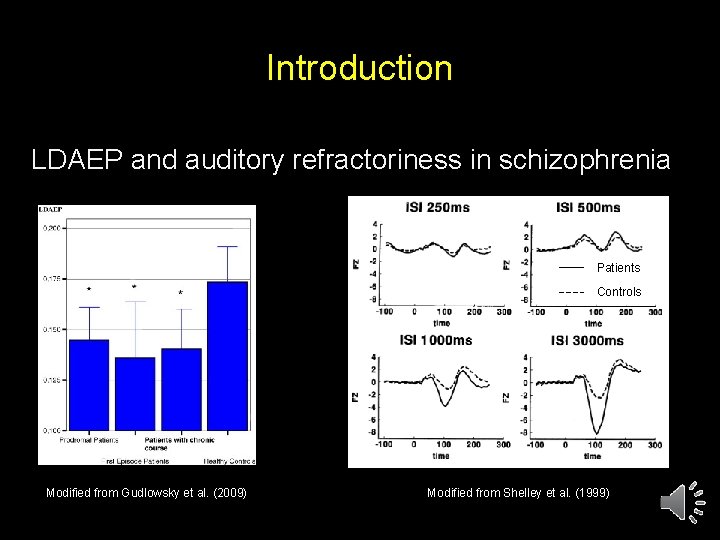
Introduction LDAEP and auditory refractoriness in schizophrenia Patients Controls Modified from Gudlowsky et al. (2009) Modified from Shelley et al. (1999)
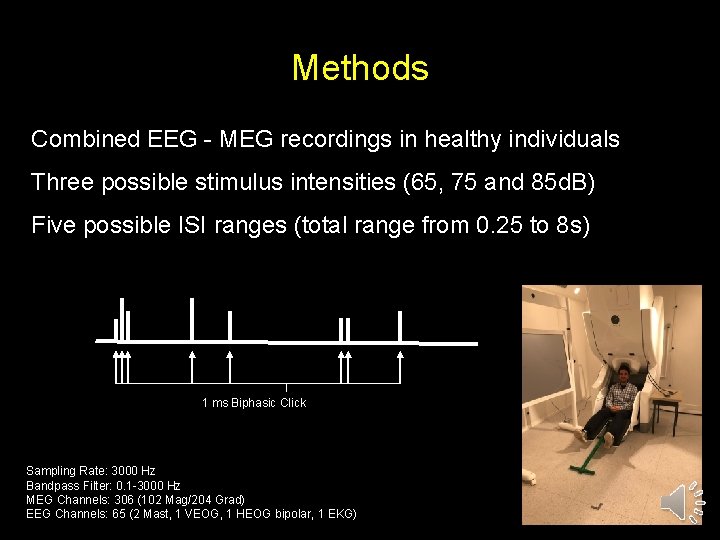
Methods Combined EEG - MEG recordings in healthy individuals Three possible stimulus intensities (65, 75 and 85 d. B) Five possible ISI ranges (total range from 0. 25 to 8 s) 1 ms Biphasic Click Sampling Rate: 3000 Hz Bandpass Filter: 0. 1 -3000 Hz MEG Channels: 306 (102 Mag/204 Grad) EEG Channels: 65 (2 Mast, 1 VEOG, 1 HEOG bipolar, 1 EKG)
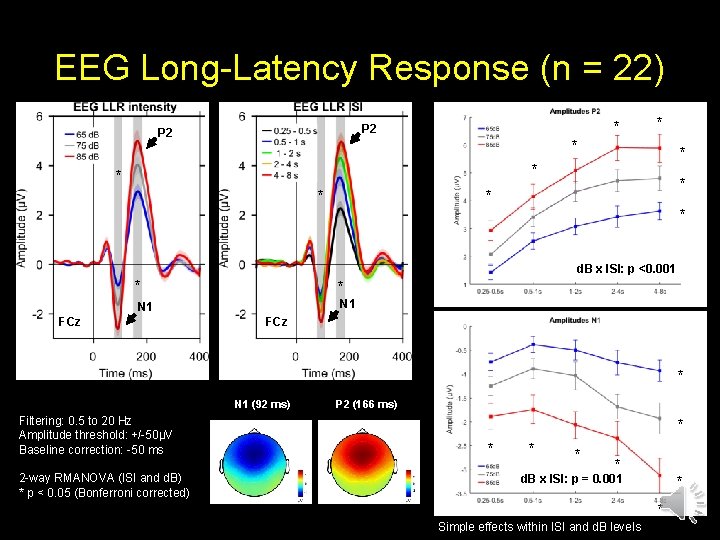
EEG Long-Latency Response (n = 22) P 2 * * * * * d. B x ISI: p <0. 001 * * N 1 FCz * N 1 (92 ms) Filtering: 0. 5 to 20 Hz Amplitude threshold: +/-50μV Baseline correction: -50 ms 2 -way RMANOVA (ISI and d. B) * p < 0. 05 (Bonferroni corrected) P 2 (166 ms) * * * d. B x ISI: p = 0. 001 * * Simple effects within ISI and d. B levels
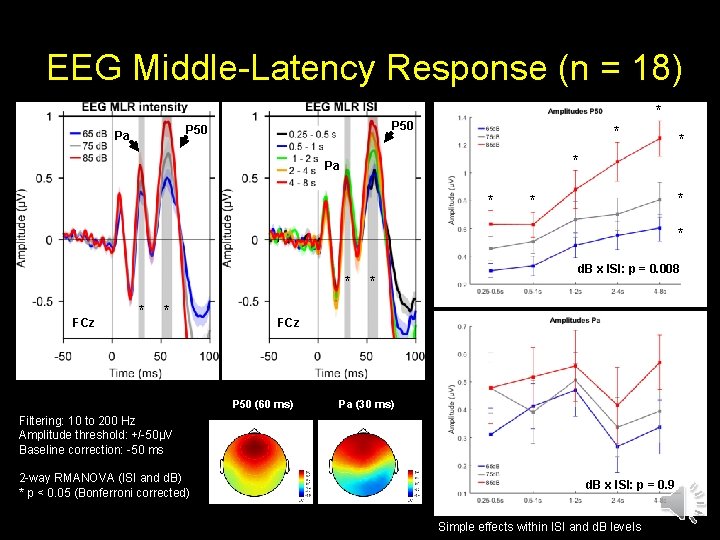
EEG Middle-Latency Response (n = 18) P 50 Pa * P 50 * * * Pa * * * FCz * * d. B x ISI: p = 0. 008 FCz P 50 (60 ms) Pa (30 ms) Filtering: 10 to 200 Hz Amplitude threshold: +/-50μV Baseline correction: -50 ms 2 -way RMANOVA (ISI and d. B) * p < 0. 05 (Bonferroni corrected) d. B x ISI: p = 0. 9 Simple effects within ISI and d. B levels
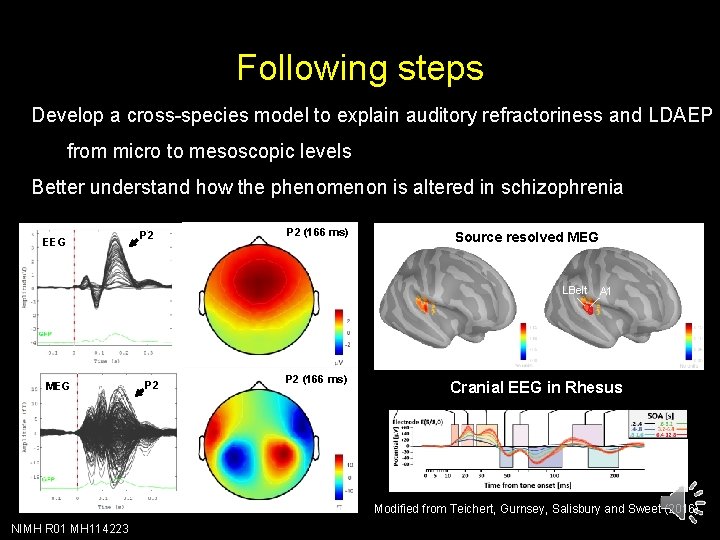
Following steps Develop a cross-species model to explain auditory refractoriness and LDAEP from micro to mesoscopic levels Better understand how the phenomenon is altered in schizophrenia EEG P 2 (166 ms) Source-resolve EEG-MEG sensor data MEG P 2 (166 ms) Source resolved MEG LBelt A 1 Cranial EEG in Rhesus Modified from Teichert, Gurnsey, Salisbury and Sweet (2016) NIMH R 01 MH 114223
- Slides: 6