
Clinical Jazz Harmonizing Clinical Experience and EvidenceBased Medicine
“Clinical Jazz” Harmonizing Clinical Experience and Evidence-Based Medicine David C. Slawson, MD Allen F. Shaughnessy, Pharm. D Lorne A. Becker, MD Shaughnessy AF, Slawson DC, Becker L. Clinical jazz: Harmonizing clinical experience and evidence-based medicine. J Fam Pract 1998; 47: 425 -8.
Objectives • Perceived conflicts between EBM and clinical experience • Problems associated with relying solely on clinical experience- self/experts • Restructuring into harmony- “clinical jazz”
Wait a Minute! What About Clinical Experience? “Clinical science and clinical expertise both have their essential place in medicine. There is potential danger in attempting to replace one by the other, in banning intuitive knowledge from the realm of the “rational” and in placing explicit, quantitative, calculating technique over implicit, intuitive human understanding as the ideal for clinical medical knowledge” Gordon DR. Clinical science and clinical expertise: changing boundaries between art and science in medicine. Lock M, Gordon DR, eds. Biomedicine Examined. 1988; Boston, Mass: Kluwer Academic Publishers, 257 -95.
Clinical Experience • The fertile ground from which ideas and hypotheses grow • Major conflict: Experience doesn’t jibe with research-based evidence
Clinical Experience • Not a source of valid POEMs • Multiple validity problems
Clinical Experience - Validity • Latest “bad experience” bias • “Out of sight, out of mind” – “he would have told me if he was having problems” • Nonrandom loss to follow up – Dissatisfied customers go elsewhere • Inability to combine outcome data for multiple patients
Clinical Experience - Validity • Small sample size • “Stacking the deck”: Biased allocation to treatment groups • “Rose-colored glasses”: Biased assessment of outcomes
“Reverse Gullibility” • The story of Semmelweis – 1847: hand washing decreased obstetric mortality from 18% to 1. 2% – Virulent attacks lead to asylum commitment • MDIs vs nebulizers, eye-patches, H. Pylori (Barry Marshall), home glucose monitors, others
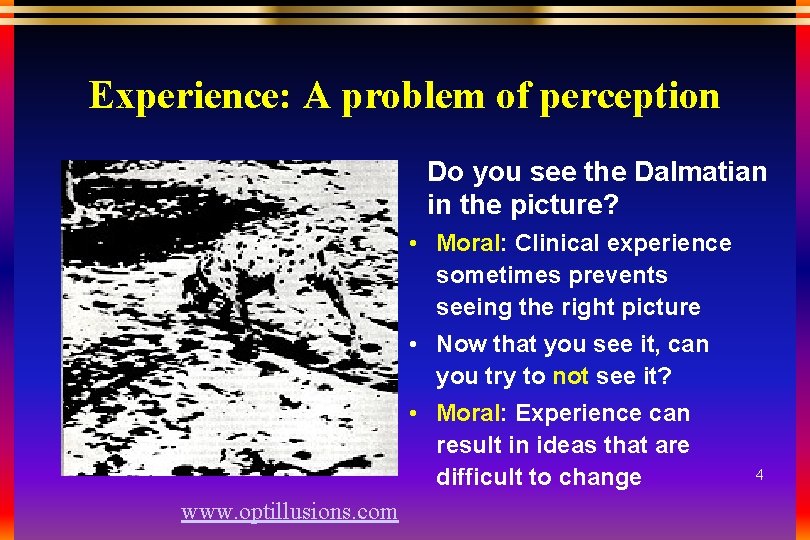
Experience: A problem of perception Do you see the Dalmatian in the picture? • Moral: Clinical experience sometimes prevents seeing the right picture • Now that you see it, can you try to not see it? • Moral: Experience can result in ideas that are difficult to change www. optillusions. com 4
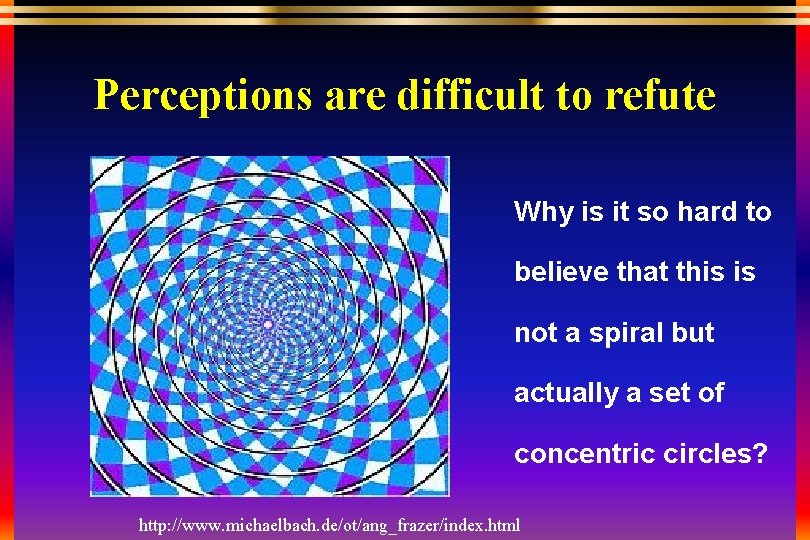
Perceptions are difficult to refute Why is it so hard to believe that this is not a spiral but actually a set of concentric circles? http: //www. michaelbach. de/ot/ang_frazer/index. html
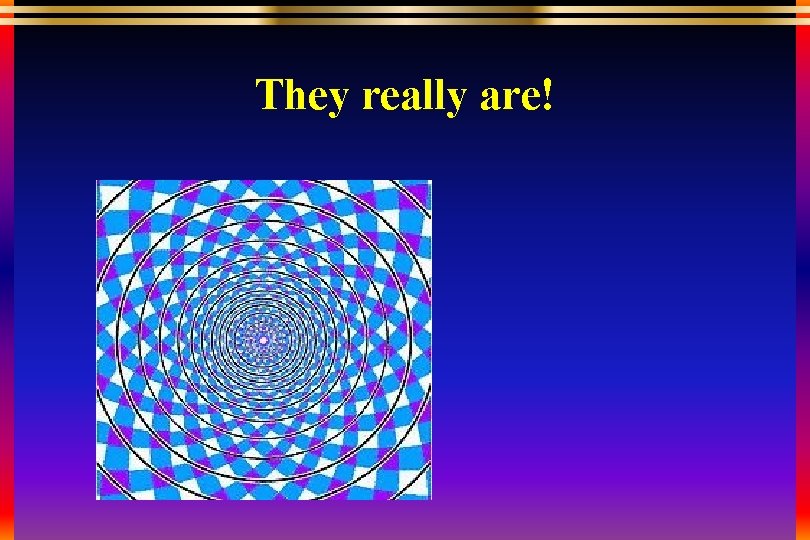
They really are!
Clinical Experience Not really in competition with EBM
Combining EBM and Experience: “Clinical Jazz” Structure plus Improvisation
Clinical Jazz Improvisation without structure = cacophony
Clinical Jazz Structure without Improvisation= tedium
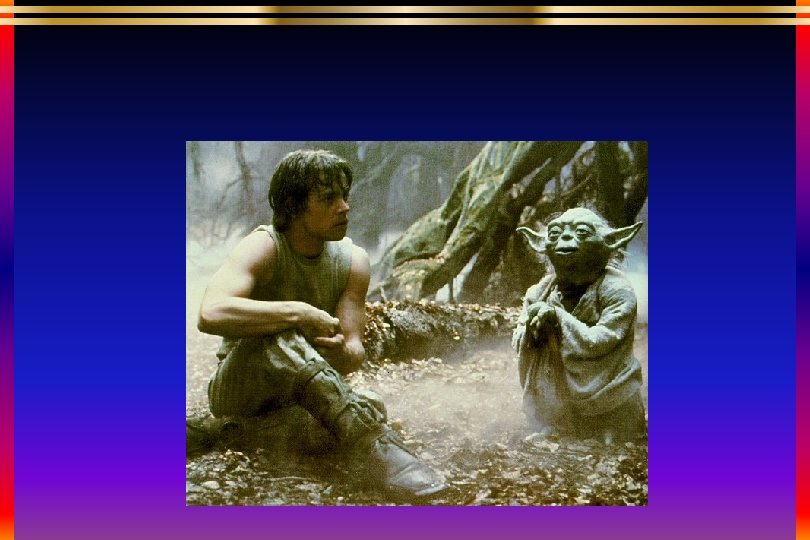
Remember “The Expert” • Expert in diagnosis and procedures (clinical experience) • Not necessarily expert in therapeutics (EBM) – Case series; LOE 4 at best • The best expert (YODA) combines experience with the evidence = Clinical Jazz
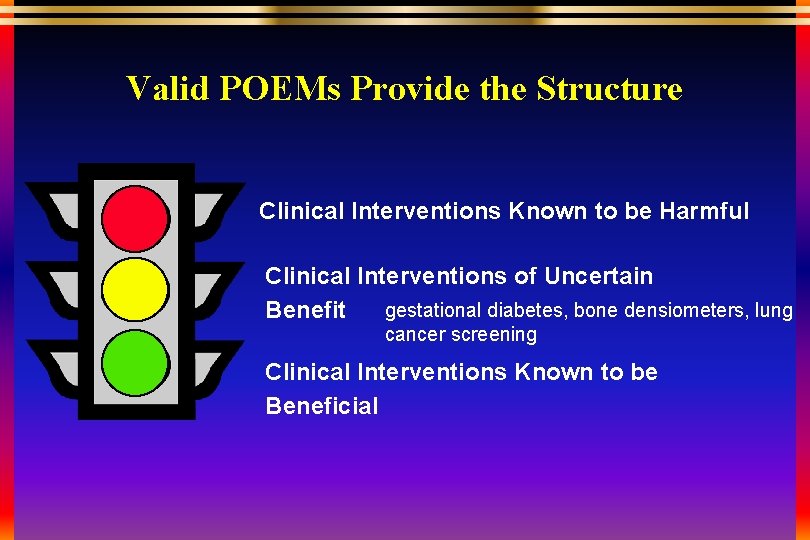
Valid POEMs Provide the Structure Clinical Interventions Known to be Harmful Clinical Interventions of Uncertain gestational diabetes, bone densiometers, lung Benefit cancer screening Clinical Interventions Known to be Beneficial
Advantages of Information Mastery • A liberating structure – Stable (little chance of ping-pongs) – Simple rules (find the valid POEMs) • Relatively non-restrictive – There aren’t that many valid POEMs!
Clinical Improvisation - Opportunities • Conditions with no valid POEMs – e. g. Screening for lung cancer • Conditions with multiple valid POEMs – e. g. depression
Clinical Improvisation - Opportunities • Patients whose characteristics differ from those of patients included in research studies • Implementation methods for valid POEMs
Clinical Improvisation - Potential Sources of Inspiration • Clinical Experience • Colleagues’ Ideas • Local Experts & Consultants • “Standard of Care” • DOEs • Others
Clinical Improvisation Not a Solo Activity • Including the patient’s perspective • Working with a clinical team • Working with consultants • Working with partners
“If you can’t listen, you can’t play jazz” Wynton Marsalis
Using Clinical Experience to Develop Valid POEMs • For Individual Patients – N of 1 clinical trials • For Groups of Patients – outcomes-based research
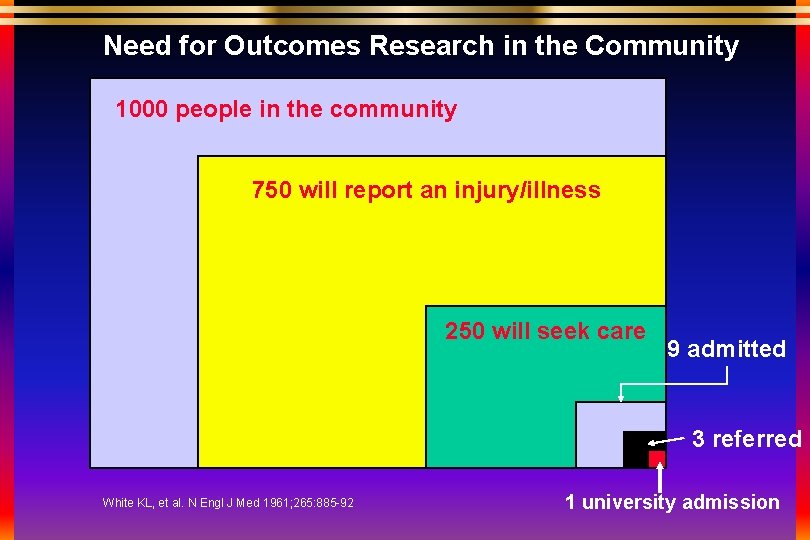
Need for Outcomes Research in the Community 1000 people in the community 750 will report an injury/illness 250 will seek care 9 admitted 3 referred White KL, et al. N Engl J Med 1961; 265: 885 -92 1 university admission
Valid POEMs “Outcomes-Based Research” • Goal: Not to replace clinical judgment, but to give clinicians more information to base opinions and practices. • “Primum non Nocere” • “Dualism”- distinction between clinical experience and patient-oriented research is in error
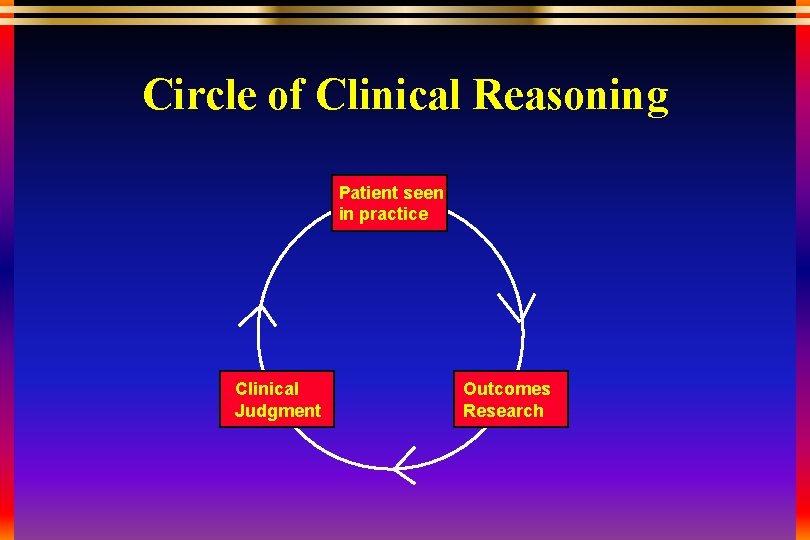
Circle of Clinical Reasoning Patient seen in practice Clinical Judgment Outcomes Research
Flaws in the Circle of Reasoning • Fallacy of Division: What is true of the whole must also be true of its parts – “Bell curve of clinical response” – Law of Diminishing Return, the “Keflex. Reflex”
Flaws in the Circle of Reasoning • Fallacy of Hasty Conclusion: What is true of the parts must also be true of the whole – Using evidence from clinical experience to justify a general approach to all patients, without applying the rigors of the scientific method, may result in harm
Why is Medicine Here? • Goals of medicine: – Relieve/prevent suffering – Maintain/provide hope – Prevent, treat, or cure disease • The science of medicine: – knowing the best way to prevent, treat, or cure disease – EBM can address this aspect • The art of medicine: – Determining, using intuition, experience, and judgment, what patients need the most • Clinical jazz = science + art
“Mundus Vult Decipi”“The world wishes to be deceived” People would rather be deceived than have the truth create anxiety. -Caleb Carr, “Killing Time”
“The only sure foundations of medicine are an intimate knowledge of the human body and observations on the effects of medicinal substances on that body” -Thomas Jefferson
“America’s two greatest gifts to the world are jazz and Medline. ” --Richard Smith, BMJ 2001
The Yin and Yang of Medicine • Start music • Rigid enforcement of outcomes-based guidelines just as misguided as foregoing results of patient-oriented research • The seeming opposites of medical practice, clinical science and clinical experience, are inseparable • Structure with improvisation = true art
The Bottom Line “We may not have all the right answers, but we need to find and verify those that do exist; for the rest, we need to ask the right questions. ”
“If we shadows have offended, Think but this, and all is mended, That you have but slumbered here, While these visions did appear. And this weak and idle theme, No more yielding but a dream, Gentles, do not reprehend. If you pardon, we will mend. . So good(bye) unto you all. ” William Shakespeare- A Midsummer Night’s Dream
- Slides: 37