
Clinical Impact of ASCO Choosing Wisely Guidelines on
- Slides: 1
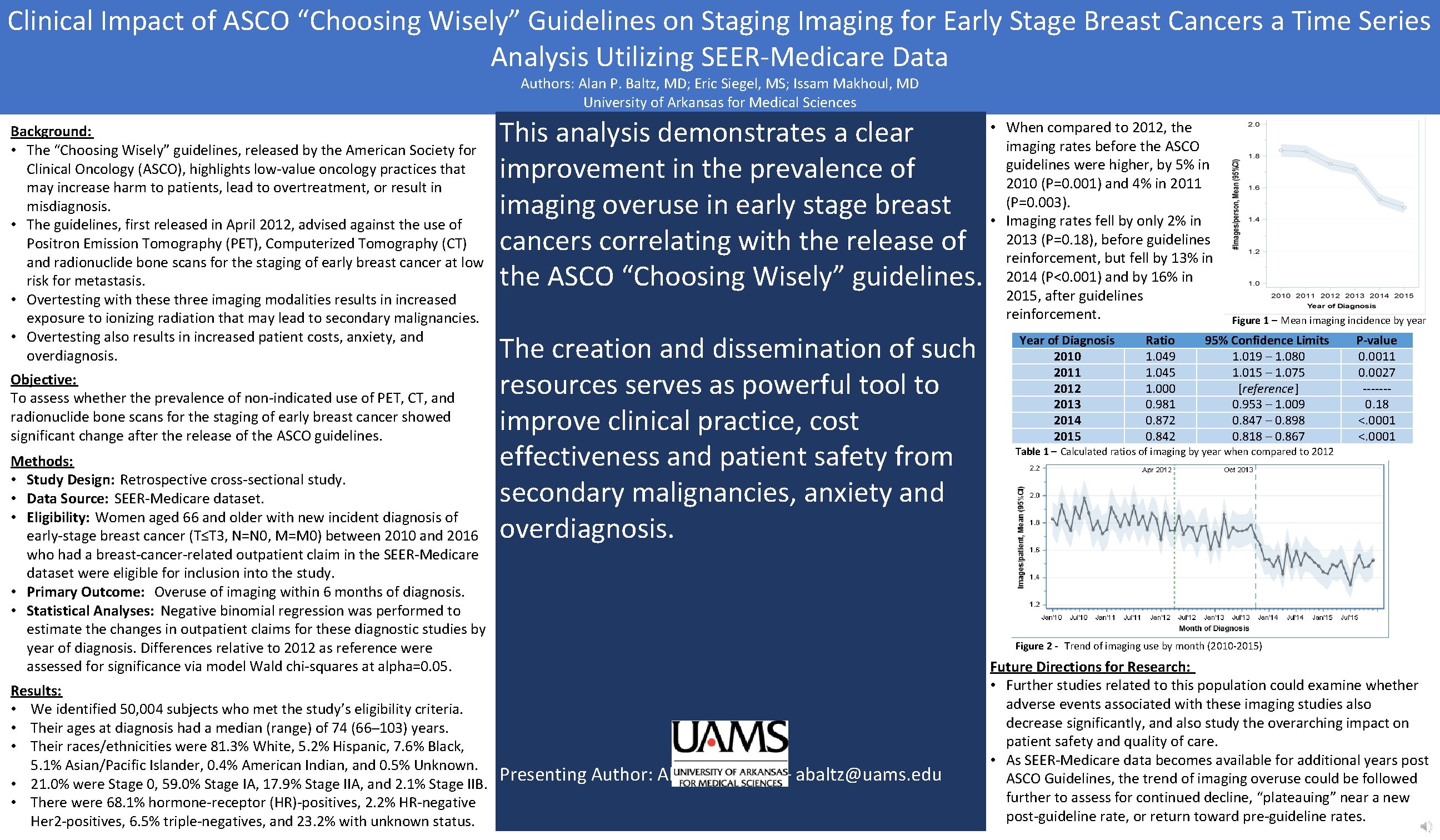
Clinical Impact of ASCO “Choosing Wisely” Guidelines on Staging Imaging for Early Stage Breast Cancers a Time Series Analysis Utilizing SEER-Medicare Data Authors: Alan P. Baltz, MD; Eric Siegel, MS; Issam Makhoul, MD University of Arkansas for Medical Sciences Background: • The “Choosing Wisely” guidelines, released by the American Society for Clinical Oncology (ASCO), highlights low-value oncology practices that may increase harm to patients, lead to overtreatment, or result in misdiagnosis. • The guidelines, first released in April 2012, advised against the use of Positron Emission Tomography (PET), Computerized Tomography (CT) and radionuclide bone scans for the staging of early breast cancer at low risk for metastasis. • Overtesting with these three imaging modalities results in increased exposure to ionizing radiation that may lead to secondary malignancies. • Overtesting also results in increased patient costs, anxiety, and overdiagnosis. Objective: To assess whether the prevalence of non-indicated use of PET, CT, and radionuclide bone scans for the staging of early breast cancer showed significant change after the release of the ASCO guidelines. Methods: • Study Design: Retrospective cross-sectional study. • Data Source: SEER-Medicare dataset. • Eligibility: Women aged 66 and older with new incident diagnosis of early-stage breast cancer (T≤T 3, N=N 0, M=M 0) between 2010 and 2016 who had a breast-cancer-related outpatient claim in the SEER-Medicare dataset were eligible for inclusion into the study. • Primary Outcome: Overuse of imaging within 6 months of diagnosis. • Statistical Analyses: Negative binomial regression was performed to estimate the changes in outpatient claims for these diagnostic studies by year of diagnosis. Differences relative to 2012 as reference were assessed for significance via model Wald chi-squares at alpha=0. 05. Results: • We identified 50, 004 subjects who met the study’s eligibility criteria. • Their ages at diagnosis had a median (range) of 74 (66─103) years. • Their races/ethnicities were 81. 3% White, 5. 2% Hispanic, 7. 6% Black, 5. 1% Asian/Pacific Islander, 0. 4% American Indian, and 0. 5% Unknown. • 21. 0% were Stage 0, 59. 0% Stage IA, 17. 9% Stage IIA, and 2. 1% Stage IIB. • There were 68. 1% hormone-receptor (HR)-positives, 2. 2% HR-negative Her 2 -positives, 6. 5% triple-negatives, and 23. 2% with unknown status. This analysis demonstrates a clear improvement in the prevalence of imaging overuse in early stage breast cancers correlating with the release of the ASCO “Choosing Wisely” guidelines. The creation and dissemination of such resources serves as powerful tool to improve clinical practice, cost effectiveness and patient safety from secondary malignancies, anxiety and overdiagnosis. • When compared to 2012, the imaging rates before the ASCO guidelines were higher, by 5% in 2010 (P=0. 001) and 4% in 2011 (P=0. 003). • Imaging rates fell by only 2% in 2013 (P=0. 18), before guidelines reinforcement, but fell by 13% in 2014 (P<0. 001) and by 16% in 2015, after guidelines reinforcement. Year of Diagnosis 2010 2011 2012 2013 2014 2015 Ratio 1. 049 1. 045 1. 000 0. 981 0. 872 0. 842 Figure 1 – Mean imaging incidence by year 95% Confidence Limits 1. 019 – 1. 080 1. 015 – 1. 075 [reference ] 0. 953 – 1. 009 0. 847 – 0. 898 0. 818 – 0. 867 P-value 0. 0011 0. 0027 ------0. 18 <. 0001 Table 1 – Calculated ratios of imaging by year when compared to 2012 Figure 2 - Trend of imaging use by month (2010 -2015) Presenting Author: Alan Baltz, MD – abaltz@uams. edu Future Directions for Research: • Further studies related to this population could examine whether adverse events associated with these imaging studies also decrease significantly, and also study the overarching impact on patient safety and quality of care. • As SEER-Medicare data becomes available for additional years post ASCO Guidelines, the trend of imaging overuse could be followed further to assess for continued decline, “plateauing” near a new post-guideline rate, or return toward pre-guideline rates.