
CLINICAL DOCUMENTATION INTEGRITY STRATEGIES FOR ACCURATE EFFECTIVE MEDICAL



- Slides: 46
CLINICAL DOCUMENTATION INTEGRITY STRATEGIES FOR ACCURATE EFFECTIVE MEDICAL DOCUMENTATION AND CLINICAL COMMUNICATION Jacob A. Martin II MD, ABPM, ABQAURP, PA-CDI, CI-CDI Sr. Physician Educator, Auditor & Consultant
PRESENTER DISCLOSURE Presenter has disclosed no relevant financial relationship
OBJECTIVES Brief review of International Classification of Diseases (ICD) version 10 and it’s effect of Clinical Modification. • Discussion of best practice strategies for achieving more specific, accurate, detailed medical documentation through an effective CDI program. • Discussion of documentation importance relative to specific medical conditions • Brief discussion of DRGs/MS-DRGs •
AGENDA • Disease Classification • Diagnosis Related Groups • Clinical Documentation Specifics • Medicare Severity Diagnosis Related Groups Documentation and Coding • Resources
ICD-10 CODING BASICS: A FOUNDATION FOR CDI THE UNDERPINNINGS OF CLINICAL DOCUMENTATION IMPROVEMENT
GOALS OF CLINICAL DOCUMENTATION INTEGRITY PROGRAM Accurate and complete medical record documentation reflective of patient clinical presentation, work-up, management/treatment, and clinical outcomes. MORE IS NOT NECESSARILY BETTER –RELEVANT VS. VOLUMINOUS DOCUMENTATION Accurate and complete representation of patient severity of illness, risk of morbidity, and mortality Accurate and complete representation of medical necessity for acute care and the procedures provided: there should be a statement in the progress note each day why the patient requires ongoing hospitalization. Underpinning of complete and accurate coding whereby to capture the most appropriate revenue CDI review activities include both concurrent and retrospective chart reviews: 1. Concurrent review is a prospective attempt to ensure specific, accurate detailed medical documentation and often involves physician query.
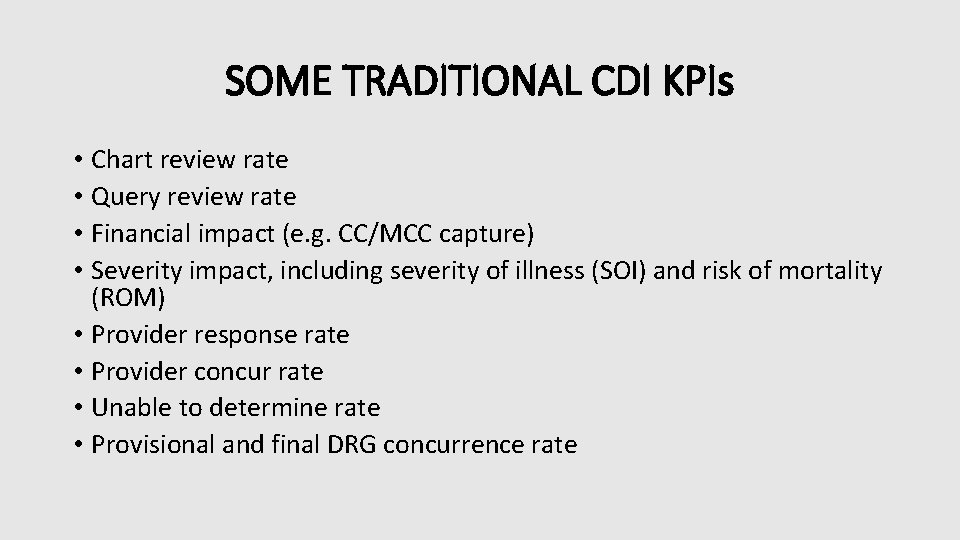
SOME TRADITIONAL CDI KPIs • Chart review rate • Query review rate • Financial impact (e. g. CC/MCC capture) • Severity impact, including severity of illness (SOI) and risk of mortality (ROM) • Provider response rate • Provider concur rate • Unable to determine rate • Provisional and final DRG concurrence rate
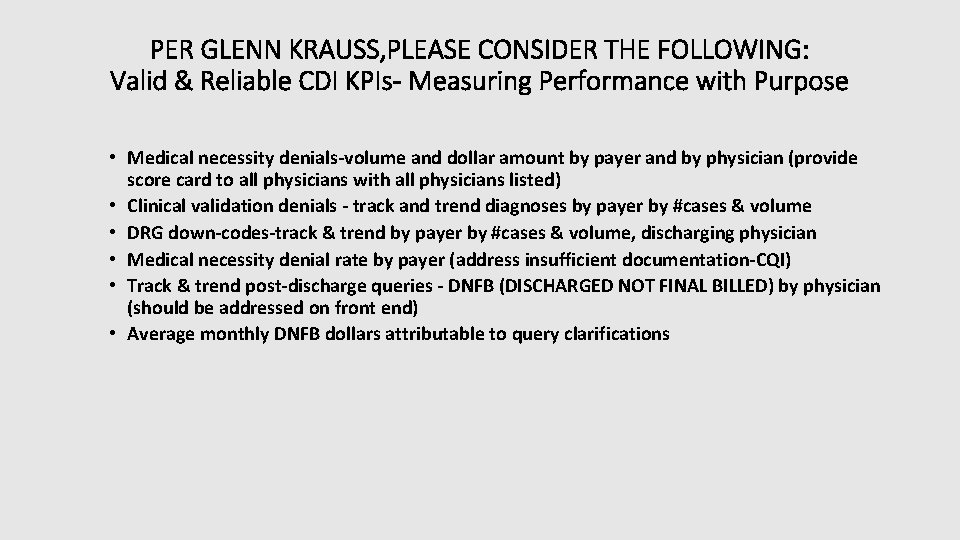
PER GLENN KRAUSS, PLEASE CONSIDER THE FOLLOWING: Valid & Reliable CDI KPIs- Measuring Performance with Purpose • Medical necessity denials-volume and dollar amount by payer and by physician (provide score card to all physicians with all physicians listed) • Clinical validation denials - track and trend diagnoses by payer by #cases & volume • DRG down-codes-track & trend by payer by #cases & volume, discharging physician • Medical necessity denial rate by payer (address insufficient documentation-CQI) • Track & trend post-discharge queries - DNFB (DISCHARGED NOT FINAL BILLED) by physician (should be addressed on front end) • Average monthly DNFB dollars attributable to query clarifications
DOCUMENTATION PRIME DIRECTIVE TO MAINTAIN CLINICAL DOCUMENTATION INTEGRITY CAUTION: NEVER DOCUMENT ANYTHING WHICH YOU DO NOT CLINICALLY SUSPECT OR BELIEVE TO BE THE CASE: EMBELLISHMENT AND FICTION HAVE NO PLACE IN A MEDICAL RECORD!!!
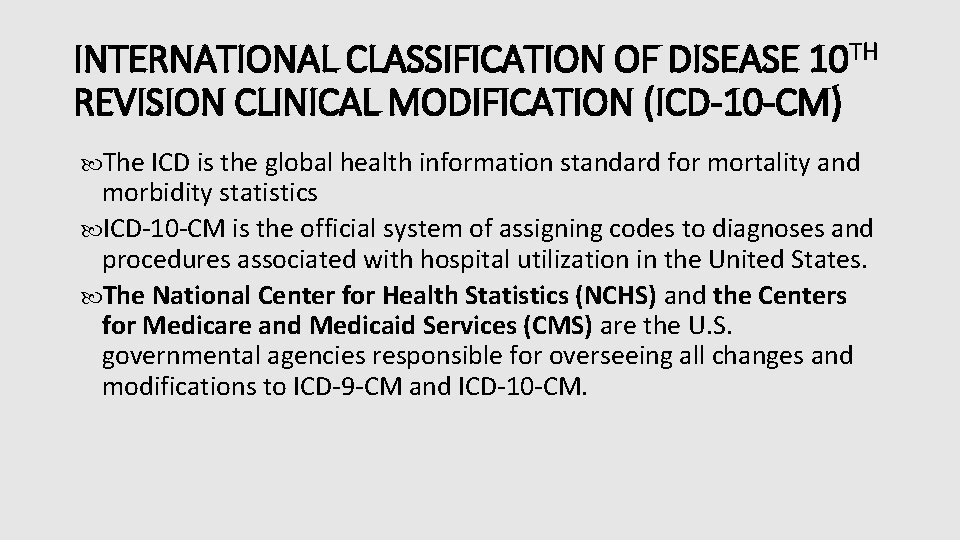
INTERNATIONAL CLASSIFICATION OF DISEASE 10 TH REVISION CLINICAL MODIFICATION (ICD-10 -CM) The ICD is the global health information standard for mortality and morbidity statistics ICD-10 -CM is the official system of assigning codes to diagnoses and procedures associated with hospital utilization in the United States. The National Center for Health Statistics (NCHS) and the Centers for Medicare and Medicaid Services (CMS) are the U. S. governmental agencies responsible for overseeing all changes and modifications to ICD-9 -CM and ICD-10 -CM.
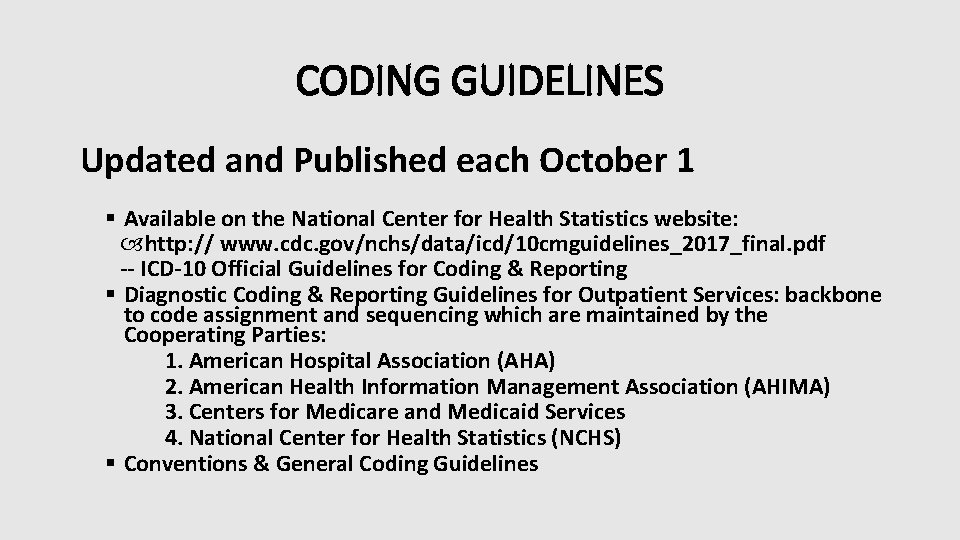
CODING GUIDELINES Updated and Published each October 1 § Available on the National Center for Health Statistics website: http: // www. cdc. gov/nchs/data/icd/10 cmguidelines_2017_final. pdf -- ICD-10 Official Guidelines for Coding & Reporting § Diagnostic Coding & Reporting Guidelines for Outpatient Services: backbone to code assignment and sequencing which are maintained by the Cooperating Parties: 1. American Hospital Association (AHA) 2. American Health Information Management Association (AHIMA) 3. Centers for Medicare and Medicaid Services 4. National Center for Health Statistics (NCHS) § Conventions & General Coding Guidelines
ICD-10 CM The ICD-10 -CM is a morbidity classification published by the United States for classifying diagnoses and reason(s) for visits in all health care settings. The ICD-10 -CM is based on the ICD-10, the statistical classification of disease published by the World Health Organization (WHO).
MEDICAL NECESSITY • In clinical documentation, we hold this truth to be self-evident: unless there is medical documentation whereby to support an inpatient level of care (LOC), CDI is irrelevant because the LOC will be OBSERVATION. • There should be a statement each hospital day to clearly delineate why an inpatient level of care is medically necessary supported in the medical record by factors such as: • • history and comorbidities severity of signs and symptoms current medical needs risk of adverse events
KNOW THY DEFINITIONS • Principal Diagnosis - That condition established after study felt to have been chiefly responsible for occasioning the admission of the patient to the hospital for care. § The circumstances of inpatient admission always govern the selection of principal diagnosis: a medical condition must have been present on admission in order to have been selected as a principal DX. • Co-morbid Condition (CC)- Any condition which has a 75% likelihood of prolonging the inpatient stay by at least one day • Complication- An event that was not planned, (may be anticipated), that develops while patient is receiving care • Major CC: higher medical resource consumption, longer LOS, increased risk of morbidity-mortality
ADDITIONAL DIAGNOSIS REPORTING Uniform Hospital Discharge Data Set (UHDDS) Additional Diagnosis Reporting relative to: “Additional Conditions” that affect patient care in terms of requiring: Clinical evaluation; or Therapeutic management; or Diagnostic procedures; or Extended length of hospital stay; or Increased nursing care and/or monitoring “Other Diagnoses” (UHDDS) defined as “All conditions that coexist at the time of admission, that develop subsequently, or that affect the treatment received and/or the length of stay”.
THE NAME OF THE GAME CAPTURE ALL CLINICAL CONDITIONS Managed, Treated, Worked-up, or Monitored with appropriate specificity in documentation.
OTHER CONSIDERATIONS Abnormal diagnostic findings (lab, x-ray, pathologic, and other diagnostic results) are not coded and reported unless the provider indicates their clinical significance via clinical correlation. Clinical Significance in ICD 10 Clinical Query Uncertain diagnosis - If the diagnosis documented at the time of discharge is qualified as “probable, ” “suspected, ” “likely, “questionable, ” “possible, ” or “still to be ruled out, ” and it is medically managed in terms of work up and or treatment, it may be coded as if it were present and the condition can be considered as part of the principal and secondary diagnoses selection.
DOCUMENTATION KEY TERMS for SPECIFICITY Relevant descriptor(s) should be on ALL Primary and Secondary Diagnoses Acute on Chronic Uncontrolled Decompensated Mild, Mod, Severe, Extensive Malignant (such as HTN) Accelerated End Stage Exacerbation Worsening Improving Stable Present on Admission (POA)!!! Nosocomial Resolving/Sequlae to… Dominant or Non-Dominant side (Left/Right/Bilateral) Gestational Trimester (1 st, 2 nd, 3 rd)
“OVER AND DONE WITH” MEDICAL CONDITIONS Please recall that, in the world of coding and external medical review: medical conditions listed under “Past Medical History” or referred to as “History Of”, may be considered to be inactive and to no longer require ongoing medical evaluation and/or management. This may result in the medical record inaccurately reflecting (1) severity of illness, (2) medical necessity for resource utilization, (3) risk of morbidity/mortality, and (4) your focused care/medical decision-making. Take appropriate credit for all medical conditions under current management whether or not (1) they were relevant to the current hospital stay and (2) whether or not you made the DX yourself.
PREEMPTIVE DOCUMENTATION PROCESSES 1. DO IT RIGHT THE FIRST TIME EVERY TIME: • reduces number of concurrent and retrospective queries: retrospective queries delay final coding-billing • facilitates quality reporting initiatives • enhances interdisciplinary communication of patient’s status and ongoing evaluation • provides timely documentation of medical necessity, patient acuity, severity of illness, and risk of mortality • facilitates case management activities • reduces number of claim denials • effectively increases time available for direct patient care • reduces medico-legal risk
PREEMPTIVE DOCUMENTATION PROCESSES 2. FOR ANY MEDICAL CONDITION ALWAYS DOCUMENT THE FOLLOWING IF KNOWN: • Type • Acuity level • Clinical indicators which you feel support the cited DX: in the setting of external reviews/audits, “It’s not so just because you say it’s so. ” • Suspected cause(s) • Current status (acuity level may suffice) NOTE: consistent documentation of a given medical condition, along with its current status, is important once the medical condition is introduced into the medical record. TRUTH: what is done during a hospitalization is not billed (or reimbursed) unless it was satisfactorily documented.
THE BIG 6: EXTERNAL MEDICAL REVIEW IS PARTICULARLY FOCUSED IN THESE AREAS. • ACUTE RESPIRATORY FAILURE • ACUTE RENAL FAILURE • ENCEPHALOPATHY • SEPSIS • PNEUMONIA • MALNUTRITION DOC PEARL: it is important to clearly document clinical indicators for all of these diagnoses at the time the DX is rendered.
ACUTE RESPIRATORY FAILURE It is important to document: • Type/acuity level • Suspected cause(s) • All clinical indicators which you feel support this DX • If superimposed on chronic respiratory failure (any type), how the acute deterioration compares to baseline respiratory parameters. • p. O 2 <60 mm Hg or Sp. O 2 (pulse oximetry) O 2 SAT <91% breathing room air • p. CO 2 >50 mm Hg and p. H <7. 35 (hypercapnic) • P/F ratio (p. O 2 / FIO 2) <300 • p. O 2 decrease or p. CO 2 increase by 10 to 15 mm Hg from baseline (if known) in setting of chronic lung disease NOTE: Terms such as hypercapnia, hypercarbia, hypoxemia, respiratory insufficiency, and respiratory acidosis do not provide, from a coding perspective, any reflection of true severity of illness.
ACUTE RENAL FAILURE It is important to document: • Suspected cause(s): there should be clinical indicators for any cause(s) proffered (e. g. ATN, acute cortical necrosis, acute papillary necrosis) • All clinical indicators which you feel support this DX (KDIGO criteria) • If superimposed upon CKD, how the acute deterioration compares to baseline renal parameters NOTE: terms such as “azotemia, ” “acute renal insufficiency, ” ”pre-renal azotemia, ” and “chronic renal insufficiency, ” in coding terms, are not reflective of severity of illness.
ENCEPHALOPATHY It is important to document: • Type and acuity level • Suspected cause(s) • All clinical indicators which you feel support this DX • If superimposed upon dementia, how the current clinical presentation differs from baseline dementia
SEPSIS It is important to document: 1. Suspected cause(s) 2. Any sepsis-related organ failure-dysfunction via explicit linkage to this DX (SOFA score ≥ 2) 3. All clinical indicators which you feel support this DX NOTE: SEPSIS: per SEPSIS-3*, there are now only 2 categories with new definitions: 1. Sepsis: life-threatening organ dysfunction caused by a dysregulated host response to infection 2. Septic shock: a subset of sepsis in which particularly profound circulatory, cellular, and metabolic abnormalities are associated with a greater risk of mortality than with sepsis alone. *Sepsis 3 = The Third International Consensus Definitions for Sepsis and Septic Shock
PNEUMONIA It is important to document: • Suspected cause(s) even if there is no definitive microbiological evidence: may be based upon demographics, risk factors, comorbid medical condition(s), and/or response to therapy selected • All clinical indicators which you feel support this DX especially if chest imaging is unrevealing) • If there is reported positive microbiological data, it must be clinically correlated and denoted as causative (or not)
MALNUTRITION It is important to document: 1. Type and degree (mild or moderate or severe) 2. All clinical indicators which you feel support this DX 3. All medical management for this cited DX
COMMENTS REGARDING SOME SPECIFIC CONDITIONS • • STROKE: under ICD-CM-10, it is important to document, to the extent possible: the (1) acuity level, (2) type of stroke, (3) laterality (i. e. side involved with comment regarding dominant side), (4) vascular territory involved, and (5) any persistent neurological deficits. ANEMIAS: it is important to document type and acuity level as well as suspected cause(s) Myocardial infarction: documentation inconsistent with the ACC’s Fourth Universal Definition of Myocardial Infarction will be rejected by insurance carriers. Urinary Tract Infection: document any associated underlying clinical factors which may have been contributory to the development of the UTI (e. g. chronic indwelling Foley catheter). Terms such as “pyuria” and ”bacteriuria” fail to reflect any degree of clinical severity.
COMMENTS REGARDING SOME SPECIFIC CONDITIONS • “Urosepsis” – there is no code for this DX within ICD 10 -CM. Therefore, it cannot be coded, and, as such, no longer exists. • Cellulitis: document any associated underlying clinical factors which may have been contributory to the development of the cellulitis (e. g. type 2 DM) • Osteomyelitis: document any associated underlying clinical factors which may have been contributory to the development of the osteomyelitis
COMMENTS REGARDING SOME SPECIFIC CONDITIONS • Symptom-based diagnoses (i. e. patient presents with one or more symptomatic complaints w/o clear-cut diagnosis/diagnoses at time of admission). After study, a definitive DX remains elusive at time of discharge. It is important, in these instances, to use your best clinical judgment to document “suspected, ” “possible, ” “likely, ” or “probable” cause(s) for cited symptom-based DX.
CONSISTENT DOCUMENTATION • THROUGHOUT THE MEDICAL RECORD (EVEN IF CLINICALLY RESOLVED) AND ESPECIALLY IN THE D/C SUMMARY • ACROSS ALL ATTENDING PHYSICIANS (BEWARE OF HANDOFF OMISSIONS) • CLARIFICATION RELATIVE TO CONFLICTING DOCUMENTATION (WHAT IF I DISAGREE? ): a. “after further study, …” b. “despite…. , nevertheless…”
POTENTIAL MEDICAL QUALITY ISSUE WITH ATTENDANT RISK The medical coding process requires complete, detailed (to the extent possible, non-conflicting), and non-ambiguous medical documentation. From a documentation perspective, one pitfall, which may arise, when multiple attending physicians provide medical documentation, is discontinuity in medical documentation. This issue may arise when, early in the hospital course, diagnostic impressions are proffered, though these diagnostic impressions may not be apparent later in the hospital course (e. g. the earlier diagnoses may not be present in D/C Summary), and it is unclear whether these conditions were excluded clinically or resolved with management.
POTENTIAL MEDICAL QUALITY ISSUE WITH ATTENDANT RISK In order to provide more specific, accurate, detailed and clinically continuous medical documentation, if a medical condition was recorded at any time in the medical record, please note in the D/C Summary whether the specific medical condition: • Was excluded diagnostically • Could not be excluded diagnostically at time of discharge (and, if so, is any additional medical evaluation planned? ) • Resolved during the hospitalization • Is present at time of discharge (if so, please indicate status at discharge) NOTE: it is very important, at time of discharge to note whether, or not, medical conditions were PRESENT ON ADMISSION (this may not have been clear at time of admission)
DIAGNOSIS RELATED GROUPS
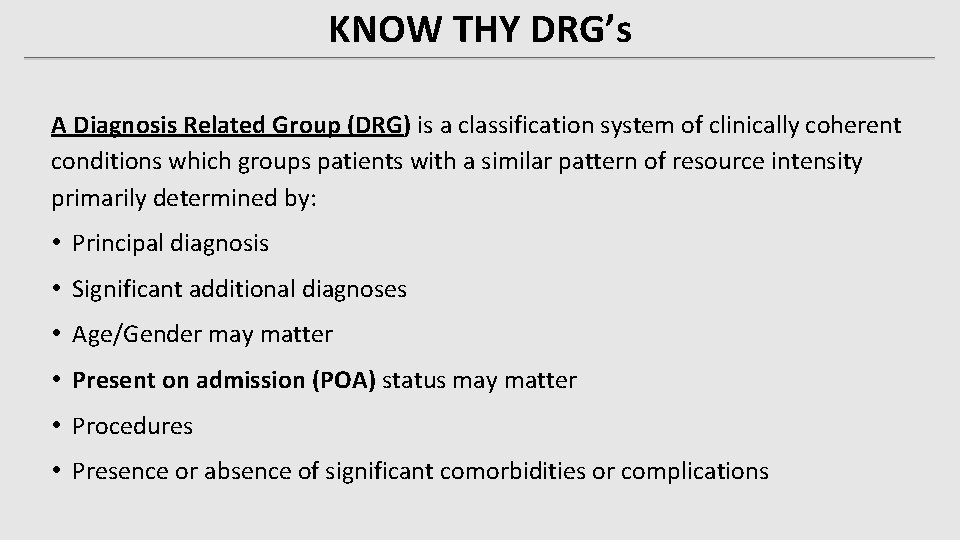
KNOW THY DRG’s A Diagnosis Related Group (DRG) is a classification system of clinically coherent conditions which groups patients with a similar pattern of resource intensity primarily determined by: • Principal diagnosis • Significant additional diagnoses • Age/Gender may matter • Present on admission (POA) status may matter • Procedures • Presence or absence of significant comorbidities or complications
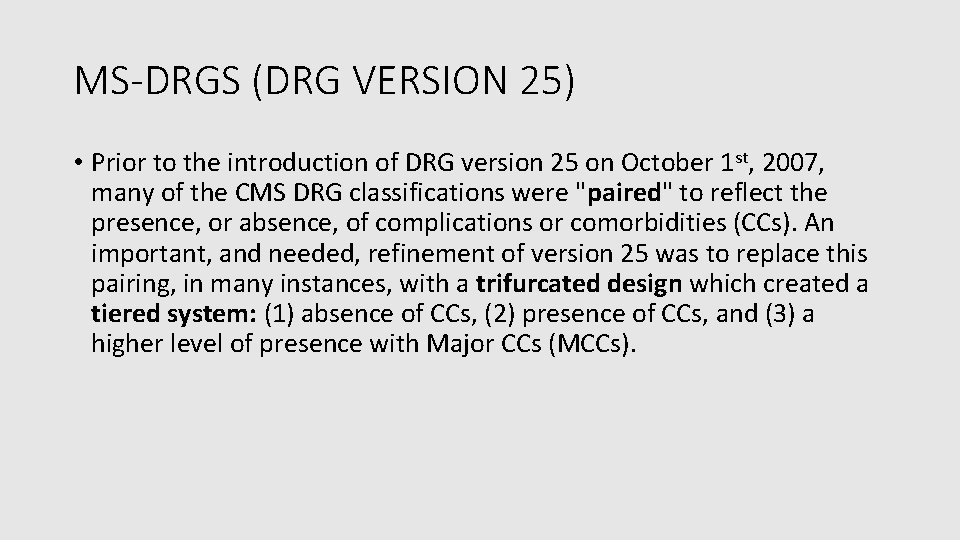
MS-DRGS (DRG VERSION 25) • Prior to the introduction of DRG version 25 on October 1 st, 2007, many of the CMS DRG classifications were "paired" to reflect the presence, or absence, of complications or comorbidities (CCs). An important, and needed, refinement of version 25 was to replace this pairing, in many instances, with a trifurcated design which created a tiered system: (1) absence of CCs, (2) presence of CCs, and (3) a higher level of presence with Major CCs (MCCs).
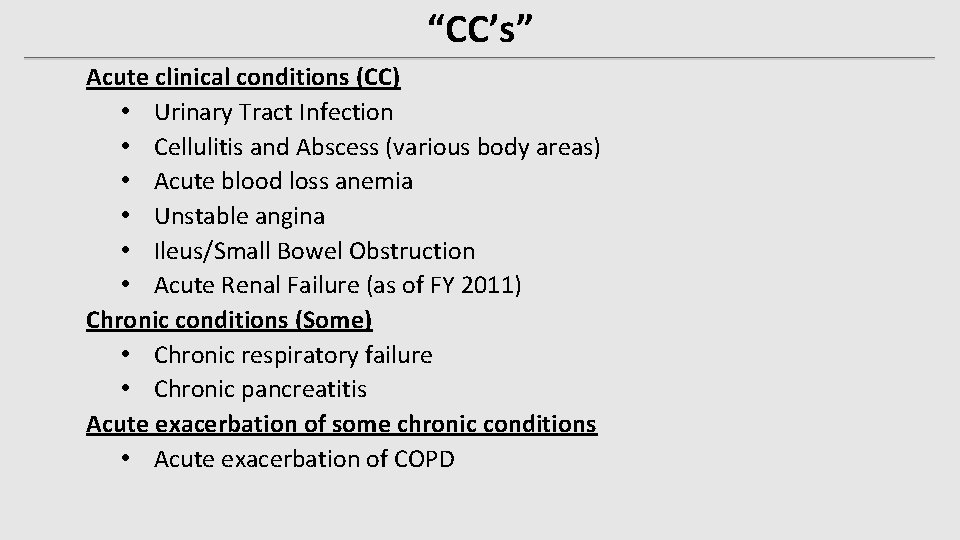
“CC’s” Acute clinical conditions (CC) • Urinary Tract Infection • Cellulitis and Abscess (various body areas) • Acute blood loss anemia • Unstable angina • Ileus/Small Bowel Obstruction • Acute Renal Failure (as of FY 2011) Chronic conditions (Some) • Chronic respiratory failure • Chronic pancreatitis Acute exacerbation of some chronic conditions • Acute exacerbation of COPD
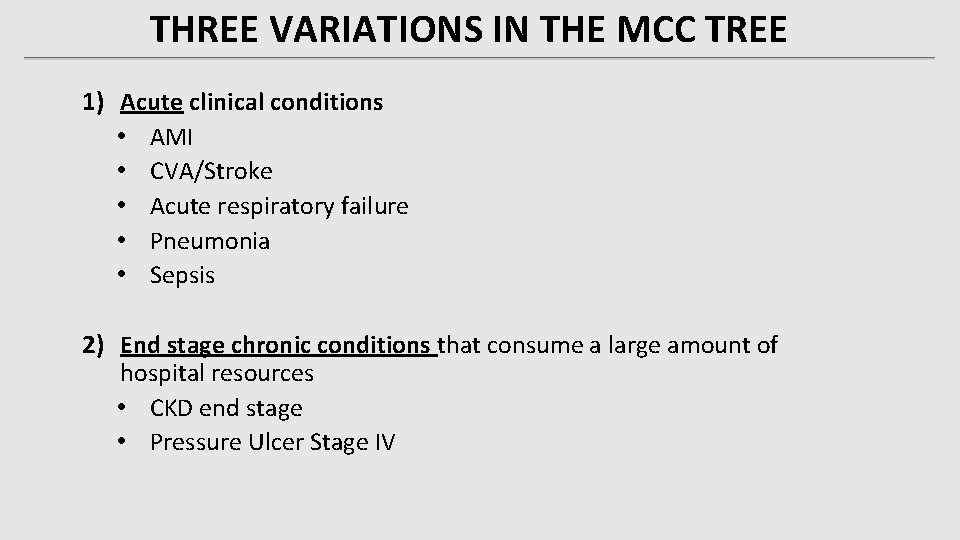
THREE VARIATIONS IN THE MCC TREE 1) Acute clinical conditions • AMI • CVA/Stroke • Acute respiratory failure • Pneumonia • Sepsis 2) End stage chronic conditions that consume a large amount of hospital resources • CKD end stage • Pressure Ulcer Stage IV
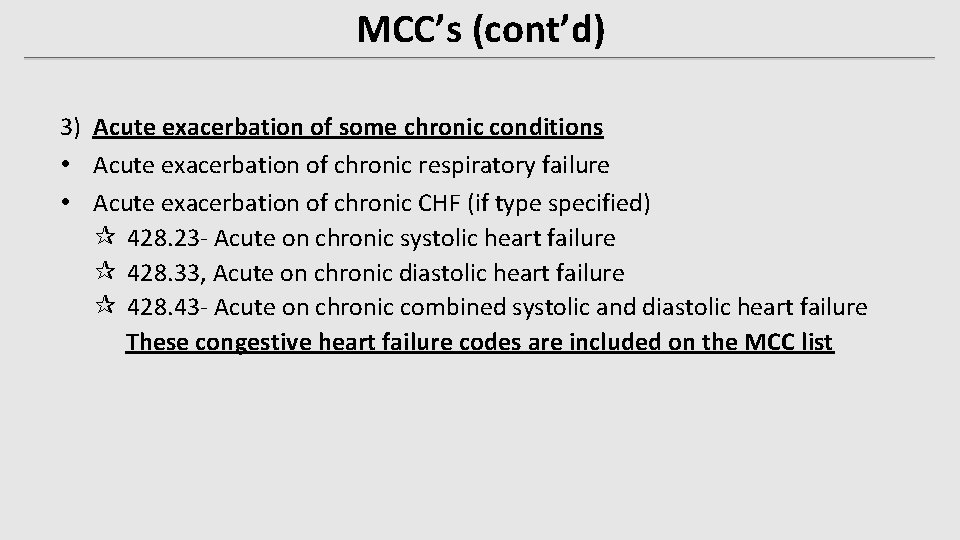
MCC’s (cont’d) 3) Acute exacerbation of some chronic conditions • Acute exacerbation of chronic respiratory failure • Acute exacerbation of chronic CHF (if type specified) ¶ 428. 23 - Acute on chronic systolic heart failure ¶ 428. 33, Acute on chronic diastolic heart failure ¶ 428. 43 - Acute on chronic combined systolic and diastolic heart failure These congestive heart failure codes are included on the MCC list
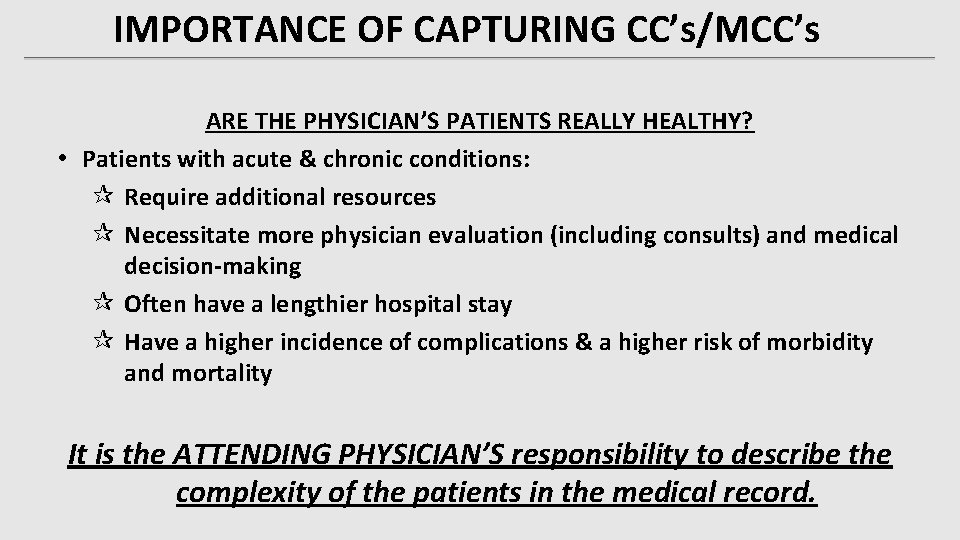
IMPORTANCE OF CAPTURING CC’s/MCC’s ARE THE PHYSICIAN’S PATIENTS REALLY HEALTHY? • Patients with acute & chronic conditions: ¶ Require additional resources ¶ Necessitate more physician evaluation (including consults) and medical decision-making ¶ Often have a lengthier hospital stay ¶ Have a higher incidence of complications & a higher risk of morbidity and mortality It is the ATTENDING PHYSICIAN’S responsibility to describe the complexity of the patients in the medical record.
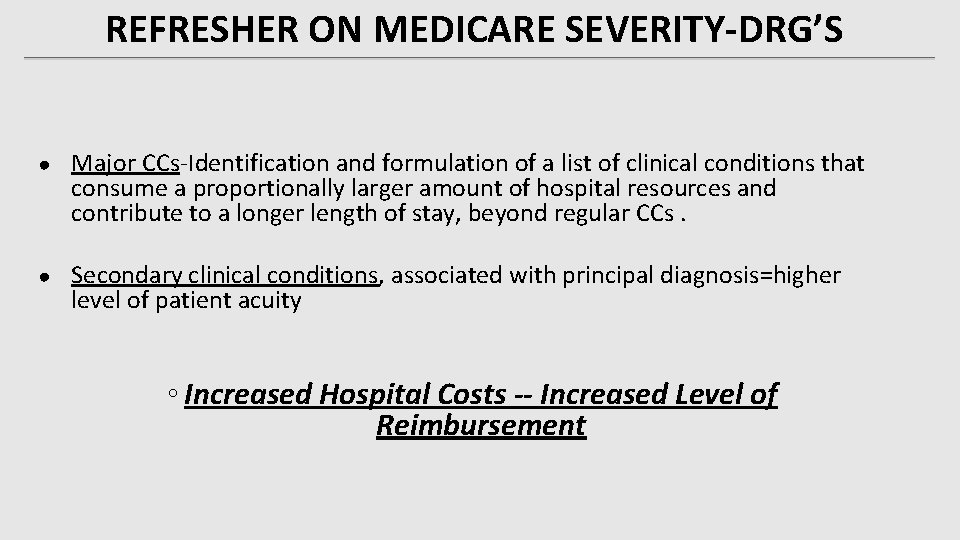
REFRESHER ON MEDICARE SEVERITY-DRG’S ● Major CCs-Identification and formulation of a list of clinical conditions that consume a proportionally larger amount of hospital resources and contribute to a longer length of stay, beyond regular CCs. ● Secondary clinical conditions, associated with principal diagnosis=higher level of patient acuity ◦ Increased Hospital Costs -- Increased Level of Reimbursement
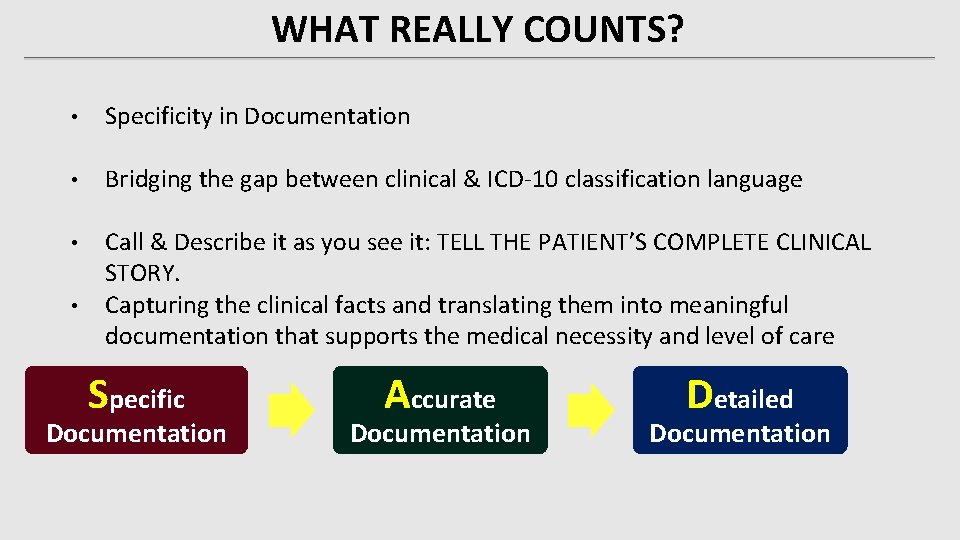
WHAT REALLY COUNTS? • Specificity in Documentation • Bridging the gap between clinical & ICD-10 classification language Call & Describe it as you see it: TELL THE PATIENT’S COMPLETE CLINICAL STORY. • Capturing the clinical facts and translating them into meaningful documentation that supports the medical necessity and level of care • Specific Documentation Accurate Documentation Detailed Documentation
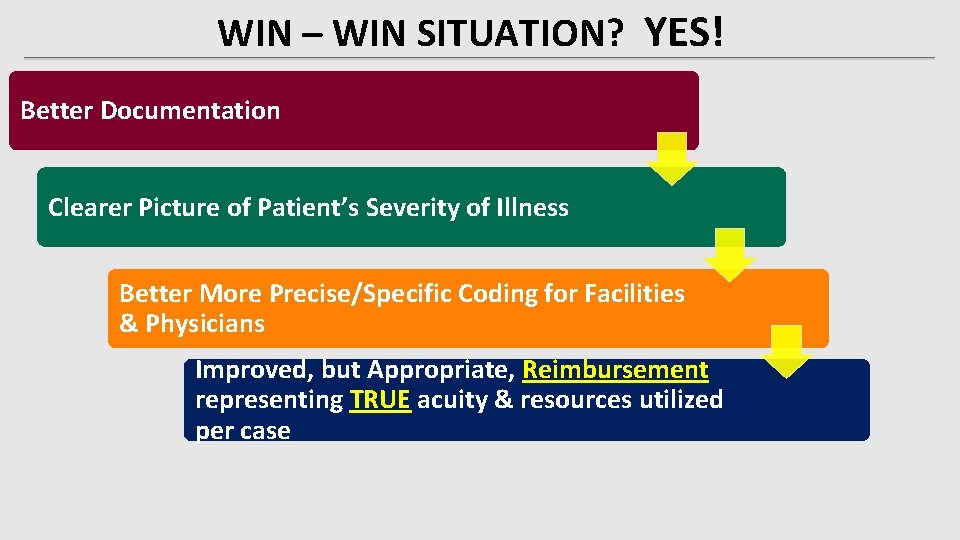
WIN – WIN SITUATION? YES! Better Documentation Clearer Picture of Patient’s Severity of Illness Better More Precise/Specific Coding for Facilities & Physicians Improved, but Appropriate, Reimbursement representing TRUE acuity & resources utilized per case
RESOURCES CMS Hospital Acquired Conditions webpage: http: //www. cms. hhs. gov/Hospital. Acq. Cond/01_Overview. asp AHIMA Education coding modules, ICD 10 Training modules CCS certification http: //ahima. org CMS VBP White Paper (2007): http: //www. cms. hhs. gov/Acute. Inpatient. PPS/downloads/hospital_VBP_plan_issues_p aper. pdf • CMS FY 2020 IPPS download page (for MCC, CC and MSDRG tables): • http: //www. cms. hhs. gov/Acute. Inpatient. PPS/IPPS 2009/List. asp • Avrill RF, Goldfield N, Hughes JS, Bonazelli J, Mc. Cullough EC, Steinbeck BA, Mullin R, Tang AM, Muldoon J, Turner L, Gay J. All Patient Refined Diagnosis Related Groups (APR-DRGs) Version 20. 0: Methodology Overview. Wallingford, CT: 3 M Health Information Systems; 2003. • • •
RESOURCES • http: //www. modernhealthcare. com/article/20070424/INFO/70424001#ixzz 2 Em. Oes 8 U • http: //www. cms. hhs. gov/Acute. Inpatient. PPS/01_overview. asp • http: //www. hfma. org/Templates/Interior. Master. aspx? id=3277 • http: //www. cms. hhs. gov/Acute. Inpatient. PPS/01_overview. asp • https: //www. cms. gov/Outreach-and-Education/Medicare. . . /MCRP_Booklet. pdf • https: //www. cms. gov/Medicare/Coding/ICD 10/2018 -ICD-10 -CM-and-GEMs. html • https: //acdis. org/resources/cdi-leaders-reveal-top-key-performance-indicators