
Clinical Documentation as a Source of Information for
- Slides: 20
Clinical Documentation as a Source of Information for Patients – Possibilities and Limitations Torunn Wibe, Mirjam Ekstedt, Ragnhild Hellesø, Karl Øyri and Laura Slaughter
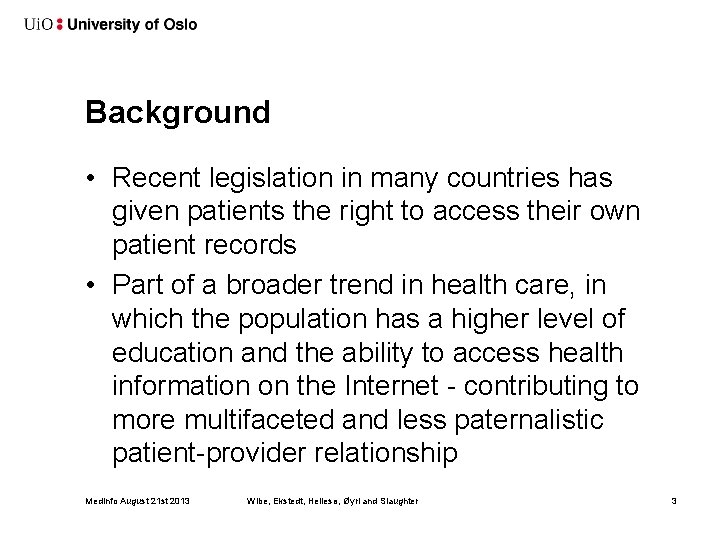
Background • Recent legislation in many countries has given patients the right to access their own patient records • Part of a broader trend in health care, in which the population has a higher level of education and the ability to access health information on the Internet - contributing to more multifaceted and less paternalistic patient-provider relationship Med. Info August 21 st 2013 Wibe, Ekstedt, Hellesø, Øyri and Slaughter 3
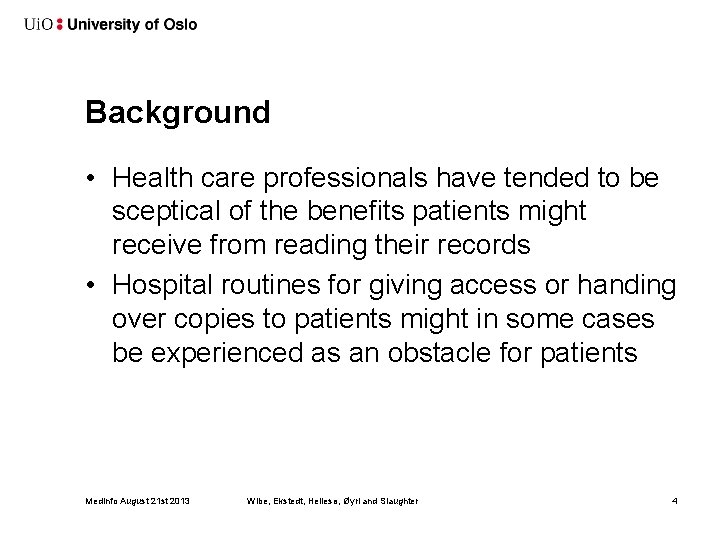
Background • Health care professionals have tended to be sceptical of the benefits patients might receive from reading their records • Hospital routines for giving access or handing over copies to patients might in some cases be experienced as an obstacle for patients Med. Info August 21 st 2013 Wibe, Ekstedt, Hellesø, Øyri and Slaughter 4
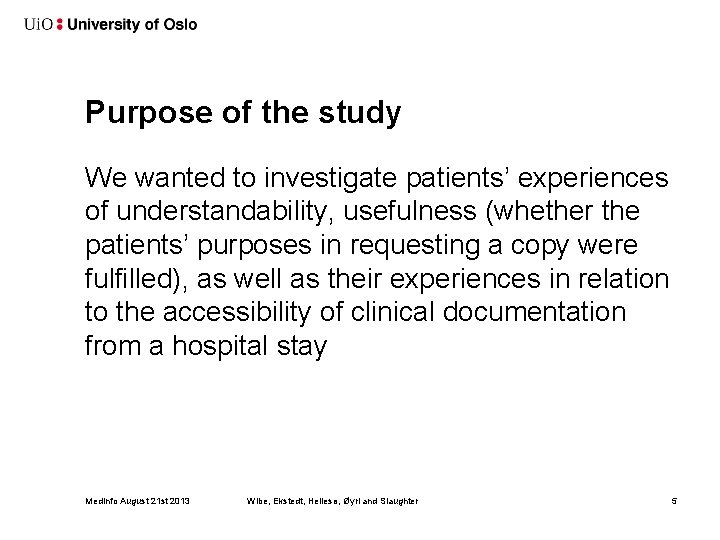
Purpose of the study We wanted to investigate patients’ experiences of understandability, usefulness (whether the patients’ purposes in requesting a copy were fulfilled), as well as their experiences in relation to the accessibility of clinical documentation from a hospital stay Med. Info August 21 st 2013 Wibe, Ekstedt, Hellesø, Øyri and Slaughter 5
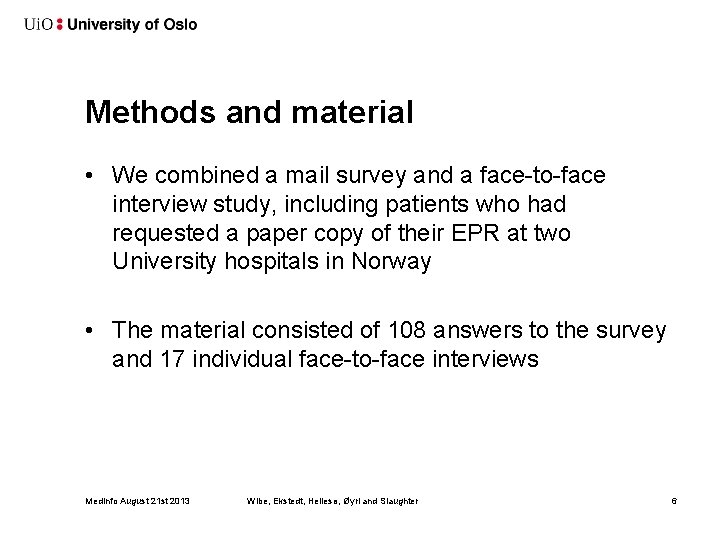
Methods and material • We combined a mail survey and a face-to-face interview study, including patients who had requested a paper copy of their EPR at two University hospitals in Norway • The material consisted of 108 answers to the survey and 17 individual face-to-face interviews Med. Info August 21 st 2013 Wibe, Ekstedt, Hellesø, Øyri and Slaughter 6
Analysis Descriptive statistics were used to analyse the findings of the survey The analysis of the interviews was guided by qualitative content analysis Med. Info August 21 st 2013 Wibe, Ekstedt, Hellesø, Øyri and Slaughter 7
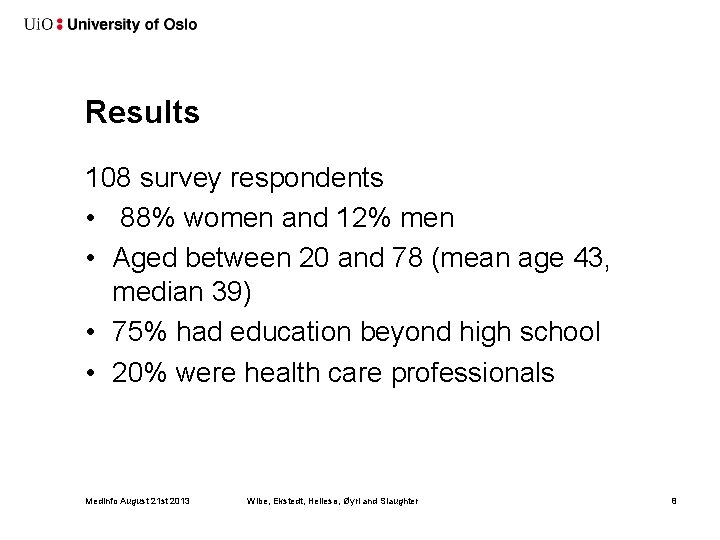
Results 108 survey respondents • 88% women and 12% men • Aged between 20 and 78 (mean age 43, median 39) • 75% had education beyond high school • 20% were health care professionals Med. Info August 21 st 2013 Wibe, Ekstedt, Hellesø, Øyri and Slaughter 8
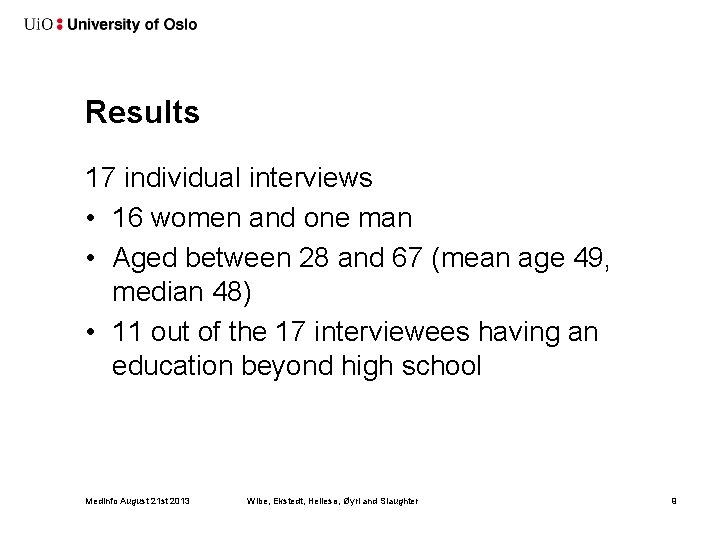
Results 17 individual interviews • 16 women and one man • Aged between 28 and 67 (mean age 49, median 48) • 11 out of the 17 interviewees having an education beyond high school Med. Info August 21 st 2013 Wibe, Ekstedt, Hellesø, Øyri and Slaughter 9
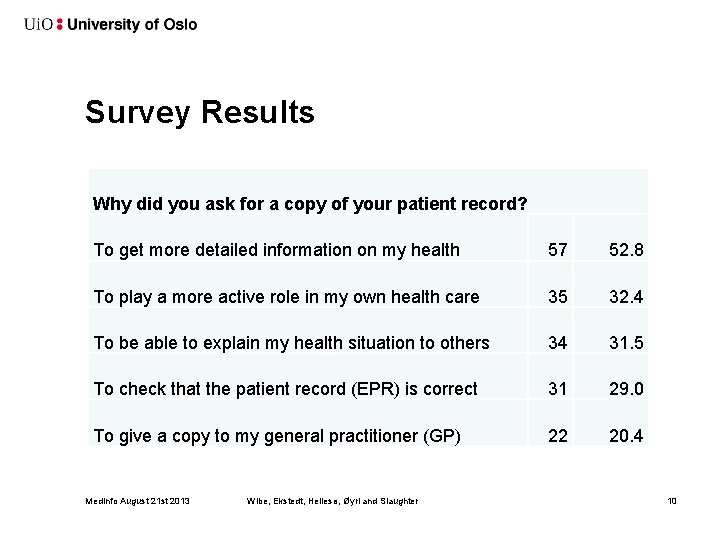
Survey Results Why did you ask for a copy of your patient record? To get more detailed information on my health 57 52. 8 To play a more active role in my own health care 35 32. 4 To be able to explain my health situation to others 34 31. 5 To check that the patient record (EPR) is correct 31 29. 0 To give a copy to my general practitioner (GP) 22 20. 4 Med. Info August 21 st 2013 Wibe, Ekstedt, Hellesø, Øyri and Slaughter 10
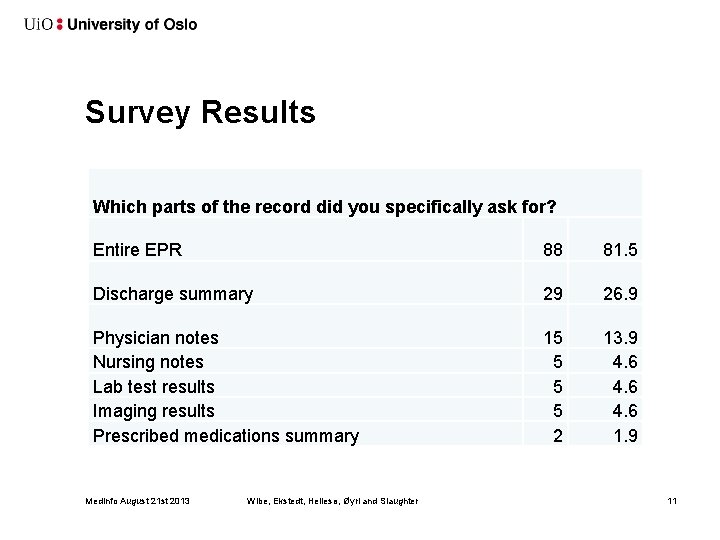
Survey Results Which parts of the record did you specifically ask for? Entire EPR Discharge summary Which parts of the record did you specifically ask for? Entire EPR 88 81. 5 Discharge summary 29 26. 9 Physician notes 15 13. 9 Nursing notes 5 4. 6 Lab test results 5 4. 6 Imaging results 5 4. 6 Prescribed medications summary 2 1. 9 Physician notes Nursing notes Lab test results Imaging results Prescribed medications summary Med. Info August 21 st 2013 Wibe, Ekstedt, Hellesø, Øyri and Slaughter 88 81. 5 29 26. 9 15 5 2 13. 9 4. 6 1. 9 11
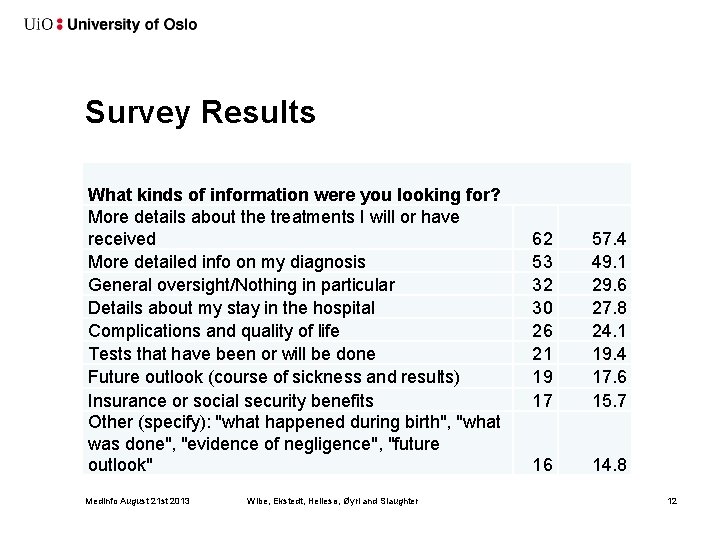
Survey Results What kinds of information were you looking for? More details about the treatments I will or have received More detailed info on my diagnosis General oversight/Nothing in particular Details about my stay in the hospital Complications and quality of life Tests that have been or will be done Future outlook (course of sickness and results) Insurance or social security benefits Other (specify): "what happened during birth", "what was done", "evidence of negligence", "future outlook" Med. Info August 21 st 2013 Wibe, Ekstedt, Hellesø, Øyri and Slaughter 62 53 32 30 26 21 19 17 57. 4 49. 1 29. 6 27. 8 24. 1 19. 4 17. 6 15. 7 16 14. 8 12
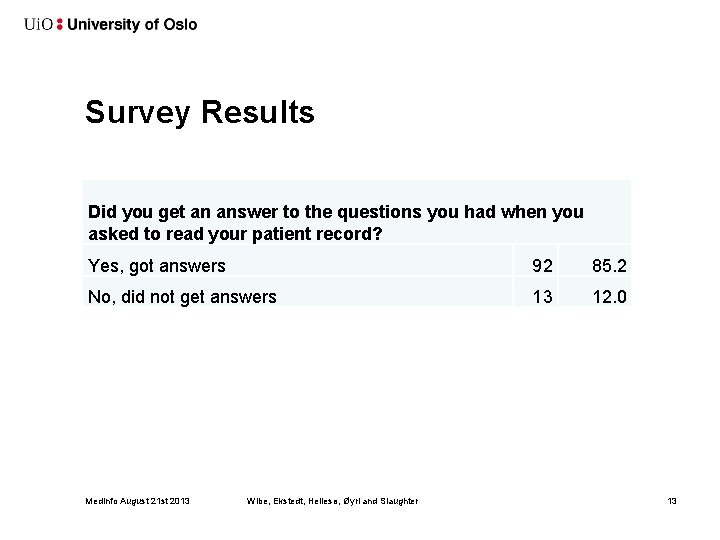
Survey Results Did you get an answer to the questions you had when you asked to read your patient record? Yes, got answers 92 85. 2 No, did not get answers 13 12. 0 Med. Info August 21 st 2013 Wibe, Ekstedt, Hellesø, Øyri and Slaughter 13
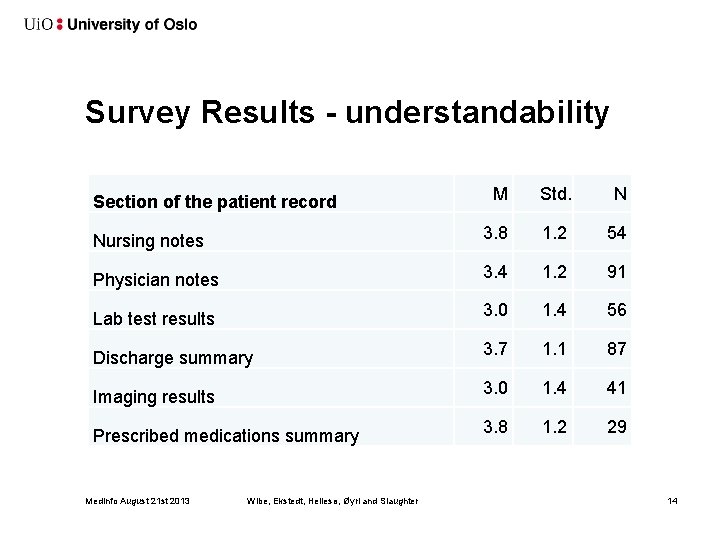
Survey Results - understandability M Std. N Nursing notes 3. 8 1. 2 54 Physician notes 3. 4 1. 2 91 Lab test results 3. 0 1. 4 56 Discharge summary 3. 7 1. 1 87 Imaging results 3. 0 1. 4 41 Prescribed medications summary 3. 8 1. 2 29 Section of the patient record Med. Info August 21 st 2013 Wibe, Ekstedt, Hellesø, Øyri and Slaughter 14
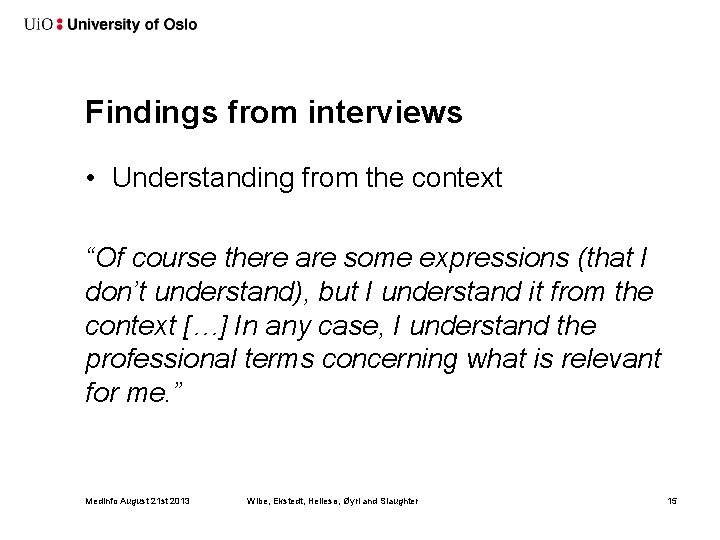
Findings from interviews • Understanding from the context “Of course there are some expressions (that I don’t understand), but I understand it from the context […] In any case, I understand the professional terms concerning what is relevant for me. ” Med. Info August 21 st 2013 Wibe, Ekstedt, Hellesø, Øyri and Slaughter 15
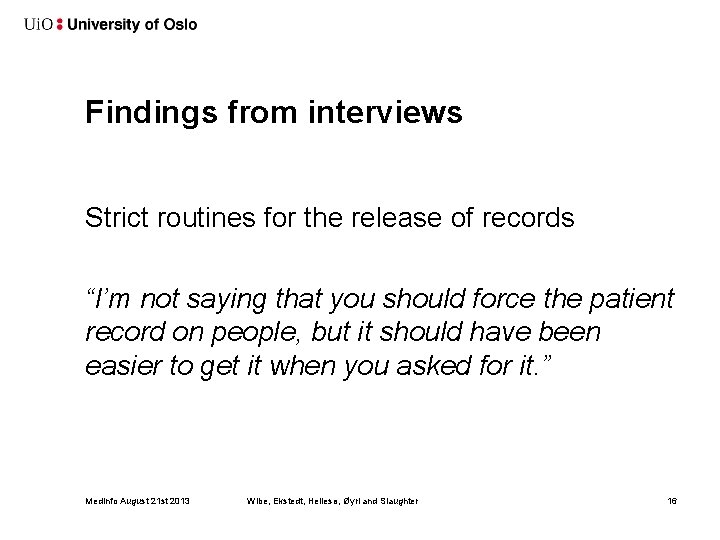
Findings from interviews Strict routines for the release of records “I’m not saying that you should force the patient record on people, but it should have been easier to get it when you asked for it. ” Med. Info August 21 st 2013 Wibe, Ekstedt, Hellesø, Øyri and Slaughter 16
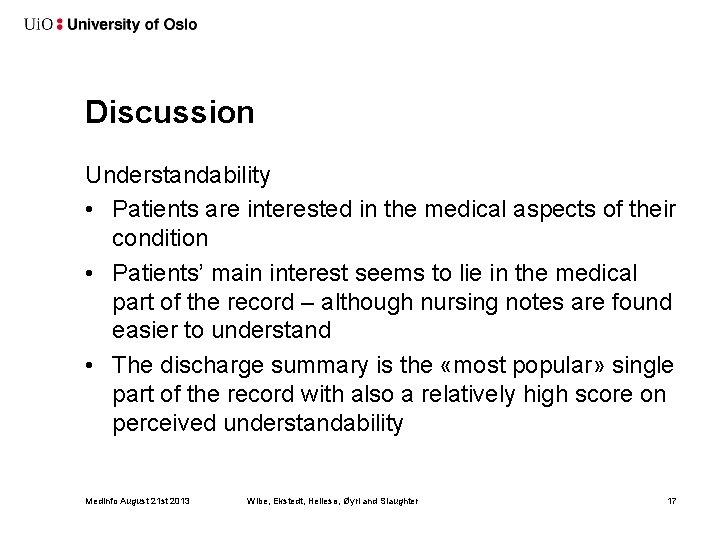
Discussion Understandability • Patients are interested in the medical aspects of their condition • Patients’ main interest seems to lie in the medical part of the record – although nursing notes are found easier to understand • The discharge summary is the «most popular» single part of the record with also a relatively high score on perceived understandability Med. Info August 21 st 2013 Wibe, Ekstedt, Hellesø, Øyri and Slaughter 17
Discussion Usefulness • Got their questions answered • Could make sure that the GP or other health care providers received necessary information from the hospital Med. Info August 21 st 2013 Wibe, Ekstedt, Hellesø, Øyri and Slaughter 18
Limitations • • Low response rate Self-selecting sample High education level Unequal participation of genders Med. Info August 21 st 2013 Wibe, Ekstedt, Hellesø, Øyri and Slaughter 19
Conclusion • Some patients are still afraid of seeming suspicious or displeased when requesting a copy of clinical documentation • Actively offer patients the chance to view their clinical documentation to a larger extent than what is done so far Med. Info August 21 st 2013 Wibe, Ekstedt, Hellesø, Øyri and Slaughter 20
Thank you for your attention. Questions? Comments? torunn. wibe@rr-research. no Med. Info August 21 st 2013 Wibe, Ekstedt, Hellesø, Øyri and Slaughter 21