
Clinical Assessment and Diagnosis Chapter 3 Assessing Psychological






- Slides: 22
Clinical Assessment and Diagnosis Chapter 3
Assessing Psychological Disorders Clinical assessment. Diagnosis Purposes of Clinical Assessment �To understand the individual � DSM- �To predict behavior �To plan treatment �To evaluate treatment outcome
Key Concepts in Assessment � Reliability � Consistency is measurement � Examples � test-retest- � inter-rater reliability- � Validity � What an assessment approach is intended to measure and how well the assessment measures it � Examples � Concurrent or descriptive � Predictive validity � Standardization and Norms � Ensures consistency in the use of a technique � Provides population benchmarks for comparison � Examples include structured administration, scoring, and evaluation procedures
The Clinical Interview �Mental Status Exam- systematic observation of somebody’s behavior � Must attain sufficient information that is organized well to determine presence of psychological disorder � 5 categories � Appearance and behavior � Thought processes � Mood and affect � Intellectual functioning � Sensorium (awareness of environment)
The Clinical Interview Continued �Rapport Building �Confidentiality – between patients & mental health professionals; protected by law in most instances �Types of interviews: structured vs. semistructured interviews �Structured�Semistructured-
Physical Examinations �Rules out medical explanations for psychological disorders �Examples: �toxic state �Hyperthyroidism �Hypothyroidism �brain tumors �drug ingestion
Behavioral Assessment �Behavioral assessment- uses direct observations to assess formally an individual's thoughts, feelings, and behaviors in specific situations or contexts �Useful when: �Limitations: 1). Purpose is to identify problematic or target behaviors and situations 2). Identify ABC antecedentsbehaviorsconsequences-
Behavioral Assessment Continued � Formal or Informal � Formal observations= identifying specific behaviors that are observable and measurable (operational definition) � Goal� Behavioral Rating Scales � Informal observation= attention paid to behavior but without defining or recording it in any systematic fashion � Limitation � Self-monitoring vs. being observed by others � Being observed by others-other individuals objectively collect information based on clear operational definitions � � Limitations- Reactivity- presence of observer causes change in behavior Self-monitoring- observation of their own behaviors � Useful when behavior is private
Psychological Testing �Must be reliable and valid �Projective testing �Personality inventories �Intelligence Testing
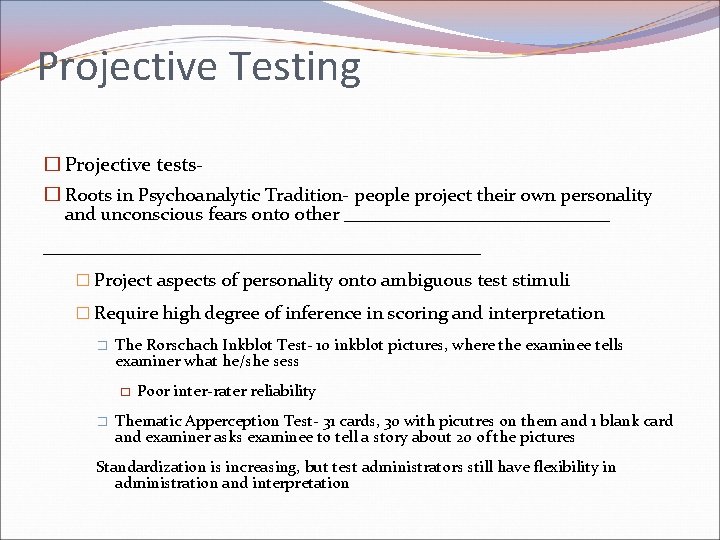
Projective Testing � Projective tests� Roots in Psychoanalytic Tradition- people project their own personality and unconscious fears onto other _____________________________________ � Project aspects of personality onto ambiguous test stimuli � Require high degree of inference in scoring and interpretation � The Rorschach Inkblot Test- 10 inkblot pictures, where the examinee tells examiner what he/she sess � � Poor inter-rater reliability Thematic Apperception Test- 31 cards, 30 with picutres on them and 1 blank card and examiner asks examinee to tell a story about 20 of the pictures Standardization is increasing, but test administrators still have flexibility in administration and interpretation
People dancing or touching hands with each other?
Personality Tests �Personality inventories�Importance- what the answers predict �Minnesota Multiphasic Personality Inventory (MMPI, MMPI- 2, MMPI-A) based on an empirical (objective) approach- collection and evaluation of data, not projective Computer scoring reduces issues with reliability Validity measures L scales. F scales. K scales-
Intelligence Tests �Nature of intellectual functioning and IQ � Intelligence quotient (IQ)- �What constitutes as intelligent? �First tests developed by Alfred Binet �Weschler developed more tests used with adults & children
Neuropsychological Testing � Measures ______ and existence of ____________ � Purpose and Goals � Assess broad range of skills and abilities � Goal is to understand brain-behavior relations � Examples � The Bender Visual Motor Gestalt Test - child is required to draw the shapes/lines on a series of cards � Halstead-Reitan Neuropsychological Battery � Rhythm Test � Strength of Grip � Tactile Performance Ability to detect organ damage is at about 80% � Problems with Neuropsychological Tests � False Positives – � � False Negatives� -
Neuroimaging � Neuroimaging: Pictures of the Brain � Allows for a window on brain structure and function � Imaging Brain Structure � Computerized axial tomography (CAT or CT scan) : utilizes X-rays � Detects ____________________________ � Useful in locating brain tumors, injuries, and structural and anatomical abnormalities � Magnetic resonance imaging (MRI): Utilizes strong magnetic fields & better resolution than CT scan � Radio frequency signals are sent � Areas of damage or lesions show darker or lighter signals
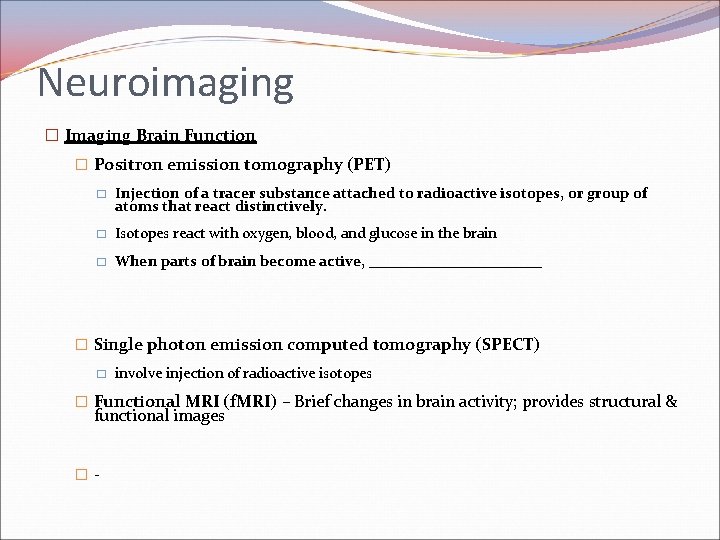
Neuroimaging � Imaging Brain Function � Positron emission tomography (PET) � Injection of a tracer substance attached to radioactive isotopes, or group of atoms that react distinctively. � Isotopes react with oxygen, blood, and glucose in the brain � When parts of brain become active, ____________ � Single photon emission computed tomography (SPECT) � involve injection of radioactive isotopes � Functional MRI (f. MRI) – Brief changes in brain activity; provides structural & functional images �-
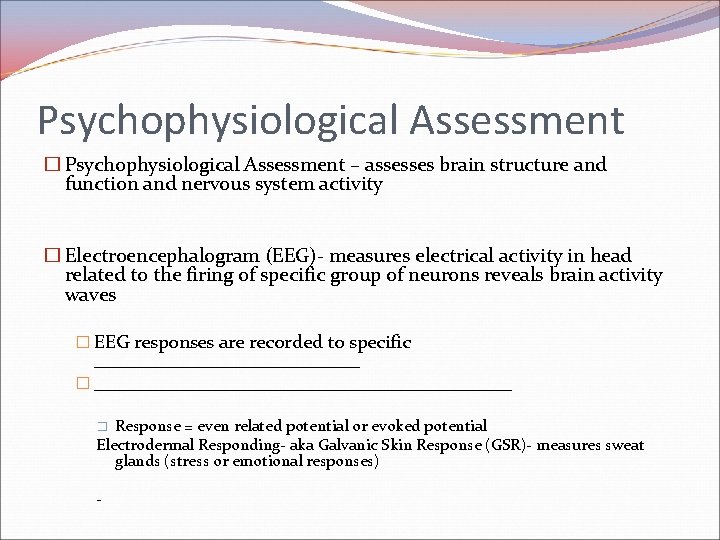
Psychophysiological Assessment � Psychophysiological Assessment – assesses brain structure and function and nervous system activity � Electroencephalogram (EEG)- measures electrical activity in head related to the firing of specific group of neurons reveals brain activity waves � EEG responses are recorded to specific ______________ � ______________________ Response = even related potential or evoked potential Electrodermal Responding- aka Galvanic Skin Response (GSR)- measures sweat glands (stress or emotional responses) � -
Diagnosis � Strategies � Idiographic strategy—detailed investigation of an individual emphasizing what __________________ � Nomothetic strategy-identification and examination of large groups of people with the same disorder to note ____________________ Classification- assignments of objects or people to categories on the basis of shared characteristics taxonomy- system of naming and classification nosology nomenclature
Classification Issues: Approaches to Classifying �Classical categorical approach- Emil Kraepelin- every diagnosis has a clear _____________ �__________________ �Not useful for psychopathology because of the complexity of psychological disorders psychopathology (several factors contribute to cause) �Dimensional Approach- a variety of cognitions, moods, and behaviors of a patient are quantified on a scale �Several symptoms are listed under a disorder, and a candidate must meet __________________ �-
Classification Issues: Reliability and Validity �Inter-rater reliability �Will two different clinicians measure symptoms the same? �Validity �____________do symptoms of a disorder adequately represent the existence of the disorder and differ from those of another disorder �____________-course prediction and effects of treatment �___________use the category adequate �___________are the symptoms and criteria of a category a true reflection of experts opinion of the disorder
DSM-IV � Multiaxial Format � The Five DSM-IV Axes � Axis I - Primary clinical diagnosis � Axis II – Personality disorders and MR � Axis III – Medical conditions � Axis IV – Environmental/Psychosocial problems � Axis V – GAF (Global assessment of functioning) Useful for understanding course and treatment �
Criticisms of the DSM-IV-TR � Comorbidity- � The Problem of Comorbidity � Course, response, course to treatment, and likelihood of associated problems are difficult to determine � High comorbidity is the rule clinically � Threatens the validity of separate diagnoses � Labeling- � Identification with negative connotations with a label affects self-esteem � Clinician and other psychology professionals should think of their own reactions and identifications � Ex. Billy is autistic. Billy is a child who has autism.