
Clinical Aspects of Biochemistry Proteins and Disease Serine
Clinical Aspects of Biochemistry Proteins and Disease Serine proteases 1. Serine proteases - summary 2. Zymogen activation and its control 3. Leukocyte elastase 4. Prohormone convertases
SERINE PROTEASES - A SUMMARY You should know most of this from previous lectures (!) 1. Serine proteases are members of a large group of proteolytic enzymes, all of which have at their active site a serine residue which plays a crucial part in the enzymic activity. All cleave peptide bonds, by a similar mechanism of action. They differ in their specificity and regulation. 2. Serine proteases include: • the pancreatic proteases, trypsin, chymotrypsin and elastase, • various tissue/intracellular proteases such as leukocyte elastase • prohormone convertases (PCs), • enzymes of the blood clotting cascade (see next lecture) • some enzymes of 'complement’ (immunology lectures? ) 3. Many serine proteases are synthesized as inactive precursors (zymogens) which are activated by proteolysis
4. The mechanism of action of serine proteases involves: A catalytic triad (Asp. . . His. . . Ser) which converts the active site serine to a powerful nucleophile. An oxyanion pocket which facilitates the formation of the tetrahedral transition state Acylation of the active site serine to give a covalent intermediate 5. Specificity arises from the presence of a pocket near the active site which binds amino acid side chains of the substrate; the structure of this pocket varies from one enzyme to the next. Three main topics will be covered in more detail in this lecture: a) Zymogen activation and its control. Premature activation cause acute pancreatitis b) Leukocyte elastase and its role in pulmonary emphysema c) Prohormone convertases - relation to other proteases, biological role, possible association with disease
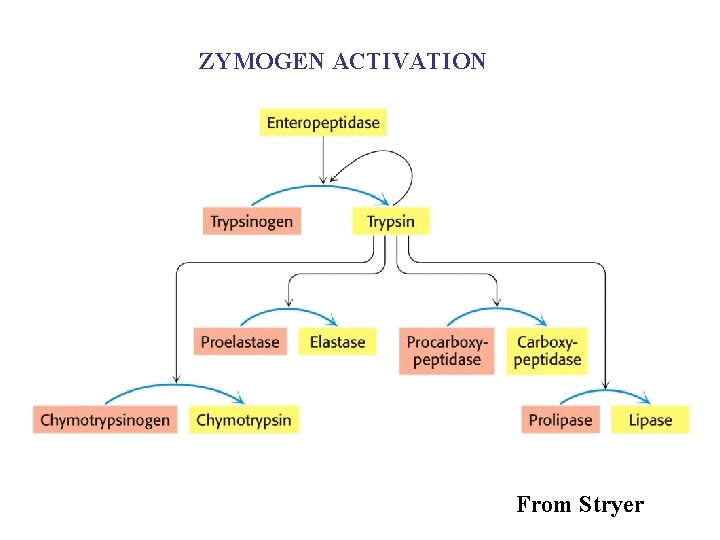
ZYMOGEN ACTIVATION From Stryer
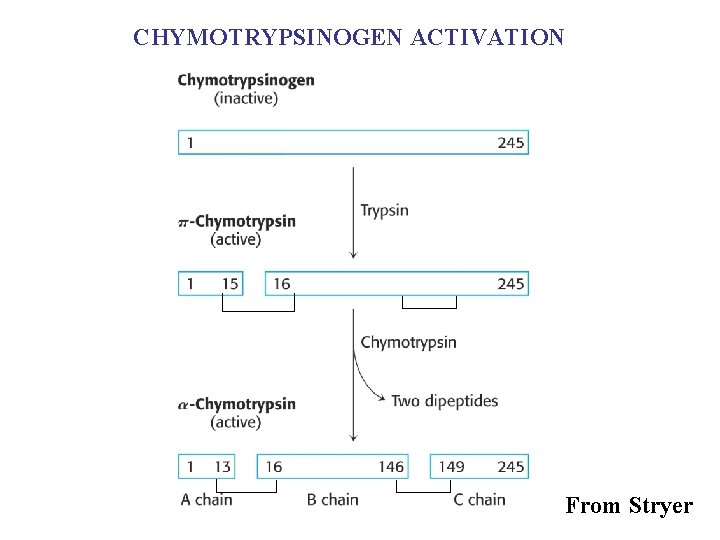
CHYMOTRYPSINOGEN ACTIVATION From Stryer
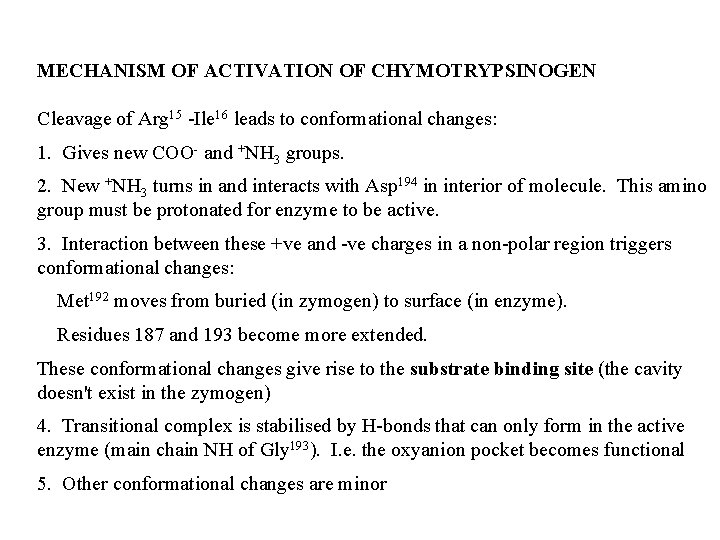
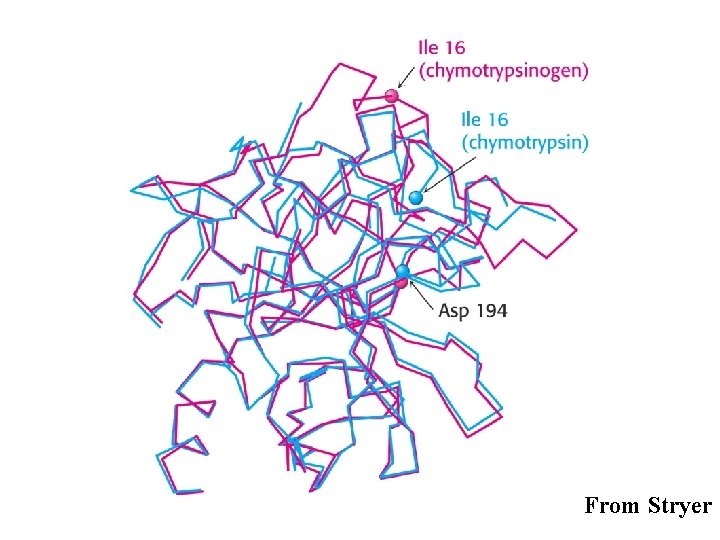
MECHANISM OF ACTIVATION OF CHYMOTRYPSINOGEN Cleavage of Arg 15 -Ile 16 leads to conformational changes: 1. Gives new COO- and +NH 3 groups. 2. New +NH 3 turns in and interacts with Asp 194 in interior of molecule. This amino group must be protonated for enzyme to be active. 3. Interaction between these +ve and -ve charges in a non-polar region triggers conformational changes: Met 192 moves from buried (in zymogen) to surface (in enzyme). Residues 187 and 193 become more extended. These conformational changes give rise to the substrate binding site (the cavity doesn't exist in the zymogen) 4. Transitional complex is stabilised by H-bonds that can only form in the active enzyme (main chain NH of Gly 193). I. e. the oxyanion pocket becomes functional 5. Other conformational changes are minor
From Stryer
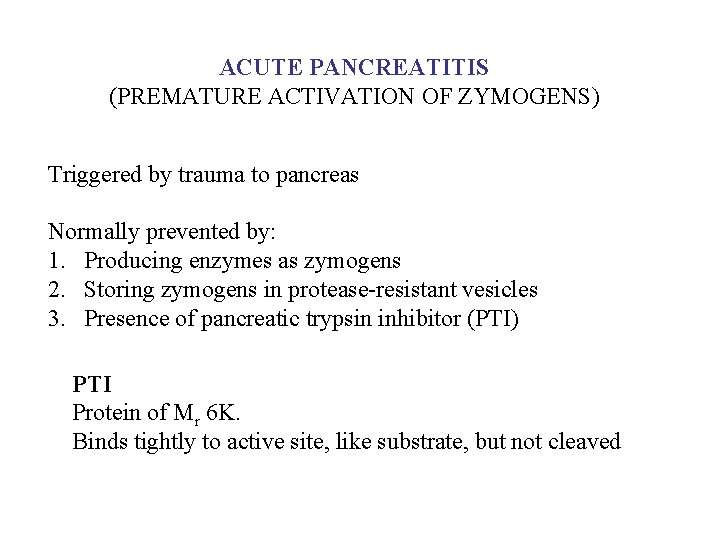
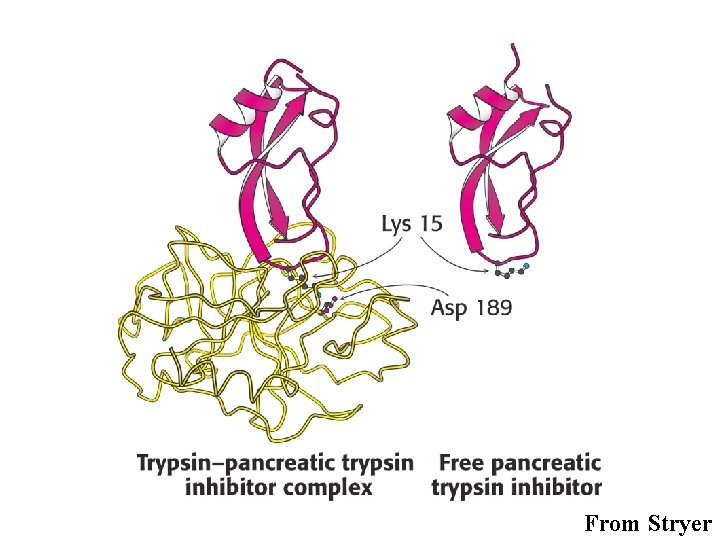
ACUTE PANCREATITIS (PREMATURE ACTIVATION OF ZYMOGENS) Triggered by trauma to pancreas Normally prevented by: 1. Producing enzymes as zymogens 2. Storing zymogens in protease-resistant vesicles 3. Presence of pancreatic trypsin inhibitor (PTI) PTI Protein of Mr 6 K. Binds tightly to active site, like substrate, but not cleaved
From Stryer
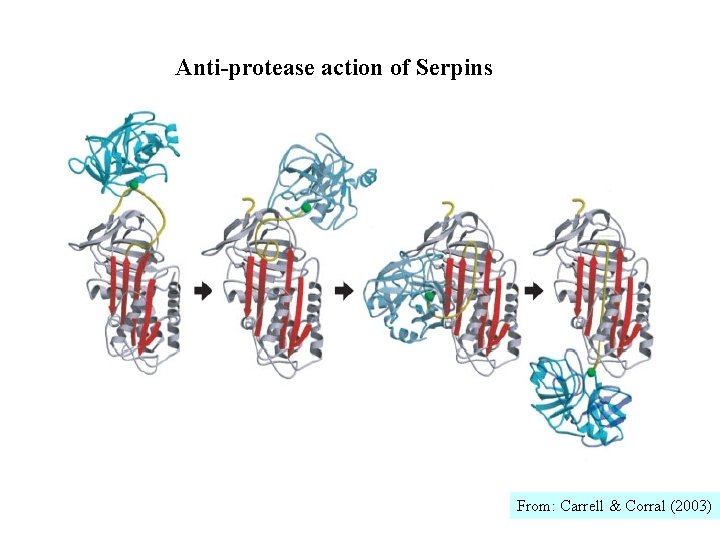
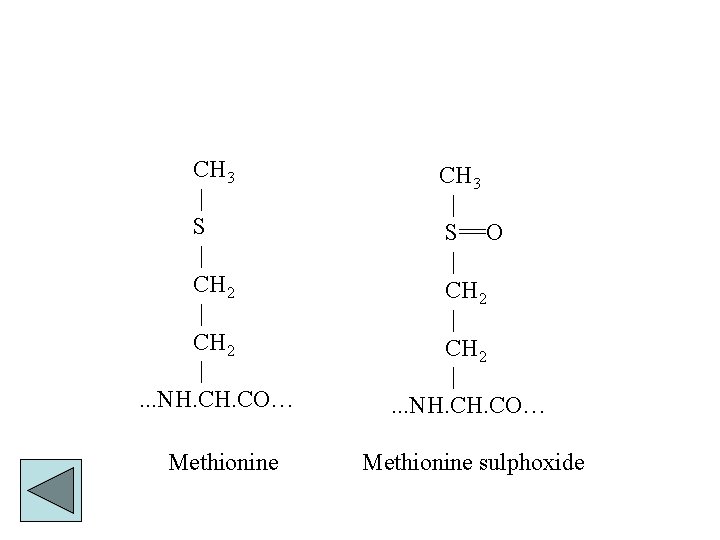
LEUKOCYTE ELASTASE & 1 -PROTEINASE INHIBITOR • Leukocyte elastase is involved in the inflammatory process • Controlled by 1 -proteinase inhibitor, a serum protein secreted by liver. A member of the serpin (serine protease inhibitor) protease family • Variants of inhibitor with reduced activity are associated with pulmonary emphysema (degenerative lung disease - damage to elastin) • Smokers also have decreased activity of the inhibitor (and lung damage) because of the oxidation of active site Met to Met sulphoxide. This is especially a problem in heterozygotes for the defective inhibitor gene. • a 1 -proteinase inhibitor and other serpins may also be involved in other degenerative diseases. Much effort to develop specific inhibitors of the enzyme
Anti-protease action of Serpins From: Carrell & Corral (2003)
CH 3 | S | CH 2 |. . . NH. CO… CH 3 | S==O | CH 2 |. . . NH. CO… Methionine sulphoxide
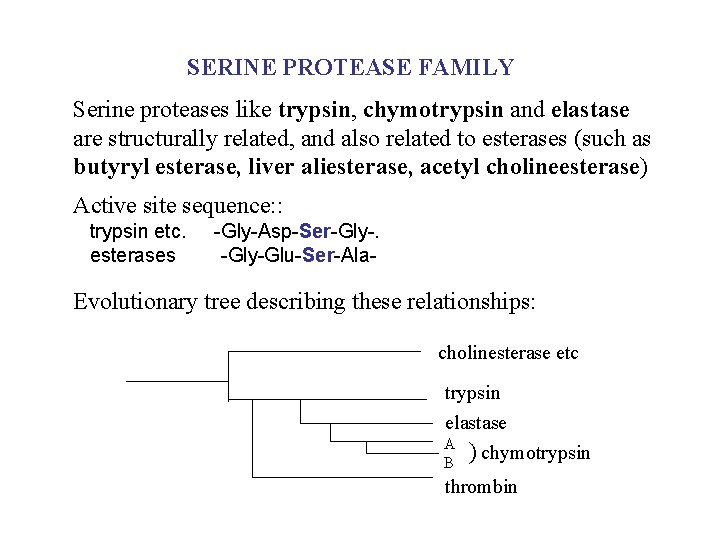
SERINE PROTEASE FAMILY Serine proteases like trypsin, chymotrypsin and elastase are structurally related, and also related to esterases (such as butyryl esterase, liver aliesterase, acetyl cholineesterase) Active site sequence: : trypsin etc. esterases -Gly-Asp-Ser-Gly-Glu-Ser-Ala- Evolutionary tree describing these relationships: cholinesterase etc trypsin elastase A ) chymotrypsin B thrombin
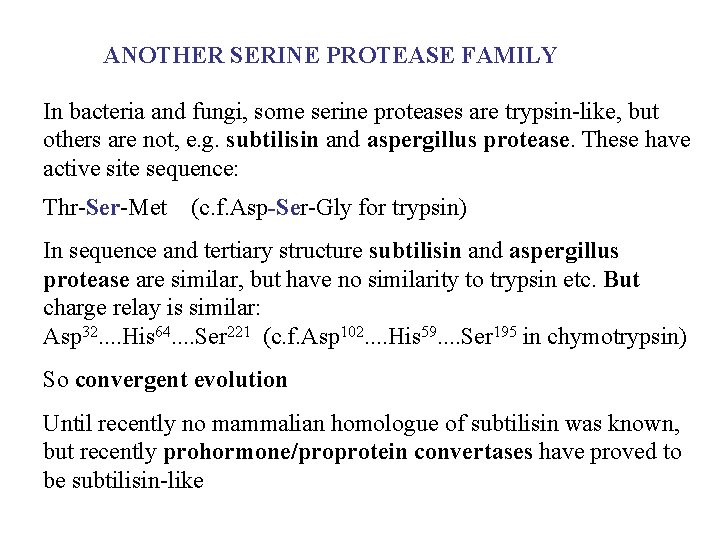
ANOTHER SERINE PROTEASE FAMILY In bacteria and fungi, some serine proteases are trypsin-like, but others are not, e. g. subtilisin and aspergillus protease. These have active site sequence: Thr-Ser-Met (c. f. Asp-Ser-Gly for trypsin) In sequence and tertiary structure subtilisin and aspergillus protease are similar, but have no similarity to trypsin etc. But charge relay is similar: Asp 32. . His 64. . Ser 221 (c. f. Asp 102. . His 59. . Ser 195 in chymotrypsin) So convergent evolution Until recently no mammalian homologue of subtilisin was known, but recently prohormone/proprotein convertases have proved to be subtilisin-like
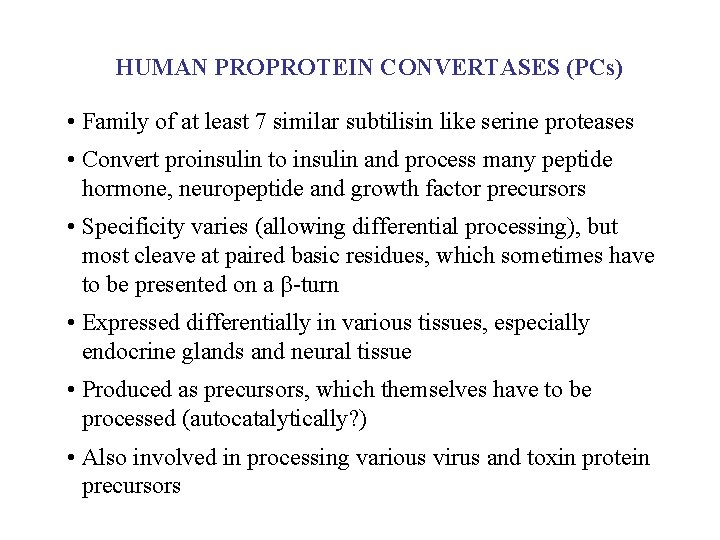
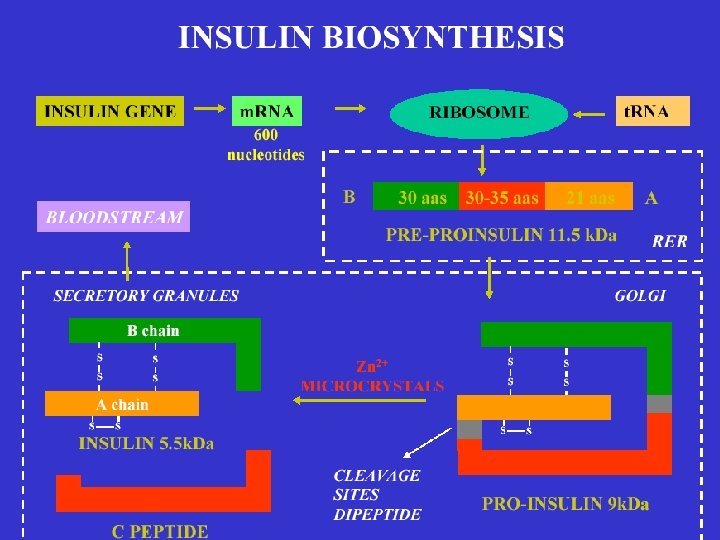
HUMAN PROPROTEIN CONVERTASES (PCs) • Family of at least 7 similar subtilisin like serine proteases • Convert proinsulin to insulin and process many peptide hormone, neuropeptide and growth factor precursors • Specificity varies (allowing differential processing), but most cleave at paired basic residues, which sometimes have to be presented on a b-turn • Expressed differentially in various tissues, especially endocrine glands and neural tissue • Produced as precursors, which themselves have to be processed (autocatalytically? ) • Also involved in processing various virus and toxin protein precursors
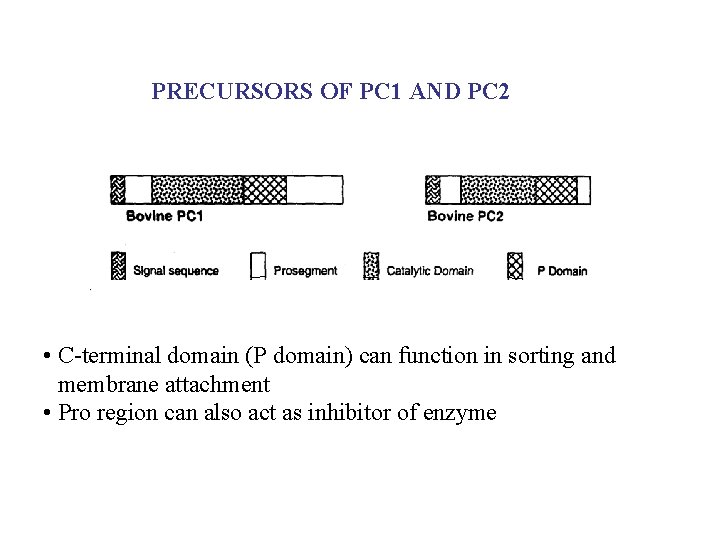
PRECURSORS OF PC 1 AND PC 2 • C-terminal domain (P domain) can function in sorting and membrane attachment • Pro region can also act as inhibitor of enzyme
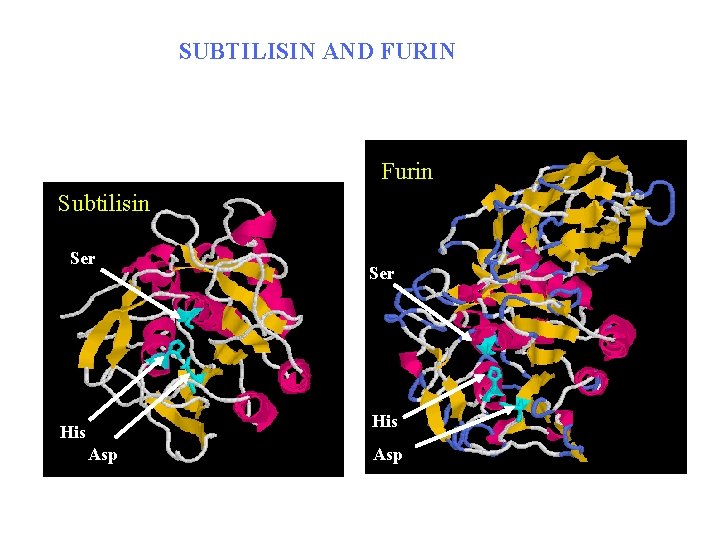
SUBTILISIN AND FURIN Furin Subtilisin Ser His Asp
PC 1 DEFICIENCY IN MAN Mutations in PC 1 can lead to severe PC 1 deficiency. Symptoms: Elevated proinsulin and ACTH precursors Obesity Hypogonadotropic hypogonadism
- Slides: 19