
Clinical Approaches to Dementia Prevention Motivational Interviewing Melanie
- Slides: 68
Clinical Approaches to Dementia Prevention: Motivational Interviewing Melanie Bunn, RN, MS, GNP melanie. bunn@yahoo. com Geriatric Grand Challenge Institute: Dementia Care Duke University School of Nursing March, 2013
Objective Demonstrate motivational interviewing & discuss how it helps older adults make lifestyle changes that can modify risk factors for dementia
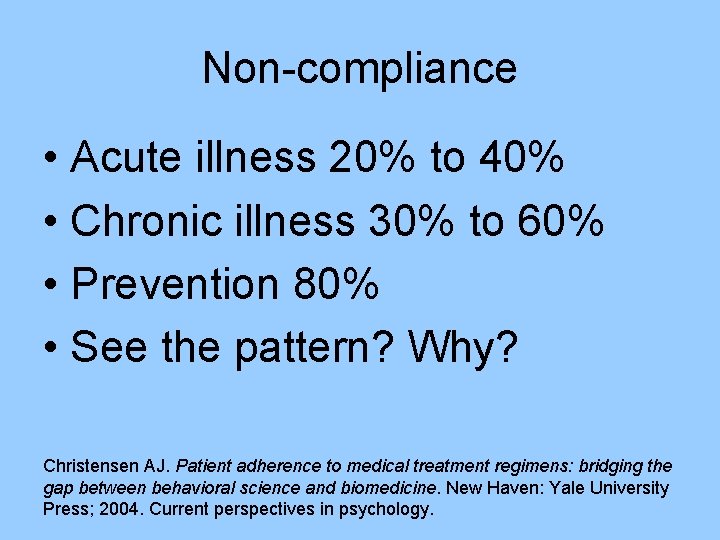
Non-compliance • Acute illness 20% to 40% • Chronic illness 30% to 60% • Prevention 80% • See the pattern? Why? Christensen AJ. Patient adherence to medical treatment regimens: bridging the gap between behavioral science and biomedicine. New Haven: Yale University Press; 2004. Current perspectives in psychology.
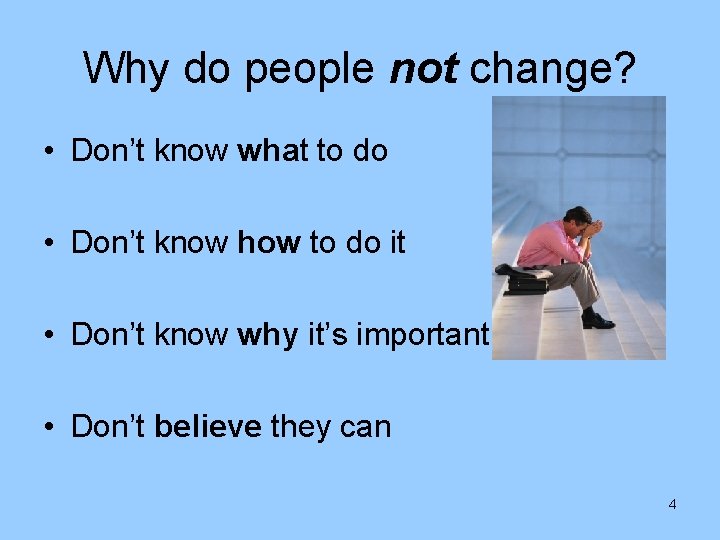
Why do people not change? • Don’t know what to do • Don’t know how to do it • Don’t know why it’s important • Don’t believe they can 4
So, you want to help people change their behaviors? The dilemma… • How can we help our clients change… • Because they want to change… • Not because you want them to change? • Or…how do we MOTIVATE change?
Motivational Interviewing (MI) • “a directive, client-centered counseling style for eliciting behavioral change by helping clients to explore and resolve ambivalence”Rollnick S, Miller WR. What is motivational interviewing? Behavioural and cognitive psychotherapy 1995; 23(4): 325 -34 – FIRST: find out what is important to the client – THEN: Use this to motivate the client to change • A method to help people change for themselves 6
History • Motivational interviewing was developed to help individuals – Change health behaviors (prevention) – Manage chronic diseases (compliance) – Deal with substance abuse • But the approach can work with other behaviors and with teams (and students)
Why try MI? • Short, 10 -20 minutes • Because – people know how to solve their own problems – people prefer to solve their own problems – their solutions are more likely to work – provides individualized strategies – promotes buy-in
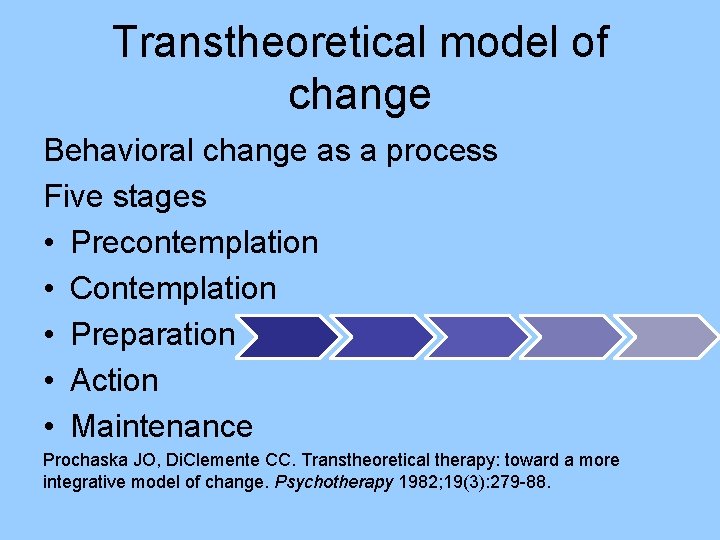
Transtheoretical model of change Behavioral change as a process Five stages • Precontemplation • Contemplation • Preparation • Action • Maintenance Prochaska JO, Di. Clemente CC. Transtheoretical therapy: toward a more integrative model of change. Psychotherapy 1982; 19(3): 279 -88.
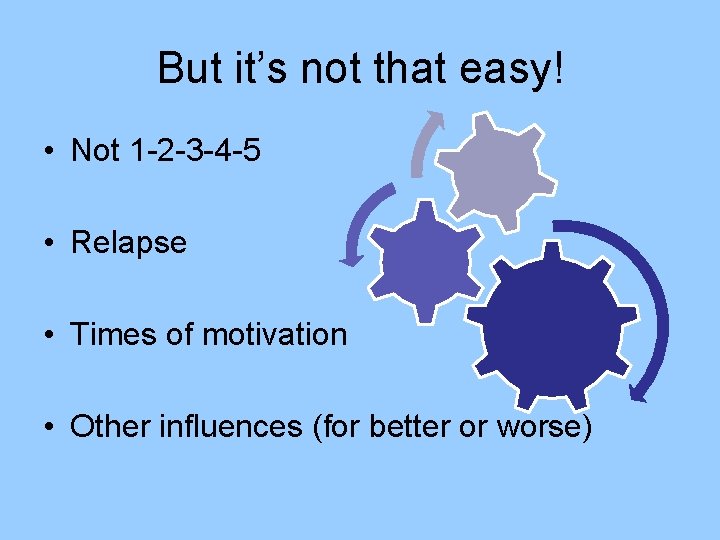
But it’s not that easy! • Not 1 -2 -3 -4 -5 • Relapse • Times of motivation • Other influences (for better or worse)
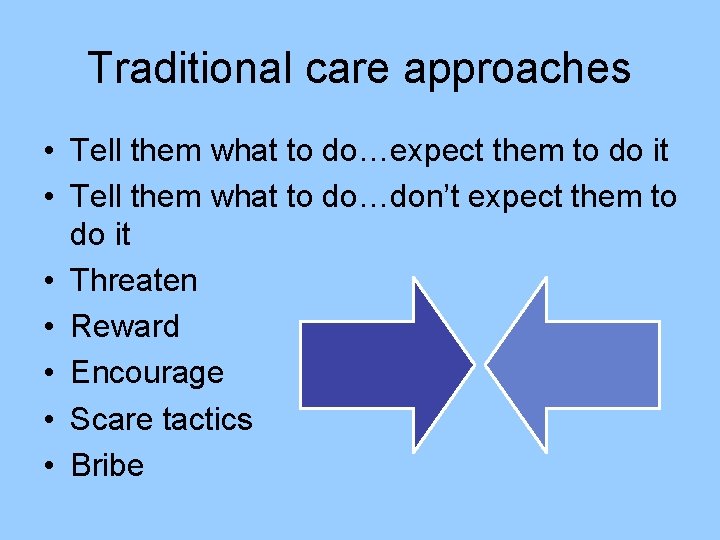
Traditional care approaches • Tell them what to do…expect them to do it • Tell them what to do…don’t expect them to do it • Threaten • Reward • Encourage • Scare tactics • Bribe
MI Activity • List 3 health behaviors that YOU would like to work on: 1. 2. 3.
MI Activity • Find a partner • Choose an A and a B person • A person: tell the B person what your health behavior is • B person: in 30 seconds, tell the A person what to do to improve this behavior, be directive • Reverse roles, repeat
MI general points • Client is in the driving seat • Promote motivation by asking probing questions that allows clients discover for themselves the reasons for their habits • Give suggestions only when asked and as infrequently as possible • Share personal experiences that are relevant to the situation to establish rapport and trust
MI general points • Avoid arguing, even when you strongly disagree • Clients will be at different stages of being ready to change– accept level of readiness for making a change this time • Avoid being judgmental – accept reasons for not making a change in their habits
MI general points People change because they want to NOT because you want them to
Motivation to change • Knowledge alone does not usually lead to change • How many of you know… • How many of you do… • People also need to become motivated to change
Motivational Interviewing Adapted from Levensky et all
4 Principles • Express empathy • Develop a discrepancy • Roll with resistance • Support self efficacy
Express empathy • Understands and accepts experience… including ambivalence about change • Different from sympathy or telling your own story
Develop discrepancy • Enhance awareness of inconsistencies between behavior and goals and values • Motivate change • Facilitate…don’t identify
Roll with resistance • Don’t directly oppose resistance • Invite, not impose, new perspectives
Support self efficacy • Belief that the person is able to do this • Confidence in Competence!!!
Getting started with MI • The first step is to create a partnership • Trustful partnerships are created by: – Listening – Asking questions
4 Skills or the HOW • Listening actively • Asking open questions • Affirming • Summarizing
How to listen Clarify “Could you explain that more? ” Restate “What you are saying is…. ” Remain neutral nod, “uh- huh. . ” Reflect “It sounds like…. ” Affirm “I think this is a plan you can achieve” Summarize “So, the problem is…”
MI Activity • Go back to your partner • A person: take 1 minute to tell the B person what you’d like to change, why you’d like to change and why it’s difficult • B person: listen, but engage in other activities (email, notebook) • Reverse roles, repeat
Two kinds of questions • Closed ended questions • Open ended questions • A key to effective MI is getting people to think more deeply about behaviors and choices. • This can be done by asking open ended questions.
Open ended questions • Question that allows many responses • Invites a story/ explanation • There is no “one – word” answer (which would be closed-ended) • Encourages communication
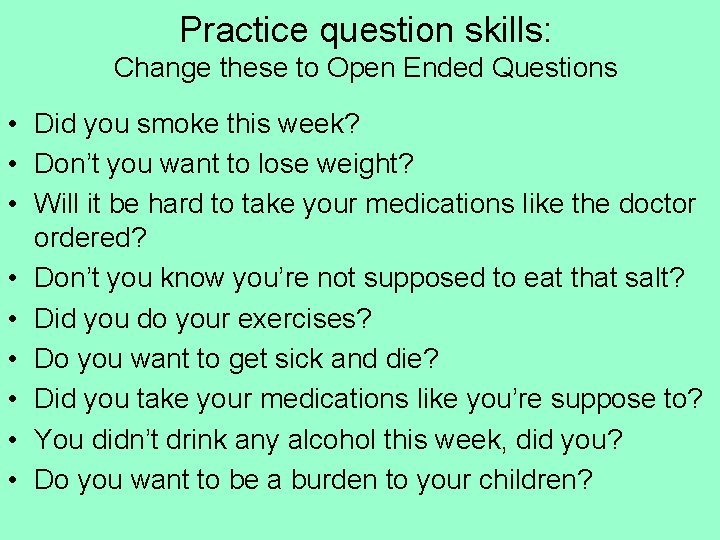
Practice question skills: Change these to Open Ended Questions • Did you smoke this week? • Don’t you want to lose weight? • Will it be hard to take your medications like the doctor ordered? • Don’t you know you’re not supposed to eat that salt? • Did you do your exercises? • Do you want to get sick and die? • Did you take your medications like you’re suppose to? • You didn’t drink any alcohol this week, did you? • Do you want to be a burden to your children?
Be careful with “WHY” questions • Seem accusatory • Resulting in defensiveness • Leading to strengthening of positions • Break down in communication
Affirming • Recognize strengths, abilities, efforts • Must be sincere, adult, accurate, believable • Builds confidence and enthusiasm
Summarizing • Use when the person finishes to make sure you understand the person knows you understand • Helpful for transitions • Keep it short • Ask for confirmation of your understanding
MI Activity • Go back to your partner • A person: take 1 minute to tell the B person what you’d like to change, why you’d like to change and why it’s difficult • B person: use active listening, open ended questions, affirming & summarizing • Reverse roles, repeat
Stages of change (WHAT) • Willing • Able • Ready
Willing • Are you interested in changing? Why? • What do you want to change? • How important is it to you to change? – Are you happy where you’re at and have no interest in change? OR – Are you torn between wanting to change and staying the same (“on the fence”)? OR – Is your desire to change strong enough for you to start taking action?
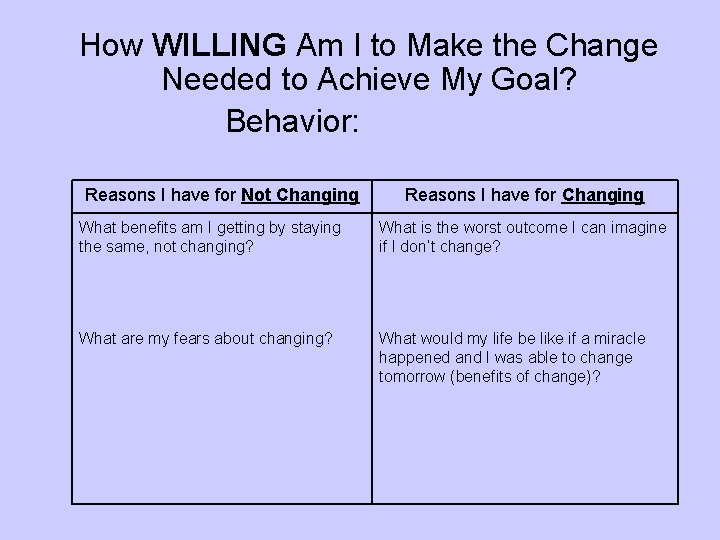
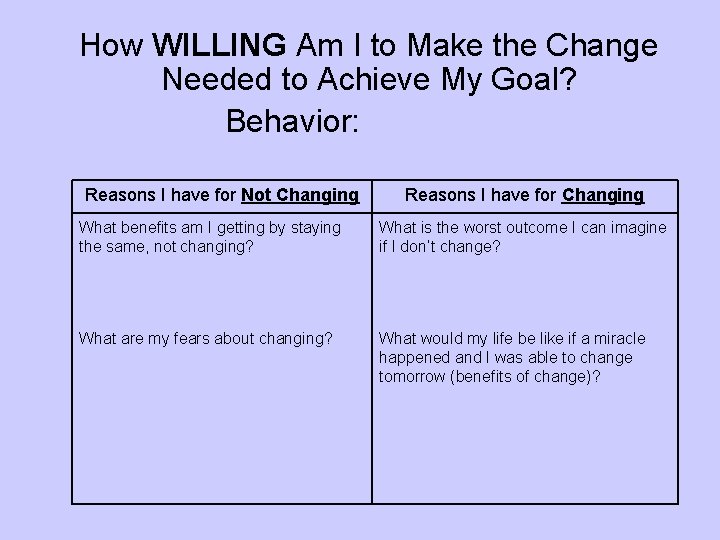
How WILLING Am I to Make the Change Needed to Achieve My Goal? Behavior: Reasons I have for Not Changing Reasons I have for Changing What benefits am I getting by staying the same, not changing? What is the worst outcome I can imagine if I don’t change? What are my fears about changing? What would my life be like if a miracle happened and I was able to change tomorrow (benefits of change)?
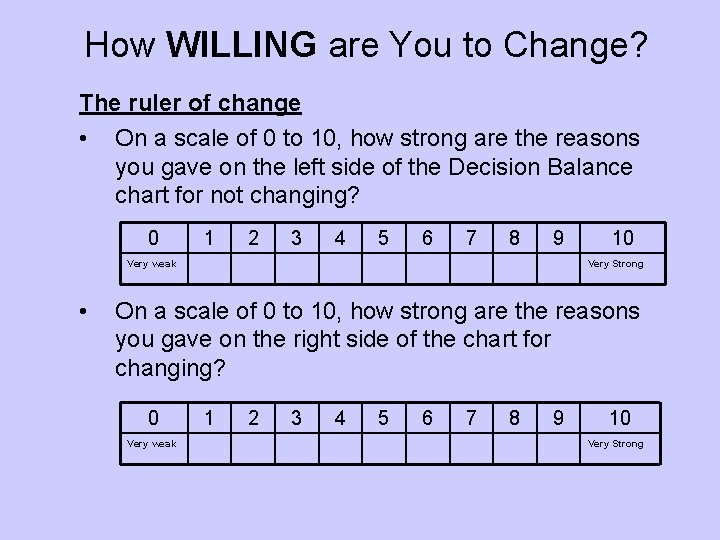
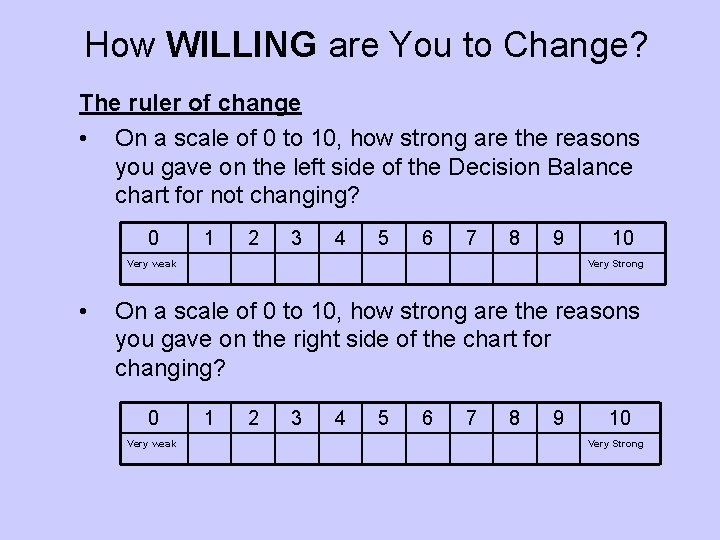
How WILLING are You to Change? The ruler of change • On a scale of 0 to 10, how strong are the reasons you gave on the left side of the Decision Balance chart for not changing? 0 1 2 3 4 5 6 7 8 9 Very weak • 10 Very Strong On a scale of 0 to 10, how strong are the reasons you gave on the right side of the chart for changing? 0 Very weak 1 2 3 4 5 6 7 8 9 10 Very Strong
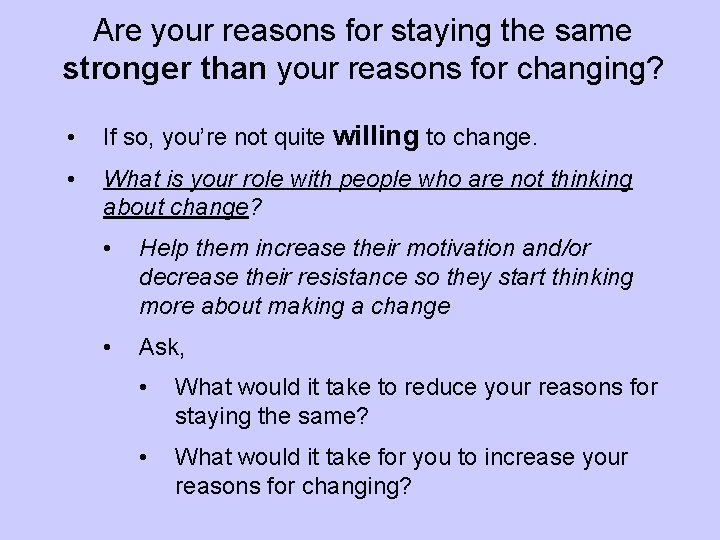
Are your reasons for staying the same stronger than your reasons for changing? • If so, you’re not quite willing to change. • What is your role with people who are not thinking about change? • Help them increase their motivation and/or decrease their resistance so they start thinking more about making a change • Ask, • What would it take to reduce your reasons for staying the same? • What would it take for you to increase your reasons for changing?
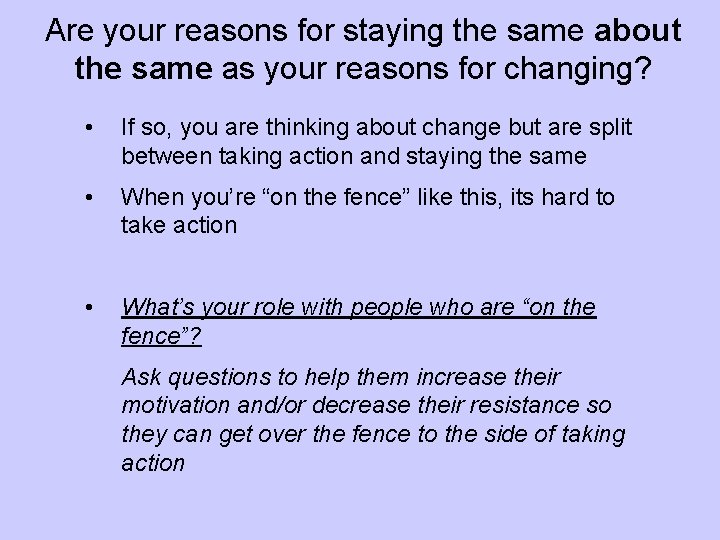
Are your reasons for staying the same about the same as your reasons for changing? • If so, you are thinking about change but are split between taking action and staying the same • When you’re “on the fence” like this, its hard to take action • What’s your role with people who are “on the fence”? Ask questions to help them increase their motivation and/or decrease their resistance so they can get over the fence to the side of taking action
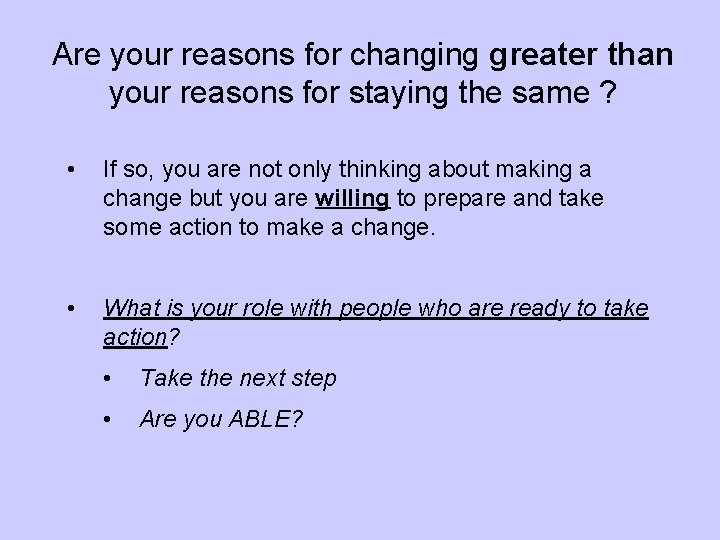
Are your reasons for changing greater than your reasons for staying the same ? • If so, you are not only thinking about making a change but you are willing to prepare and take some action to make a change. • What is your role with people who are ready to take action? • Take the next step • Are you ABLE?
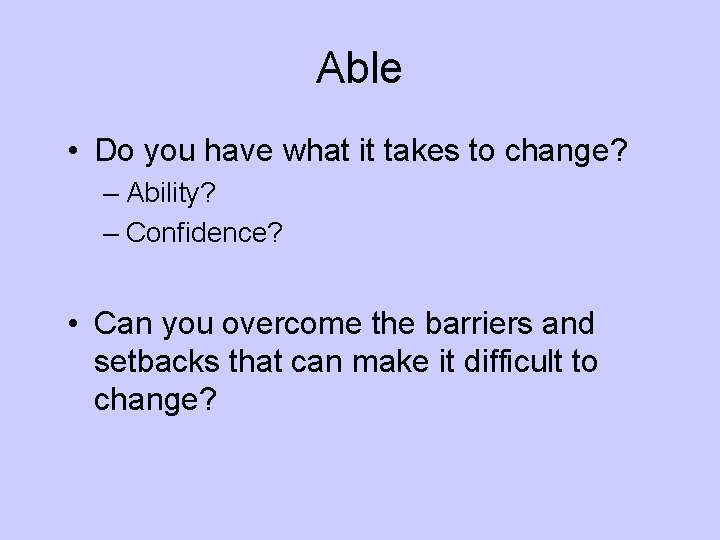
Able • Do you have what it takes to change? – Ability? – Confidence? • Can you overcome the barriers and setbacks that can make it difficult to change?
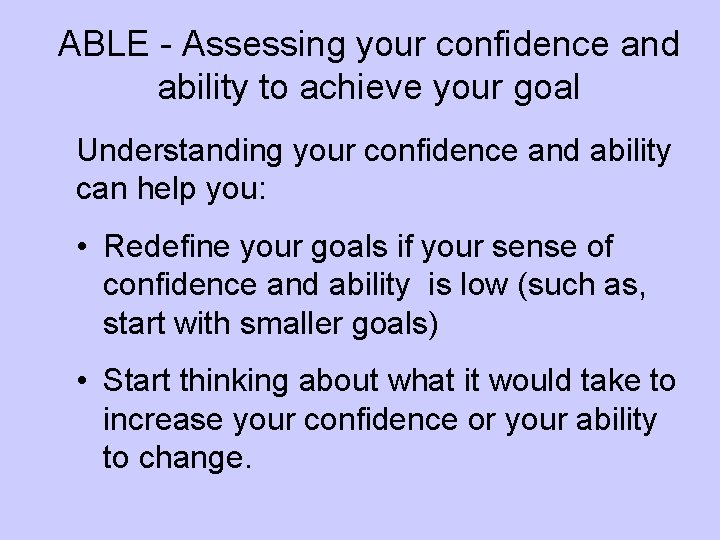
ABLE - Assessing your confidence and ability to achieve your goal Understanding your confidence and ability can help you: • Redefine your goals if your sense of confidence and ability is low (such as, start with smaller goals) • Start thinking about what it would take to increase your confidence or your ability to change.
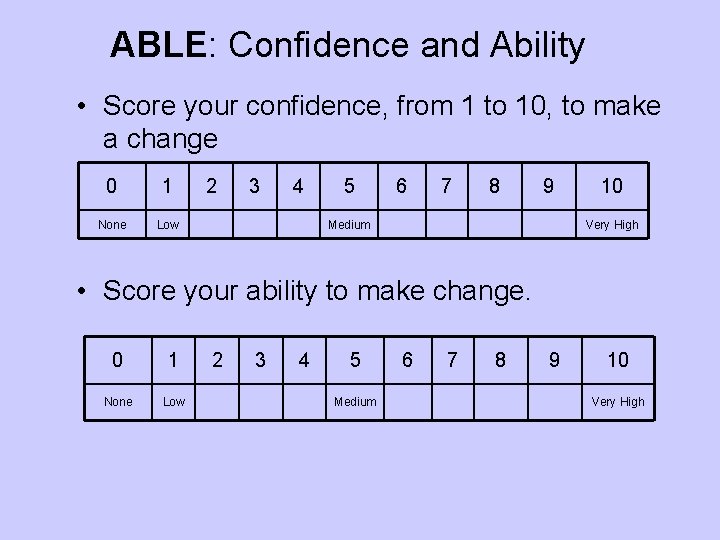
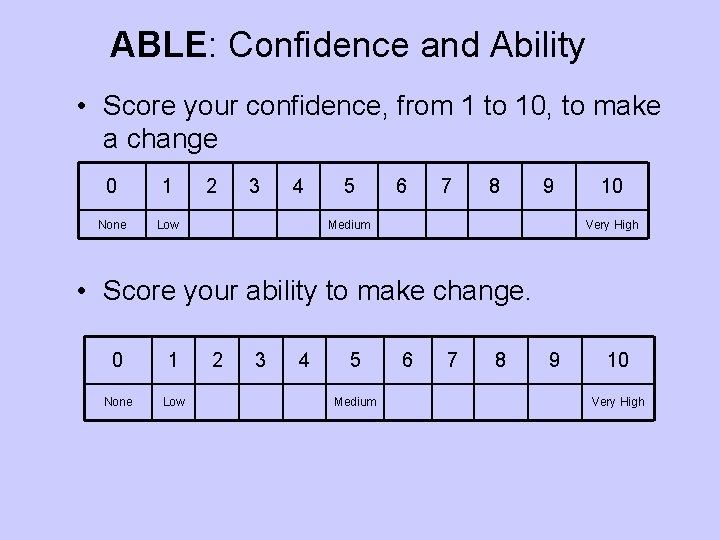
ABLE: Confidence and Ability • Score your confidence, from 1 to 10, to make a change 0 1 None Low 2 3 4 5 6 7 8 9 Medium 10 Very High • Score your ability to make change. 0 1 None Low 2 3 4 5 Medium 6 7 8 9 10 Very High
Increasing your confidence & ability to change Increase your motivation by asking questions – evoking change talk: • Ask yourself, “What would it take to increase my confidence to make this change (the change being eating smarter, moving more, stop smoking, etc)? ” • Ask yourself, “What would it take to increase my ability to make this change? ”
Optimism about change • People with high confidence and a high sense of their ability to make the change • More likely to occur when external supports are there to help people change. • Ask questions that can uncover these supports.
Optimism about change • Questions that help you define the supports – What encourages you to believe that you can change? – What else would help you change? – Who else would help you change? • You are one of the most important supports – You can give people a higher sense of confidence and ability and encourage their optimism.
Ready If you are willing and able, • How will you do it? Do you have a plan? • Can you “troubleshoot” as your plan unfolds? – Are you prepared with alternate plans if barriers and obstacles arise that can cause setbacks? – Are you prepared to monitor your progress in completing the steps in your plan?
Ready • Setting goals and making plans for action • Being prepared for dealing with setbacks
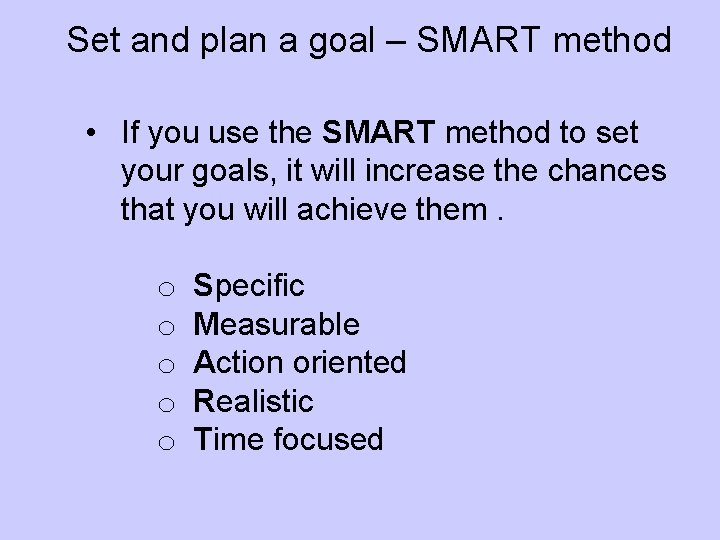
Set and plan a goal – SMART method • If you are Willing and Able, you are Ready to take the actions needed to make your goal. • But to create success, define a goal in a way that is Specific, can be Measured, is Action oriented, is Realistic, and is set in a specific Time frame.
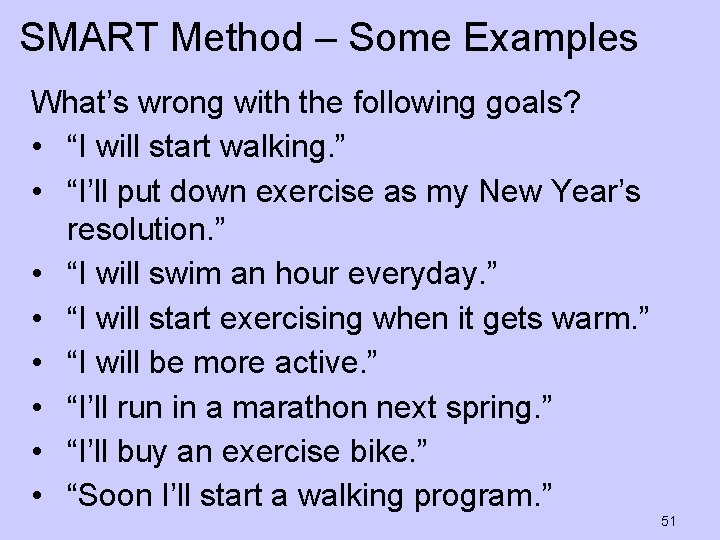
SMART Method – Some Examples What’s wrong with the following goals? • “I will start walking. ” • “I’ll put down exercise as my New Year’s resolution. ” • “I will swim an hour everyday. ” • “I will start exercising when it gets warm. ” • “I will be more active. ” • “I’ll run in a marathon next spring. ” • “I’ll buy an exercise bike. ” • “Soon I’ll start a walking program. ” 51
Set and plan a goal – SMART method • If you use the SMART method to set your goals, it will increase the chances that you will achieve them. o o o Specific Measurable Action oriented Realistic Time focused
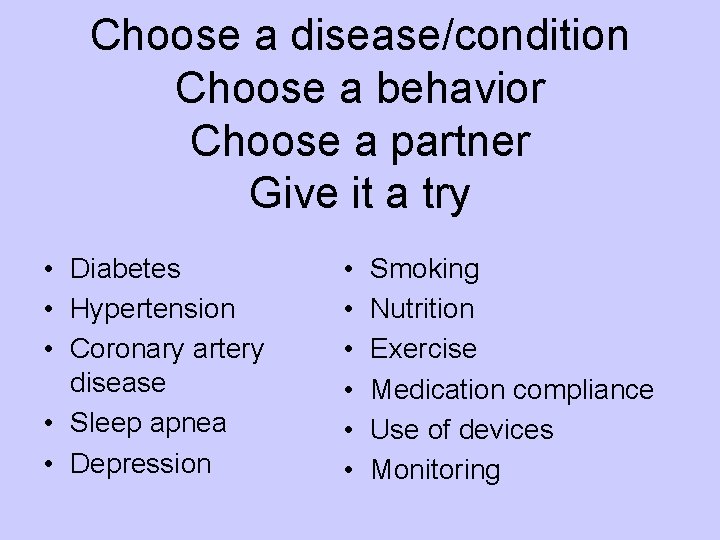
Choose a disease/condition Choose a behavior Choose a partner Give it a try • Diabetes • Hypertension • Coronary artery disease • Sleep apnea • Depression • • • Smoking Nutrition Exercise Medication compliance Use of devices Monitoring
How WILLING Am I to Make the Change Needed to Achieve My Goal? Behavior: Reasons I have for Not Changing Reasons I have for Changing What benefits am I getting by staying the same, not changing? What is the worst outcome I can imagine if I don’t change? What are my fears about changing? What would my life be like if a miracle happened and I was able to change tomorrow (benefits of change)?
How WILLING are You to Change? The ruler of change • On a scale of 0 to 10, how strong are the reasons you gave on the left side of the Decision Balance chart for not changing? 0 1 2 3 4 5 6 7 8 9 Very weak • 10 Very Strong On a scale of 0 to 10, how strong are the reasons you gave on the right side of the chart for changing? 0 Very weak 1 2 3 4 5 6 7 8 9 10 Very Strong
ABLE: Confidence and Ability • Score your confidence, from 1 to 10, to make a change 0 1 None Low 2 3 4 5 6 7 8 9 Medium 10 Very High • Score your ability to make change. 0 1 None Low 2 3 4 5 Medium 6 7 8 9 10 Very High
Set and plan a goal – SMART method • If you use the SMART method to set your goals, it will increase the chances that you will achieve them. o o o Specific Measurable Action oriented Realistic Time focused
Examples from: Kinston North Wilkesboro Durham
Ready: Dealing with barriers and setbacks • After taking action and beginning to change a habit, setbacks will occur • Lapses and relapses are natural parts of the change process • The key to staying motivated is to view setbacks as learning experiences, not as failures
Ready: Dealing with barriers and setbacks • Setbacks are not failures • You can help people acquire this attitude • A Progress Check can be helpful in identifying setbacks and learning from them
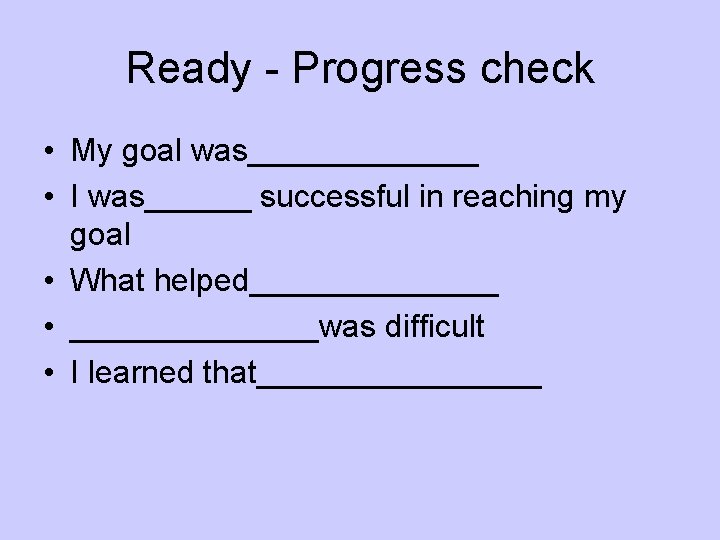
Ready - Progress check • My goal was_______ • I was______ successful in reaching my goal • What helped_______ • _______was difficult • I learned that________
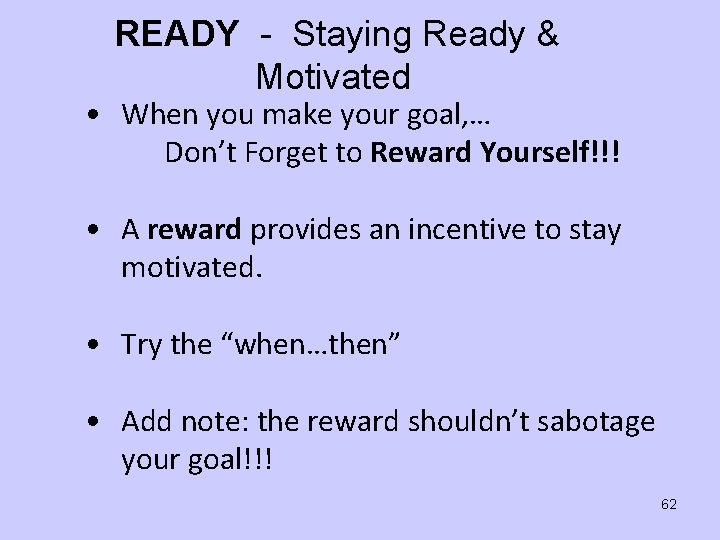
READY - Staying Ready & Motivated • When you make your goal, … Don’t Forget to Reward Yourself!!! • A reward provides an incentive to stay motivated. • Try the “when…then” • Add note: the reward shouldn’t sabotage your goal!!! 62
Follow up • Always include in your plan • Provide encouragement for any change in the right direction, even if people fall short of the goal • Focus on sense of control and success
Ask…Provide…Ask • What do you know? • This is what I know • What do you think or feel?
Traps • Confrontation (leader gives reasons or suggestions, client counters) • Question-answer (leader asks serial questions with client giving short answers) • Expert trap (leader gives direction, advice, client responds passively) • Premature focus (leader’s priority)
Final point • Motivation and Emotion come from the same Latin word MOVERE meaning “to move” • We’ MOVING towards being better!!! Not perfect!!!
Could you use MI to help older adults make lifestyle changes that can modify risk factors for dementia? What risk factors?
References/Resources • https: //www. miclab. org/sites/default/files/i mages/Lundahl 2010%20 Meta-analysis. pdf • Miller WR, Rollnick S, editors. Motivational interviewing: preparing people for change. 2 nd ed. New York: Guilford Press; 2002 • Levensky ER, Forcehimes A, O’Donohue WT &Beitz K. Motivational Interviewing. AJN 2007; 107(10): 50 -58 (http: //www. nursingcenter. com/pdf. asp ? AID=744988_)