
Clinical application of r TMS in treatment of
- Slides: 45
Clinical application of r. TMS in treatment of neurological disorders Abbas Tafakhori Assistant professor of neurology Tehran university of Medical Sciences Imam khomeini Hospital complex
Transcranial magnetic stimulation (TMS) is a safe and non-invasive method of stimulating cortical neurons. The procedure involves a short strong electrical current that is delivered through an insulated coil of wire placed over the scalp (magnetic coil).
The induced electrical currents modulate neuronal excitability at the stimulated sites. Depending on stimulation parameters, transcranial magnetic stimulation can upregulate or down regulate excitability to different extents in the neural structures under the stimulating coil. Maeda F, et al. Exp Brain Res 2000; 133: 425– 30.
Motor function in stroke Recovery of motor function after stroke is typically incomplete. 6 months after the episode, two-thirds of stroke survivors are unable to take part in activities of daily living with their paretic hand to the extent they were before and only a few are able to carry out professional work. Kolominsky-Rabas Plet al. Epidemiology of ischemic stroke subtypes according to TOAST criteria: incidence, recurrence, and long-term survival in ischemic stroke subtypes: a population-based study. Stroke 2001; 32: 2735– 40.
It remains a desirable goal to develop strategies to improve the beneficial effects of neurorehabilitative treatments.
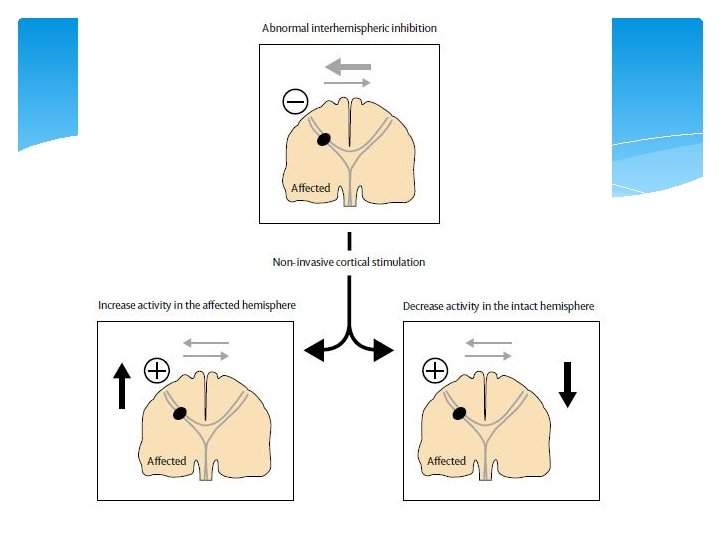
Neuroimaging studies showed increased activity of M 1(intact hemisphere) with movements of the paretic hand in patients with motor impairment. purposeful modulation of excitability in motor regions of the intact and affected hemisphere may contribute to improvements in motor function.
Recent studies in animals showed that motor recovery after focal lesions in the hand motor representation can improve with direct epidural cortical stimulation. Alternative approach is the use of non-invasive cortical stimulation. Brown JA, et al. Motor cortex stimulation for the enhancement of recovery from stroke: a prospective, multicenter safety study. Neurosurgery 2006; 58: 464– 73.
Low frequency (<=1 Hz): inhibitory effect High frequency (>5 Hz): excitability effect
Upregulation of excitability in the affected hemisphere Two non invasive strategies : 1. Transcranial direct current stimulation 2. r. TMS
In an study: repetitive transcranial magnetic stimulation daily (ten 10 s trains of 3 Hz stimulation with 50 s between each train) combined with customary rehabilitative treatment for 10 days within the first 2 weeks after stroke.
Results: Motor improvements with repetitive transcranial magnetic stimulation relative to sham lasting for at least 10 days. There were no complications with either interventions and the researchers proposed that repetitive stimulation sessions could elicit longer-lasting effects than single applications. Khedr EM, et al. Therapeutic trial of repetitive transcranial magnetic stimulation after acute ischemic stroke. Neurology 2005; 65: 466– 68
Downregulation of excitability in the intact hemisphere An alternative approach that could theoretically improve motor function in the paretic hand is downregulation of excitability in M 1(intact hemisphere), possibly through modulation of inappropriate interhemispheric inhibition.
Previous studies in healthy volunteers showed that downregulation of excitability in one motor cortex results in increased excitability in the opposite motor cortex and performance improvements in motor functions of the ipsilateral hand, a mechanism proposed to rely on modulation of interhemispheric inhibition between both primary motor cortices. Kobayashi Met al Ipsilateral motor cortex activation on functional magnetic resonance imaging during unilateral hand movements is related to interhemispheric interactions. Neuroimage 2003; 20: 2259– 70.
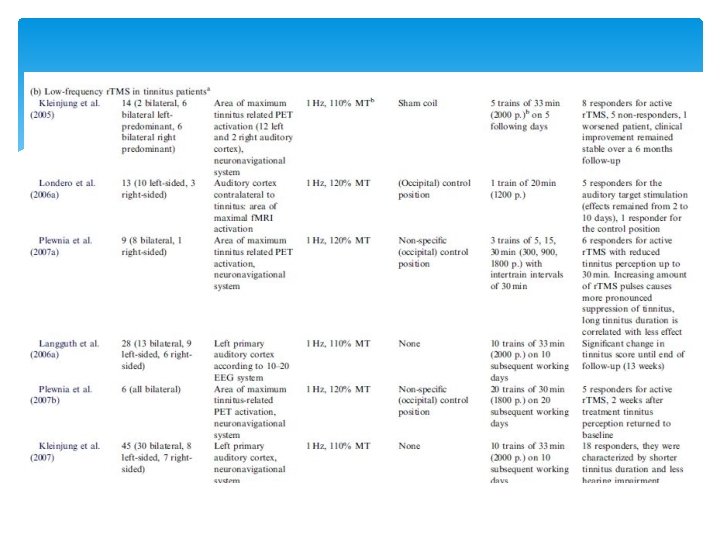
Chronic tinnitus r. TMS can relieve tinnitus by modulating the excitability of neurons in the auditory cortex to decrease the hyperexcitability that is associated with generating the neural activity that causes some form of tinnitus.
There is increasing evidence that expression of neural plasticity is involved in tinnitus. Many forms of chronic tinnitus are auditory phantom perceptions. That might be a result of maladaptive attempts at cortical reorganization due to distorted sensory input
The results of positron emission tomography (PET) have shown signs of an abnormal asymmetry in the auditory cortices of some individuals with tinnitus indicating higher levels of spontaneous activity on the left side, independent on the side to which the tinnitus is referred.
Since r. TMS has the ability to modulate cortical activity focally, it seems likely to assume that application of r. TMS to cortical auditory areas can alleviate tinnitus.
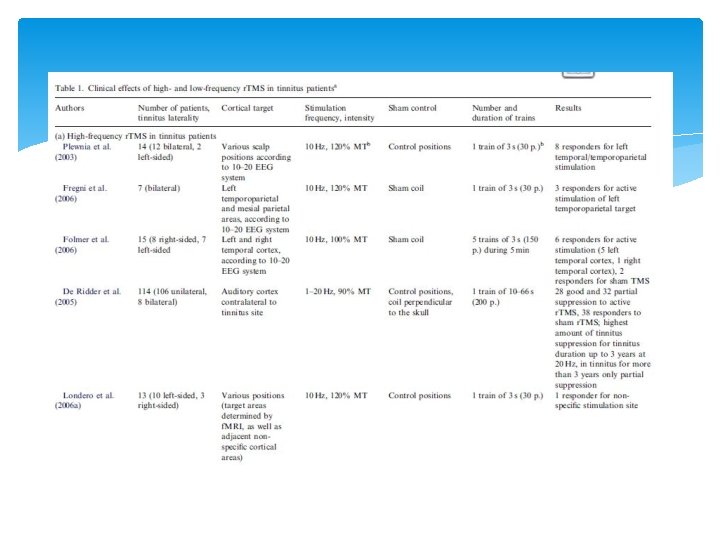
It has been shown that trains of high-frequency r. TMS (10– 20 Hz) can induce an immediate, shortlasting interruption of tinnitus perception, whereas repeated stimulations with low-frequency (1 Hz) r. TMS on several consecutive days can have a lasting beneficial effect on tinnitus and thus represent a potential therapeutic method.
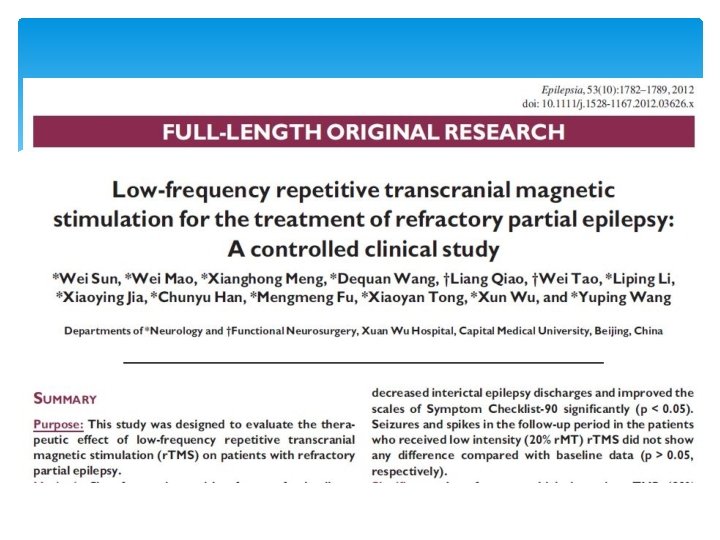
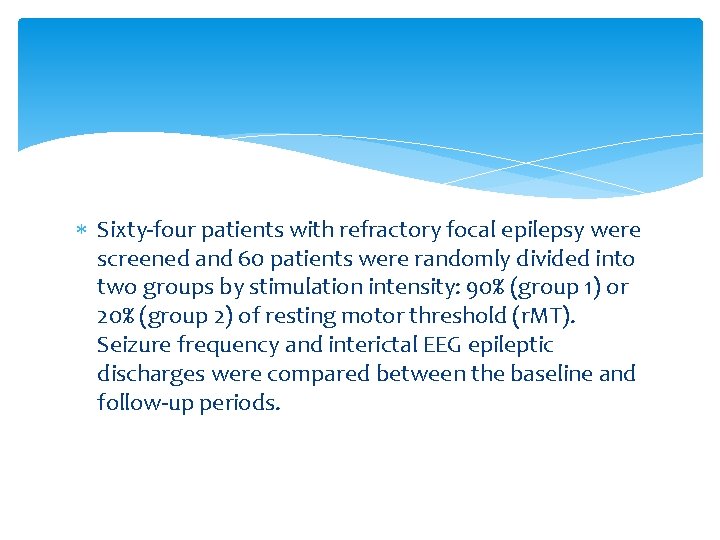
Sixty-four patients with refractory focal epilepsy were screened and 60 patients were randomly divided into two groups by stimulation intensity: 90% (group 1) or 20% (group 2) of resting motor threshold (r. MT). Seizure frequency and interictal EEG epileptic discharges were compared between the baseline and follow-up periods.
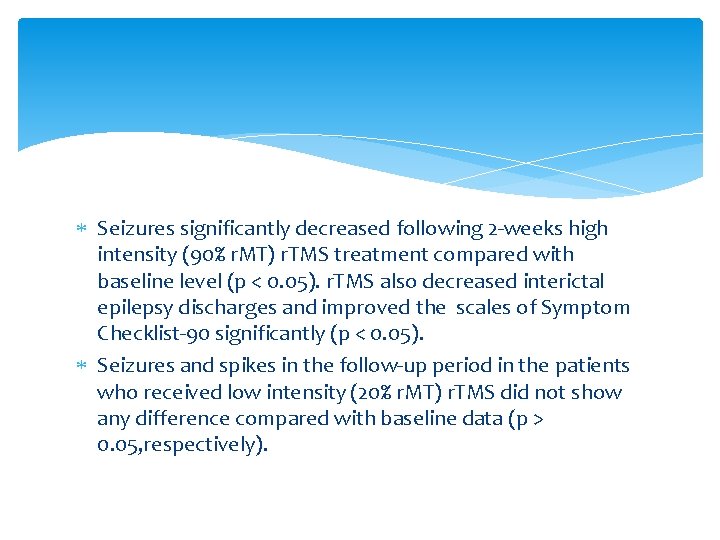
Seizures significantly decreased following 2 -weeks high intensity (90% r. MT) r. TMS treatment compared with baseline level (p < 0. 05). r. TMS also decreased interictal epilepsy discharges and improved the scales of Symptom Checklist-90 significantly (p < 0. 05). Seizures and spikes in the follow-up period in the patients who received low intensity (20% r. MT) r. TMS did not show any difference compared with baseline data (p > 0. 05, respectively).
Low-frequency high intensity r. TMS (90% r. MT) delivered into the epileptogenic zone had a significant antiepileptic effect on patients with refractory partial seizures. r. TMS treatment can also reduce the interictal epileptic discharge frequency and improve the sychological condition of these patients.
Parkinson disease Of all the movement disorders, PD has received the most attention with regard to r. TMS therapeutic studies.
Physiological evidence for r. TMS The pathological process that underlies PD causes widespread dysfunction of the brain and that particularly affects processing in the cortico–basal ganglial loops. Functional imaging studies have, in general, identified hypometabolism within the supplementary motor area (SMA) and the prefrontal cortex during movement in patients with PD that are thought to be caused by the primary dysfunction in the basal ganglia. Jahanshahi Met al. Self-initiated versus externally triggered movements. I. An investigation using measurement of regional cerebral blood fl ow with PET and movement-related potentials in normal and Parkinson’s disease subjects. Brain 1995; 118: 913– 33.
Therapy for PD (eg, levodopa) can, to a certain extent, reverse such changes in both human beings and animals. Therefore, excitatory r. TMS might have a similar effect, which might be translated into an improvement in clinical (motor) symptoms.
r. TMS is also capable of inducing dopamine release from the basal ganglia: in healthy individuals, application of 10 Hz of r. TMS over the motor cortex (M 1) or the dorsolateral prefrontal cortex (DLPFC) induced ipsilateral dopamine release from the putamen and caudate, respectively.
There is evidence, at least in animal models of PD, that levodopa-induced dyskinesia might represent abnormal plasticity in the motor system. In light of this, some studies with r. TMS have specifically looked at the potential application of brain stimulation in PD patients with dyskinesia.
Therapeutic trials of motor symptoms 1. single-session studies 2. multiple-session studies
single-session studies Early studies of the potential therapeutic application of r. TMS in PD investigated changes in parkinsonian motor symptoms during a high-frequency (5 Hz), lowintensity r. TMS protocol delivered once over the M 1, with the aim to increase excitability.
After all applications of real r. TMS, a 10– 30% improvement was shown in most studies for almost all outcome measures, with no effects after sham stimulation.
multiple-session studies Despite the inconsistency of the single-session results, the transient clinical gains seen in some studies after a single session of r. TMS have encouraged long-term treatment studies in patients with PD.
Despite the methodological differences, excitatory (high-frequency) r. TMS can improve upper-limb bradykinesia, gait speed, and the score in the motor section of the unified Parkinson’s disease rating scale (UPDRS); these improvements range from 15% to an impressive 50% for some of the outcome measures.
On some occasions, improvements were shown to last for up to 1 month after the end of the stimulation regimen, but were gradually lost. Khedr EM, Rothwell JC, Shawky OA, Ahmed MA, Hamdy A. Eff ect of daily repetitive transcranial magnetic stimulation on motor performance in Parkinson’s disease. Mov Disord 2006; 21: 2201– 05.
Therapeutic trials of levodopa-induced dyskinesia Three small studies have specifi cally investigated the effect of r. TMS protocols on the severity of levodopa induced dyskinesia. Koch and colleagues found that a single session of r. TMS at 1 Hz to the SMA bilaterally lowered the severity of dyskinesia for 30 min after stimulation. No effect was seen after sham stimulation. Dyskinesia worsened after stimulation with 5 Hz.
In a follow-up paper, a transient effect of a single session of 1 Hz stimulation over the SMA was again seen, by contrast with sham stimulation. Rektorova and colleagues assessed the effect of high frequency (10 Hz) stimulation of the DLPFC or motor cortex, given as daily sessions for 5 days, on gait and bradykinesia in patients with PD. The intervention did not show any benefit and the study was terminated early.
Painful diabetic neuropathy Painful neuropathy is associated with plasticity changes in the nervous system. Deep r. TMS is a newer development that allows direct activation of deeper neuronal populations, by a unique coil design termed the H-coil. Deep H-coil r. TMS provides pain relief in patients with diabetic neuropathy. This technique can induce a therapeutic effect on brain areas that otherwise remain difficult to target. Onesti E, et al, H-coil repetitive transcranial magnetic stimulation for pain relief in patients with diabetic neuropathy, Eur J Pain. 2013
Neuropathic pain In an study efficacy and safety of 10 daily r. TMS was evaluated in NP patients. In this randomized, doubleblind, sham-controlled, crossover study at 7 centers: The real r. TMS, compared with the sham, showed significant short-term improvements in VAS. No serious adverse events were observed. Hosomi K, et al, Daily repetitive transcranial magnetic stimulation of primary motor cortex for neuropathic pain: A randomized, multicenter, double-blind, crossover, sham-controlled trial. Pain. 2013
Migraine Effect of high rate repetitive transcranial magnetic stimulation (r. TMS) in migraine prophylaxis in medically refractory patients: 98% patients had more than 50% reduction of headache frequency at the end and 1 week after r. TMS and the improvement persisted till the fourth week in 80. 4% patients. The headache frequency, severity, functional disability, migraine index, and rescue medications significantly reduced at all time points, but the maximum benefit was observed in the first 2 weeks. There were no serious adverse events. Misra UK, et al, Neurol Res. 2012 Jul; 34(6): 547 -51
Low-frequency r. TMS of the vertex in the prophylactic treatment of migraine. The r. TMS treatment was tolerated well. r. TMS stimulation over vertex with 1 Hz was not effective in migraine prophylaxis when compared with placebo. Teepker M, et al. Cephalalgia. 2010 Feb; 30(2): 137 -44
Aphasia Loss of fluency is a significant source of functional impairment in many individuals with aphasia. Repetitive transcranial magnetic stimulation (r. TMS) administered to the right inferior frontal gyrus (IFG) has been shown to facilitate naming in persons with chronic left hemisphere stroke and non-fluent aphasia. Medina J, Aphasiology. 2012 Sep 1; 26(9): 1153 -1168
r. TMS with or without conventional rehabilitation has positive effects on post-stroke aphasia. Wong IS, Tsang HW, Rev Neurosci. 2013; 24(1): 105 -14