
CLINICAL APPLICATION OF METABOLITES AND ELECTROLYTES AS DIAGNOSTIC

CLINICAL APPLICATION OF METABOLITES AND ELECTROLYTES AS DIAGNOSTIC TOOLS DR MD REZAUL KARIM DEPARMENT OF BIOCHEMISTRY AND MOLECULAR BIOLOGY UNIVERSITY OF RAJSHAHI

LESSON OUTCOME ØTo make the students aware of clinical significance of serum electrolytes and metabolites in diagnosing diseases. ØTo develop student’s skills in using methods and tools for the assay of those parameters. Ø To enable students in explaining the data obtained from the lab tests. ØTo make students aware of the possible causes of false positive and false negative values of tested parameters.

BMP (BASIC METABOLIC PANEL) • BMP is a chemistry panel where multiple chemistry tests are grouped as a single profile for ease of ordering since this group of tests are often all medically necessary. • The BMP includes electrolytes and tests of kidney function: – – – – – Sodium (Na) Potassium (K) Chloride (Cl) Carbon Dioxide Content (CO 2) Blood Urea Nitrogen (BUN) Serum Creatinine (Cr) Serum and urinary glucose (Glu) Total Calcium (Calcium) Lipid Profile Serum Billirubin Q. 1. Why some biological compounds are grouped under the name ‘BMP’? Enlist five major compounds.
SODIUM • Sodium (Na) is the major extracellular cation (serum levels of approximately 134 to 145 m. Eq/L. or m. M/L). • It is the major determinants of extracellular osmolality. • Increased serum sodium level (Hypernatremia) is due to excessive water loss or salt gain due to vomiting, infusions containing sodium such as sodium chloride or sodium bicarbonate ) • Clinical features of hypernatraemia may include fever, irritability, drowsiness, lethargy and confusion. • Decreased serum sodium level (Hyponatraemia) is caused by water retention due to cardiac or renal or hepatic failure). Syndrome of inappropriate ADH secretion, and chronic or severe diarrhea. Q. 2. What is meant by extracellular osmolality? Describe the clinical significance of hypoand hyper-natraemia.
POTASSIUM • Potassium (K) is responsible for the functioning of excitable tissues such as skeletal and cardiac muscle and nerves. Normal range for potassium is 3. 5 to 5. 0 m. M/L. • Hypokalaemia (serum potassium <3. 5 m. M/L) may result from decreased oral intake, increased renal or gastrointestinal loss, or a shift of potassium within the body’s fluid compartments (from outside the cell where it should be, to inside the cell). • Clinical features of hypokalaemia range from muscle weakness and ileus (lack of peristalsis), to serious cardiac arrhythmias such as ventricular tachycardias. • Hyperkalaemia (serum K level ˃5. 0 m. M/L), may be caused by excessive intake, tissue damage from burns or trauma, medicines such as potassium sparing diuretics, and most commonly, due to renal failure. • Clinical signs of hyperkalaemia include muscle weakness, hypotension, bradycardia and loss of cardiac output, and ECG changes may include peaked T waves and • flattened P waves. Q. 3. Construct a comparative list of serum potassium level with clinical significance.
CHLORIDE • Chloride is the major extracellular anion with serum concentration in normal adult ranging from 97 -107 m. Eq/L or m. M/L • Hyperchloremia and hypochloremia are rarely isolated phenomena. • Usually they are part of shifts in sodium or bicarbonate to maintain electrical neutrality. • It usually occurs with a concomitant occurrence of hyper and hyponatrimea. • The clinical features are also the same as those of hyper- and hyponatrimea. • Chloride is vital for maintenance of serum electroneutrality, acid-base balance, fluid homeostasis, osmotic pressure, hydrochloric acid (HCl) production in the gastrointestinal tract, renal function, and for electrical activity in general, e. g. , in muscular activity. Q. 4. Note down the assay of Cl- during intensive care.
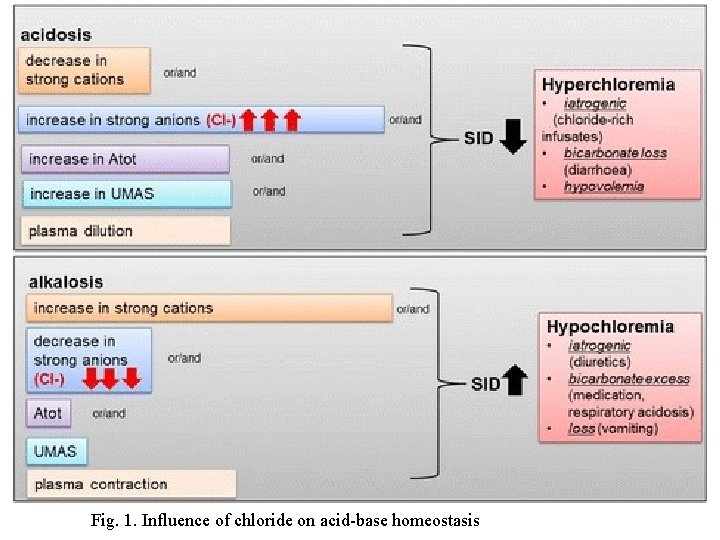
Fig. 1. Influence of chloride on acid-base homeostasis
CARBON DIOXIDE CONTENT • Total carbon dioxide (CO 2) constitute H 2 CO 3, dissolved CO 2 and bicarbonate ion (HCO 3) that exists in the serum. • Serum H 2 CO 3 and dissolved CO 2 are very small. Therefore, HCO 3 content is an indirect measure of CO 2. • ‘Range : 18– 24 m. M/L (as total carbon dioxide, 22– 26 m. M/L); • Alert levels: less than 10 m. M/L and greater than 40 m. M/L. Clinical significance • This test is ordered to determine if there’s an imbalance between the O 2 and CO 2 or a p. H imbalance in blood indicating a kidney, respiratory, or metabolic disorder. • Signs include: shortness of breath, other breathing difficulties, nausea, vomiting. • These symptoms may point to lung dysfunction involving the exchange between oxygen and carbon dioxide. • Frequent assay of serum O 2 and CO 2 levels is required if one is on O 2 therapy or having certain surgeries.
• Blood test often measures blood p. H (a measure of acidity or alkalinity) along with CO 2 levels. • Alkalosis indicates body fluids too alkaline. Acidosis, on the other hand, is when your body fluids are too acidic. Typically, a blood is slightly basic with p. H measurement of close to 7. 4 in maintained by the body. Normal range from 7. 35 to 7. 45 is considered neutral. A blood p. H measurement less than 7. 35 is considered acidic. A substance is more alkaline when its blood p. H measurement is greater than 7. 45. Low bicarbonate (HCO 3) A test result of low bicarbonate and low p. H (less than 7. 35) is a condition called metabolic acidosis. Common causes are: kidney failure, severe diarrhea, lactic acidosis, seizures, cancer, prolonged lack of oxygen from severe anemia, heart failure, or shock, diabetic ketoacidosis (diabetic acidosis) A test result of low bicarbonate and high p. H (more than 7. 45) is a condition called respiratory alkalosis. Common causes are: hyperventilation, fever, pain, anxiety High bicarbonate (HCO 3) A test result of high bicarbonate and low p. H (less than 7. 35) is a condition called respiratory acidosis. Common causes are: pneumonia, chronic obstructive, pulmonary disease (COPD), asthma, pulmonary fibrosis, exposure to toxic chemicals drugs that suppress breathing, especially when they’re combined with alcohol, tuberculosis, lung cancer, pulmonary hypertension, severe obesity. A test result of high bicarbonate and high p. H (more than 7. 45) is a condition called metabolic alkalosis. Common causes are: chronic vomiting, low potassium levels, hypoventilation, which involves slowed breathing and decreased CO 2 elimination.
ASSAY OF ELECTROLYTES • • • Electrolytes are measured by a process known as potentiometry. This method measures the voltage that develops between the inner and outer surfaces of an ion selective electrode. The electrode (membrane) is made of a material that is selectively permeable to the ion being measured. This potential is measured by comparing it to the potential of a reference electrode. Since the potential of the reference electrode is held constant, the difference in voltage between the two electrodes is attributed to the concentration of ion in the sample. CAUSES OF ELECTROLYTE IMBALANCE • • Diarrhea, vomiting, excessive sweating, Use of certain combinations of diuretics (thiazides and benzodiazepines), Significant burns, trauma, Congestive heart failure, Abuse of alcohol (especially long-term abuse), Kidney disorders, and diabetes. Hepatic disorders
- Slides: 10