
Clinical and simulation outcomes of a multifocal intraocular

- Slides: 12
Clinical and simulation outcomes of a multifocal intraocular lens with rotational asymmetry and two different levels of near addition Jorge Alió, MD, Ph. D 1, 2 Luis J Moreno, MSc 1, 2 Ana B Plaza, MSc 1 David P Piñero, Ph. D 1 1 VISSUM Corporation. Alicante. 2 Department of Pathology and Surgery. University Miguel Hernández, Alicante.
Financial Disclosure for Jorge Alió, MD, Ph. D Abbott Medical Optics D Acu. Focus D Akkolens A, D Alcon Laboratories D Bausch & Lomb A, D Carl Zeiss Meditec D Chemedica D Eyemaginations A Index Instruments P Intra. Lase Corporation D Len. Sx A, D Mediphacos A Novagali Pharma D Nulens D, P Oculentis A, D OSN/SLACK A Presbia A SCHWIND eye-tech-solutions. D, E Springer P Tekia P Thea D
Clinical and simulation outcomes of a multifocal intraocular lens with rotational asymmetry and two different levels of near addition PURPOSE: To evaluate and compare the visual acuity outcomes of a multifocal intraocular lens with rotational asymmetry and two different levels of addition and correlate these outcomes with computer simulations at different distances. Clinical results are compared with mathematical simulations. SETTING: Vissum Corporation, Alicante, Spain METHODS: 43 consecutive eyes of 26 cataract patients (age range 55 -83 years) were divided into two groups: group A, 22 eyes implanted with the Lentis Mplus LS-312 MF 15 IOL (Oculentis); group B, 21 eyes implanted with the Lentis Mplus LS-312 MF 30 IOL (Oculentis). Distance, near and intermediate visual acuity outcomes were evaluated preoperatively and postoperatively during a 6 -month follow up. Additionally, postoperative contrast sensitivity, patient satisfaction, ocular aberrations, ocular optical quality and defocus curve were analyzed.
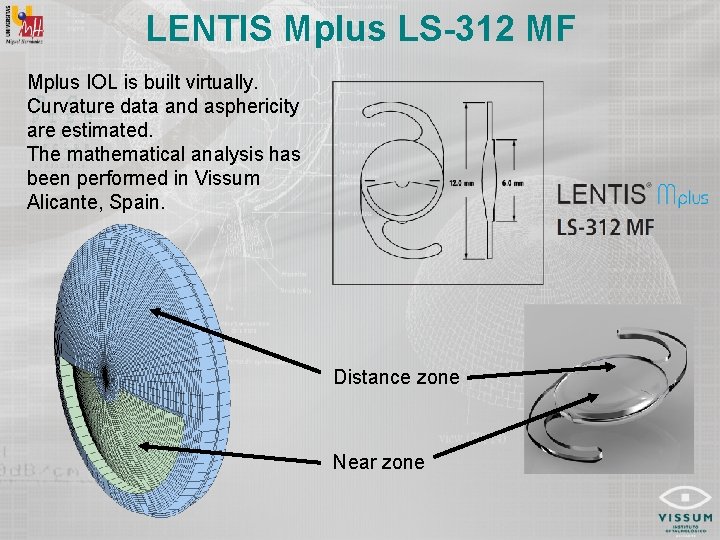
LENTIS Mplus LS-312 MF Mplus IOL is built virtually. Curvature data and asphericity are estimated. The mathematical analysis has been performed in Vissum Alicante, Spain. Distance zone Near zone
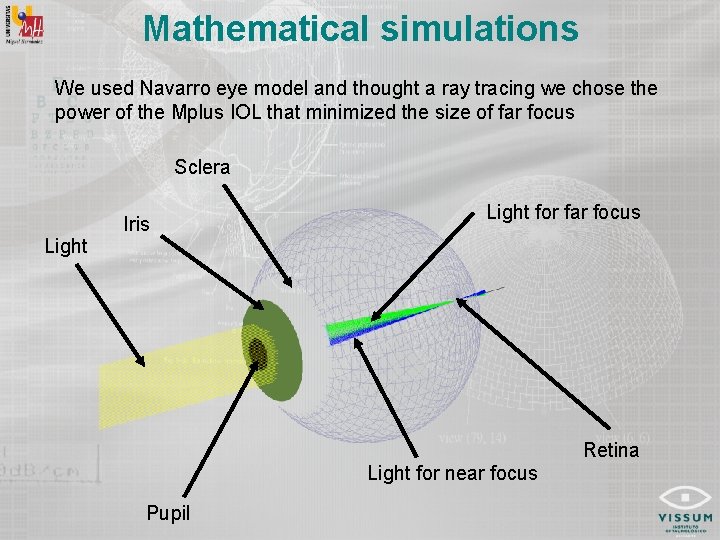
Mathematical simulations We used Navarro eye model and thought a ray tracing we chose the power of the Mplus IOL that minimized the size of far focus Sclera Iris Light for far focus Light Retina Light for near focus Pupil
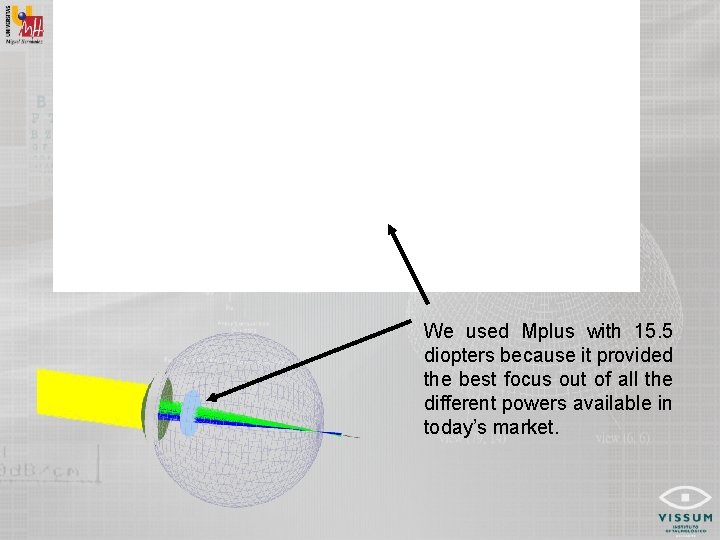
We used Mplus with 15. 5 diopters because it provided the best focus out of all the different powers available in today’s market.
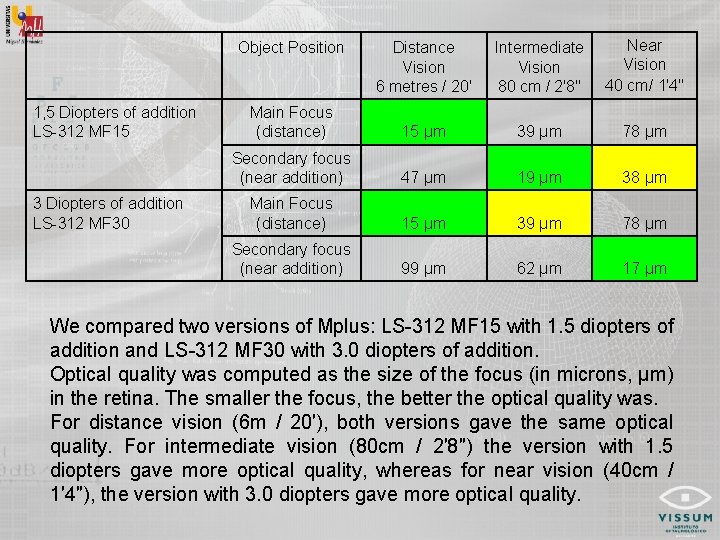
Distance Vision 6 metres / 20′ Intermediate Vision 80 cm / 2′ 8′′ Near Vision 40 cm/ 1′ 4′′ Main Focus (distance) 15 μm 39 μm 78 μm Secondary focus (near addition) 47 μm 19 μm 38 μm Main Focus (distance) 15 μm 39 μm 78 μm Secondary focus (near addition) 99 μm 62 μm 17 μm Object Position 1, 5 Diopters of addition LS-312 MF 15 3 Diopters of addition LS-312 MF 30 We compared two versions of Mplus: LS-312 MF 15 with 1. 5 diopters of addition and LS-312 MF 30 with 3. 0 diopters of addition. Optical quality was computed as the size of the focus (in microns, μm) in the retina. The smaller the focus, the better the optical quality was. For distance vision (6 m / 20′), both versions gave the same optical quality. For intermediate vision (80 cm / 2′ 8′′) the version with 1. 5 diopters gave more optical quality, whereas for near vision (40 cm / 1′ 4′′), the version with 3. 0 diopters gave more optical quality.
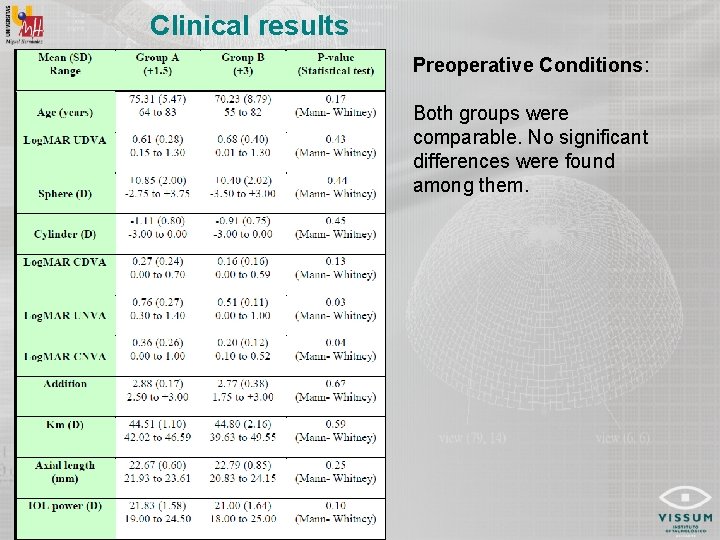
Clinical results Preoperative Conditions: Both groups were comparable. No significant differences were found among them.
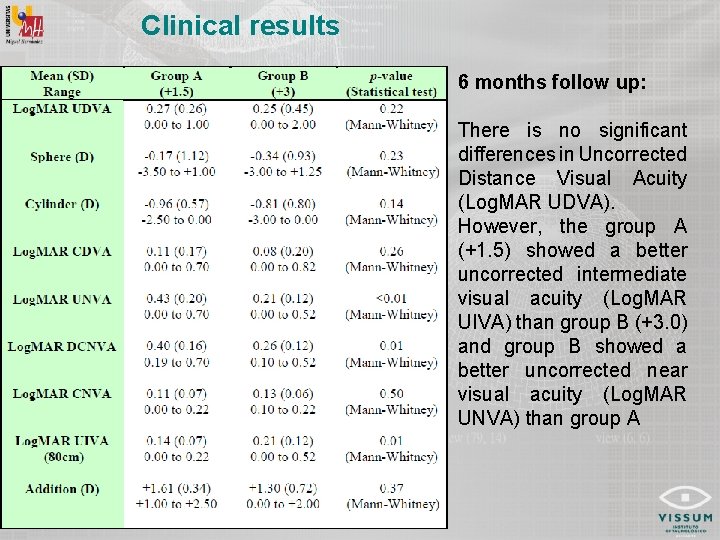
Clinical results 6 months follow up: There is no significant differences in Uncorrected Distance Visual Acuity (Log. MAR UDVA). However, the group A (+1. 5) showed a better uncorrected intermediate visual acuity (Log. MAR UIVA) than group B (+3. 0) and group B showed a better uncorrected near visual acuity (Log. MAR UNVA) than group A
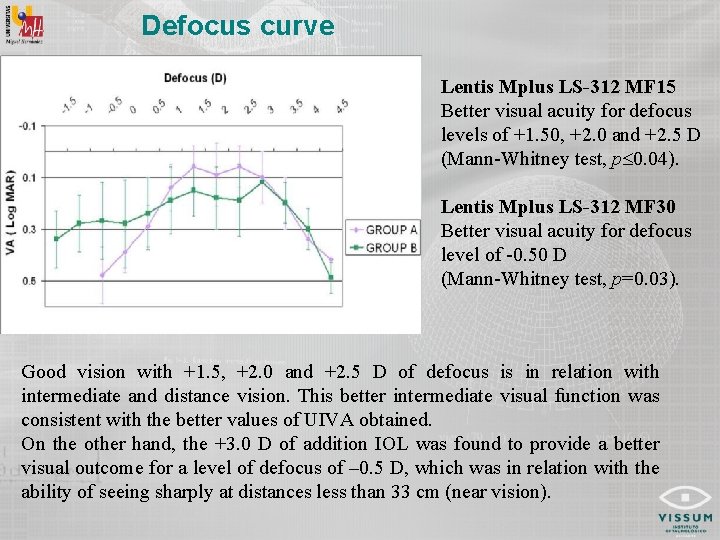
Defocus curve Lentis Mplus LS-312 MF 15 Better visual acuity for defocus levels of +1. 50, +2. 0 and +2. 5 D (Mann-Whitney test, p 0. 04). Lentis Mplus LS-312 MF 30 Better visual acuity for defocus level of -0. 50 D (Mann-Whitney test, p=0. 03). Good vision with +1. 5, +2. 0 and +2. 5 D of defocus is in relation with intermediate and distance vision. This better intermediate visual function was consistent with the better values of UIVA obtained. On the other hand, the +3. 0 D of addition IOL was found to provide a better visual outcome for a level of defocus of – 0. 5 D, which was in relation with the ability of seeing sharply at distances less than 33 cm (near vision).
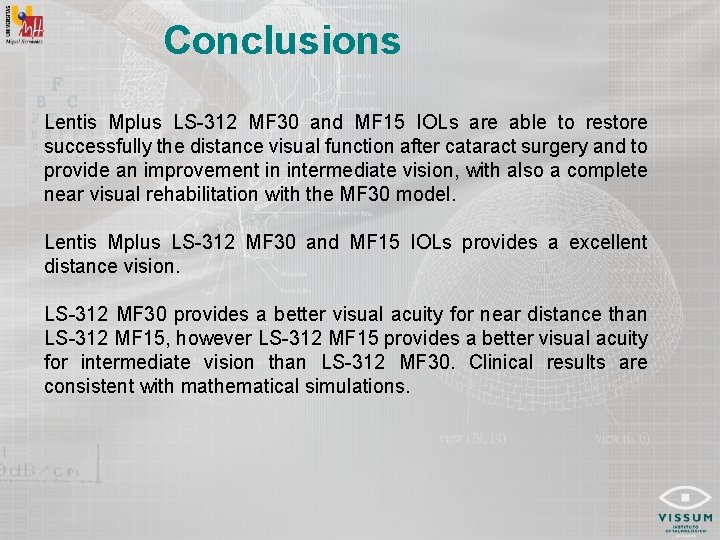
Conclusions Lentis Mplus LS-312 MF 30 and MF 15 IOLs are able to restore successfully the distance visual function after cataract surgery and to provide an improvement in intermediate vision, with also a complete near visual rehabilitation with the MF 30 model. Lentis Mplus LS-312 MF 30 and MF 15 IOLs provides a excellent distance vision. LS-312 MF 30 provides a better visual acuity for near distance than LS-312 MF 15, however LS-312 MF 15 provides a better visual acuity for intermediate vision than LS-312 MF 30. Clinical results are consistent with mathematical simulations.
Luis J Moreno Ms. C Jorge Alió, MD, Ph. D Ana Belén Plaza MSc David Piñero Ph. D