
Climbing and Descending The Flight Training Manual Sections
Climbing and Descending The Flight Training Manual - Sections 7 and 8
Objectives • To enter the climb or the descent from straight and level flight. • To maintain a climb or a descent at a: - constant speed; - constant rate; - in a constant direction; and, - in balance. • To level off at specific altitudes.
Principles of Flight • Forces in a Climb • Climb Performance • Climb Configurations • Forces in a Glide/Descent • Descent Performance • Descent Configurations
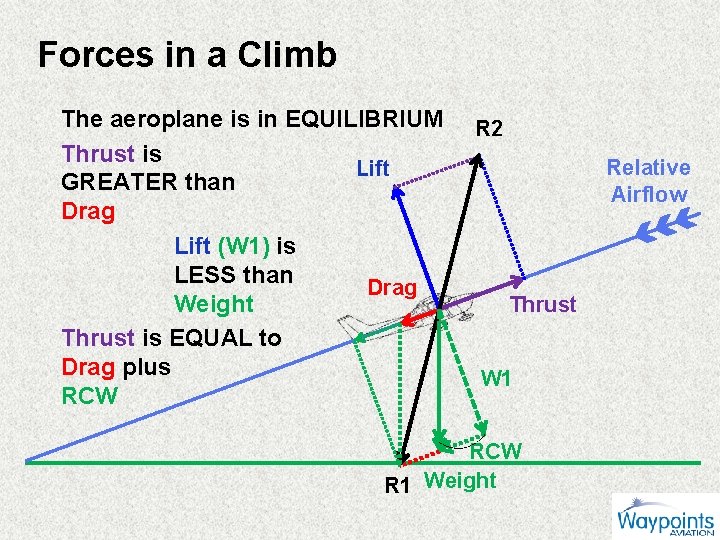
Forces in a Climb The aeroplane is in EQUILIBRIUM Thrust is Lift GREATER than Drag Lift (W 1) is LESS than Drag Weight Thrust is EQUAL to Drag plus RCW R 2 Relative Airflow Thrust W 1 RCW R 1 Weight
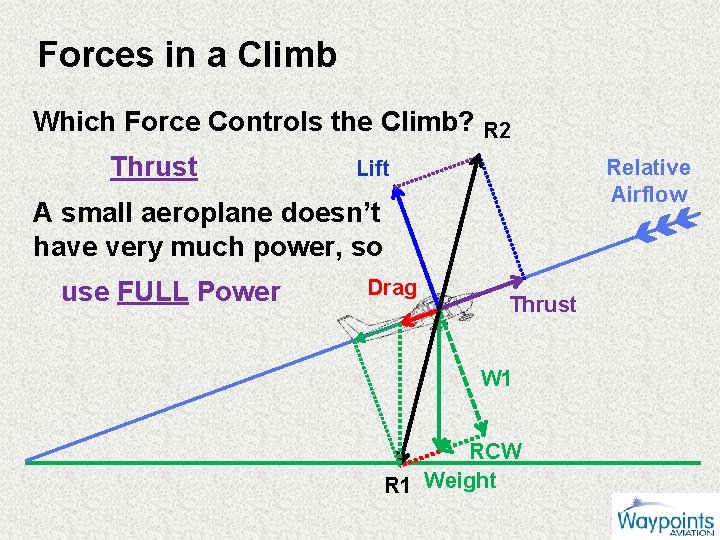
Forces in a Climb Which Force Controls the Climb? R 2 Thrust Relative Airflow Lift A small aeroplane doesn’t have very much power, so use FULL Power Drag Thrust W 1 RCW R 1 Weight
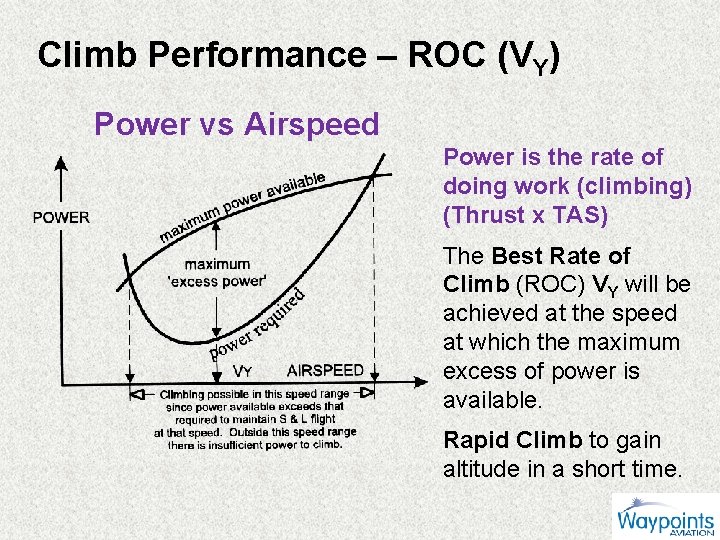
Climb Performance – ROC (VY) Power vs Airspeed Power is the rate of doing work (climbing) (Thrust x TAS) The Best Rate of Climb (ROC) VY will be achieved at the speed at which the maximum excess of power is available. Rapid Climb to gain altitude in a short time.
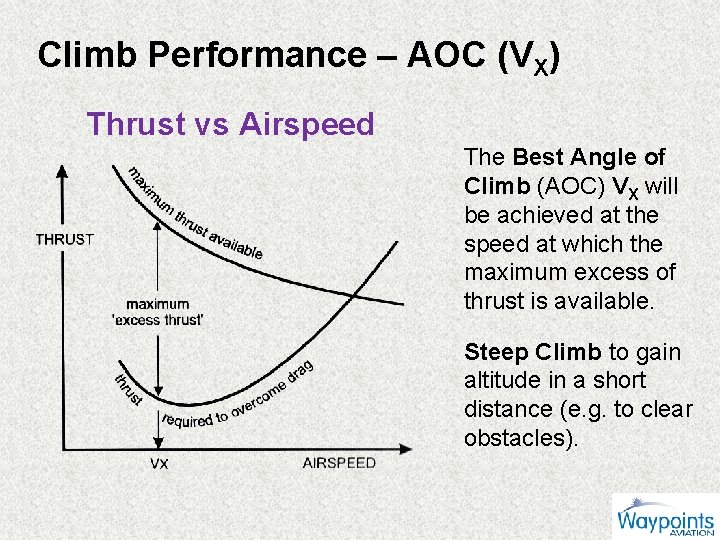
Climb Performance – AOC (VX) Thrust vs Airspeed The Best Angle of Climb (AOC) VX will be achieved at the speed at which the maximum excess of thrust is available. Steep Climb to gain altitude in a short distance (e. g. to clear obstacles).

Climb Performance – Density Altitude Engine Performance (Power) decreases with increasing density altitude, therefore there is a limit to how high the aeroplane can climb
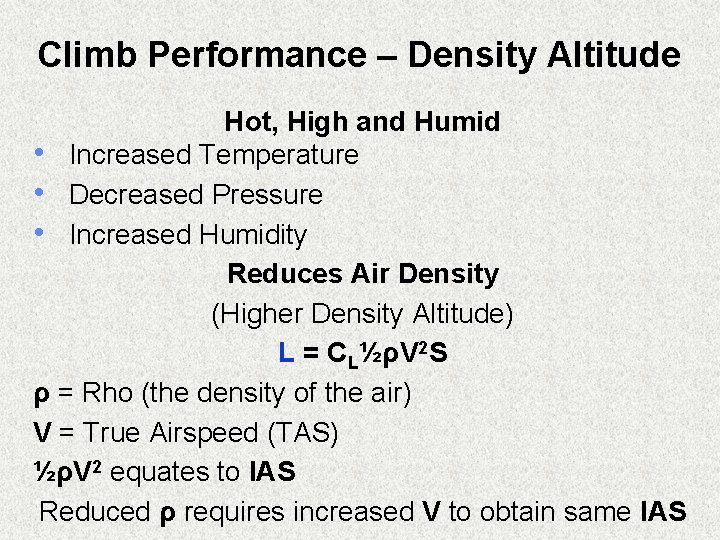
Climb Performance – Density Altitude Hot, High and Humid • Increased Temperature • Decreased Pressure • Increased Humidity Reduces Air Density (Higher Density Altitude) L = CL½ρV 2 S ρ = Rho (the density of the air) V = True Airspeed (TAS) ½ρV 2 equates to IAS Reduced ρ requires increased V to obtain same IAS
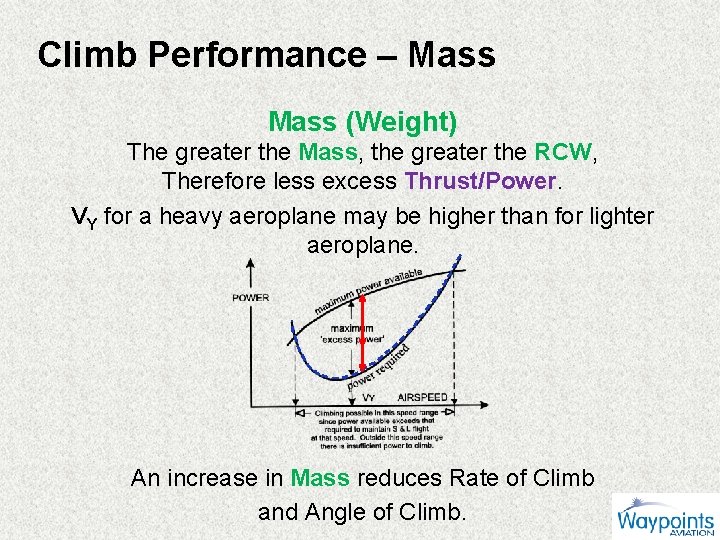
Climb Performance – Mass (Weight) The greater the Mass, the greater the RCW, Therefore less excess Thrust/Power. VY for a heavy aeroplane may be higher than for lighter aeroplane. An increase in Mass reduces Rate of Climb and Angle of Climb.
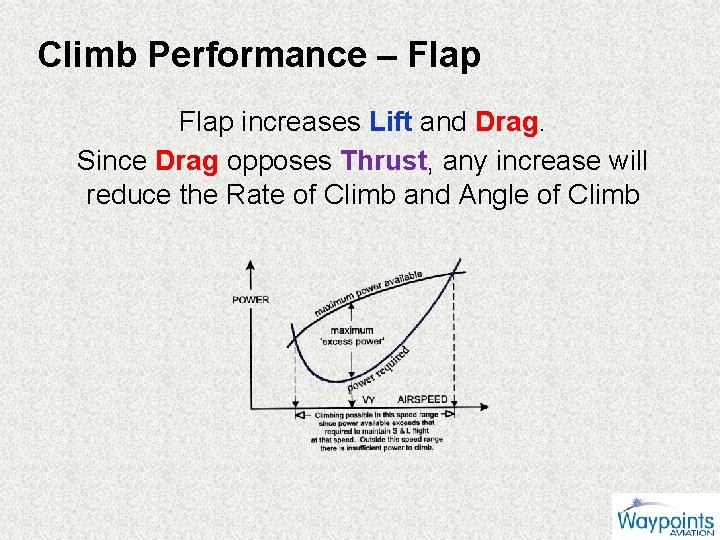
Climb Performance – Flap increases Lift and Drag. Since Drag opposes Thrust, any increase will reduce the Rate of Climb and Angle of Climb

Climb Performance – Wind Affects only the climb angle, i. e. distance travelled over the ground to reach a specific altitude.
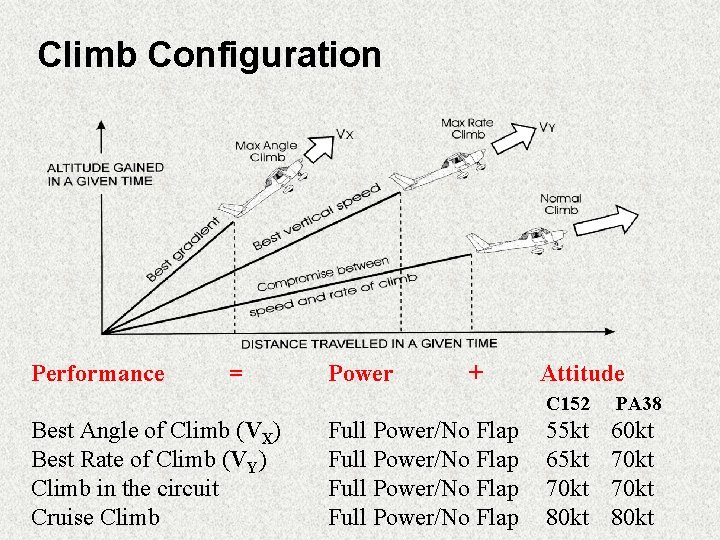
Climb Configuration Performance = Best Angle of Climb (VX) Best Rate of Climb (VY) Climb in the circuit Cruise Climb Power + Full Power/No Flap Attitude C 152 PA 38 55 kt 65 kt 70 kt 80 kt 60 kt 70 kt 80 kt
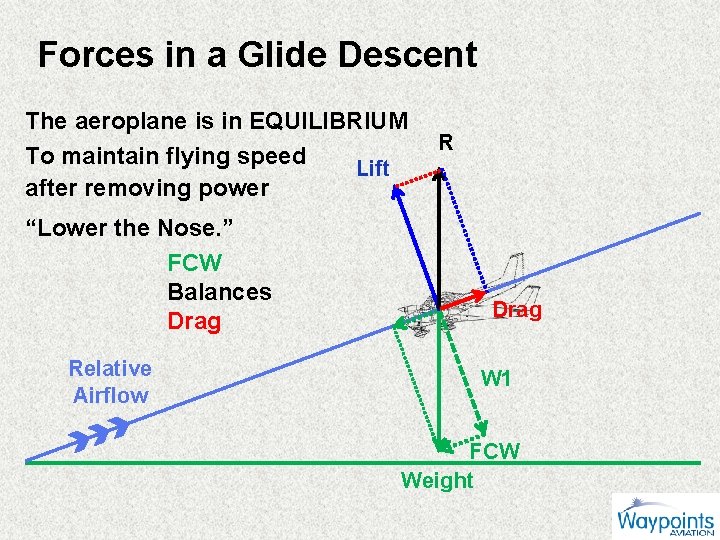
Forces in a Glide Descent The aeroplane is in EQUILIBRIUM To maintain flying speed Lift after removing power “Lower the Nose. ” FCW Balances Drag Relative Airflow R Drag W 1 FCW Weight
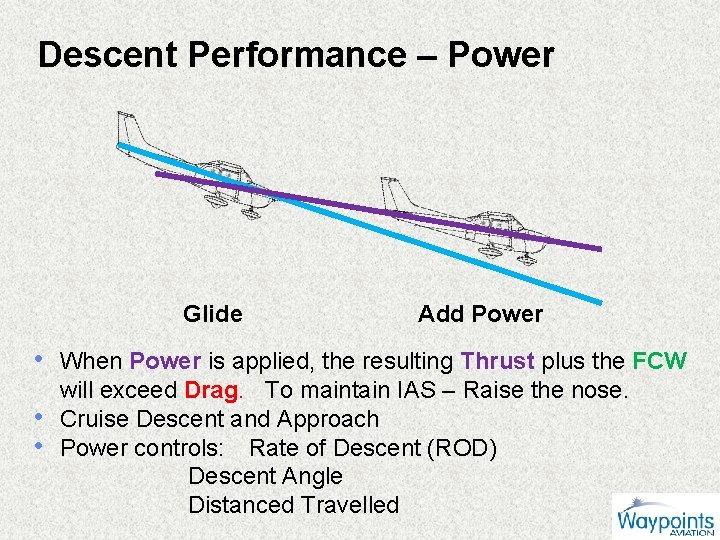
Descent Performance – Power Glide Add Power • When Power is applied, the resulting Thrust plus the FCW • • will exceed Drag. To maintain IAS – Raise the nose. Cruise Descent and Approach Power controls: Rate of Descent (ROD) Descent Angle Distanced Travelled

Descent Performance – Lift/Drag Ratio Maximum Gliding Range The maximum gliding range is achieved at the speed for: Best Lift/Drag Ratio

Descent Performance – Lift/Drag Ratio • Lift/Drag (L/D) Ratio is a measure of the efficiency • • of the wing Steepness of the glide depends on the L/D Ratio The HIGHER L/D, the GREATER the gliding range • C 152 L/D Ratio = 9: 1 (1. 5 NM per 1000 ft) at 60 kt • PA 38 L/D Ratio = 8: 1 (1. 3 NM per 1000 ft) at 70 kt
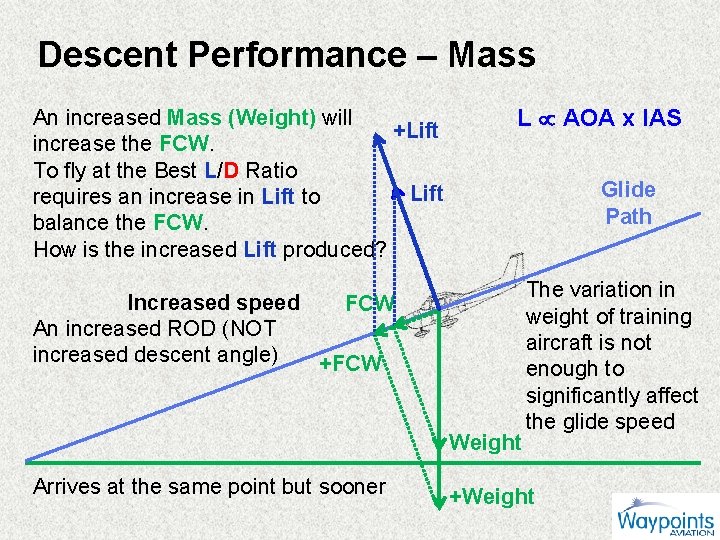
Descent Performance – Mass An increased Mass (Weight) will +Lift increase the FCW. To fly at the Best L/D Ratio Lift requires an increase in Lift to balance the FCW. How is the increased Lift produced? L AOA x IAS Glide Path Increased speed FCW An increased ROD (NOT increased descent angle) +FCW Weight Arrives at the same point but sooner The variation in weight of training aircraft is not enough to significantly affect the glide speed +Weight
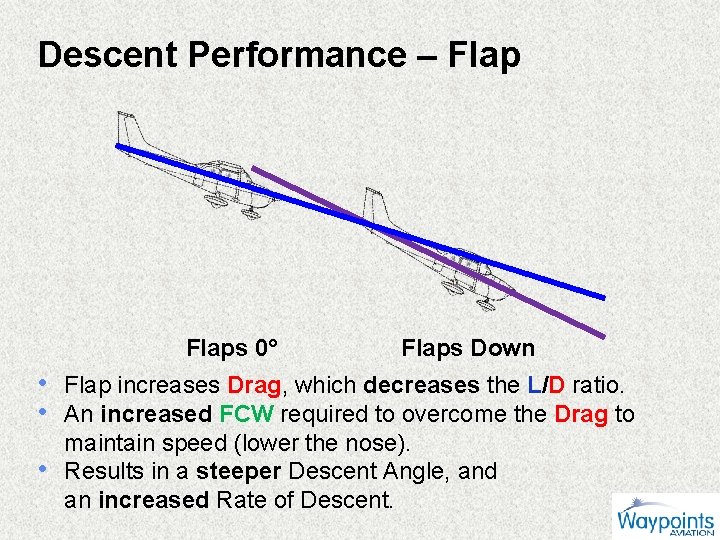
Descent Performance – Flaps 0° Flaps Down • Flap increases Drag, which decreases the L/D ratio. • An increased FCW required to overcome the Drag to • maintain speed (lower the nose). Results in a steeper Descent Angle, and an increased Rate of Descent.

Descent Performance – Wind Affects the Descent Angle and the Range from an Altitude • Tailwind – Extends the Gliding Range • Headwind – Reduces the Gliding Range
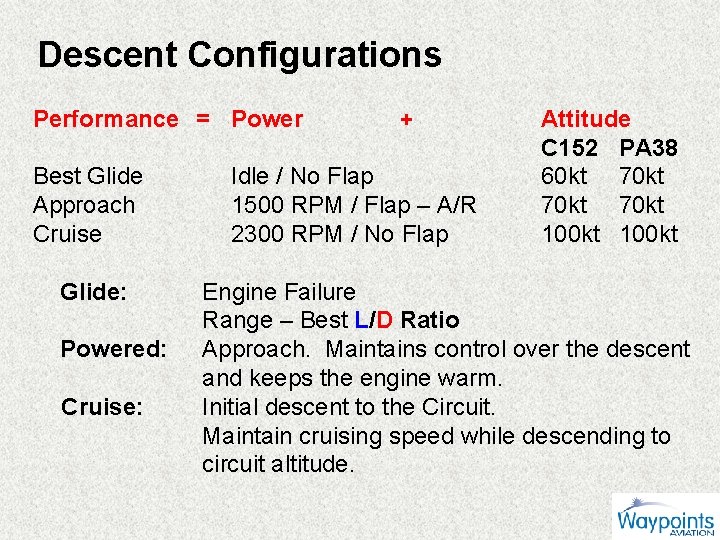
Descent Configurations Performance = Power Best Glide Approach Cruise Glide: Powered: Cruise: + Idle / No Flap 1500 RPM / Flap – A/R 2300 RPM / No Flap Attitude C 152 PA 38 60 kt 70 kt 100 kt Engine Failure Range – Best L/D Ratio Approach. Maintains control over the descent and keeps the engine warm. Initial descent to the Circuit. Maintain cruising speed while descending to circuit altitude.
Airmanship Situational Awareness Knowing what is going on around you, and being able to predict what could happen. (Street Smarts) • Level 1: Perception of the current environment; • Level 2: Interpretation of the immediate situation; and • Level 3: Anticipation of the future environment. Traffic • Radio Maintain listening watch • Location Vicinity of airfield, training area, etc. Terrain • Location and Elevation
Airmanship Threat and Error Management Threats are defined as external events or errors that: • occur outside the influence of the pilot(s); • increase the operational complexity of the flight; and • require pilot attention and management if safety margins are to be maintained. Errors are defined as pilot actions or inactions that: • lead to a deviation from pilot or organisational intentions or expectations; • reduce safety margins; and • increase the probability of adverse operational events on the ground and during flight.
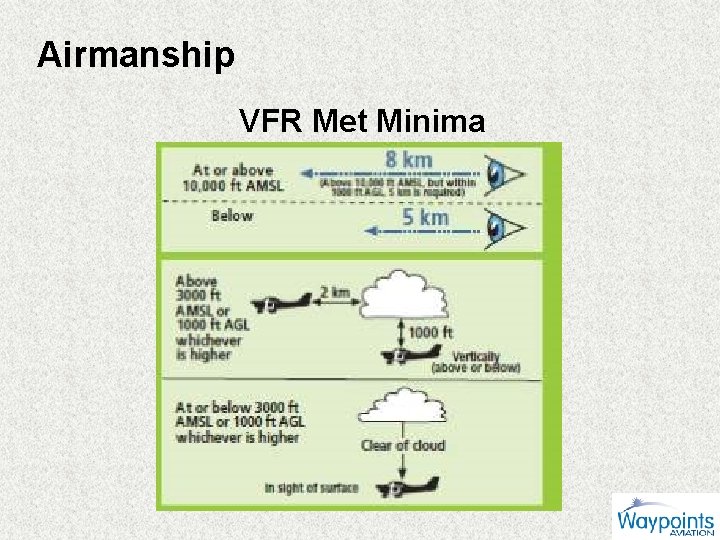
Airmanship VFR Met Minima
Airmanship – Levels QNH – Subscale set correctly Maximum Altitudes Lower level of Controlled Airspace? Minimum Heights • Terrain Minimum Safe Altitude (MSA) • Unpopulated areas 500 ft AGL • Built-up areas 1000 ft AGL, but not less than required to Glide clear of the area
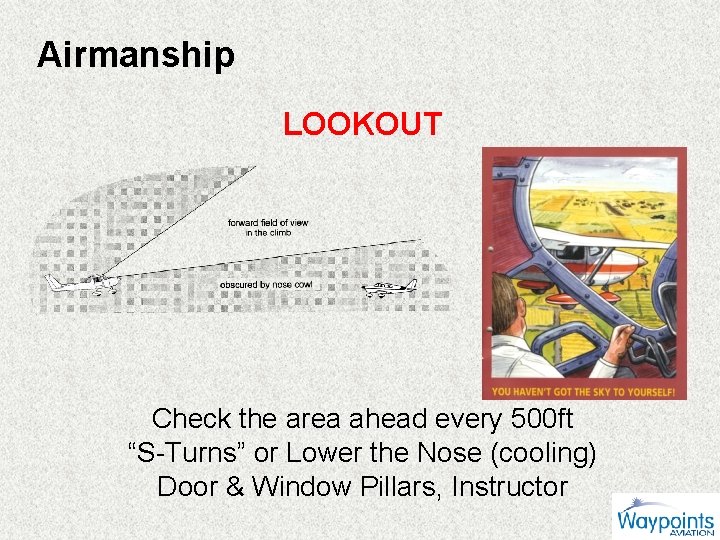
Airmanship LOOKOUT Check the area ahead every 500 ft “S-Turns” or Lower the Nose (cooling) Door & Window Pillars, Instructor
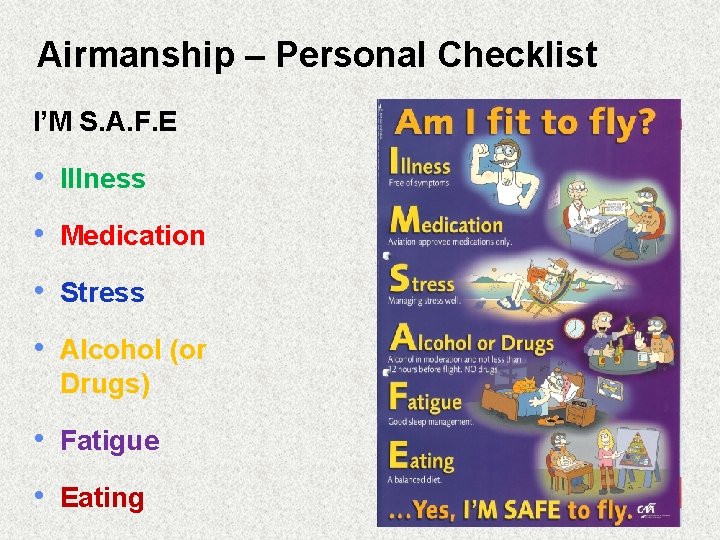
Airmanship – Personal Checklist I’M S. A. F. E • Illness • Medication • Stress • Alcohol (or Drugs) • Fatigue • Eating
Aeroplane Management Throttle • Smooth throttle movements (Idle to Full Power ~ 2 sec) • Climb: Full Power • Prolonged Glide: Plug Fouling Excessive Cylinder Head Cooling Engine warms or Powered Descent? Mixture RICH • Climb: Aids engine cooling and prevents detonation • Descent: Common practice for training. • Mixture will become progressively more lean as aircraft • descends An excessively lean mixture can lead to detonation
Aeroplane Management Carburettor Heat • Climb: • Not used. Reduces engine performance and therefore climb performance. Descent: Select Carb Heat HOT prior to reducing power. Difficult to detect Carb Icing at low power settings, and with a closed throttle means a greater chance of it occurring. Power may not be available when needed to level out • Temperatures and Pressures Climb Descent Oil Temperature Increases Decreases Oil Pressure Decreases Increase CHT Increases Decrease Gauges in Normal Range (GREEN) Lower Nose for Cooling Engine Warm 500 ft – 1000 ft Powered Descent
Human Factors Trapped Gases • Gases in the Middle Ear, Sinus (toothache), Stomach • Valsalva Manoeuvre Diving • Mixed with flying can be dangerous – increase pressure change Empty sky • With nothing to focus on, a short distance resting focal length (a few metres). Ensure the windscreen is clean and clear. • Noise • Increased noise at high power – added distraction • Protection against damage to hearing.
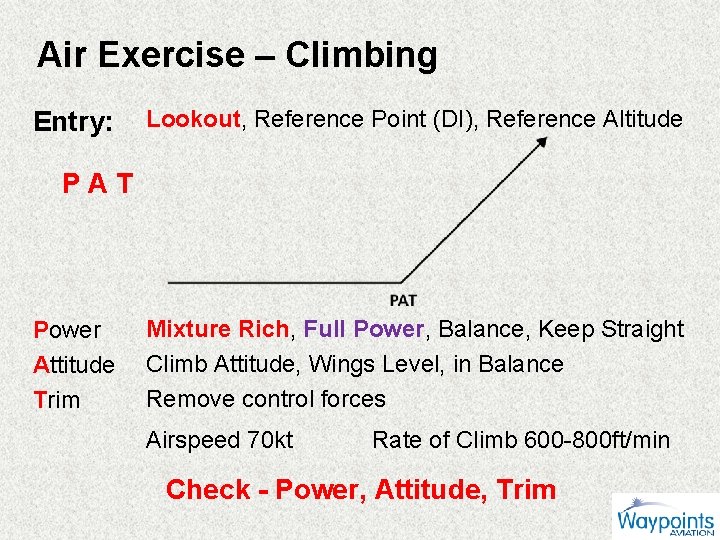
Air Exercise – Climbing Entry: Lookout, Reference Point (DI), Reference Altitude PAT Power Attitude Trim Mixture Rich, Full Power, Balance, Keep Straight Climb Attitude, Wings Level, in Balance Remove control forces Airspeed 70 kt Rate of Climb 600 -800 ft/min Check - Power, Attitude, Trim
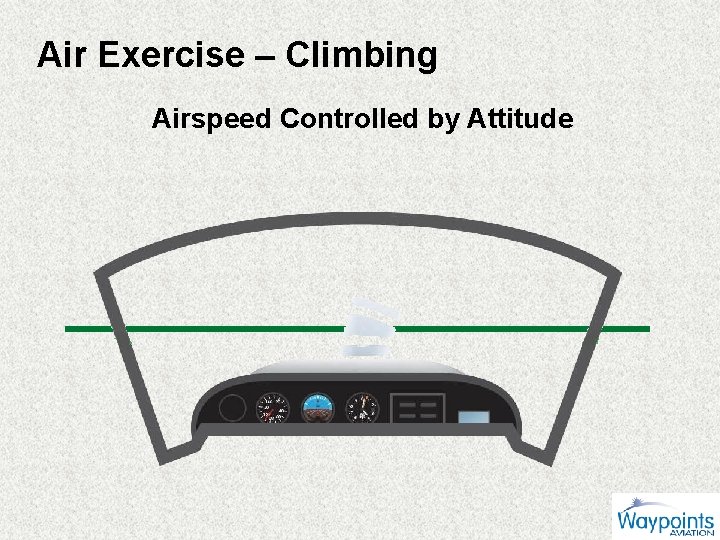
Air Exercise – Climbing Airspeed Controlled by Attitude
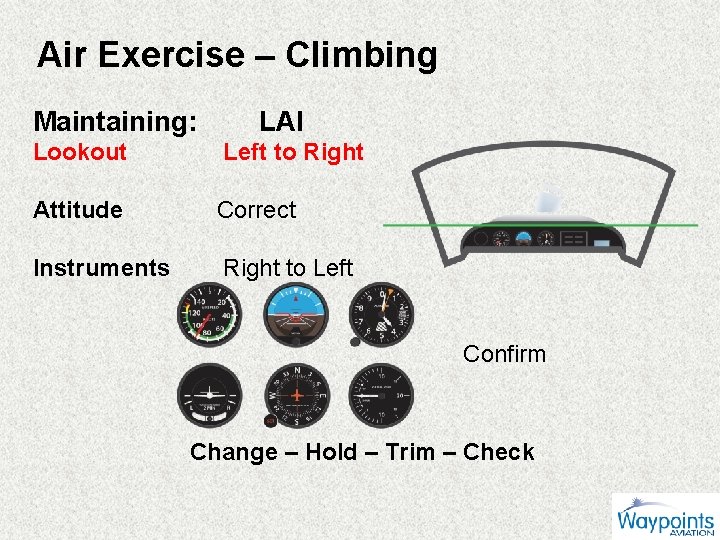
Air Exercise – Climbing Maintaining: LAI Lookout Left to Right Attitude Correct Instruments Right to Left Confirm Change – Hold – Trim – Check
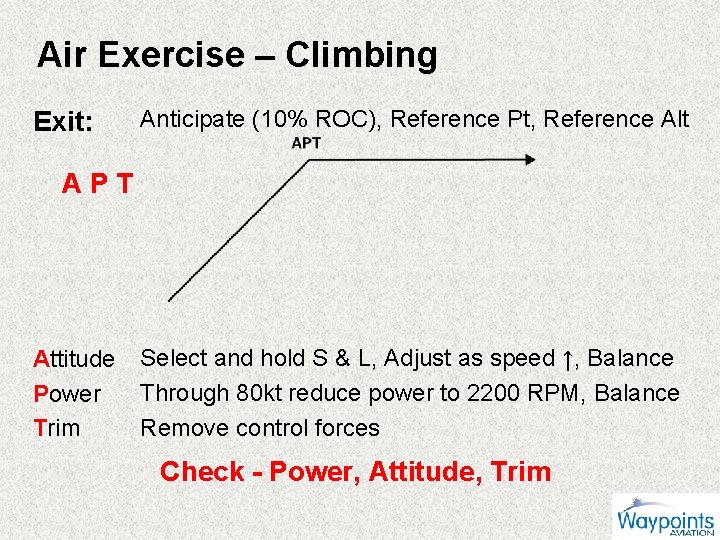
Air Exercise – Climbing Exit: Anticipate (10% ROC), Reference Pt, Reference Alt APT Attitude Power Trim Select and hold S & L, Adjust as speed ↑, Balance Through 80 kt reduce power to 2200 RPM, Balance Remove control forces Check - Power, Attitude, Trim
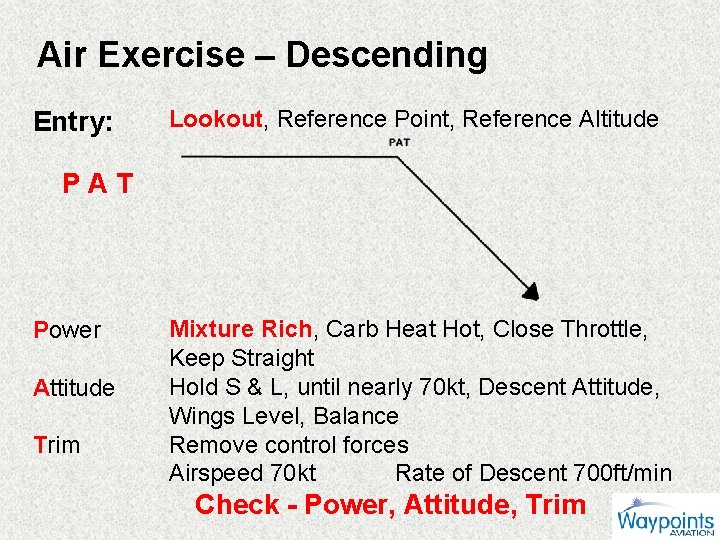
Air Exercise – Descending Entry: Lookout, Reference Point, Reference Altitude PAT Power Attitude Trim Mixture Rich, Carb Heat Hot, Close Throttle, Keep Straight Hold S & L, until nearly 70 kt, Descent Attitude, Wings Level, Balance Remove control forces Airspeed 70 kt Rate of Descent 700 ft/min Check - Power, Attitude, Trim
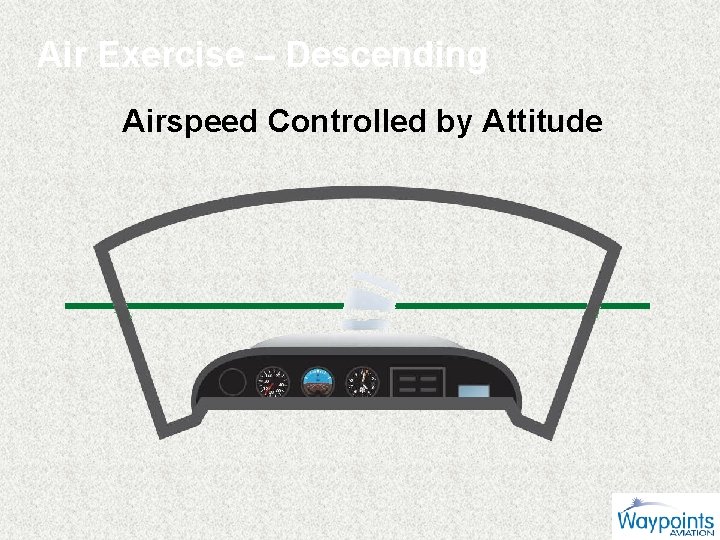
Air Exercise – Descending Airspeed Controlled by Attitude
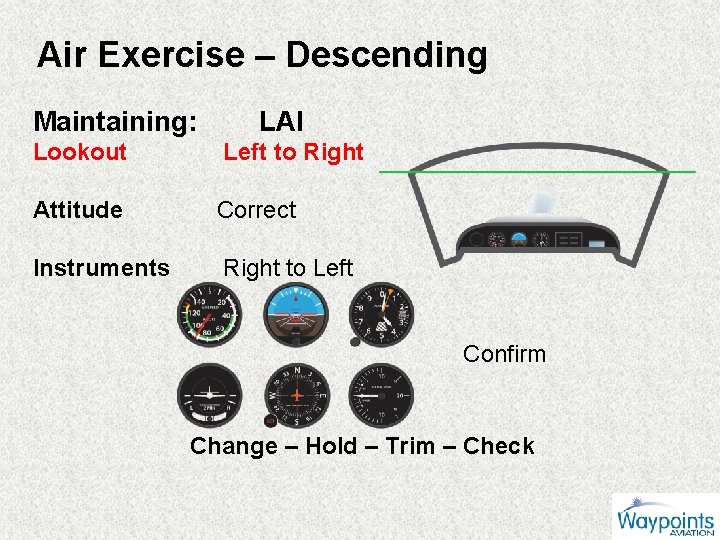
Air Exercise – Descending Maintaining: LAI Lookout Left to Right Attitude Correct Instruments Right to Left Confirm Change – Hold – Trim – Check
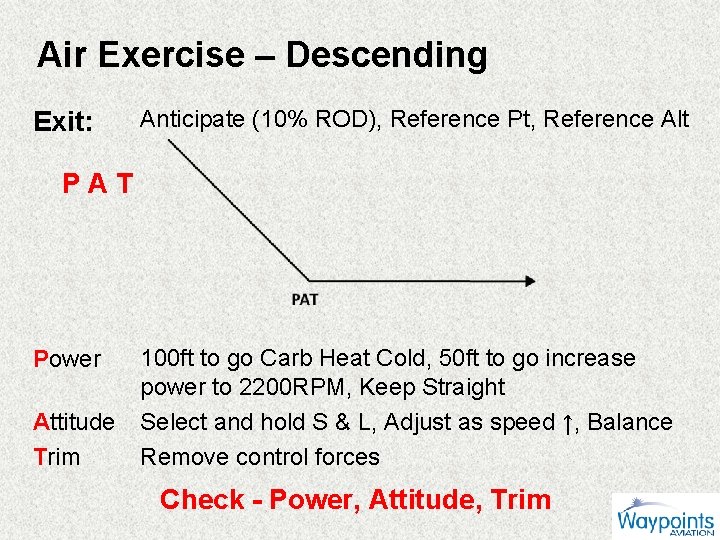
Air Exercise – Descending Exit: Anticipate (10% ROD), Reference Pt, Reference Alt PAT Power Attitude Trim 100 ft to go Carb Heat Cold, 50 ft to go increase power to 2200 RPM, Keep Straight Select and hold S & L, Adjust as speed ↑, Balance Remove control forces Check - Power, Attitude, Trim
- Slides: 38