
Climate Resilient Agriculture CARE Zimbabwe CRA Learning Hub
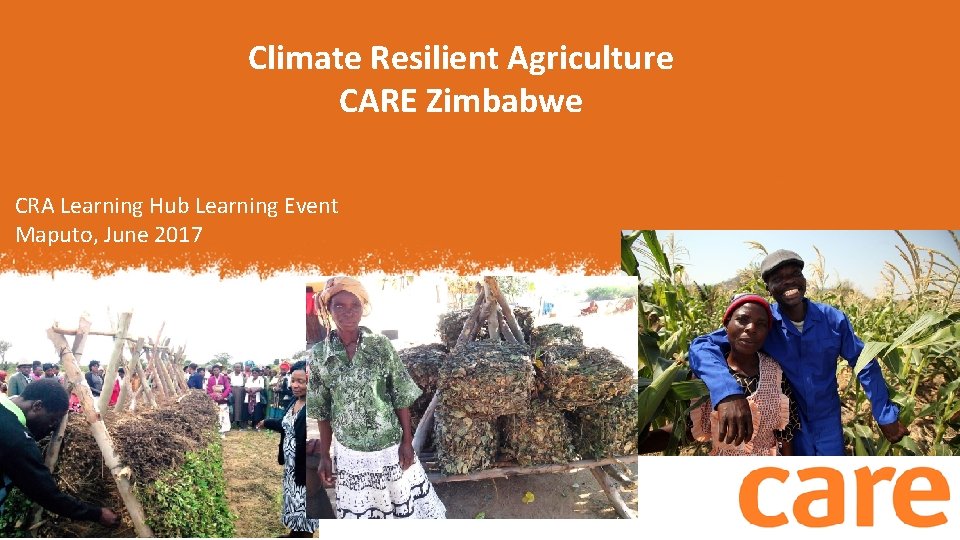
Climate Resilient Agriculture CARE Zimbabwe CRA Learning Hub Learning Event Maputo, June 2017
Context • Zimbabwe is classified a "least developed country", ranking 156 out of 187 • UNDP HDI Gender Inequality Index, Zimbabwe ranks 110 th out of 149 countries • Zimbabwe is not considered as susceptible to disasters as some countries in the world, it does experience droughts and floods on a regular basis, and with the level of poverty so high in the country, any shock, no matter how small, puts people at risk. (Since 2002, with as many as 50% of the people in the country receiving food aid in some years. ) • The most crucial climate issue for small-holder farmers in arid and semi -arid regions of Zimbabwe is rainfall.
Context • Only about 37% of the country receives adequate rainfall for rainfed agriculture (FAO, 2005). (90% of small-farmers in Zimbabwe depending on rainfed agriculture for their livelihoods) • Agricultural production in many areas will likely be especially hard hit, with yields declining by 20 -50% by 2050 according to IPCC estimates. • Some of the challenges for adaptation interventions in arid and semi-arid regions of • Zimbabwe include insufficient local level historic and future climate change information and relevant examples of adaptive strategies that work for a given context.
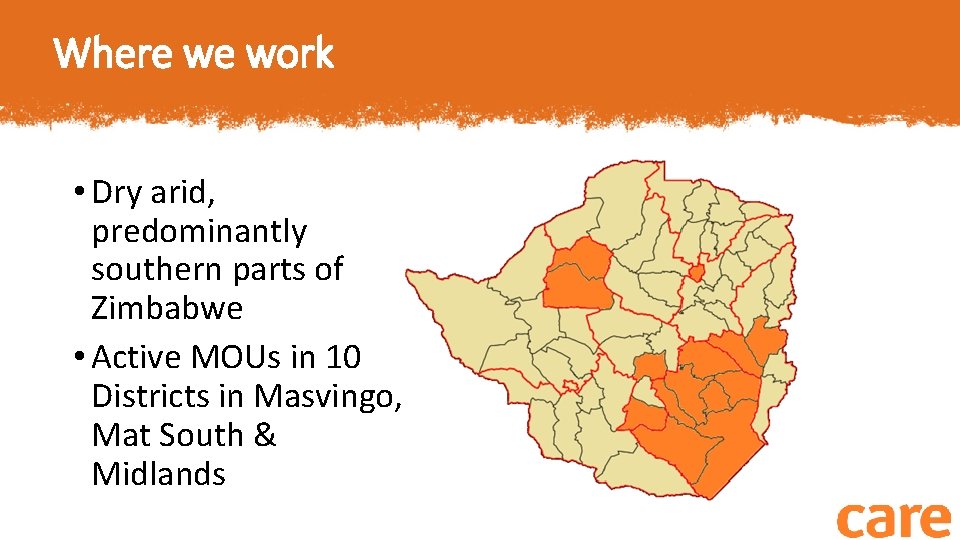
Where we work • Dry arid, predominantly southern parts of Zimbabwe • Active MOUs in 10 Districts in Masvingo, Mat South & Midlands
Previous CRA initiatives • PRIZE, PRP and FOSIL (2004 – 2013) • Working in partnership with Government Agricultural Extension Workers, supported more than 50, 000 smallholder farmers to adopt conservation agriculture. • Generally adoption was very low. However, in one district, farmers observed that CA farmers always had a reasonable harvest even in drought years. Adoption increased dramatically in that area. (Changed slogan from “dig and die” dig and eat”) • CA seen as poor farmer’s technology, hence negative perceptions
Previous CRA initiatives • Program Partnership Agreement (PPA) (2012 – 2016) • Supported various initiatives to improve CO capacity in CRA • Piloted combination of CA and HLLM to address land degradation as well as shrinking grazing land livestock water resources. • CO started developing a smallholder resilience farming approach. This work stream phased into CI Resilience Framework development in 2016
Current CRA Interventions Enhancing Nutrition, Stepping Up Resilience and Enterprise (ENSURE) (June 2013 – June 2018) • 6, 816 farmers were trained, 60% of whom were women. In addition, 270 producer groups were formed and actively engaged in crop and livestock value chain activities • 81% of ENSURE-trained farmers applied at least five sustainable agricultural practices in crops, livestock and natural resources management compared with the population-level baseline figure of 68% in ENSURE wards who were applying at least five practices in early 2014. (Sustainable practices may be mechanical/ physical (e. g land preparation), biological (e. g improved seed variety/ breeds), chemical (e. g fertiliser, insecticides) or management and cultural practices which are deemed critical improvements to improve productivity)
Current CRA Interventions ENSURE Continued… • Farming as a Business, agro-dealers in input and output marketing, linkages among the value chain actors. • Two multi-stakeholder platforms bring together small livestock and groundnut stakeholders respectively in deliberations on opportunities in the value chains. Lesson: • Droughts result in significant productivity and production decreases among farmers. Small grains and CA not taken seriously.
Current CRA Interventions • Enhancing Community Resilience and Sustainability in Chiredzi and Mwenezi Districts (ECRAS) July 2016 – June 2019 • 9, 700 farmers supported in nutrition sensitive Climate Smart Agriculture, to achieve improved climate resilience and reduced poverty • CO starts implementing CBA approach Learning: • Private sector engagement for inputs and output markets was reactive, hence suitable partners are taking long to engage • Government extension fully committed to extension service delivery
Current CRA Interventions • Improving Agricultural Production and Access to Water, Sanitation and Hygiene for Drought-Affected Populations in Masvingo Province (OFDA) July 2016 – October 2017 • 6, 245 farmers engaging in CA as part of El Nino recovery • Short term project with inputs (sorghum and cowpeas seed) • Negative: Highly incentivized CA, short term support
The future… • Enhanced Community Resilience and Inclusive Market Systems (ECRIMS) July 2017 – June 2020 • 31, 000 farmers, 4, 500 model households • CBA, CA • ICRISAT building capacity of government extension on sorghum and groundnuts production • Drawing from lessons in CA in the past as well as food safety (aflotoxin management) • Crop-livestock farming systems
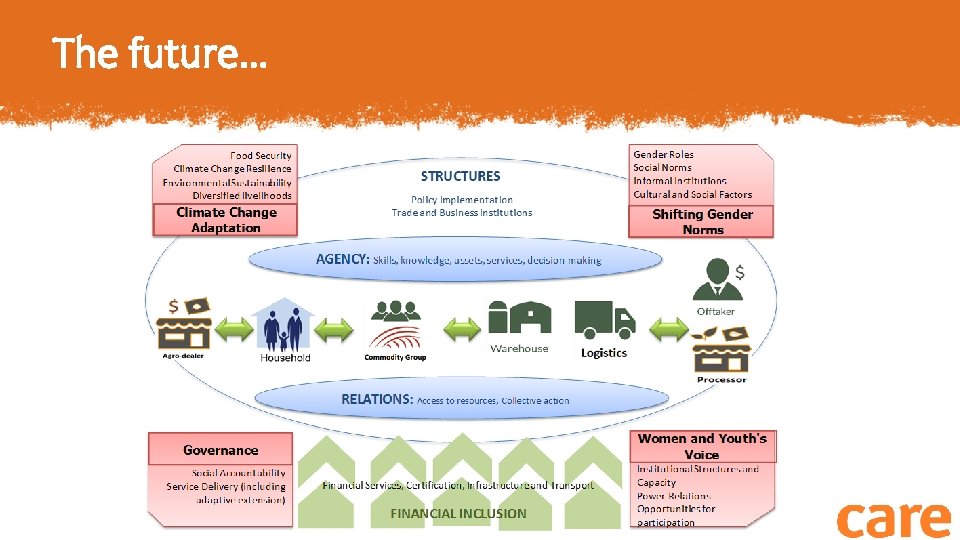
The future…
The future… • Global Climate Fund project – Sub to WV, 10, 445 farmers to implement evergreen agriculture, increase awareness of the practice in neighbouring communities; engage in agroforestry value-chains • In the just ended CO Business Planning process, FNS/CCR focus was reaffirmed
Thank you!
- Slides: 14