
Climate resilience Metrics and indicators Why look at

- Slides: 11
Climate resilience Metrics and indicators
Why look at indicators of resilience? § Climate change poses major risk to WASH beyond current sustainability § Utilities and HICs developed sophisticated responses (e. g. Seattle), much less work in LMICs § Some very good work (e. g. GWP and UNICEF) have developed wide range of factors to consider for resilience § But remains lack of simplified indicators suitable for routine use by water suppliers, governments and donors/NGOs
Metrics of resilience § Need to consider multi-faceted nature of resilience § Small number (e. g. recent review identified 176 indicators used more widely in climate resilience!) § Easy to use and score (semi-quantitative) § Do not need to be perfect, but do need to help support action
How could such metrics be used? § National/sub-national level – Identify particular communities or regions of highest priority – Identify systemic failures requiring design, policy, regulatory or operational change at scale – Both requiring consolidation and analysis of large data sets § Community level – Score card approach – Use to generate discussion within communities about risks and solutions
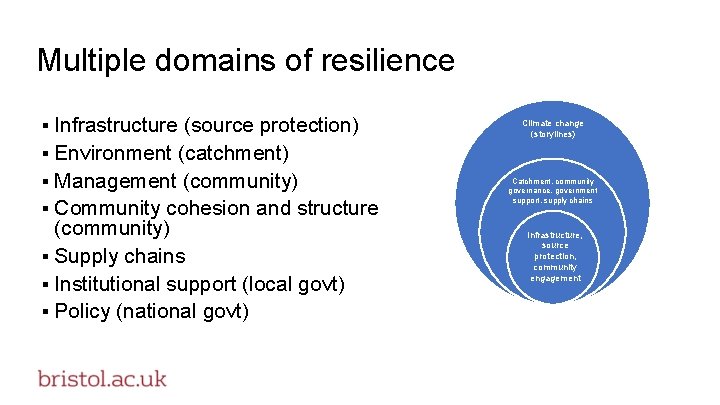
Multiple domains of resilience § Infrastructure (source protection) Climate change (storylines) § Environment (catchment) § Management (community) § Community cohesion and structure (community) § Supply chains § Institutional support (local govt) § Policy (national govt) Catchment, community governance, government support, supply chains Infrastructure, source protection, community engagement
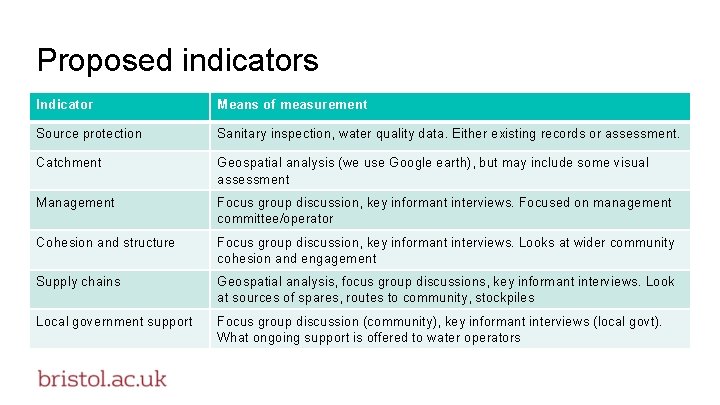
Proposed indicators Indicator Means of measurement Source protection Sanitary inspection, water quality data. Either existing records or assessment. Catchment Geospatial analysis (we use Google earth), but may include some visual assessment Management Focus group discussion, key informant interviews. Focused on management committee/operator Cohesion and structure Focus group discussion, key informant interviews. Looks at wider community cohesion and engagement Supply chains Geospatial analysis, focus group discussions, key informant interviews. Look at sources of spares, routes to community, stockpiles Local government support Focus group discussion (community), key informant interviews (local govt). What ongoing support is offered to water operators
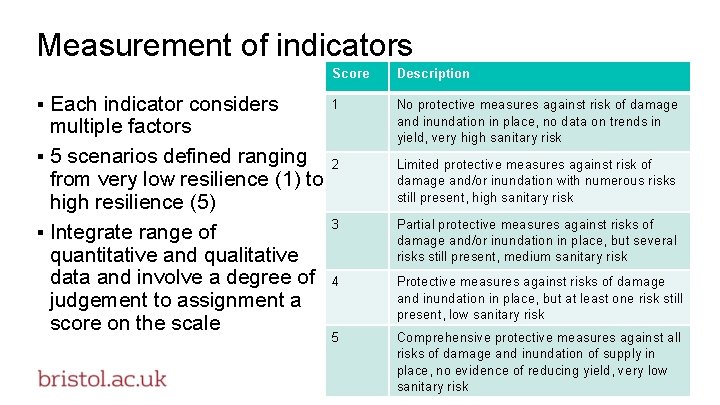
Measurement of indicators § Each indicator considers multiple factors § 5 scenarios defined ranging from very low resilience (1) to high resilience (5) § Integrate range of quantitative and qualitative data and involve a degree of judgement to assignment a score on the scale Score Description 1 No protective measures against risk of damage and inundation in place, no data on trends in yield, very high sanitary risk 2 Limited protective measures against risk of damage and/or inundation with numerous risks still present, high sanitary risk 3 Partial protective measures against risks of damage and/or inundation in place, but several risks still present, medium sanitary risk 4 Protective measures against risks of damage and inundation in place, but at least one risk still present, low sanitary risk 5 Comprehensive protective measures against all risks of damage and inundation of supply in place, no evidence of reducing yield, very low sanitary risk
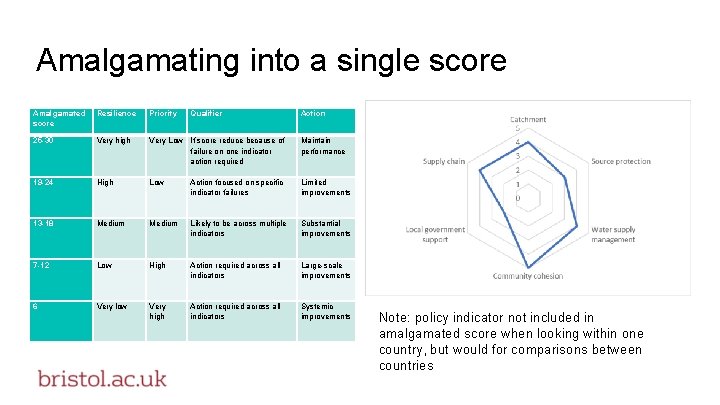
Amalgamating into a single score Amalgamated score Resilience Priority Qualifier Action 25 -30 Very high Very Low If score reduce because of failure on one indicator action required Maintain performance 19 -24 High Low Action focused on specific indicator failures Limited improvements 13 -18 Medium Likely to be across multiple indicators Substantial improvements 7 -12 Low High Action required across all indicators Large-scale improvements 6 Very low Very high Action required across all indicators Systemic improvements Note: policy indicator not included in amalgamated score when looking within one country, but would for comparisons between countries
Integrating climate § Focus on meaningful information § Climate storylines being developed looking at drivers of major events to help inform planning and preparedness § Storylines focus on impacts rather than frequency of events to help users identify and plan action
Current activities § How tough is WASH? (initial findings published in 2021 https: //climateresilientwash. blogs. bristol. ac. uk/researchareas/home/ § Sanitation and Climate: Assessing Resilience and Emissions (SCARE) - GHG methodology finalised in late 2020, building on CACTUS; fieldwork starts early 2021 § Guidance on climate vulnerability assessment for WASH (WHO) – draft available in 2021, country pilots (Nepal, Bangladesh) 2021 § Climate resilience modules for WASH-FIT (already being tested as part of CRESH)
Is resilience simply part of sustainability or a separate, complementary construct? § One argument is that resilience should simply be addressed through our current (admittedly rather weak) sector tools for looking at sustainability § Alternative view is that how we measure and understand resilience (spanning known-knowns to unknown-unknowns) is distinct from approaches to sustainability (which tend to focus on known-knowns) § But will multiple metrics enhance or confuse?