
Climate Effects on Hurricane Frequency and Severity Dail
- Slides: 16
Climate Effects on Hurricane Frequency and Severity Dail Rowe, Ph. D Accurate Environmental Forecating © 2006 Accurate Environmental Forecasting
Overview • Clear links between climate and hurricanes – Atlantic Sea-Surface Temperature – El Nino/ENSO – North Atlantic Oscillation • The Hurricane Index – Objective, peer-reviewed analysis technique – Performance and validation – Use in hurricane catastrophe risk assessment tools • What’s new? – Is their really a cycle in the Atlantic SST anomaly? – Predictions from months to decades – Inclusion of climate forecast uncertainty © 2006 Accurate Environmental Forecasting
Climate Signals – Fundamental Physics • Atlantic Sea-Surface Temperature (SST): – Warmer water provides more energy for storms • El Niño (ENSO): – Vertical wind-shear, which retards hurricane growth, increases during El Niño and decreases during La Niña • North Atlantic Oscillation (NAO): – Correlated with SST changes in the southwestern Atlantic and average steering winds, both of which affect hurricane activity © 2006 Accurate Environmental Forecasting
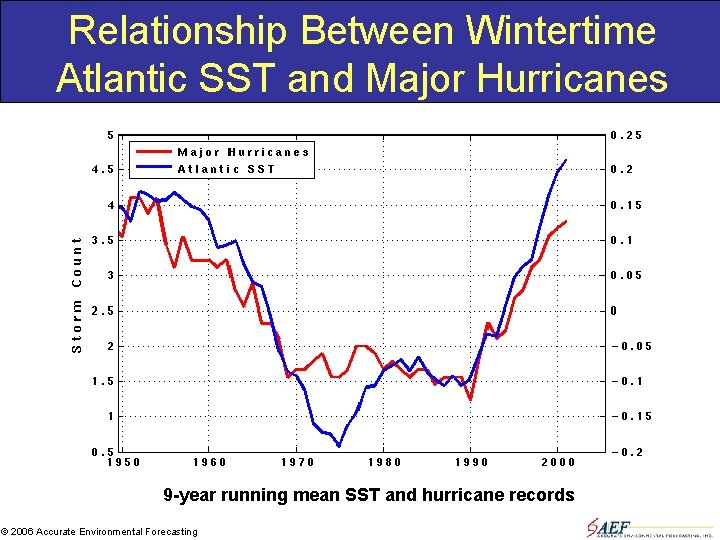
Relationship Between Wintertime Atlantic SST and Major Hurricanes 9 -year running mean SST and hurricane records © 2006 Accurate Environmental Forecasting
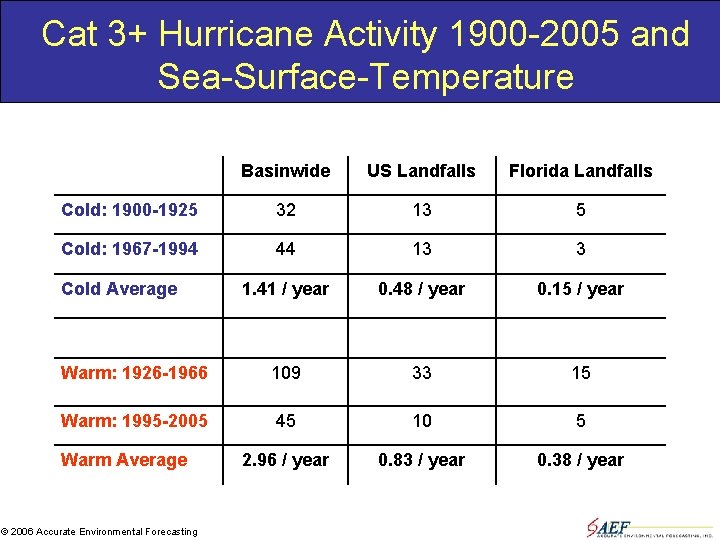
Cat 3+ Hurricane Activity 1900 -2005 and Sea-Surface-Temperature Basinwide US Landfalls Florida Landfalls Cold: 1900 -1925 32 13 5 Cold: 1967 -1994 44 13 3 1. 41 / year 0. 48 / year 0. 15 / year Warm: 1926 -1966 109 33 15 Warm: 1995 -2005 45 10 5 2. 96 / year 0. 83 / year 0. 38 / year Cold Average Warm Average © 2006 Accurate Environmental Forecasting
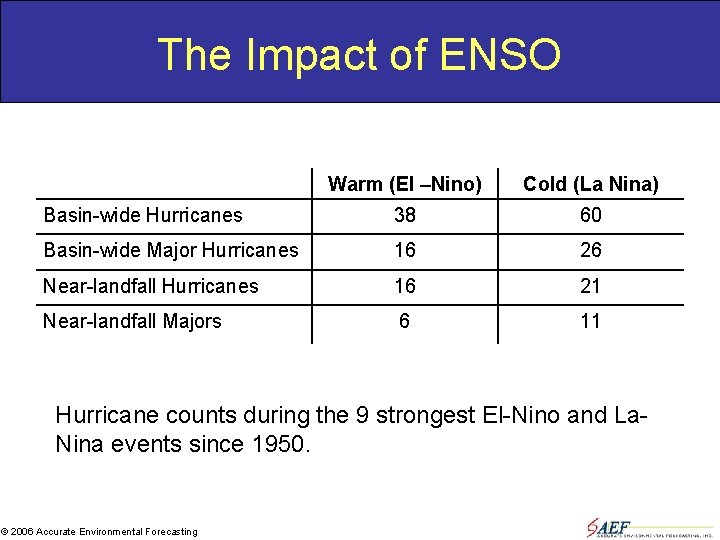
The Impact of ENSO Warm (El –Nino) Cold (La Nina) Basin-wide Hurricanes 38 60 Basin-wide Major Hurricanes 16 26 Near-landfall Hurricanes 16 21 Near-landfall Majors 6 11 Hurricane counts during the 9 strongest El-Nino and La. Nina events since 1950. © 2006 Accurate Environmental Forecasting
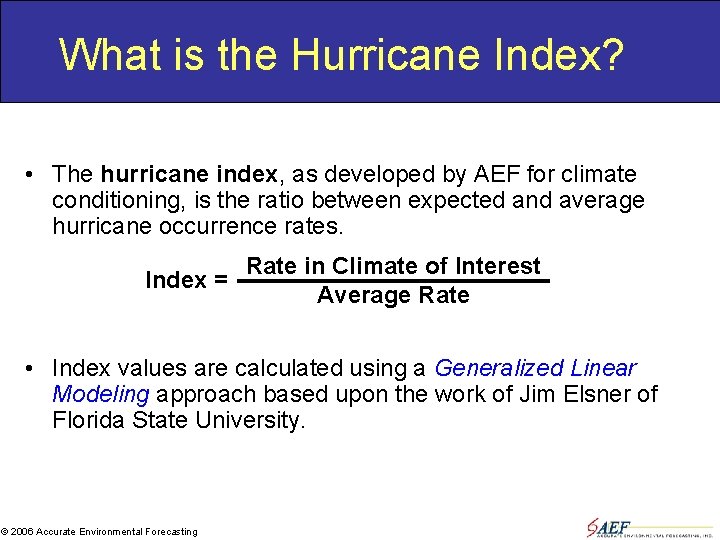
What is the Hurricane Index? • The hurricane index, as developed by AEF for climate conditioning, is the ratio between expected and average hurricane occurrence rates. Rate in Climate of Interest Index = Average Rate • Index values are calculated using a Generalized Linear Modeling approach based upon the work of Jim Elsner of Florida State University. © 2006 Accurate Environmental Forecasting
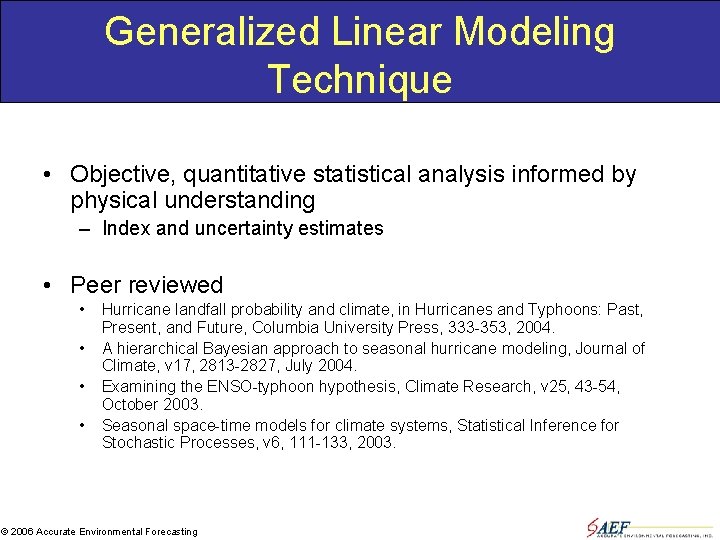
Generalized Linear Modeling Technique • Objective, quantitative statistical analysis informed by physical understanding – Index and uncertainty estimates • Peer reviewed • • Hurricane landfall probability and climate, in Hurricanes and Typhoons: Past, Present, and Future, Columbia University Press, 333 -353, 2004. A hierarchical Bayesian approach to seasonal hurricane modeling, Journal of Climate, v 17, 2813 -2827, July 2004. Examining the ENSO-typhoon hypothesis, Climate Research, v 25, 43 -54, October 2003. Seasonal space-time models for climate systems, Statistical Inference for Stochastic Processes, v 6, 111 -133, 2003. © 2006 Accurate Environmental Forecasting
Forecasting Climate Induced Variability in Hurricane Activity • A mix of observed and forecast climate data is used for seasonal predictions – Observed NAO • October – February average – Observed SST • January – February average – Forecast ENSO • August-October ENSO average – Uncertainty in the ENSO forecast is included • Forecast SST is used for multi-season predictions – Statistical forecasts including uncertainty © 2006 Accurate Environmental Forecasting
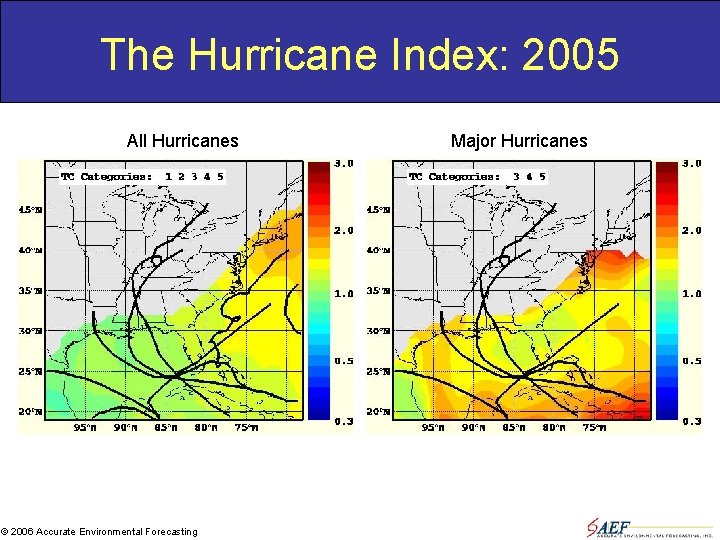
The Hurricane Index: 2005 All Hurricanes © 2006 Accurate Environmental Forecasting Major Hurricanes
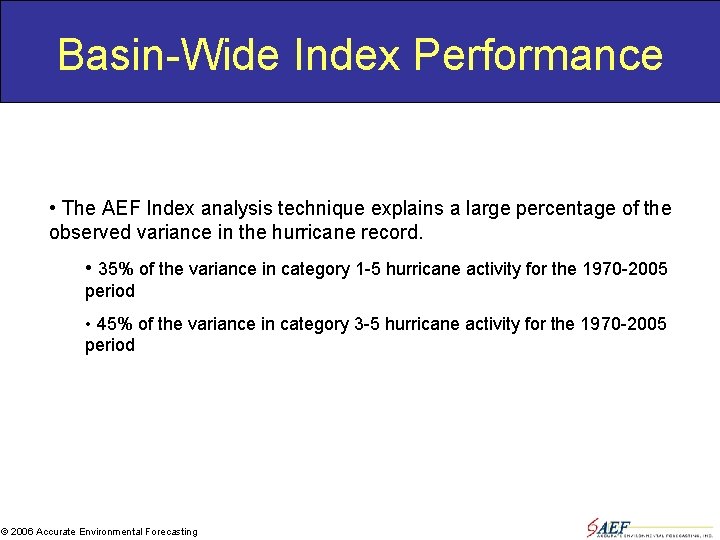
Basin-Wide Index Performance • The AEF Index analysis technique explains a large percentage of the observed variance in the hurricane record. • 35% of the variance in category 1 -5 hurricane activity for the 1970 -2005 period • 45% of the variance in category 3 -5 hurricane activity for the 1970 -2005 period © 2006 Accurate Environmental Forecasting
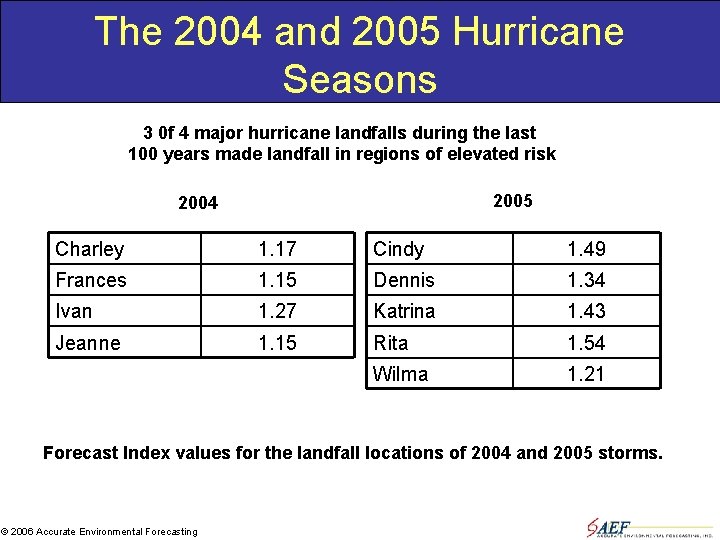
The 2004 and 2005 Hurricane Seasons 3 0 f 4 major hurricane landfalls during the last 100 years made landfall in regions of elevated risk 2005 2004 Charley 1. 17 Cindy 1. 49 Frances 1. 15 Dennis 1. 34 Ivan 1. 27 Katrina 1. 43 Jeanne 1. 15 Rita 1. 54 Wilma 1. 21 Forecast Index values for the landfall locations of 2004 and 2005 storms. © 2006 Accurate Environmental Forecasting
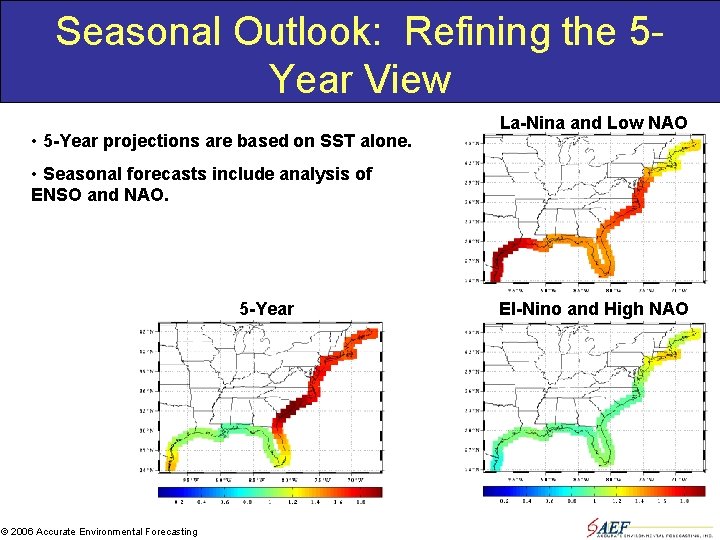
Seasonal Outlook: Refining the 5 Year View • 5 -Year projections are based on SST alone. La-Nina and Low NAO • Seasonal forecasts include analysis of ENSO and NAO. 5 -Year © 2006 Accurate Environmental Forecasting El-Nino and High NAO
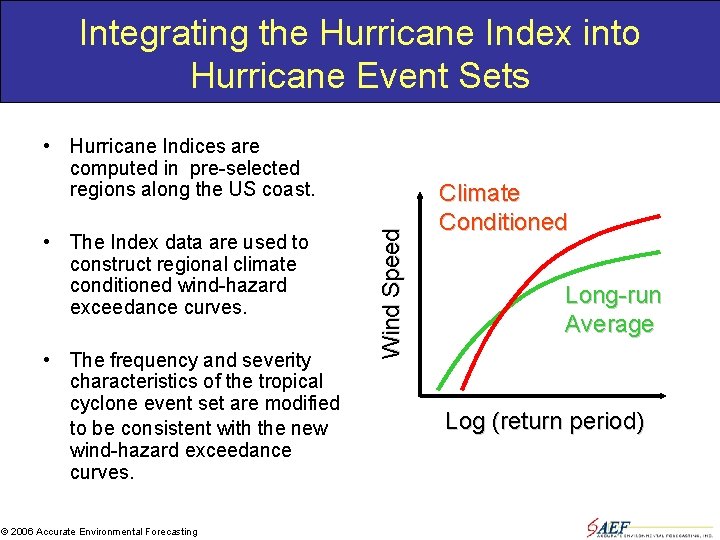
Integrating the Hurricane Index into Hurricane Event Sets • The Index data are used to construct regional climate conditioned wind-hazard exceedance curves. • The frequency and severity characteristics of the tropical cyclone event set are modified to be consistent with the new wind-hazard exceedance curves. © 2006 Accurate Environmental Forecasting Wind Speed • Hurricane Indices are computed in pre-selected regions along the US coast. Climate Conditioned Long-run Average Log (return period)
The Hurricane Index is integrated into AIR’s Catrader and Classic 2 Products • Seasonal catalogs released in May 2005 and 2006 • Near-term (5 -year) catalog released May 2006 © 2006 Accurate Environmental Forecasting
Summary • Hurricane frequency and severity are modulated by climate – Atlantic Sea-Surface-Temperature – El-Nino and La-Nina – North Atlantic Oscillation • AEF uses a peer-reviewed Generalized-Linear-Modeling approach to quantify the relationship between climate variability and hurricane activity. – Seasonal and multi-season risk assessment – Accounts for uncertainty in the climate forecasts • Climate information can be used to modify the frequency and severity of hurricanes in the event sets that are used for modeling hurricane catastrophe risk. © 2006 Accurate Environmental Forecasting