
CLIMATE CHANGE SCENARIOS AND IMPACTS ON THE BIOMES
CLIMATE CHANGE SCENARIOS AND IMPACTS ON THE BIOMES OF SOUTH AMERICA Carlos A. Nobre CPTEC/INPE, Cachoeira Paulista, SP- Brazil
What are the likely biome changes in Tropical South America due to Global Warming?
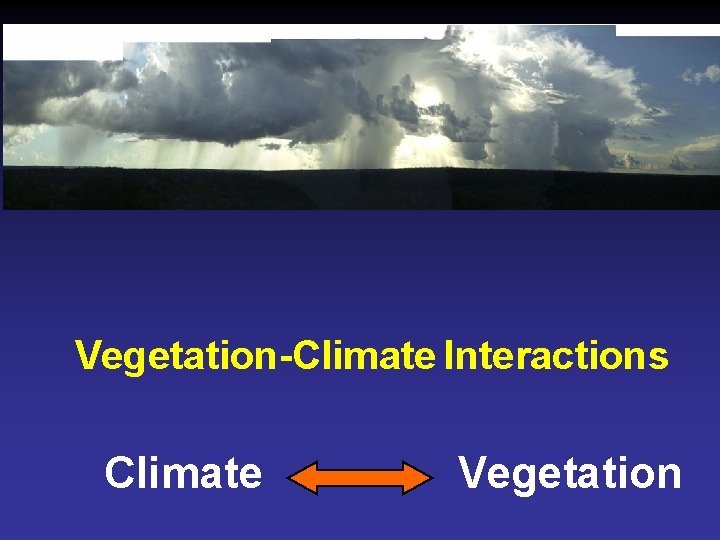
Vegetation-Climate Interactions Climate Vegetation
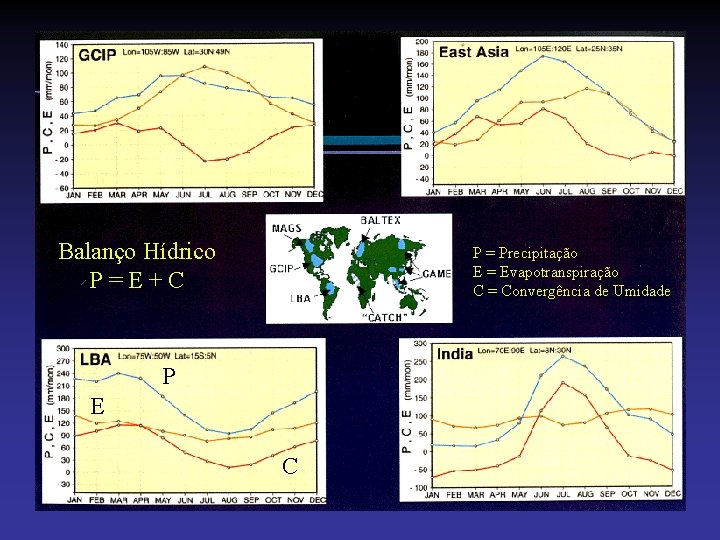
Balanço Hídrico P=E+C P = Precipitação E = Evapotranspiração C = Convergência de Umidade P E C
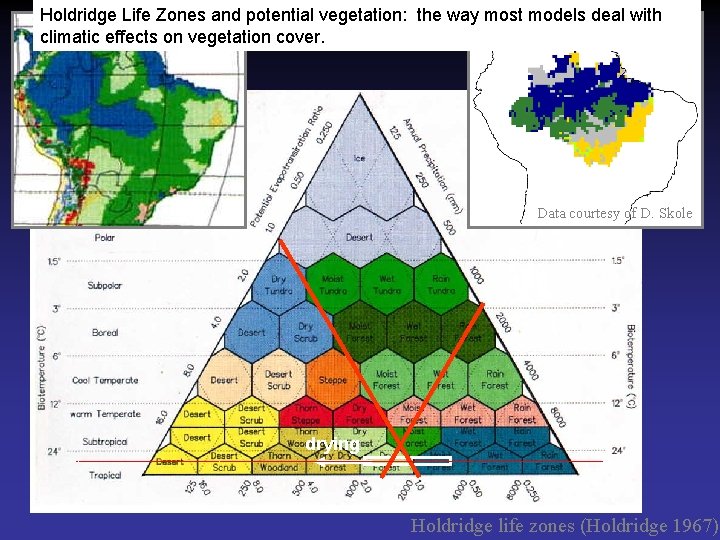
Holdridge Life Zones and potential vegetation: the way most models deal with climatic effects on vegetation cover. Data courtesy of D. Skole drying Holdridge life zones (Holdridge 1967)
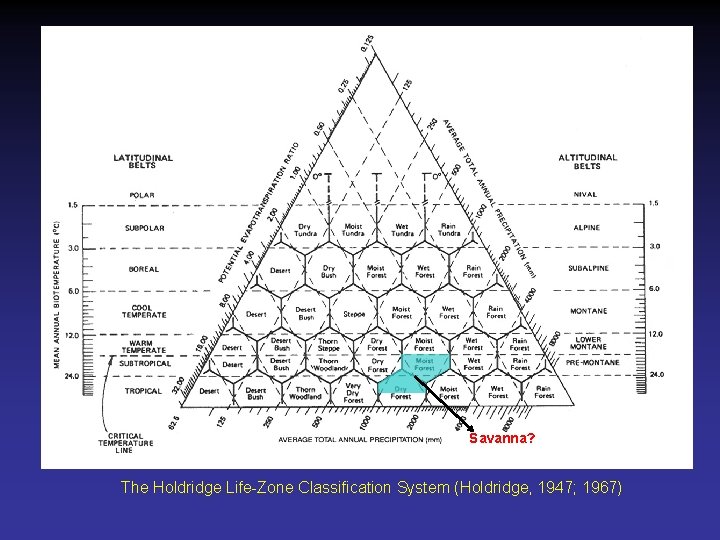
Savanna? The Holdridge Life-Zone Classification System (Holdridge, 1947; 1967)
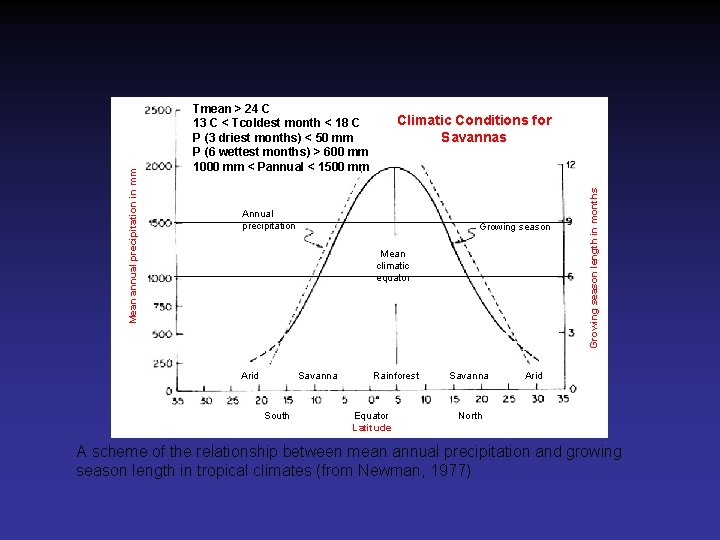
Climatic Conditions for Savannas Annual precipitation Growing season Mean climatic equator Arid Savanna South Rainforest Equator Latitude Savanna Growing season length in months Mean annual precipitation in mm Tmean > 24 C 13 C < Tcoldest month < 18 C P (3 driest months) < 50 mm P (6 wettest months) > 600 mm 1000 mm < Pannual < 1500 mm Arid North A scheme of the relationship between mean annual precipitation and growing season length in tropical climates (from Newman, 1977)
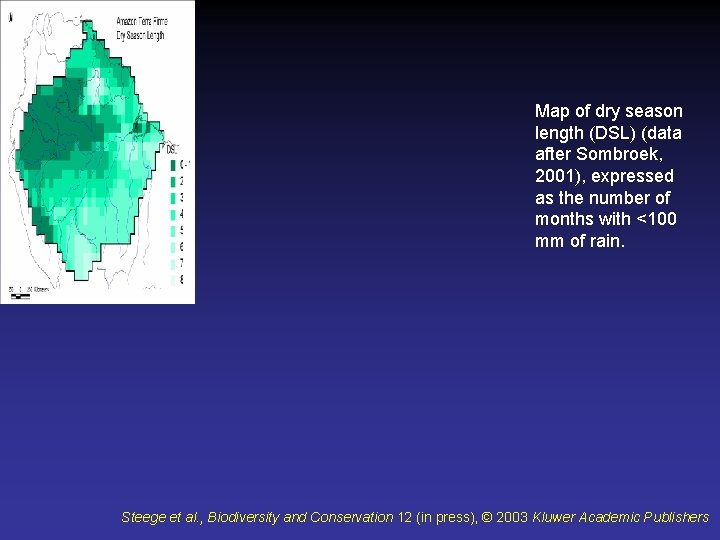
Map of dry season length (DSL) (data after Sombroek, 2001), expressed as the number of months with <100 mm of rain. Steege et al. , Biodiversity and Conservation 12 (in press), © 2003 Kluwer Academic Publishers
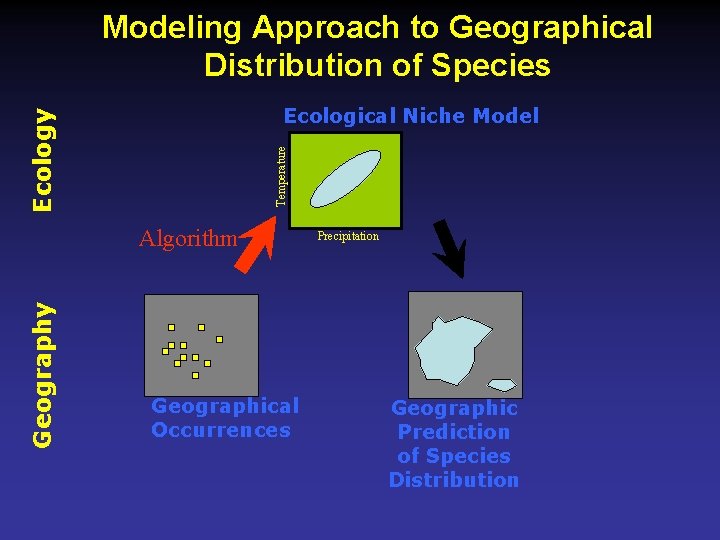
Modeling Approach to Geographical Distribution of Species Temperature Ecology Ecological Niche Model Geography Algorithm Geographical Occurrences Precipitation Geographic Prediction of Species Distribution
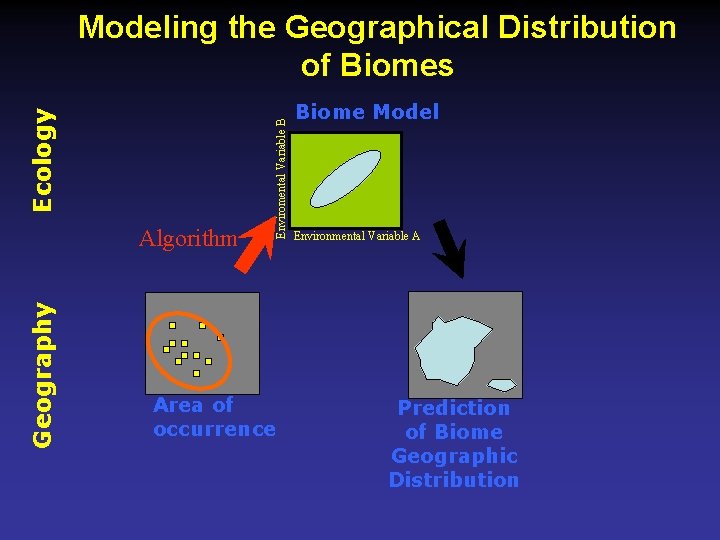
Geography Algorithm Enviromental Variable B Ecology Modeling the Geographical Distribution of Biomes Area of occurrence Biome Model Environmental Variable A Prediction of Biome Geographic Distribution
The Algorithm A Potential Biome Model that uses 5 climate parameters to represent the (Si. B) biome classification was developed (CPTEC-PBM).
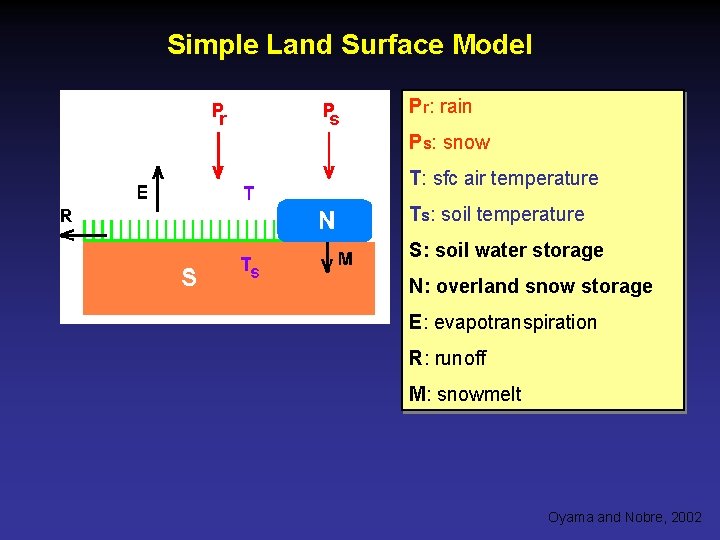
Simple Land Surface Model Pr: rain Ps: snow T: sfc air temperature Ts: soil temperature S: soil water storage N: overland snow storage E: evapotranspiration R: runoff M: snowmelt Oyama and Nobre, 2002
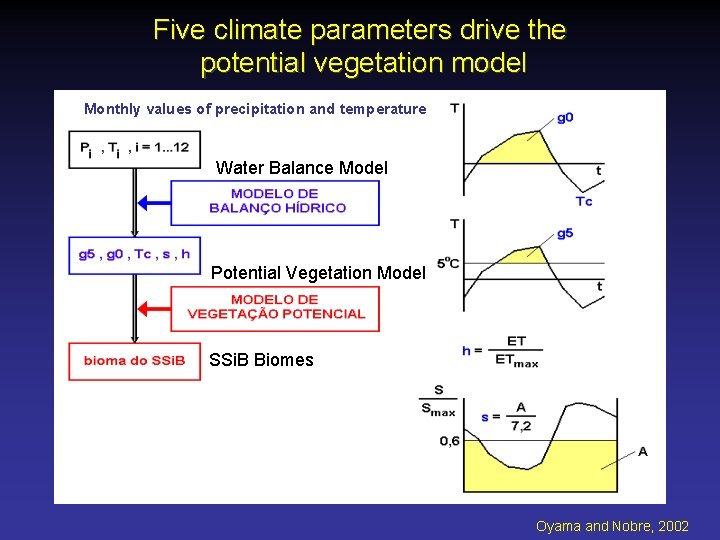
Five climate parameters drive the potential vegetation model Monthly values of precipitation and temperature Water Balance Model Potential Vegetation Model SSi. B Biomes Oyama and Nobre, 2002
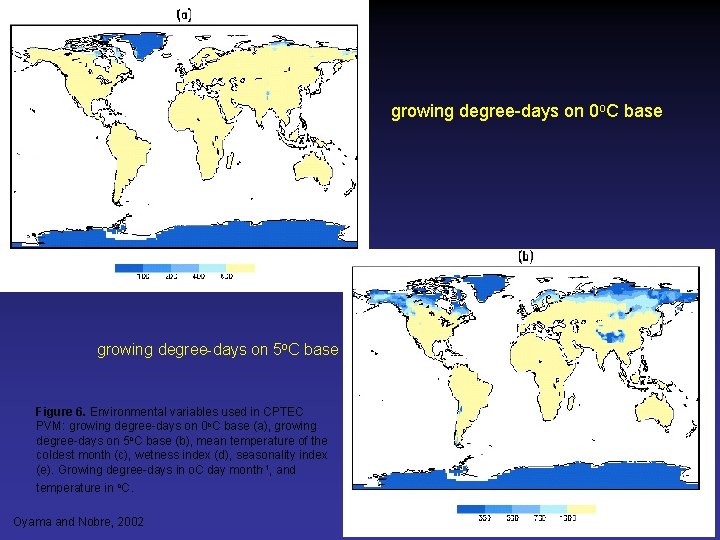
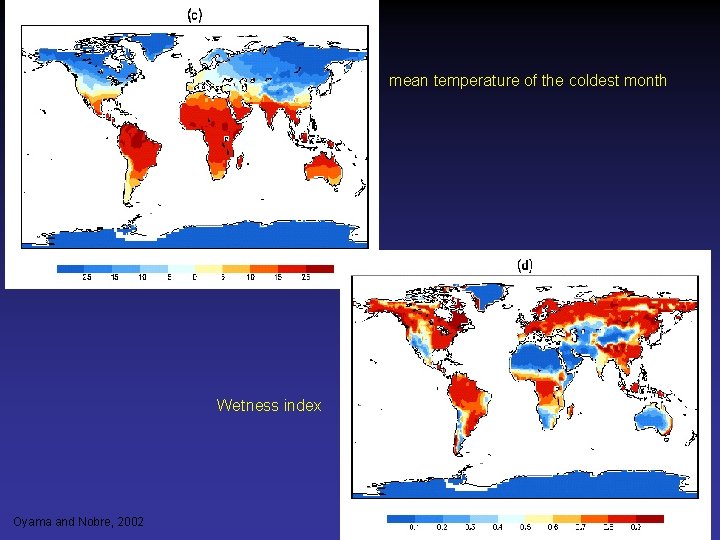
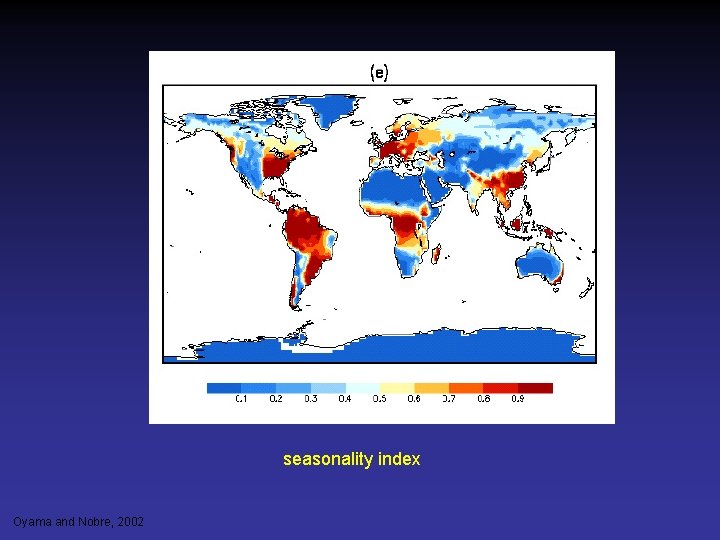
growing degree-days on 0 o. C base growing degree-days on 5 o. C base Figure 6. Environmental variables used in CPTEC PVM: growing degree-days on 0 o. C base (a), growing degree-days on 5 o. C base (b), mean temperature of the coldest month (c), wetness index (d), seasonality index (e). Growing degree-days in o. C day month-1, and temperature in o. C. Oyama and Nobre, 2002
mean temperature of the coldest month Wetness index Oyama and Nobre, 2002
seasonality index Oyama and Nobre, 2002
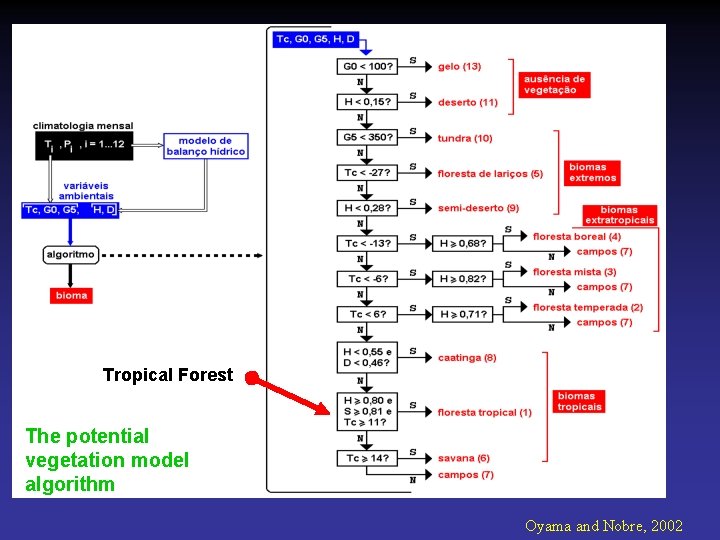
Tropical Forest The potential vegetation model algorithm Oyama and Nobre, 2002
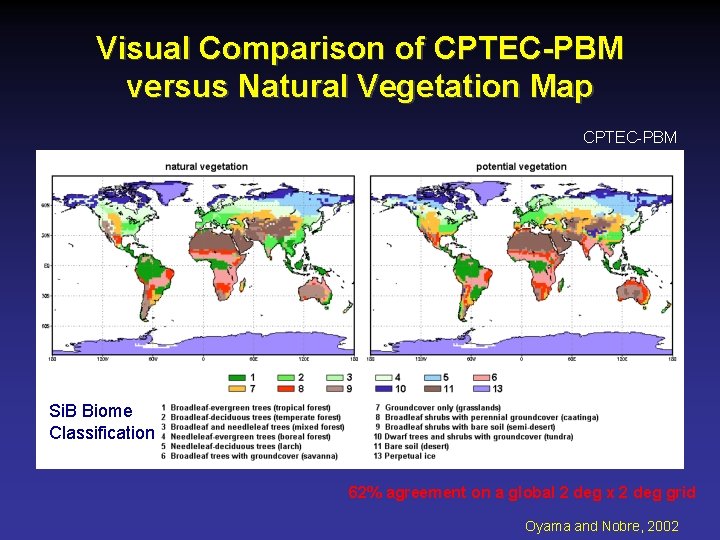
Visual Comparison of CPTEC-PBM versus Natural Vegetation Map CPTEC-PBM Si. B Biome Classification 62% agreement on a global 2 deg x 2 deg grid Oyama and Nobre, 2002
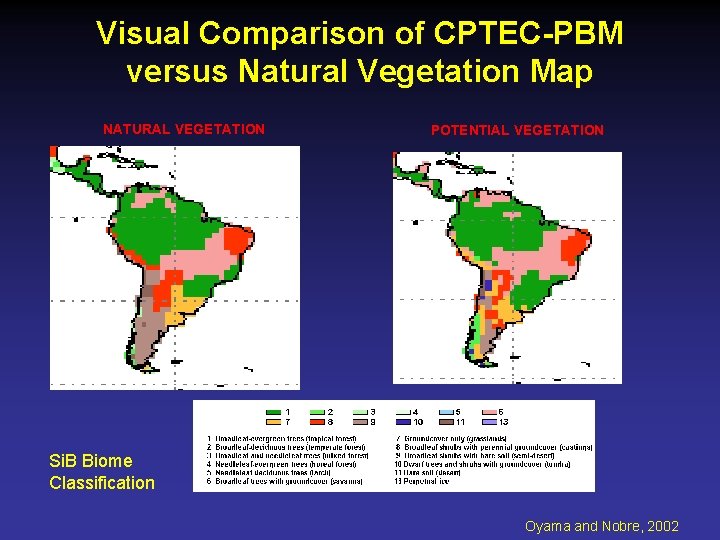
Visual Comparison of CPTEC-PBM versus Natural Vegetation Map NATURAL VEGETATION POTENTIAL VEGETATION Si. B Biome Classification Oyama and Nobre, 2002
What are the likely biome changes in Tropical South America due to Global Warming?
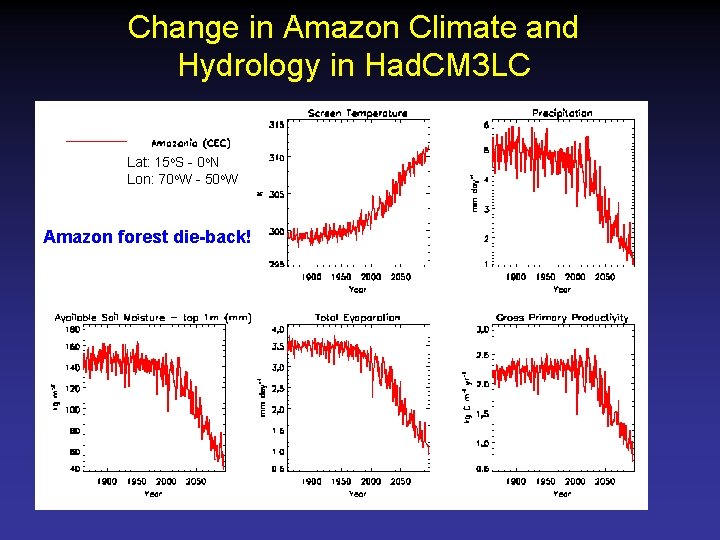
Change in Amazon Climate and Hydrology in Had. CM 3 LC Lat: 15 o. S - 0 o. N Lon: 70 o. W - 50 o. W Amazon forest die-back!
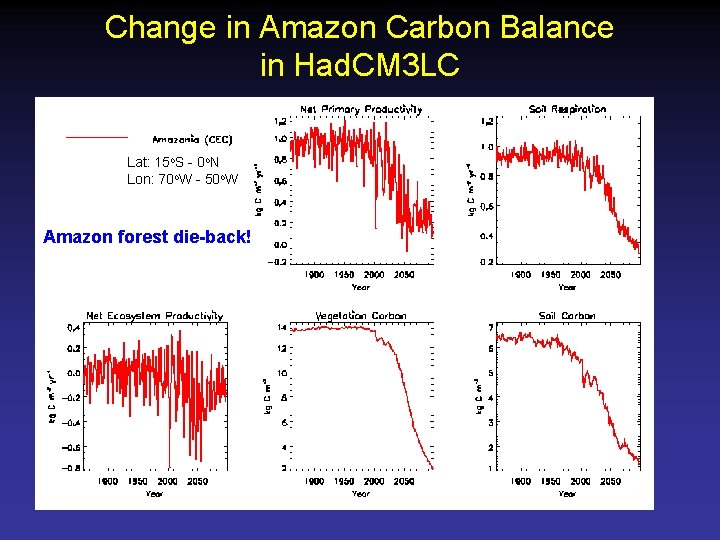
Change in Amazon Carbon Balance in Had. CM 3 LC Lat: 15 o. S - 0 o. N Lon: 70 o. W - 50 o. W Amazon forest die-back!
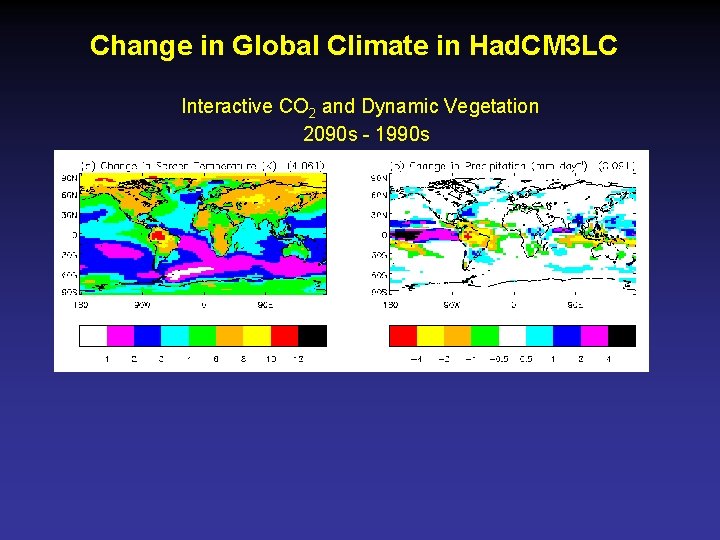
Change in Global Climate in Had. CM 3 LC Interactive CO 2 and Dynamic Vegetation 2090 s - 1990 s
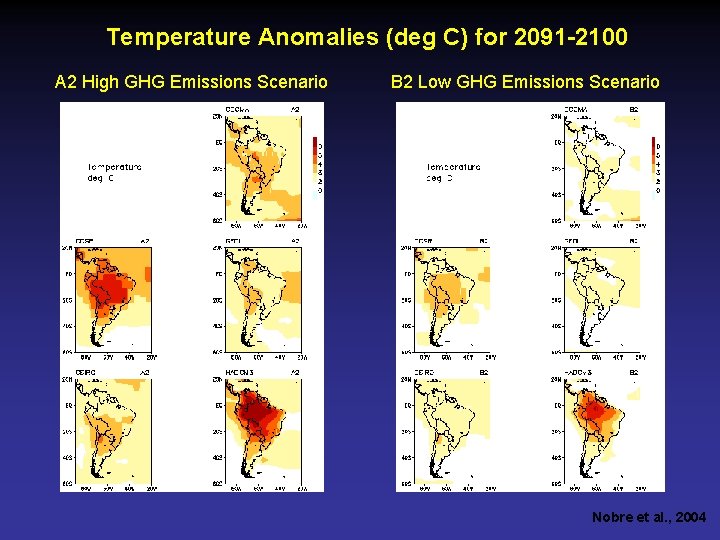
Temperature Anomalies (deg C) for 2091 -2100 A 2 High GHG Emissions Scenario B 2 Low GHG Emissions Scenario Nobre et al. , 2004
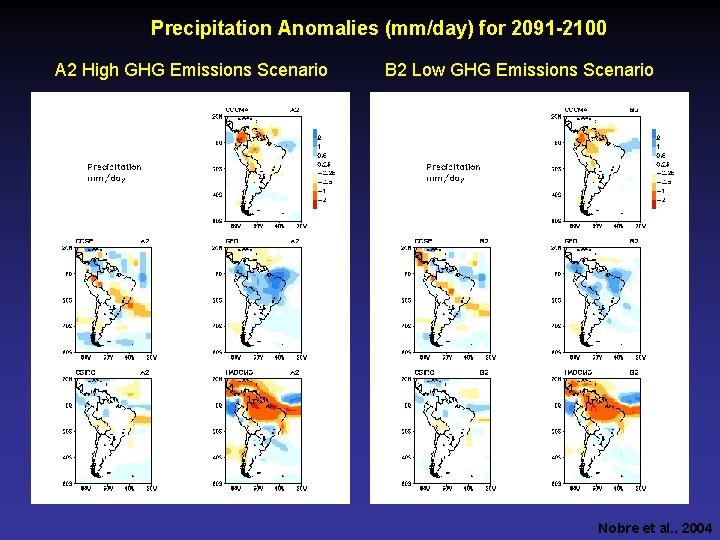
Precipitation Anomalies (mm/day) for 2091 -2100 A 2 High GHG Emissions Scenario B 2 Low GHG Emissions Scenario Nobre et al. , 2004
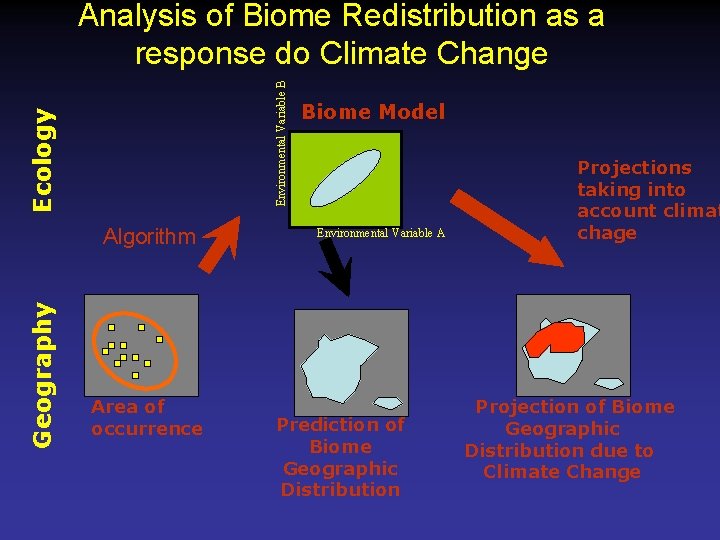
Ecology Environmental Variable B Analysis of Biome Redistribution as a response do Climate Change Geography Algorithm Area of occurrence Biome Model Environmental Variable A Prediction of Biome Geographic Distribution Projections taking into account climat chage Projection of Biome Geographic Distribution due to Climate Change
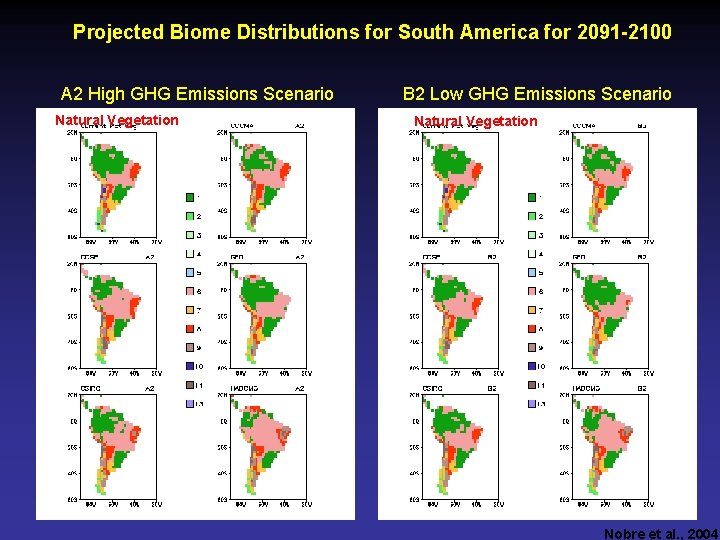
Projected Biome Distributions for South America for 2091 -2100 A 2 High GHG Emissions Scenario Natural Vegetation B 2 Low GHG Emissions Scenario Natural Vegetation Nobre et al. , 2004
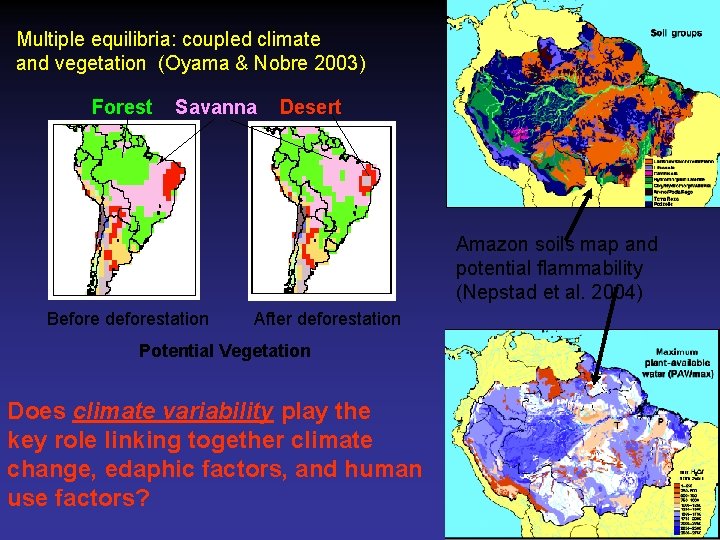
Multiple equilibria: coupled climate and vegetation (Oyama & Nobre 2003) Forest Savanna Desert Amazon soils map and potential flammability (Nepstad et al. 2004) Before deforestation After deforestation Potential Vegetation Does climate variability play the key role linking together climate change, edaphic factors, and human use factors?
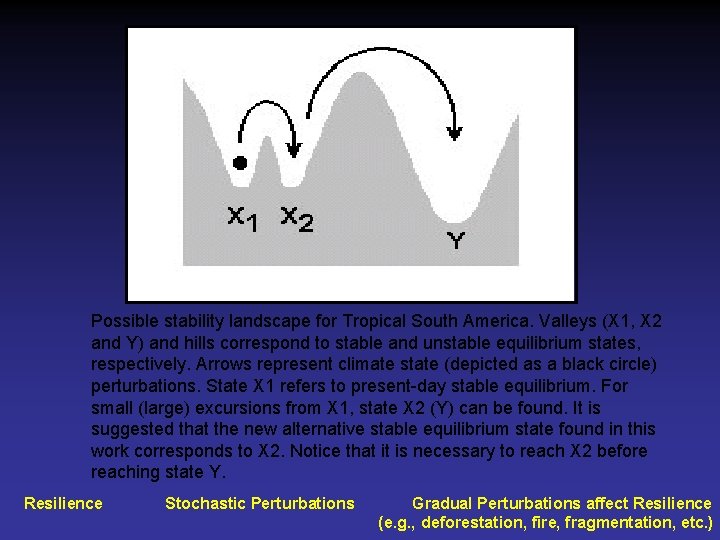
Possible stability landscape for Tropical South America. Valleys (X 1, X 2 and Y) and hills correspond to stable and unstable equilibrium states, respectively. Arrows represent climate state (depicted as a black circle) perturbations. State X 1 refers to present-day stable equilibrium. For small (large) excursions from X 1, state X 2 (Y) can be found. It is suggested that the new alternative stable equilibrium state found in this work corresponds to X 2. Notice that it is necessary to reach X 2 before reaching state Y. Resilience Stochastic Perturbations Gradual Perturbations affect Resilience (e. g. , deforestation, fire, fragmentation, etc. )
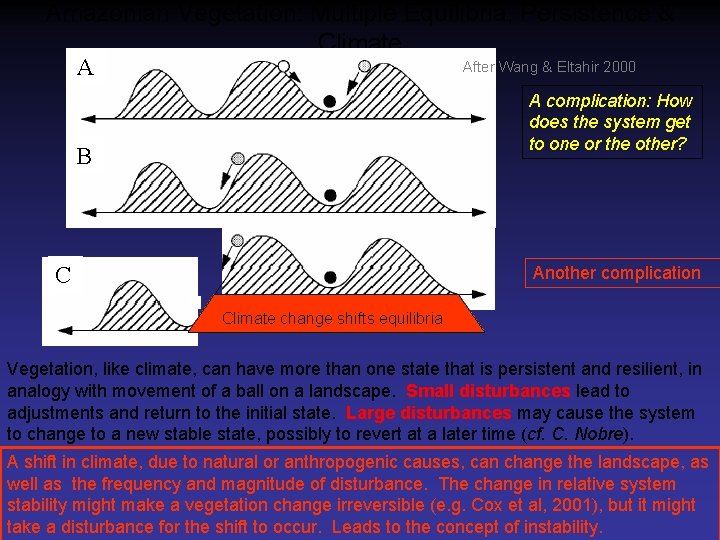
Amazonian Vegetation: Multiple Equilibria, Persistence & Climate After Wang & Eltahir 2000 A A complication: How does the system get to one or the other? B C Another complication Climate change shifts equilibria Vegetation, like climate, can have more than one state that is persistent and resilient, in analogy with movement of a ball on a landscape. Small disturbances lead to adjustments and return to the initial state. Large disturbances may cause the system to change to a new stable state, possibly to revert at a later time (cf. C. Nobre). A shift in climate, due to natural or anthropogenic causes, can change the landscape, as well as the frequency and magnitude of disturbance. The change in relative system stability might make a vegetation change irreversible (e. g. Cox et al, 2001), but it might take a disturbance for the shift to occur. Leads to the concept of instability.
Conclusions The future of biome distribution in South America in face of climate changes • “Savannization” of Amazonia and tendency of even drier biomes of Northeast Brazil • Some tendency for southward displacement of the Atlantic forest. • Results do depend strongly on climate model used and less so on emissions scenarios. • The synergistic combination of regional climate changes caused by global warming and by land cover change over the next several decades could tip the biome-climate state to a new stable equilibrium with ‘savannization’ of parts of Amazonia (and ‘desertification’ in Northeast Brazil).
- Slides: 31