
Climate Change our final Tragedy of the Commons


- Slides: 33
Climate Change: our final Tragedy of the Commons? Kevin Anderson Tyndall Centre 2012
Presentation outline § Current aspirations and emission trends § Why we should strive for 2°C § The levels of mitigation required of the UK § Behavioural and technical opportunities § Messages for business § Summary Manchester Energy
The international energy agency’s view on climate change § “When I look at this [CO 2] data, the trend is perfectly in line with a temperature increase of 6 degrees Celsius, which would have devastating consequences for the planet. ” § “we have 5 years to change the energy system – or have it changed” Fatih Birol - IEA chief economist Similar concerns expressed by government chief scientists, Pw. C, World Bank Manchester Energy
Climate change commitments § International ‘To hold the increase in global temperature below 2 degrees Celsius and take action. . consistent with science and on the basis of equity‘ § EU ‘must ensure global average temperature increases do not exceed preindustrial levels by more than 2°C’ § UK Manchester Energy ‘average global temperatures must rise no more than 2°C’
§ How do 2 & 4°C futures fit with CO 2 trends? § What is the role of energy?
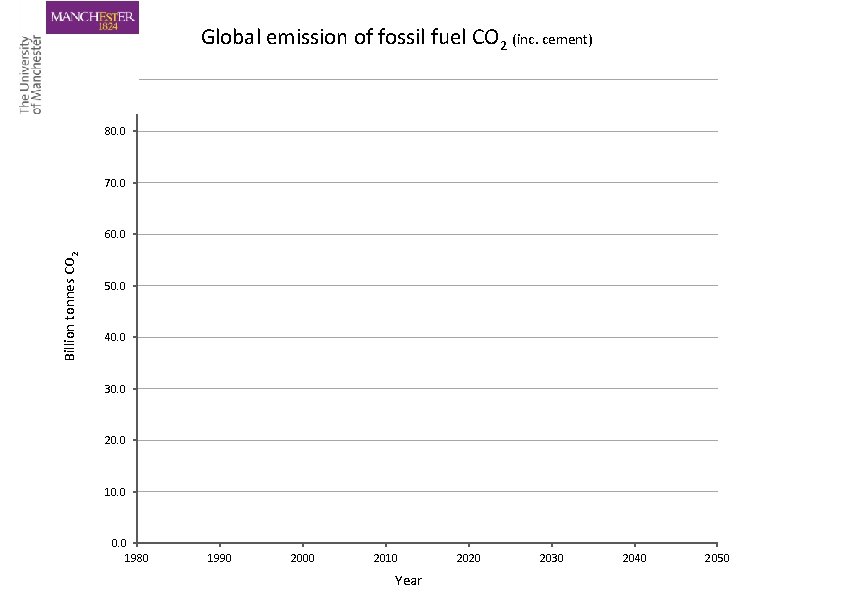
Global emission of fossil fuel CO 2 (inc. cement) 90. 0 80. 0 70. 0 Billion tonnes CO 2 60. 0 50. 0 40. 0 30. 0 20. 0 10. 0 1980 1990 2000 2010 Year 2020 2030 2040 2050
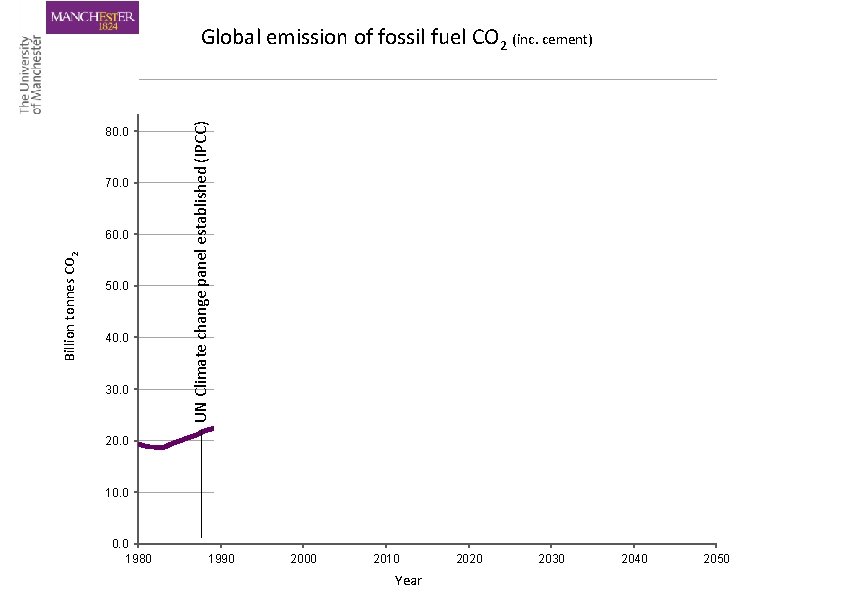
Billion tonnes CO 2 80. 0 70. 0 60. 0 50. 0 40. 0 30. 0 1980 1990 2000 Copenhagen Accord David King CC most dangerous threat Royal Commission report (60% by 2050) RIO Earth Summit UN Climate change panel established (IPCC) Global emission of fossil fuel CO 2 (inc. cement) 90. 0 20. 0 10. 0 2010 Year 2020 2030 2040 2050
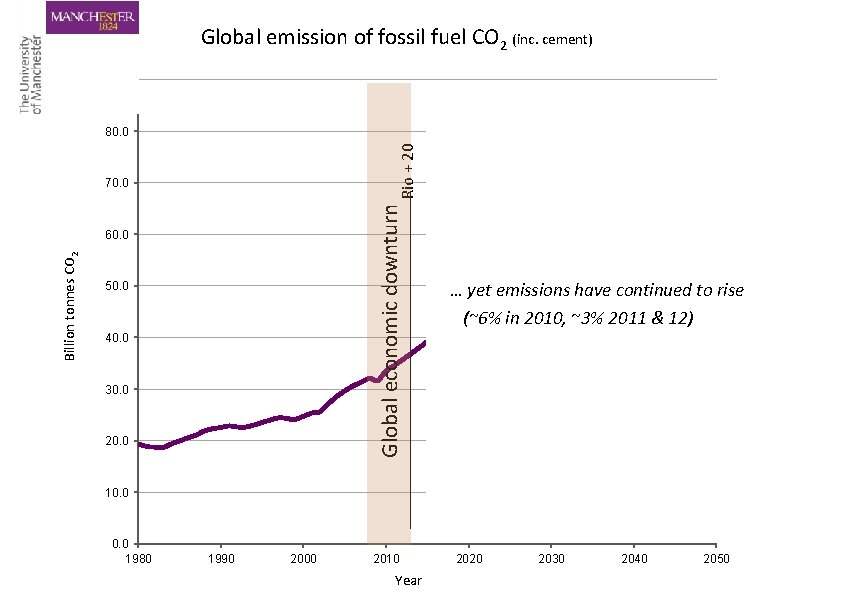
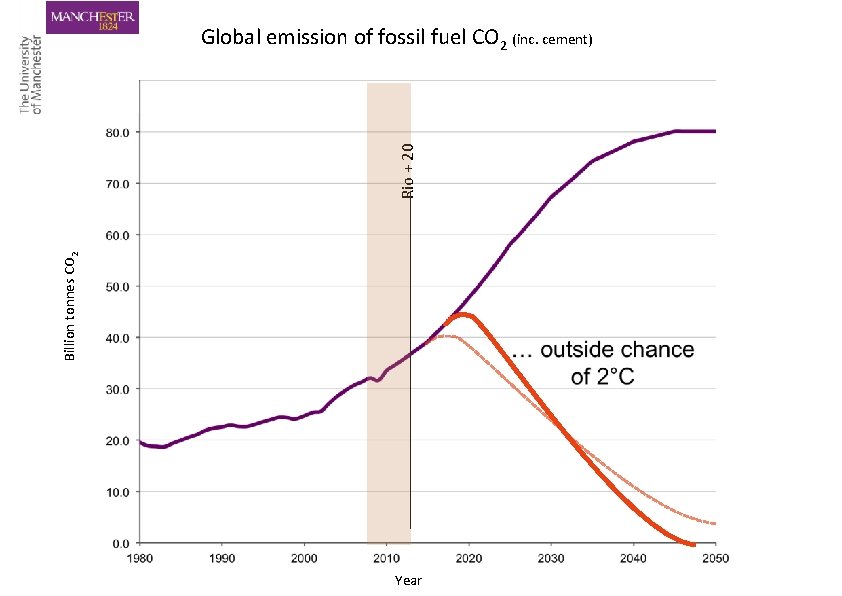
Global emission of fossil fuel CO 2 (inc. cement) 90. 0 Rio + 20 80. 0 Global economic downturn 70. 0 Billion tonnes CO 2 60. 0 50. 0 40. 0 30. 0 20. 0 … yet emissions have continued to rise (~6% in 2010, ~3% 2011 & 12) 10. 0 1980 1990 2000 2010 Year 2020 2030 2040 2050
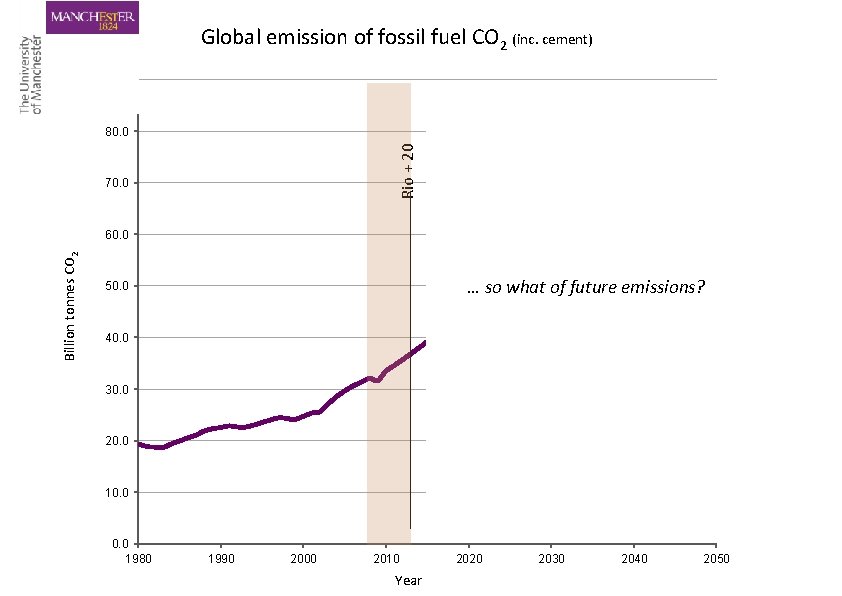
Global emission of fossil fuel CO 2 (inc. cement) 90. 0 Rio + 20 80. 0 70. 0 Billion tonnes CO 2 60. 0 … so what of future emissions? 50. 0 40. 0 30. 0 20. 0 10. 0 1980 1990 2000 2010 Year 2020 2030 2040 2050
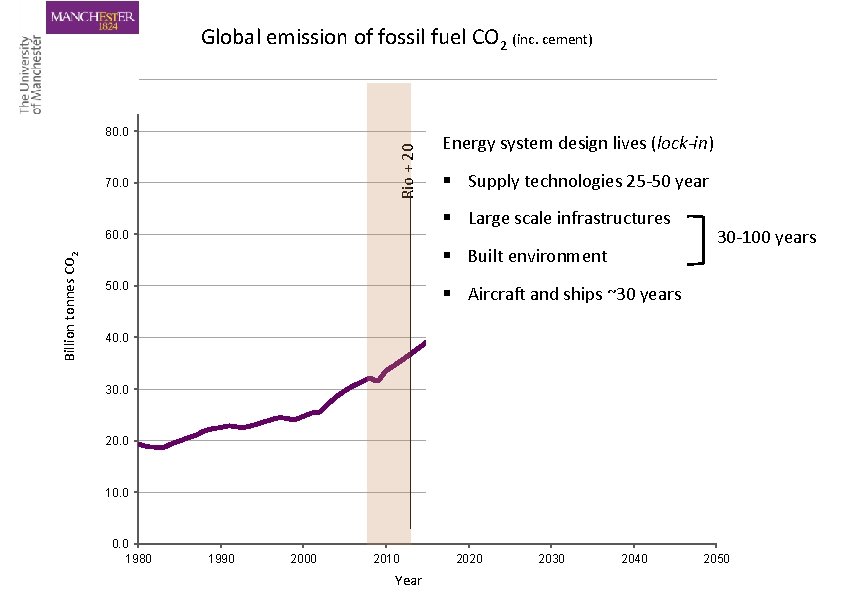
Global emission of fossil fuel CO 2 (inc. cement) 90. 0 Rio + 20 80. 0 70. 0 § Supply technologies 25 -50 year § Large scale infrastructures 60. 0 Billion tonnes CO 2 Energy system design lives (lock-in) § Built environment 50. 0 30 -100 years § Aircraft and ships ~30 years 40. 0 30. 0 20. 0 10. 0 1980 1990 2000 2010 Year 2020 2030 2040 2050
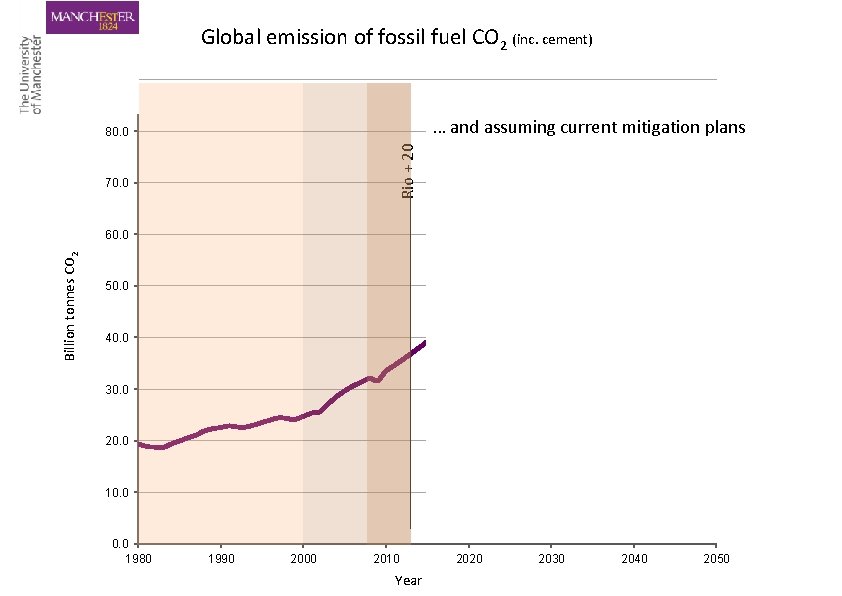
Global emission of fossil fuel CO 2 (inc. cement) 90. 0 … and assuming current mitigation plans Rio + 20 80. 0 70. 0 Billion tonnes CO 2 60. 0 50. 0 40. 0 30. 0 20. 0 10. 0 1980 1990 2000 2010 Year 2020 2030 2040 2050
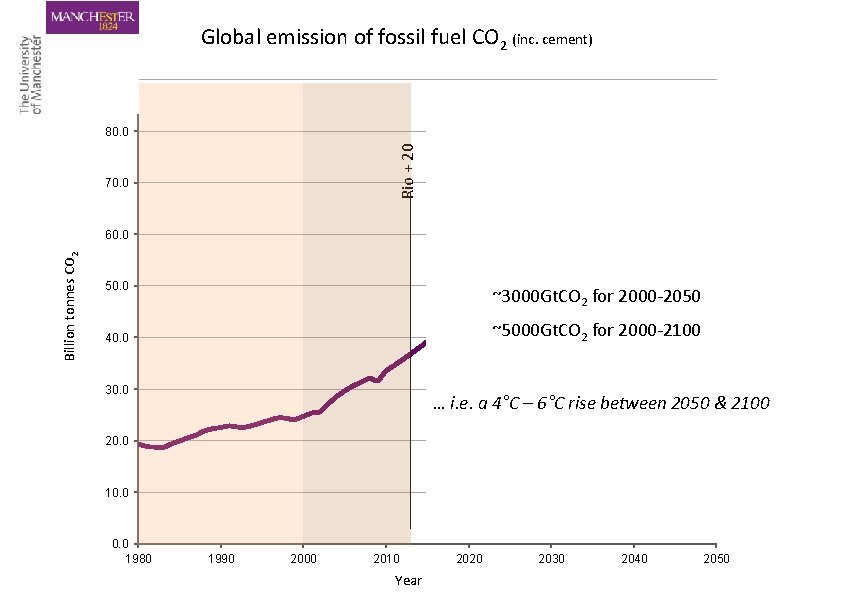
Global emission of fossil fuel CO 2 (inc. cement) 90. 0 Rio + 20 80. 0 70. 0 Billion tonnes CO 2 60. 0 50. 0 ~3000 Gt. CO 2 for 2000 -2050 ~5000 Gt. CO 2 for 2000 -2100 40. 0 30. 0 … i. e. a 4°C – 6°C rise between 2050 & 2100 20. 0 10. 0 1980 1990 2000 2010 Year 2020 2030 2040 2050
Billion tonnes CO 2 Rio + 20 Global emission of fossil fuel CO 2 (inc. cement) Year
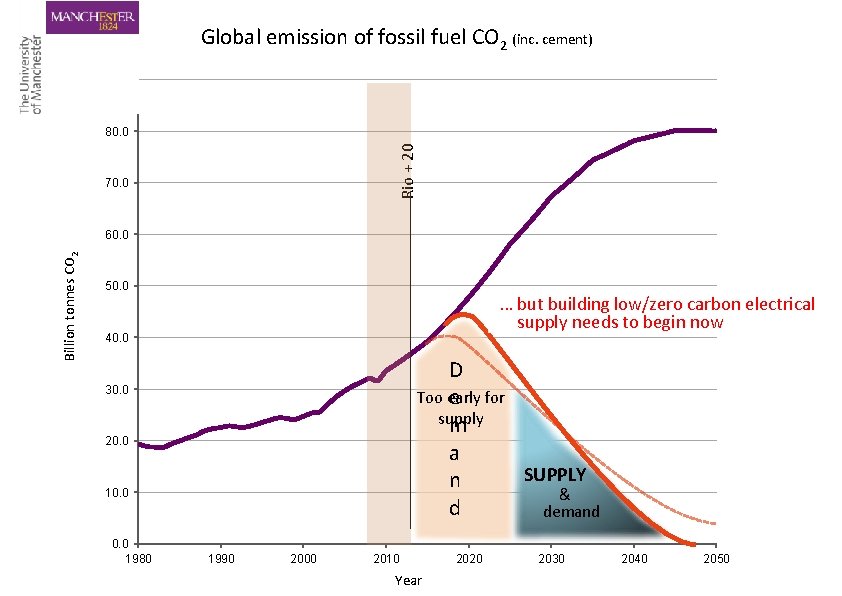
Global emission of fossil fuel CO 2 (inc. cement) 90. 0 Rio + 20 80. 0 70. 0 Billion tonnes CO 2 60. 0 50. 0 … but building low/zero carbon electrical supply needs to begin now 40. 0 D Too early e for supply m a SUPPLY n & d demand 30. 0 20. 0 10. 0 1980 1990 2000 2010 Year 2020 2030 2040 2050
So, if 2°C is too challenging, what about 4°C – or more?
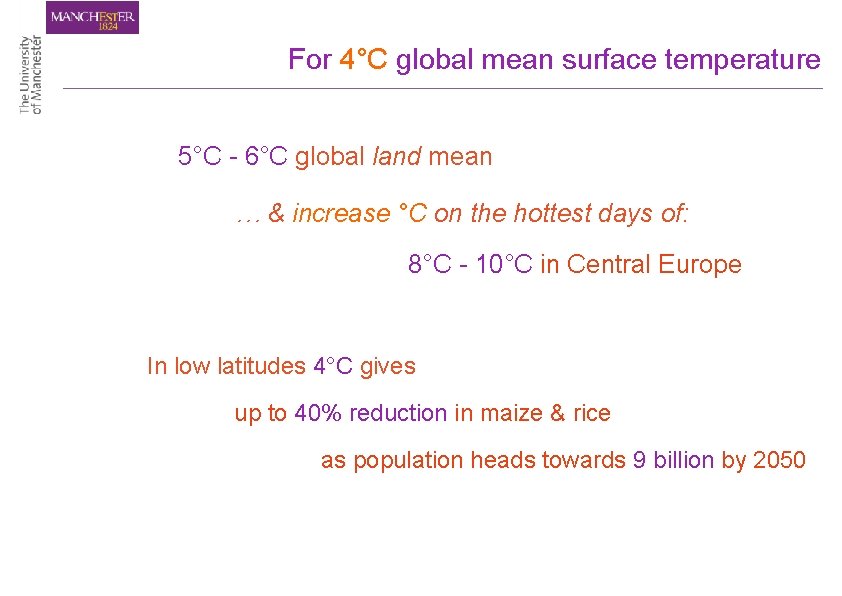
For 4°C global mean surface temperature 5°C - 6°C global land mean … & increase °C on the hottest days of: 8°C - 10°C in Central Europe In low latitudes 4°C gives up to 40% reduction in maize & rice as population heads towards 9 billion by 2050
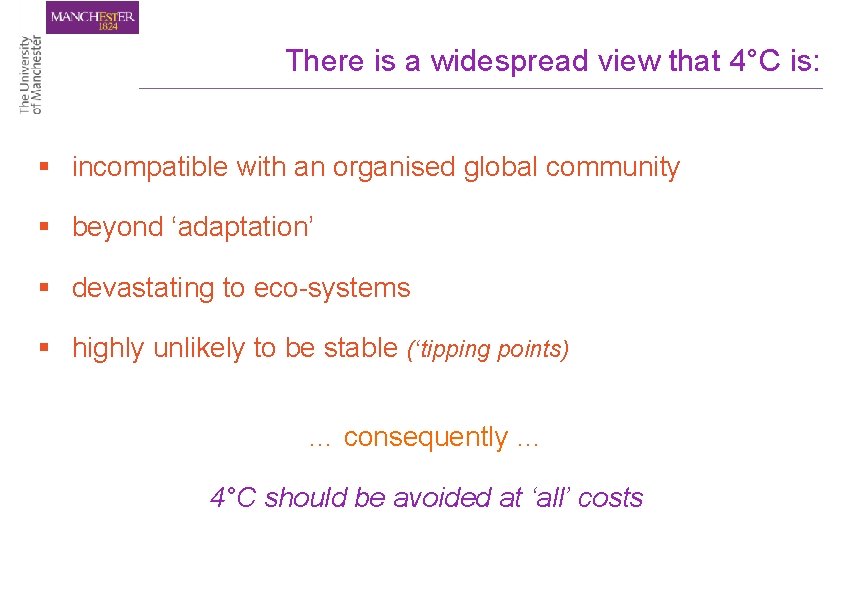
There is a widespread view that 4°C is: § incompatible with an organised global community § beyond ‘adaptation’ § devastating to eco-systems § highly unlikely to be stable (‘tipping points) … consequently … 4°C should be avoided at ‘all’ costs
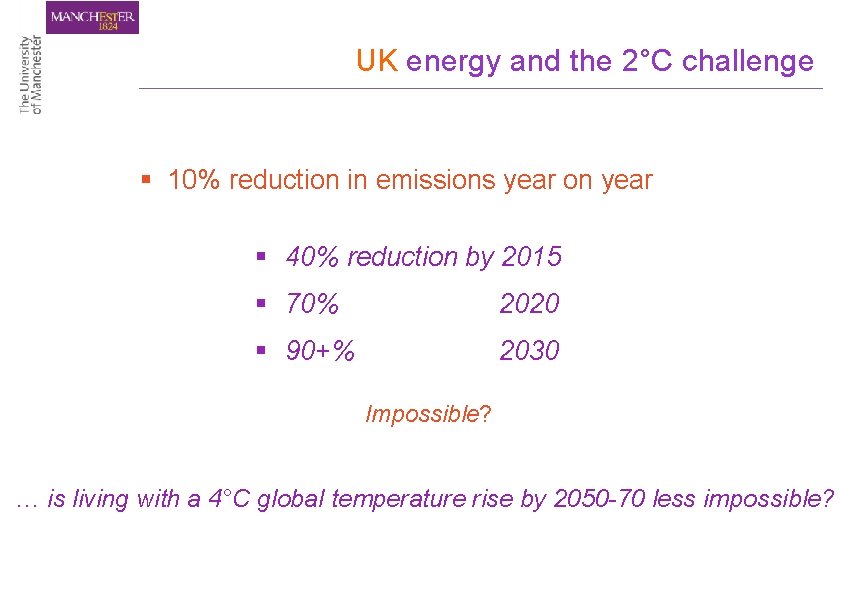
UK energy and the 2°C challenge § 10% reduction in emissions year on year § 40% reduction by 2015 § 70% 2020 § 90+% 2030 Impossible? … is living with a 4°C global temperature rise by 2050 -70 less impossible?
Where to from here?
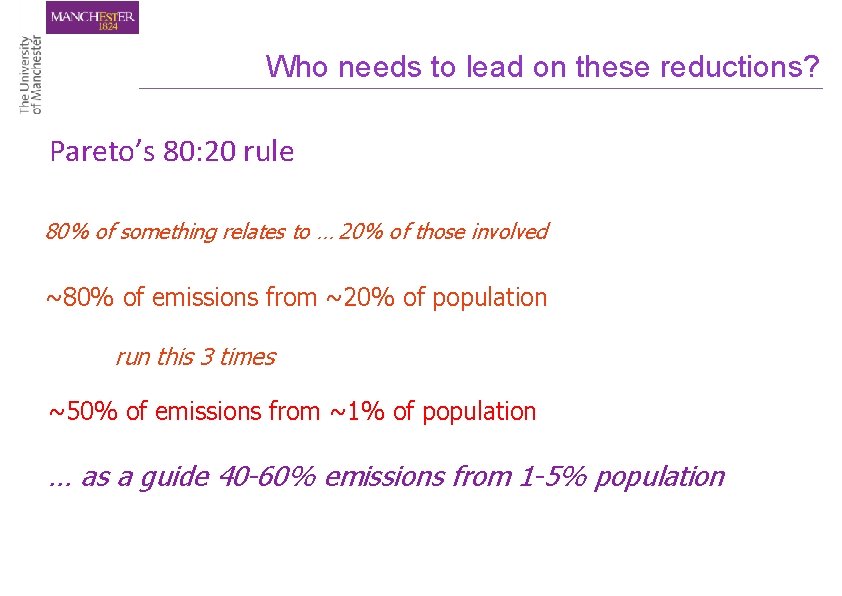
Who needs to lead on these reductions? Pareto’s 80: 20 rule 80% of something relates to … 20% of those involved ~80% of emissions from ~20% of population run this 3 times ~50% of emissions from ~1% of population … as a guide 40 -60% emissions from 1 -5% population
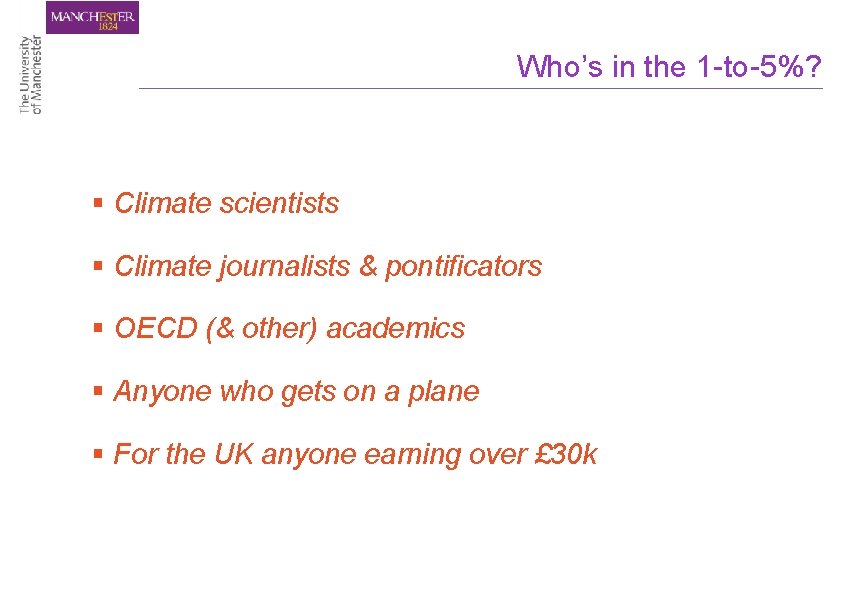
Who’s in the 1 -to-5%? § Climate scientists § Climate journalists & pontificators § OECD (& other) academics § Anyone who gets on a plane § For the UK anyone earning over £ 30 k
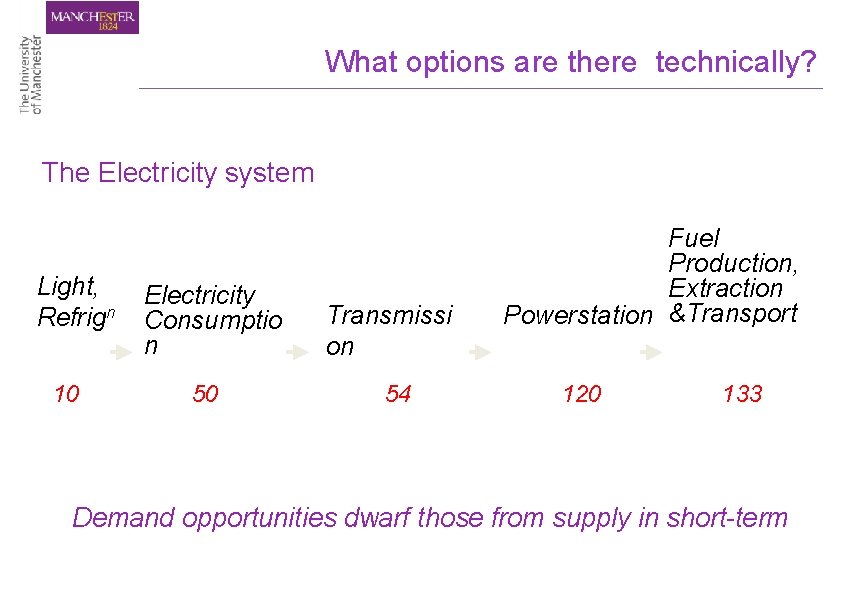
What options are there technically? The Electricity system Light, Refrign 10 Electricity Consumptio n 50 Transmissi on 54 Fuel Production, Extraction Powerstation &Transport 120 133 Demand opportunities dwarf those from supply in short-term
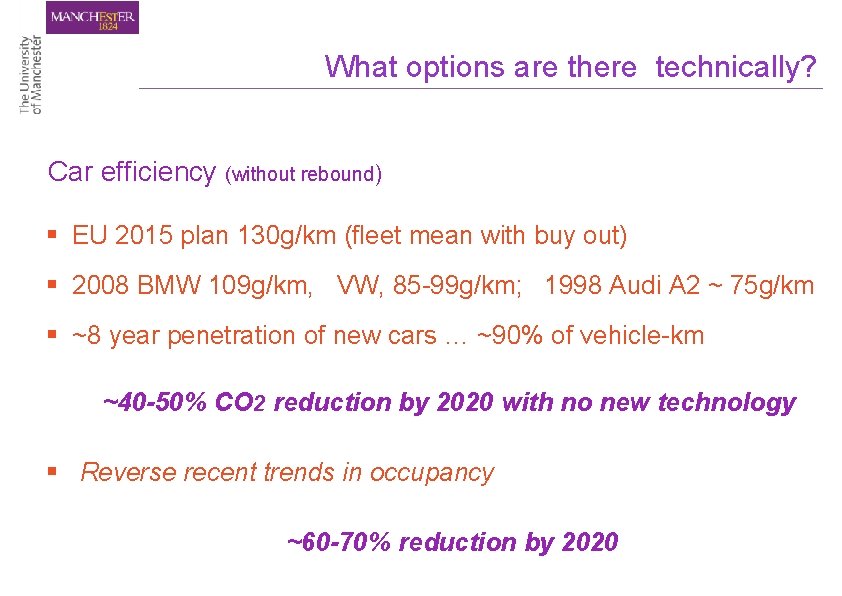
What options are there technically? Car efficiency (without rebound) § EU 2015 plan 130 g/km (fleet mean with buy out) § 2008 BMW 109 g/km, VW, 85 -99 g/km; 1998 Audi A 2 ~ 75 g/km § ~8 year penetration of new cars … ~90% of vehicle-km ~40 -50% CO 2 reduction by 2020 with no new technology § Reverse recent trends in occupancy ~60 -70% reduction by 2020
So what do we know?
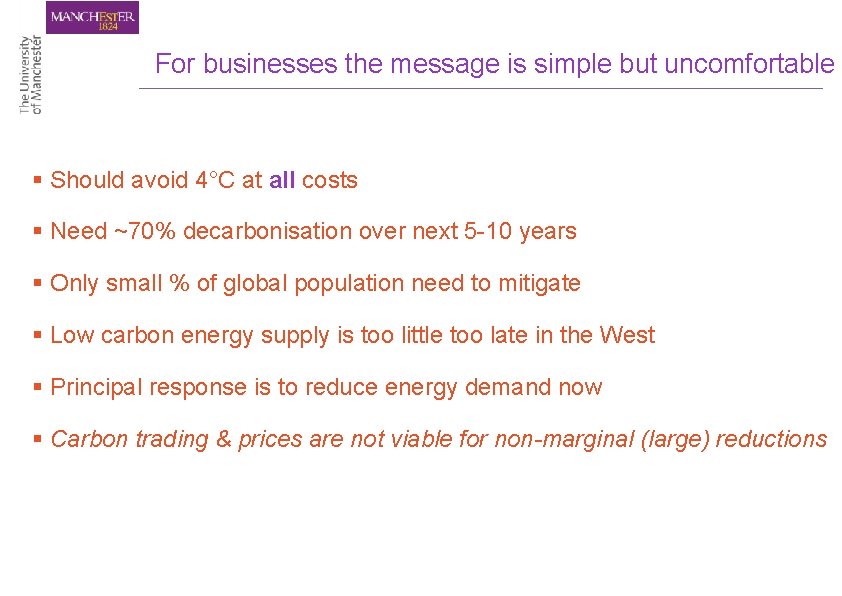
For businesses the message is simple but uncomfortable § Should avoid 4°C at all costs § Need ~70% decarbonisation over next 5 -10 years § Only small % of global population need to mitigate § Low carbon energy supply is too little too late in the West § Principal response is to reduce energy demand now § Carbon trading & prices are not viable for non-marginal (large) reductions
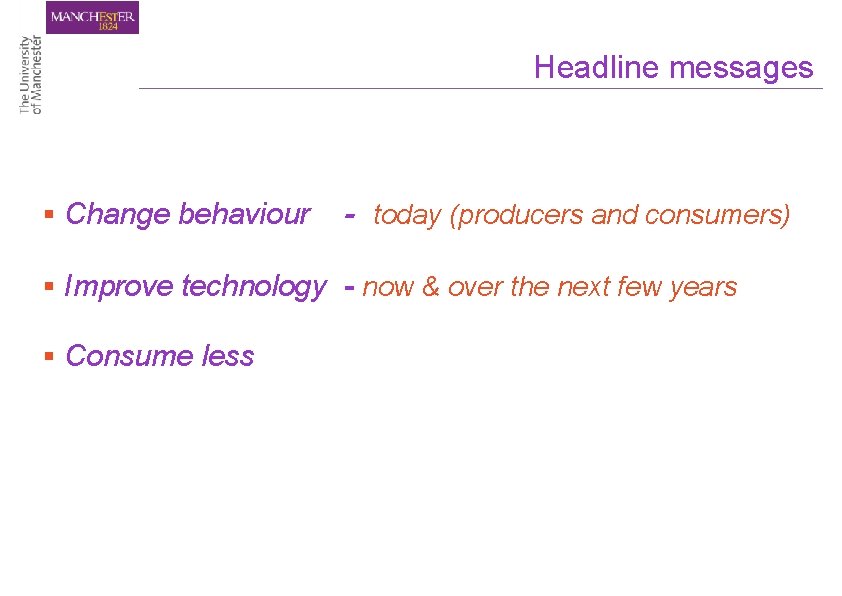
Headline messages § Change behaviour - today (producers and consumers) § Improve technology - now & over the next few years § Consume less
To Summarise
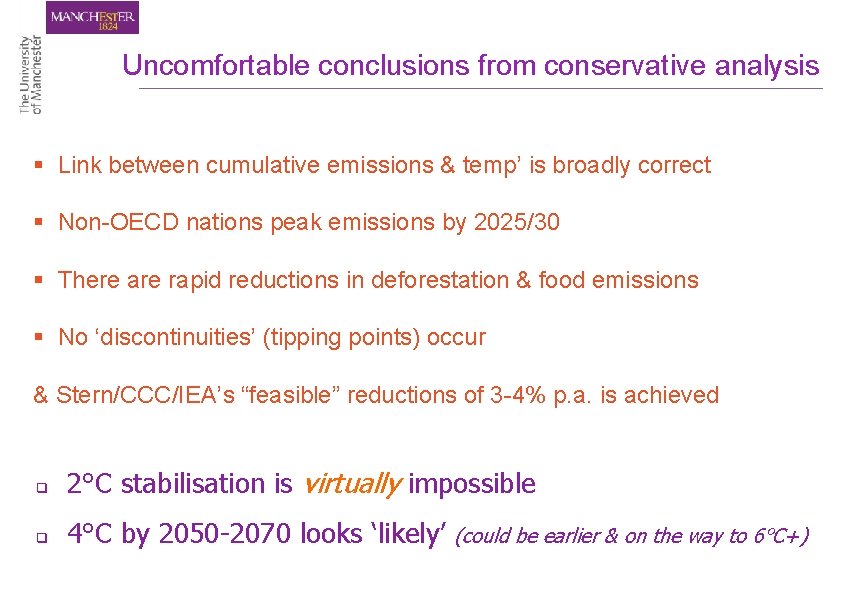
Uncomfortable conclusions from conservative analysis § Link between cumulative emissions & temp’ is broadly correct § Non-OECD nations peak emissions by 2025/30 § There are rapid reductions in deforestation & food emissions § No ‘discontinuities’ (tipping points) occur & Stern/CCC/IEA’s “feasible” reductions of 3 -4% p. a. is achieved q 2°C stabilisation is virtually impossible q 4°C by 2050 -2070 looks ‘likely’ (could be earlier & on the way to 6°C+)
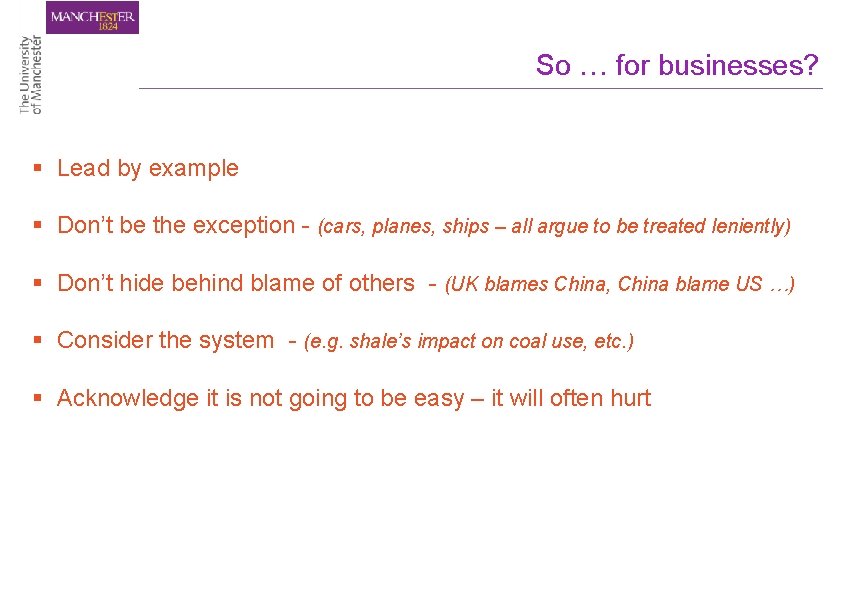
So … for businesses? § Lead by example § Don’t be the exception - (cars, planes, ships – all argue to be treated leniently) § Don’t hide behind blame of others - (UK blames China, China blame US …) § Consider the system - (e. g. shale’s impact on coal use, etc. ) § Acknowledge it is not going to be easy – it will often hurt
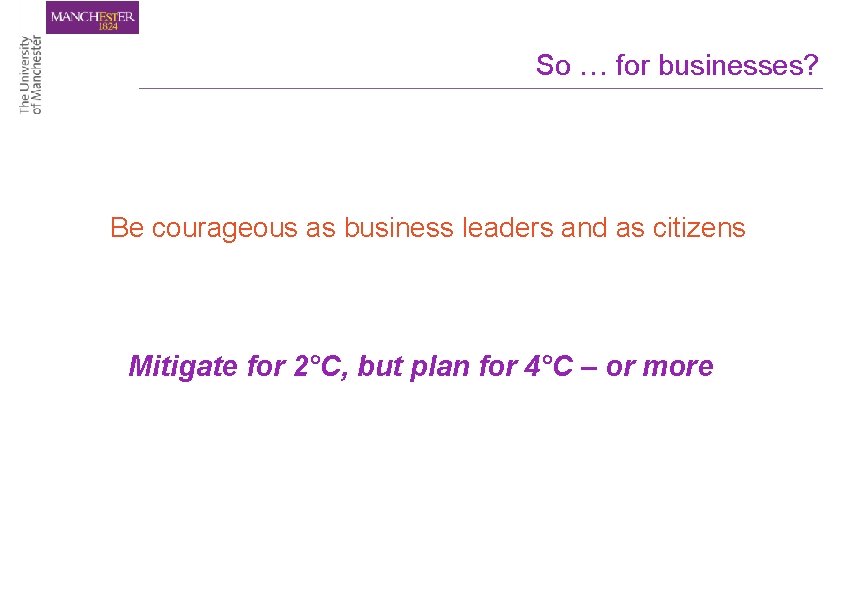
So … for businesses? Be courageous as business leaders and as citizens Mitigate for 2°C, but plan for 4°C – or more
… and finally “… this is not a message of futility, but a wake-up call of where our rose-tinted spectacles have brought us. Real hope, if it is to arise at all, will do so from a bare assessment of the scale of the challenge we now face. ” Anderson & Bows. Royal Society 2011
… and finally “at every level the greatest obstacle to transforming the world is that we lack the clarity and imagination to conceive that it could be different. ” Roberto Unger
End Kevin Anderson Tyndall Centre 2012