
CLIMATE CHANGE NATIONAL STRATEGY Ministry of Environment and
- Slides: 10
CLIMATE CHANGE NATIONAL STRATEGY Ministry of Environment and Natural Resources Jamaica, july 2009
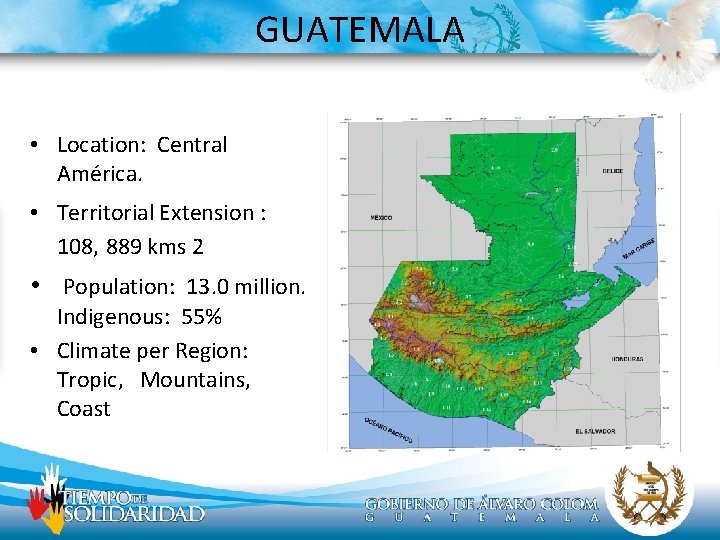
GUATEMALA • Location: Central América. • Territorial Extension : 108, 889 kms 2 • Population: 13. 0 million. Indigenous: 55% • Climate per Region: Tropic, Mountains, Coast
Context • In accordance with the IPCC, the global warming is caused by the increase of greenhouse gases emissions provoked by human beings actions, mainly those who live in industrialized countries. • Although Guatemala contributes very little to the increase of the global temperature (national emissions of greenhouse gases are reduced), our country is being seriously impacted by the climate change and variability. Their intensity and frequency have increased.
Climate Change and Variability Efects • • • “El Niño” phenom Mitch Hurricane Drought Tropical Storm “Stan” Flooding, sinking landslides, deaths 1991 1998 2001 2005 2008
Negative Impacts • Loss of biodiversity, farming, basic infraestructure and services • Food security • Quality and quantity reduction of hydrological resources • Increase of soil erosion processes • Increase of illnesses • Tourism This situation affects mainly the rural and urban marginal population. Consecuently to people in extreme poverty
Policy Framework on Climate Change National: • Government Plan 2008 -2012 • Environmental Improvement Plan 2008 -2032 • Environmental Policy • Governmental Strategic Plan • Climate Change National Strategy International: • Climate Change Regional Strategy • Mesoamerican Strategy of Sustentability Environmental
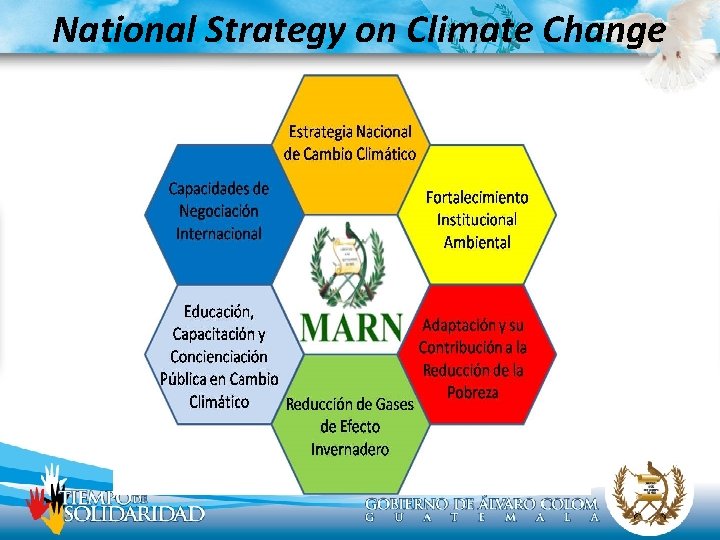
National Strategy on Climate Change
Adaptation and its contribution to the reduction of Poverty 1. Promotion of good practices to reduce negative impacts of variability and climate change 2. Increase the knowledge of extreme meteorological phenomenon to reduce the level of incertity 3. Preparation of models and scenarios in climate change to predict the climate future behaviors 4. Encourage the participation of all sectors to raise the methodological issue and implementation of concret actions 5. Reinforce the national and local coordination to guarantee coherence between actions in climate change and other objectives of national policies.
How do we implement the Strategy? Main Actions: 1. Second National Communication 2. Climate Change Policy 3. COP Copenhague Preparation 4. Joint Program “Environmental Governance in the face of Climate Risk in Guatemala” 5. Education National Program on Climate Change focused to Strengthen the local capacities 6. Support Program to reduce climate vulnerability in the Dry Corridor (Kf. W) 7. Strengthening the capacity of adaptation to Climate Change (Japón) 8. Mesoamerican Barrier Reef System (GEF) 9. Small Grants Program
Joint Program “Strengthening Environmental Governance in the face of Climate Risks in Guatemala” • Dry Corridor: 6 departaments. • Focal Area: 6 municipalities in Baja Verapaz. • Demostrative Area: 6 micro-watershed in Baja Verapaz.