
Climate Change Lesson 2 Heat Transfer and the
- Slides: 21
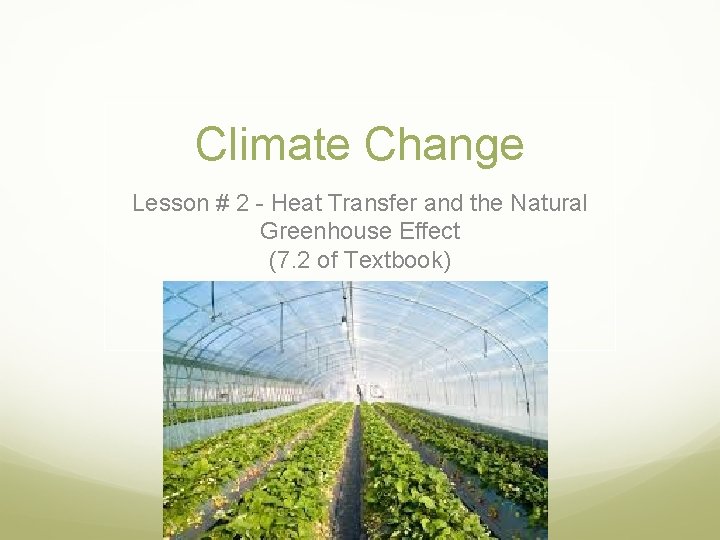
Climate Change Lesson # 2 - Heat Transfer and the Natural Greenhouse Effect (7. 2 of Textbook)
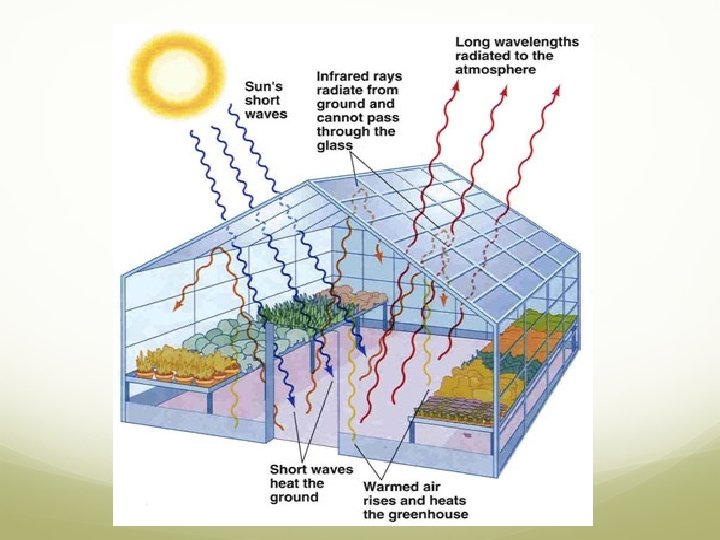
Greenhouses Many of you have heard of the “greenhouse effect” before, but how does a greenhouse even work? Don’t forget that energy travels from the sun as solar radiation, and anything that absorbs that energy converts it to thermal energy (heat).
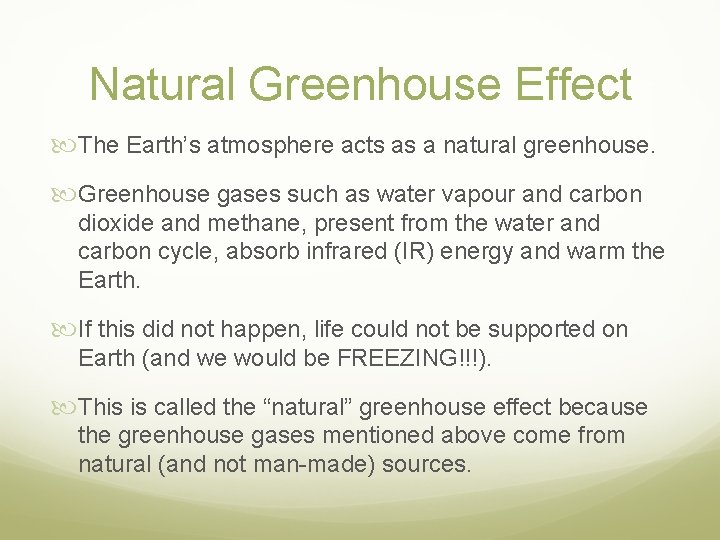
Natural Greenhouse Effect The Earth’s atmosphere acts as a natural greenhouse. Greenhouse gases such as water vapour and carbon dioxide and methane, present from the water and carbon cycle, absorb infrared (IR) energy and warm the Earth. If this did not happen, life could not be supported on Earth (and we would be FREEZING!!!). This is called the “natural” greenhouse effect because the greenhouse gases mentioned above come from natural (and not man-made) sources.
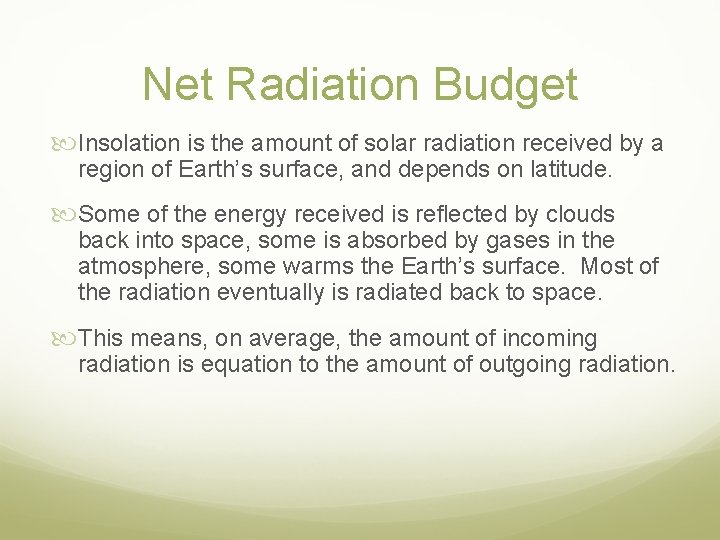
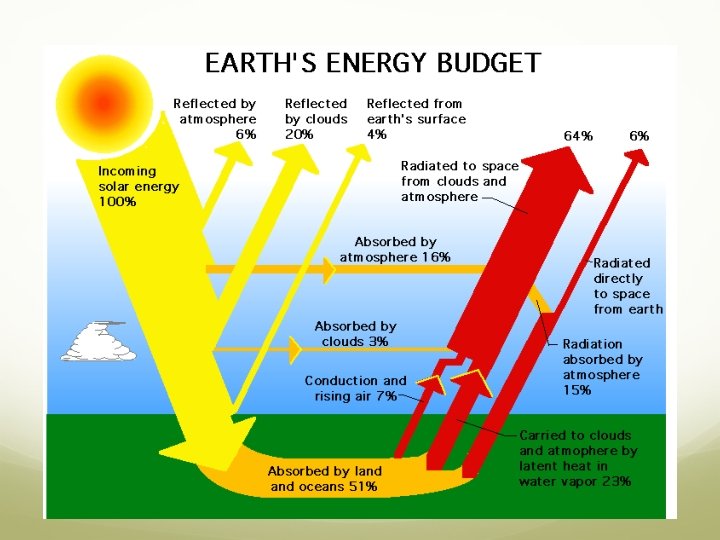
Net Radiation Budget Insolation is the amount of solar radiation received by a region of Earth’s surface, and depends on latitude. Some of the energy received is reflected by clouds back into space, some is absorbed by gases in the atmosphere, some warms the Earth’s surface. Most of the radiation eventually is radiated back to space. This means, on average, the amount of incoming radiation is equation to the amount of outgoing radiation.
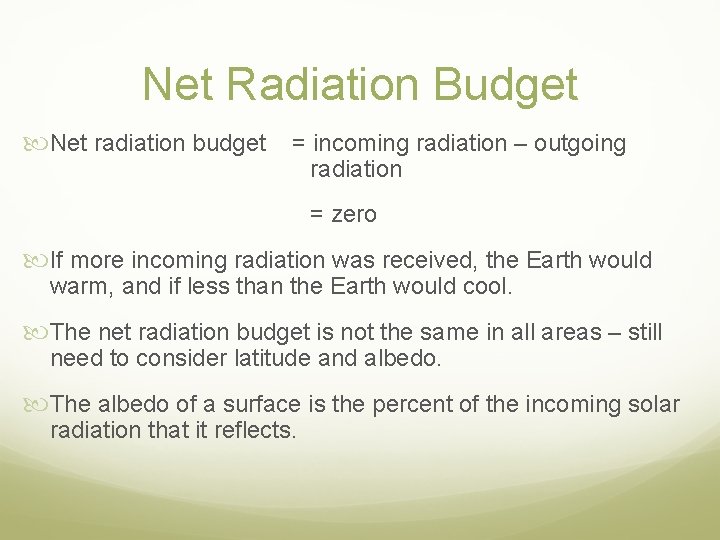
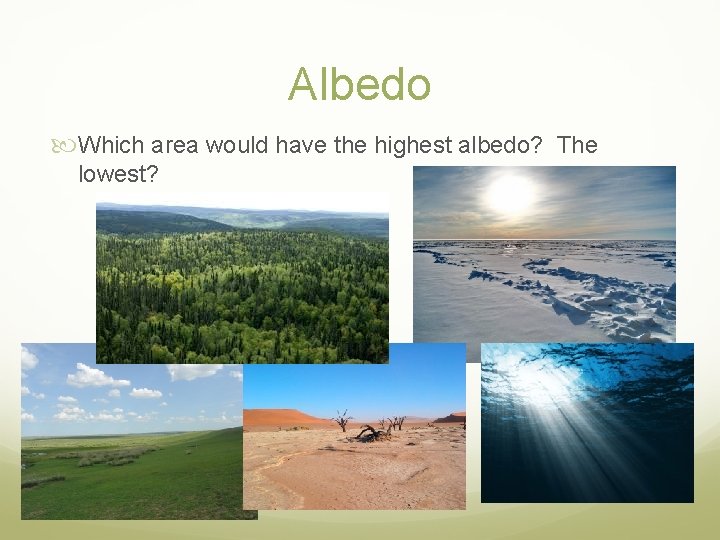
Net Radiation Budget Net radiation budget = incoming radiation – outgoing radiation = zero If more incoming radiation was received, the Earth would warm, and if less than the Earth would cool. The net radiation budget is not the same in all areas – still need to consider latitude and albedo. The albedo of a surface is the percent of the incoming solar radiation that it reflects.
Albedo Which area would have the highest albedo? The lowest?
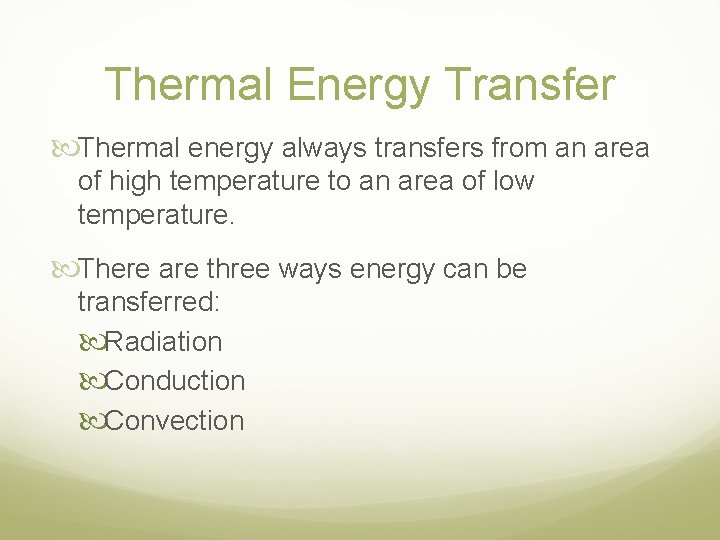
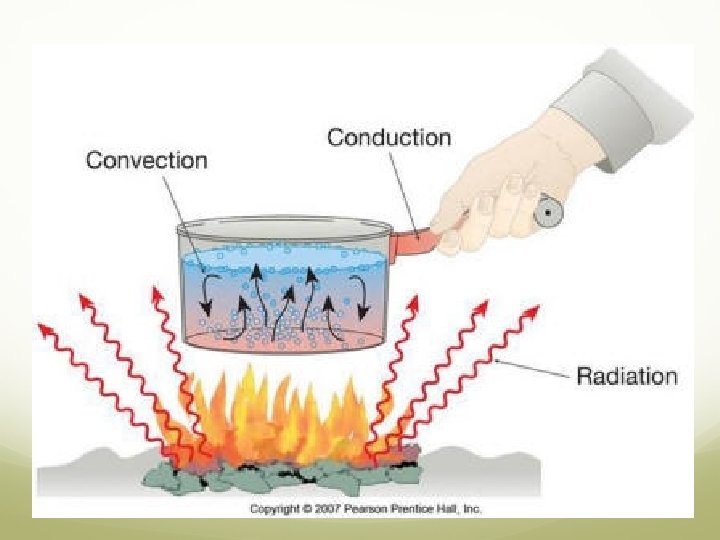
Thermal Energy Transfer Thermal energy always transfers from an area of high temperature to an area of low temperature. There are three ways energy can be transferred: Radiation Conduction Convection
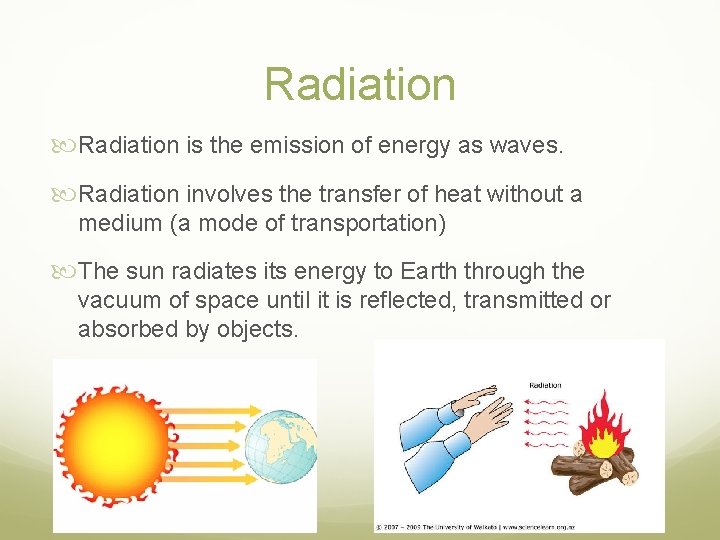
Radiation is the emission of energy as waves. Radiation involves the transfer of heat without a medium (a mode of transportation) The sun radiates its energy to Earth through the vacuum of space until it is reflected, transmitted or absorbed by objects.
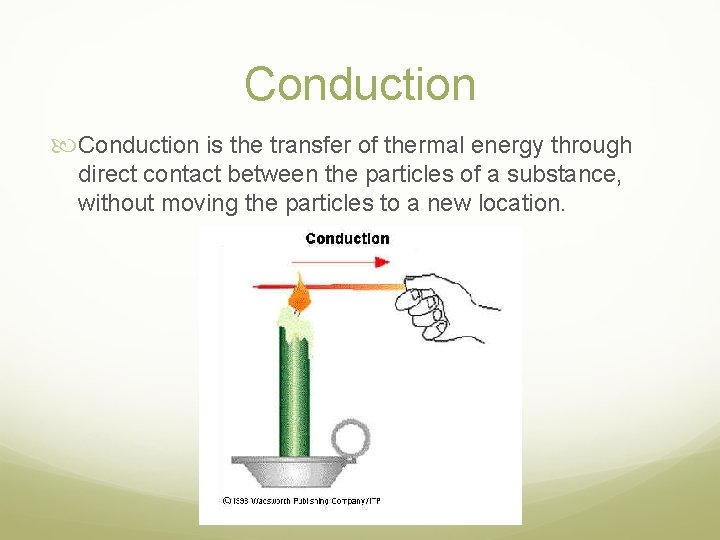
Conduction is the transfer of thermal energy through direct contact between the particles of a substance, without moving the particles to a new location.
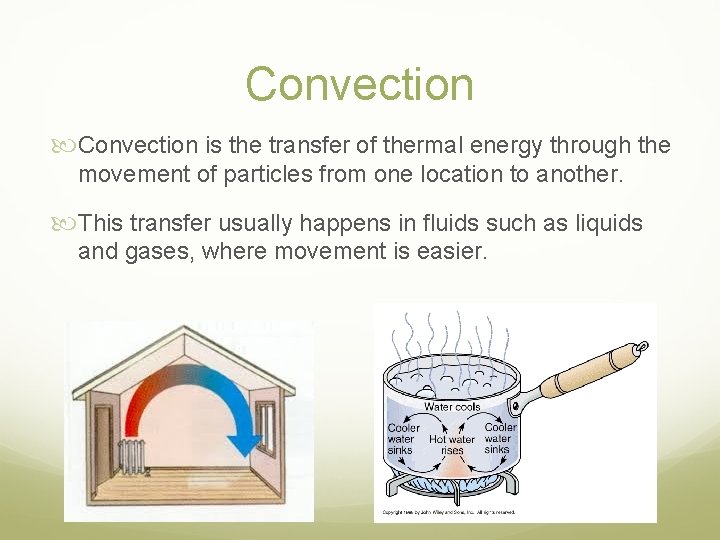
Convection is the transfer of thermal energy through the movement of particles from one location to another. This transfer usually happens in fluids such as liquids and gases, where movement is easier.
Energy Transfer in the Atmosphere When atmospheric gases are heated at the equator, they become less dense and rise (low pressure). These warm gases move to areas with less heat, like at the poles. Here they lose energy, contract, and fall (high pressure). If they Earth were not spinning, there would be a continuous convection current between the poles and equator, but there is not, and so we have this pressure difference. Wind is the movement of air from areas of high pressure to low pressure. The rising and sinking air masses in convection currents cause pressure changes which causes wind.
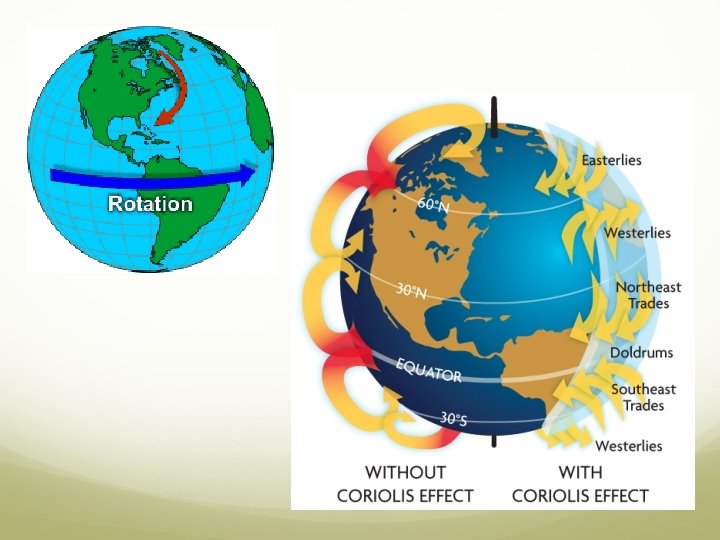
The Coriolis Effect The difference in energy (as heat) at the poles and causes air to move directly north and south from the equator. Since Earth is spinning, winds twist to the right or to the left as this occurs. The Coriolis effect is the deflection of any object from a straight-lined path by the rotation of Earth. Winds twist to the right (clock-wise) in the northern hemisphere and to the left in the southern hemisphere.
Global Winds vs. Jet Streams Global winds transfer energy in the troposphere from areas of net radiation surplus (equator) to deficit (poles). If this did not happen, the equator would be filled with boiling water and the poles would be completely frozen over, living a very small chunk of livable Earth. Jet streams are bands of fast-moving air in the stratosphere. During cooler months, jet streams tend to be closer to the equator and move more quickly. If they enter the troposphere at their speeds, they cause extreme weather like squalls, storms, and cyclones.
Energy Transfer in the Hydrosphere Water covers 70% of the Earth’s surface. When solid ice changes to liquid water or to gas (evaporation), thermal energy is absorbed. When gas changes to liquid or to solid, thermal energy is released. These changes allow energy to transfer through the water cycle, and keeps the Earth’s temperature relatively stable.
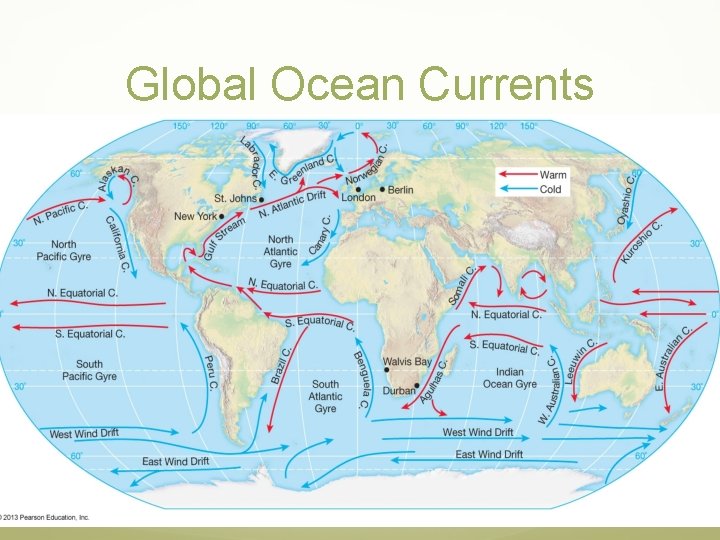
Energy Transfer in the Oceans Ocean currents transfer energy from the equator to the poles. As global winds blow on the ocean’s surface, they push the water and move the surface currents. They move warmer water to the poles and cooler water to the equator. Currents are also affected by the Coriolis Effect – currents veer to the right in the Northern hemisphere, though they do change direction somewhat when they interact with the continents. Thermal energy is also transferred vertically. Warmer water has a lower density so it rises to the surface and cooler water sinks.
Global Ocean Currents
Homework 1. Radiation, Conduction or Convection Worksheet 2. Read “Who Owns the Arctic Ocean? ” on Page 286 and answer question # 1. 3. Page 289 # 1, 3, 5 -8, 10 -13