
Climate Change II Midchapter summary Possible Causes of
Climate Change - II
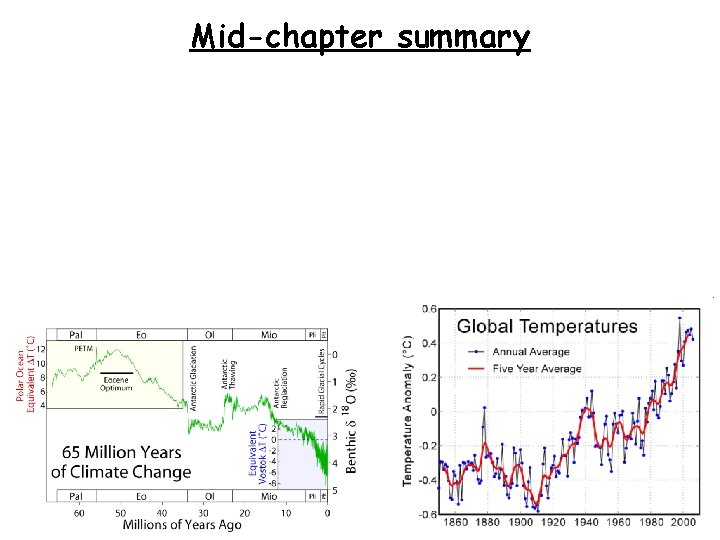
Mid-chapter summary
Possible Causes of Climatic Change • • External: changes in the 1. incoming solar radiation 2. composition of the atmosphere 3. Earth’s surface Natural phenomena may contribute to all three (1 -3) Human activity may contribute to 2 and 3 Internal: changes in the circulation patterns of the ocean and the atmosphere, etc.
Climate Change and Feedback Mechanisms • • • The climatic elements are intertwined: feedback Negative feedback: counteracts changes, stabilizes climate ♦ Thermal (IR) radiation of the planet: increased temperature leads to increased IR emission from the planet -> the planet cools and the temperature drops. ♦ Cloud negative feedback: higher temperature leads to more water vapor and therefore more clouds. The clouds increase the planet’s albedo and less solar light reaches the surface -> planet cools and the temperature drops. Positive feedback: enhances the changes, destabilizes the climate (runaway warming or cooling) ♦ Water vapor-greenhouse feedback: T increases, water evaporates -> greenhouse effect -> T increases more ♦ Snow-albedo feedback: T increases, snow melts -> albedo decreases -> less solar energy reflected at the surface -> T increases even more
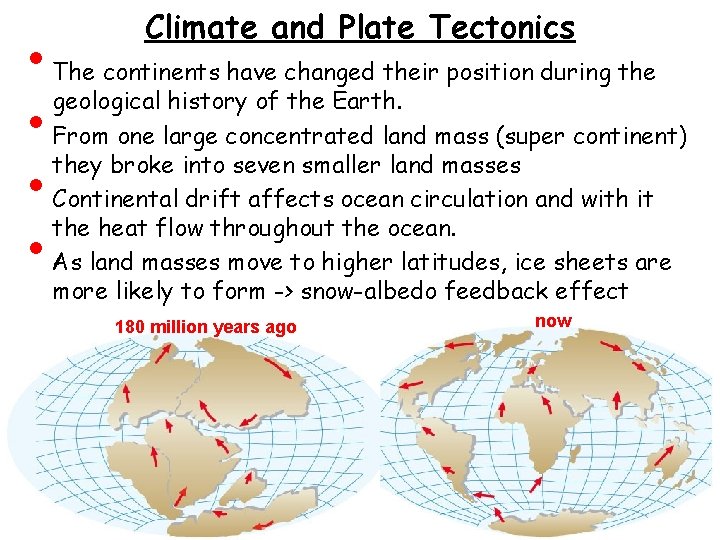
• • Climate and Plate Tectonics The continents have changed their position during the geological history of the Earth. From one large concentrated land mass (super continent) they broke into seven smaller land masses Continental drift affects ocean circulation and with it the heat flow throughout the ocean. As land masses move to higher latitudes, ice sheets are more likely to form -> snow-albedo feedback effect 180 million years ago now

• • Climate change and plate tectonics Tectonic and volcanic activity adds CO 2 and water vapor to the atmosphere Mountain building affects global circulation patterns in the atmosphere degassing volcano underwater volcano spreading subduction
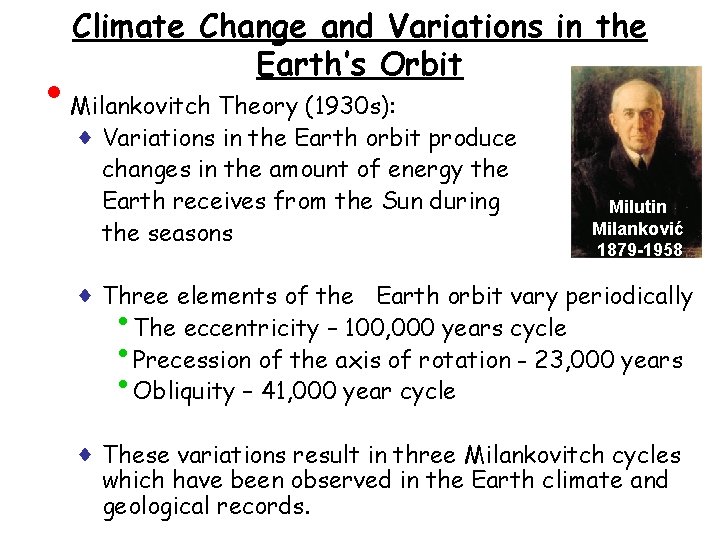
• Climate Change and Variations in the Earth’s Orbit Milankovitch Theory (1930 s): ♦ Variations in the Earth orbit produce changes in the amount of energy the Earth receives from the Sun during the seasons Milutin Milanković 1879 -1958 ♦ Three elements of the Earth orbit vary periodically The eccentricity – 100, 000 years cycle Precession of the axis of rotation - 23, 000 years Obliquity – 41, 000 year cycle • • • ♦ These variations result in three Milankovitch cycles which have been observed in the Earth climate and geological records.
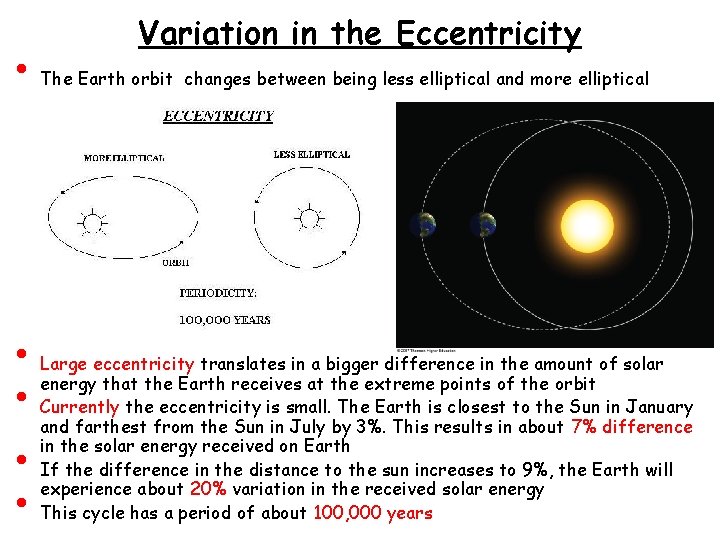
Variation in the Eccentricity • The Earth orbit changes between being less elliptical and more elliptical • • Large eccentricity translates in a bigger difference in the amount of solar energy that the Earth receives at the extreme points of the orbit Currently the eccentricity is small. The Earth is closest to the Sun in January and farthest from the Sun in July by 3%. This results in about 7% difference in the solar energy received on Earth If the difference in the distance to the sun increases to 9%, the Earth will experience about 20% variation in the received solar energy This cycle has a period of about 100, 000 years
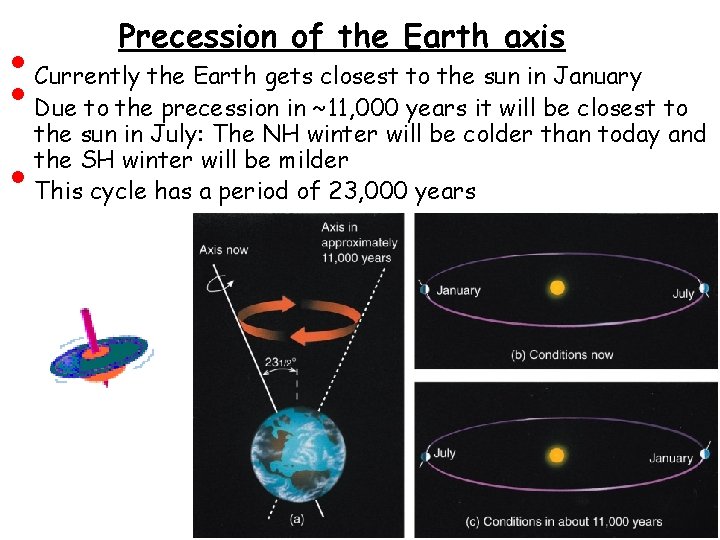
• • • Precession of the Earth axis Currently the Earth gets closest to the sun in January Due to the precession in ~11, 000 years it will be closest to the sun in July: The NH winter will be colder than today and the SH winter will be milder This cycle has a period of 23, 000 years
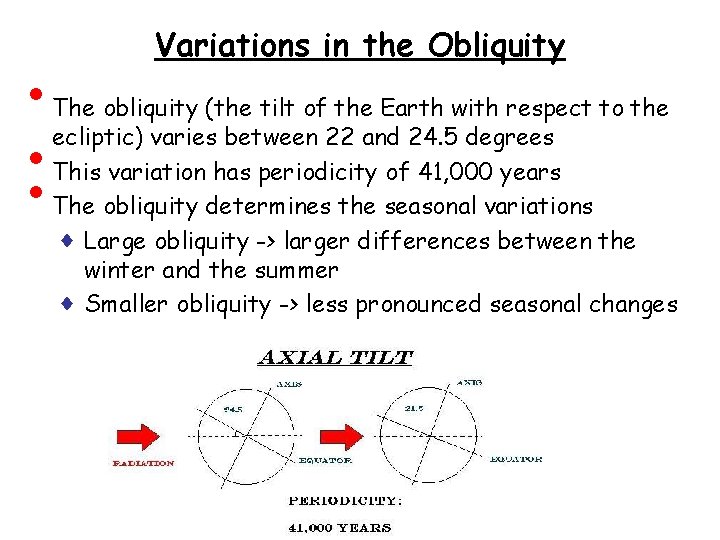
• • • Variations in the Obliquity The obliquity (the tilt of the Earth with respect to the ecliptic) varies between 22 and 24. 5 degrees This variation has periodicity of 41, 000 years The obliquity determines the seasonal variations ♦ Large obliquity -> larger differences between the winter and the summer ♦ Smaller obliquity -> less pronounced seasonal changes
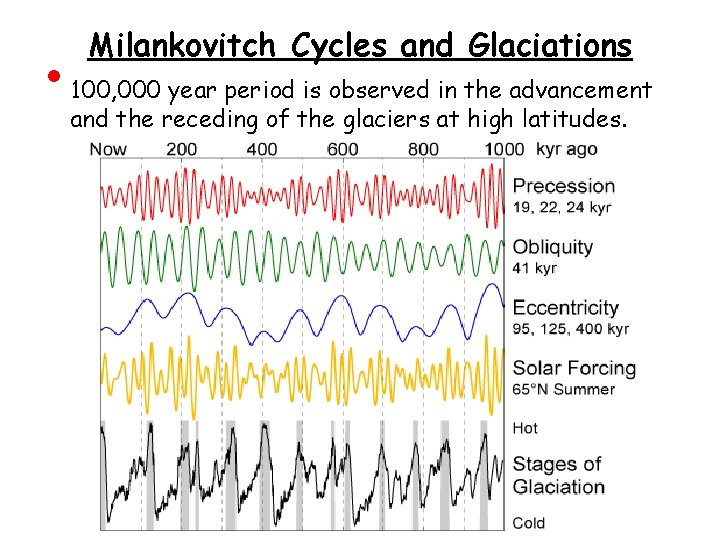
• Milankovitch Cycles and Glaciations 100, 000 year period is observed in the advancement and the receding of the glaciers at high latitudes.
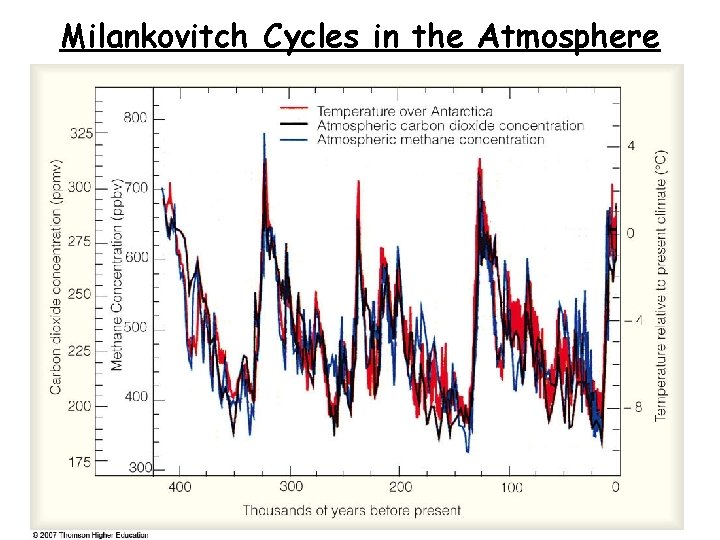
Milankovitch Cycles in the Atmosphere
• • Aerosols in the Troposphere Sources: factory and auto emissions, agricultural burning, wildland fires, dust storms … Impact on the energy balance: ♦ Some particles reflect sunlight very efficiently, which results in cooling of the atmosphere. ♦ Others are selective absorbers and absorb some of the incoming solar light or outgoing IR emission of the Erath. These aerosols result in heating of the Earth and the atmosphere. Aerosols serve as condensation nuclei and change the characteristics of clouds. Aerosols stay in the atmosphere typically for a few days before they settle down. They tend to accumulate over the sources (industrial cities, large fires …)
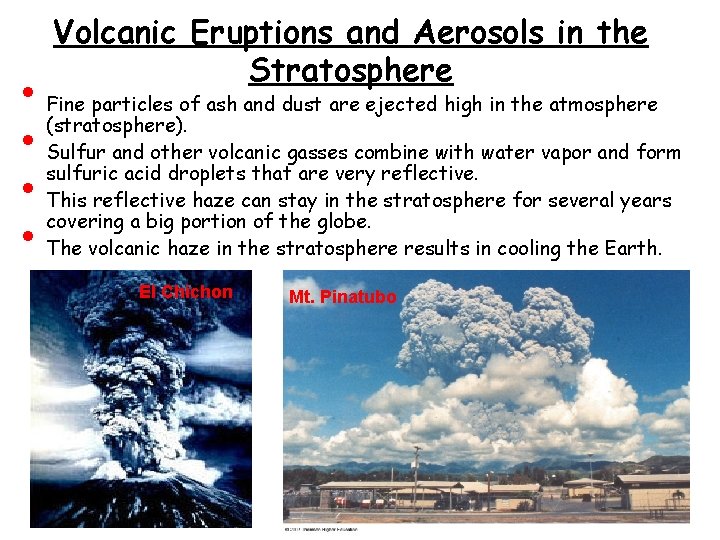
• • Volcanic Eruptions and Aerosols in the Stratosphere Fine particles of ash and dust are ejected high in the atmosphere (stratosphere). Sulfur and other volcanic gasses combine with water vapor and form sulfuric acid droplets that are very reflective. This reflective haze can stay in the stratosphere for several years covering a big portion of the globe. The volcanic haze in the stratosphere results in cooling the Earth. El Chichon Mt. Pinatubo
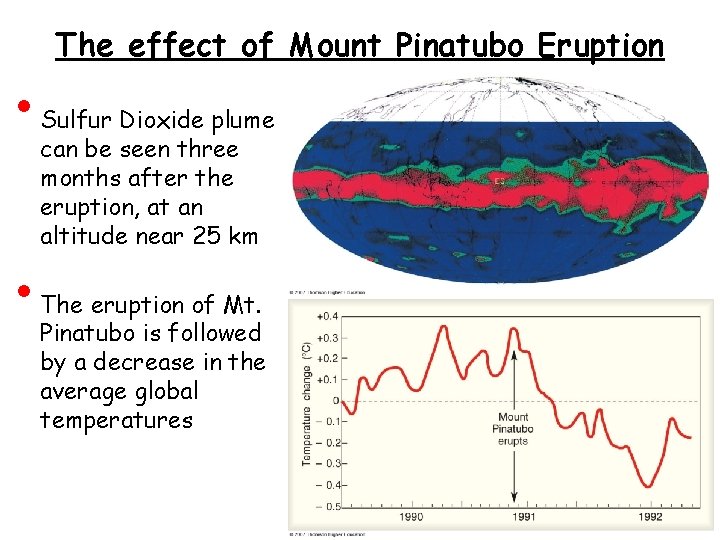
• • The effect of Mount Pinatubo Eruption Sulfur Dioxide plume can be seen three months after the eruption, at an altitude near 25 km The eruption of Mt. Pinatubo is followed by a decrease in the average global temperatures
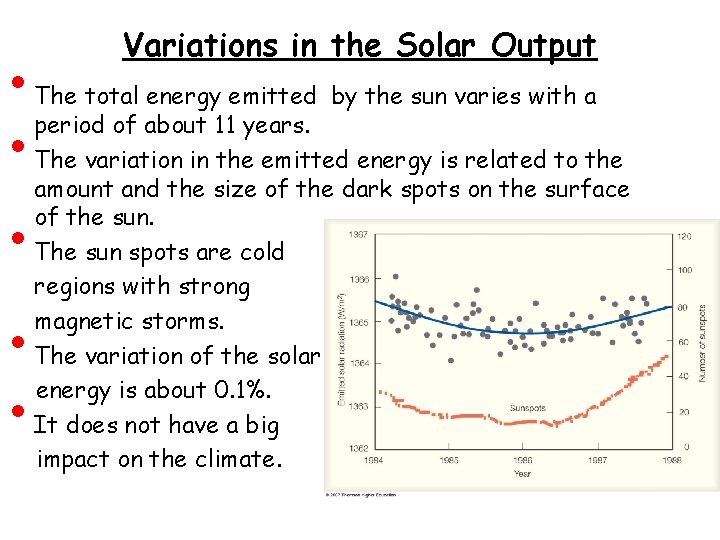
• • • Variations in the Solar Output The total energy emitted by the sun varies with a period of about 11 years. The variation in the emitted energy is related to the amount and the size of the dark spots on the surface of the sun. The sun spots are cold regions with strong magnetic storms. The variation of the solar energy is about 0. 1%. It does not have a big impact on the climate.
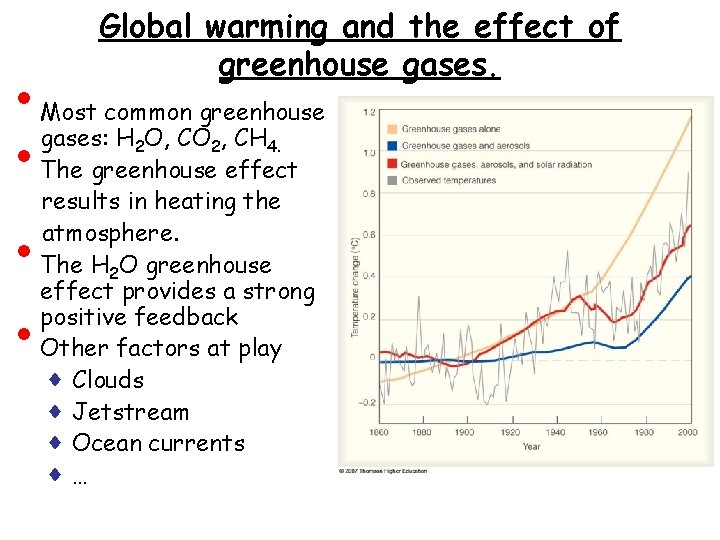
• • Global warming and the effect of greenhouse gases. Most common greenhouse gases: H 2 O, CO 2, CH 4. The greenhouse effect results in heating the atmosphere. The H 2 O greenhouse effect provides a strong positive feedback Other factors at play ♦ Clouds ♦ Jetstream ♦ Ocean currents ♦ …
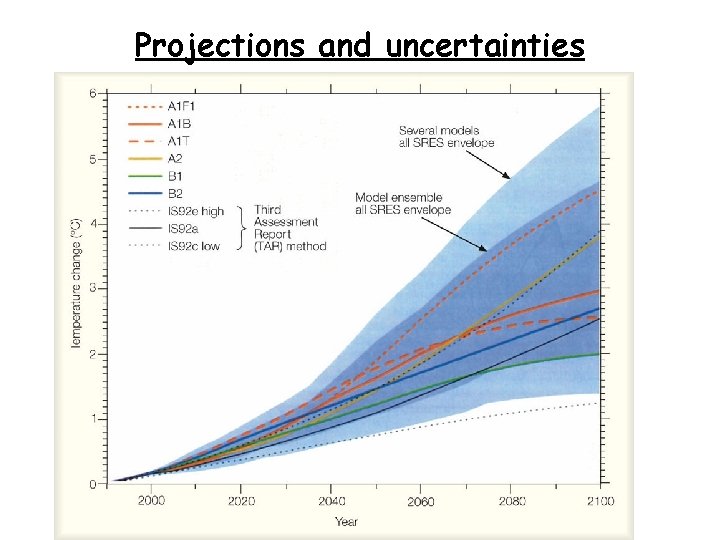
Projections and uncertainties
- Slides: 18