
Climate Change during the Quaternary Period Weather patterns
- Slides: 2
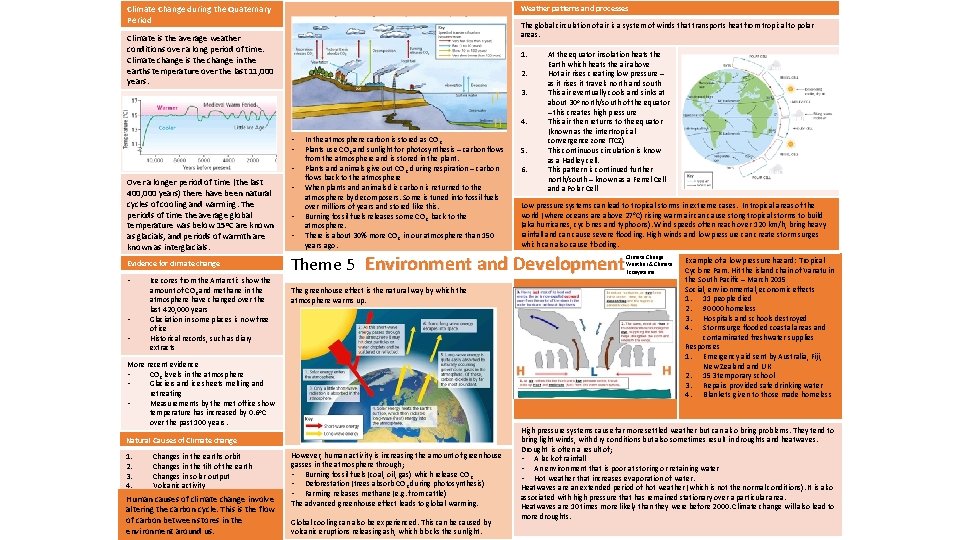
Climate Change during the Quaternary Period Weather patterns and processes The global circulation of air is a system of winds that transports heat from tropical to polar areas. Climate is the average weather conditions over a long period of time. Climate change is the change in the earths temperature over the last 11, 000 years. 1. Page 77 carbon cycle 2. 3. 4. Page 74 fig 1 • • • Over a longer period of time (the last 400, 000 years) there have been natural cycles of cooling and warming. The periods of time the average global temperature was below 15 o. C are known as glacials, and periods of warmth are known as interglacials. Evidence for climate change • • • Ice cores from the Antarctic show the amount of CO 2 and methane in the atmosphere have changed over the last 420, 000 years Glaciation in some places is now free of ice Historical records, such as diary extracts • • • In the atmosphere carbon is stored as CO 2 Plants use CO 2 and sunlight for photosynthesis – carbon flows from the atmosphere and is stored in the plant. Plants and animals give out CO 2 during respiration – carbon flows back to the atmosphere When plants and animals die carbon is returned to the atmosphere by decomposers. Some is tuned into fossil fuels over millions of years and stored like this. Burning fossil fuels releases some CO 2 back to the atmosphere. There is about 30% more CO 2 in our atmosphere than 150 years ago. The greenhouse effect is the natural way by which the atmosphere warms up. Natural Causes of Climate change Changes in the earths orbit Changes in the tilt of the earth Changes in solar output Volcanic activity Human causes of climate change involve altering the carbon cycle. This is the flow of carbon between stores in the environment around us. 6. Low pressure systems can lead to tropical storms in extreme cases. In tropical areas of the world (where oceans are above 27 o. C) rising warm air can cause stong tropical storms to build (aka hurricanes, cyclones and typhoons). Wind speeds often reach over 120 km/h, bring heavy rainfall and can cause severe flooding. High winds and low pressure can create storm surges which can also cause flooding. Theme 5 Environment and Development More recent evidence • CO 2 levels in the atmosphere • Glaciers and ice sheets melting and retreating • Measurements by the met office show temperature has increased by 0. 6 o. C over the past 100 years. 1. 2. 3. 4. 5. At the equator insolation heats the Earth which heats the air above Hot air rises creating low pressure – as it rises it travels north and south This air eventually cools and sinks at about 30 o north/south of the equator – this creates high pressure This air then returns to the equator (known as the intertropical convergence zone ITCZ) This continuous circulation is know as a Hadley cell. This pattern is continued further north/south – known as a Ferrel Cell and a Polar Cell However, human activity is increasing the amount of greenhouse gasses in the atmosphere through; • Burning fossil fuels (coal, oil, gas) which release CO 2 • Deforestation (trees absorb CO 2 during photosynthesis) • Farming releases methane (e. g. from cattle) The advanced greenhouse effect leads to global warming. Global cooling can also be experienced. This can be caused by volcanic eruptions releasing ash, which blocks the sunlight. Climate Change Weather & Climate Ecosystems Example of a low pressure hazard: Tropical Cyclone Pam. Hit the island chain of Vanatu in the South Pacific – March 2015 Social, environmental, economic effects 1. 11 people died 2. 90000 homeless 3. Hospitals and schools destroyed 4. Stormsurge flooded coastal areas and contaminated freshwater supplies Responses 1. Emergency aid sent by Australia, Fiji, New Zealand UK 2. 153 temporary school 3. Repairs provided safe drinking water 4. Blankets given to those made homeless High pressure systems cause far more settled weather but can also bring problems. They tend to bring light winds, with dry conditions but also sometimes result in droughts and heatwaves. Drought is often a result of; • A lack of rainfall • An environment that is poor at storing or retaining water • Hot weather that increases evaporation of water. Heatwaves are an extended period of hot weather (which is not the normal conditions). It is also associated with high pressure that has remained stationary over a particular area. Heatwaves are 10 times more likely than they were before 2000. Climate change will also lead to more droughts.
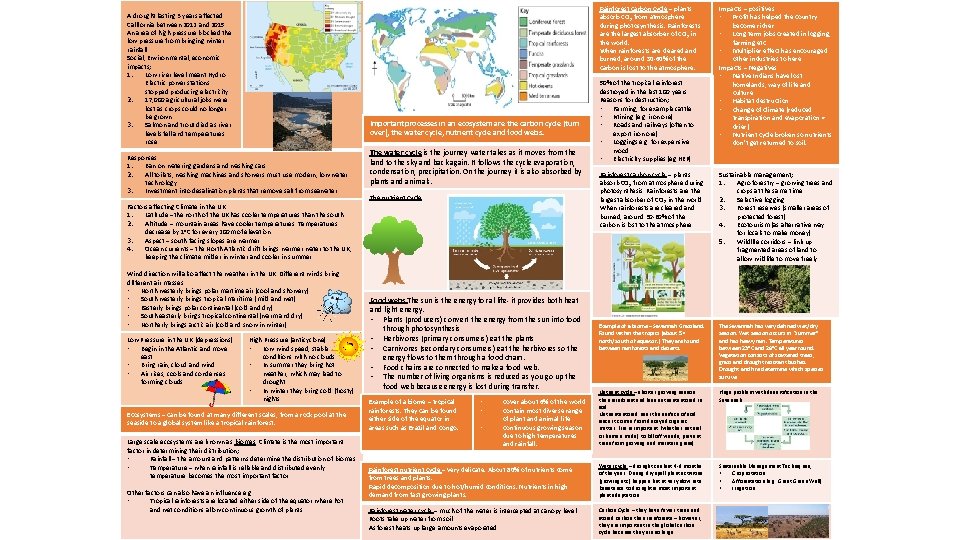
Rainforest carbon cycle – plants absorb CO 2 from atmosphere during photosynthesis. Rainforests are the largest absorber of CO 2 in the world. When rainforests are cleared and burned, around 30 -60% of the carbon is lost to the atmosphere. A drought lasting 3 years affected California between 2012 and 2015. An area of high pressure blocked the low pressure from bringing winter rainfall. Social, Environmental, economic impacts; 1. Low river level meant Hydro Electric power stations stopped producing electricity 2. 17, 000 agricultural jobs were lost as crops could no longer be grown. 3. Salmon and trout died as river levels fell and temperatures rose Important processes in an ecosystem are the carbon cycle (turn over), the water cycle, nutrient cycle and food webs. Responses 1. Ban on watering gardens and washing cars 2. All toilets, washing machines and showers must use modern, low water technology 3. Investment into desalination plants that remove salt from seawater The water cycle is the journey water takes as it moves from the land to the sky and back again. It follows the cycle evaporation, condensation, precipitation. On the journey it is also absorbed by plants and animals. Rainforest carbon cycle – plants absorb CO 2 from atmosphere during photosynthesis. Rainforests are the largest absorber of CO 2 in the world. When rainforests are cleared and burned, around 30 -60% of the carbon is lost to the atmosphere. Sustainable management; 1. Agro forestry – growing trees and crops at the same time 2. Selective logging 3. Forest reserves (smaller areas of protected forest) 4. Ecotourism (as alternative way for locals to make money) 5. Wildlife corridors – link up fragmented areas of land to allow wildlife to move freely Example of a biome – Savannah Grassland. Found within the tropics (about 5 o north/south of equator. ) They are found between rainforests and deserts. The Savannah has very defined wet/dry season. Wet season occurs in “summer” and has heavy rain. Temperatures between 23 o. C and 28 o. C all year round. Vegetation consists of scattered trees, grass and drought resistant bushes. Drought and fire determine which species survive Nutrient cycle – shorter growing season than rainforest and less nutrients stored in soil. Nutrients stored near the surface of soil since it comes from decayed organic matter. Fire is important (whether natural or human made) to kill off weeds, prevent trees from growing and maintain grass) Huge problem with desertification in the Savannah Rainforest nutrient cycle – very delicate. About 80% of nutrients come from trees and plants. Rapid decomposition due to hot/humid conditions. Nutrients in high demand from fast growing plants. Water cycle – drought can last 4 -8 months of the year. During dry spell plant activities (growing etc) happen but at very slow rate. Resistance to drought is most important plant adaptation Sustainable Management Techniques; • Crop rotation • Afforestation (e. g. Great Green Wall) • Irrigation Rainforest water cycle – much of the water is intercepted at canopy level. Roots take up water from soil. As forest heats up large amounts evaporated. Carbon Cycle – they have fewer trees and stored carbon than rainforests – however, they are important in the global carbon cycle because they are so large. The nutrient cycle Factors affecting Climate in the UK 1. Latitude –the north of the UK has cooler temperatures than the south 2. Altitude – mountain areas have cooler temperatures. Temperatures decrease by 1 o. C for every 200 m of elevation. 3. Aspect – south facing slopes are warmer 4. Ocean currents – the North Atlantic drift brings warmer water to the UK, keeping the climate milder in winter and cooler in summer. Wind direction will also affect the weather in the UK. Different winds bring different air masses. • North westerly brings polar martime air (cool and showery) • South westerly brings tropical maritime (mild and wet) • Easterly brings polar continental (cold and dry) • South easterly brings tropical continental (warm and dry) • Northerly brings arctic air (cold and snow in winter) Low Pressure in the UK (depressions) • Begin in the Atlantic and move east • Bring rain, cloud and wind • Air rises, cools and condenses forming clouds High Pressure (anticyclone) • Low wind speed, stable conditions with no clouds • In summer they bring hot weather, which may lead to drought • In winter they bring cold (frosty) nights Ecosystems – can be found at many different scales, from a rock pool at the seaside to a global system like a tropical rainforest. Large scale ecosystems are known as biomes. Climate is the most important factor in determining their distribution; • Rainfall – the amount and patterns determine the distribution of biomes • Temperature – when rainfall is reliable and distributed evenly temperature becomes the most important factor. Other factors can also have an influence e. g. • Tropical rainforests are located either side of the equator where hot and wet conditions allow continuous growth of plants 50% of the tropical rainforest destroyed in the last 100 years. Reasons for destruction; • Farming, for example cattle • Mining (e. g. iron ore) • Roads and railways (often to export iron ore) • Loggings e. g. for expensive wood • Electricity supplies (eg HEP) Impacts – positives • Profit has helped the country become richer • Long term jobs created in logging, farming etc • Multiplier effect has encouraged other industries to here Impacts – Negatives • Native Indians have lost homelands, way of life and culture • Habitat destruction • Change of climate (reduced transpiration and evaporation = drier) • Nutrient cycle broken so nutrients don’t get returned to soil. Food webs The sun is the energy for al life- it provides both heat and light energy. • Plants (producers) convert the energy from the sun into food through photosynthesis • Herbivores (primary consumers) eat the plants • Carnivores (secondary consumers) eat the herbivores so the energy flows to them through a food chain. • Food chains are connected to make a food web. • The number of living organisms is reduced as you go up the food web because energy is lost during transfer. Example of a biome – tropical rainforests. They can be found either side of the equator in areas such as Brazil and Congo. • • • Cover about 6% of the world Contain most diverse range of plant and animal life Continuous growing season due to high temperatures and rainfall.