
Climate Change and Population Health Ahmad Rafay Alam

- Slides: 11
Climate Change and Population Health Ahmad Rafay Alam Advocate of the High Courts Department of Law & Policy, LUMS Vice President, Pakistan Environmental Law Association
• LEAD Pakistan and Lucille & David Packard Foundation, “Our World - Women Leadership in Reproductive Health & Development” • Sensitization of cross-section of leaders and stakeholders • To raise the profile of RH in social development sector • To encourage debate and to enable informed policy making • Literature review of climate change, health and development policies • Analysis of Climate Change Policy from a health lens and Health Policy from climate lens • Stakeholder dialogue in late 2012 to identify climate-health issues Background to Discussion Paper
Health-Poverty-Development Nexus • “investment in the health sector is viewed as an integral part of the government’s poverty alleviation sector” - Pakistan Economic Survey 2011 -2012. National Climate Change Policy, 2012 recognizes one of the goals of economic planning is poverty alleviation. • “Protecting the poor from catastrophic health expenditure” a key challenge identified by National Health Policy, 2009 • Poor health indicators represent immeasurable human cost and immense challenge to development • Changing demographics suggest urban poverty will be a health issue Emergent Issues
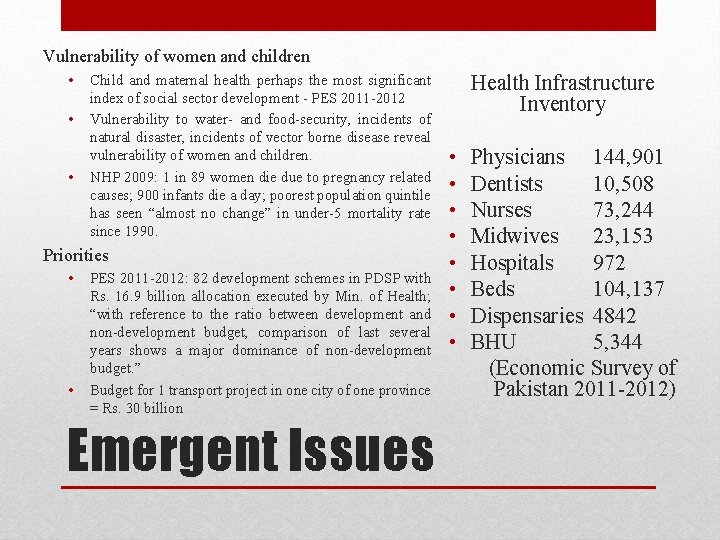
Vulnerability of women and children • • • Child and maternal health perhaps the most significant index of social sector development - PES 2011 -2012 Vulnerability to water- and food-security, incidents of natural disaster, incidents of vector borne disease reveal vulnerability of women and children. NHP 2009: 1 in 89 women die due to pregnancy related causes; 900 infants die a day; poorest population quintile has seen “almost no change” in under-5 mortality rate since 1990. Priorities • • PES 2011 -2012: 82 development schemes in PDSP with Rs. 16. 9 billion allocation executed by Min. of Health; “with reference to the ratio between development and non-development budget, comparison of last several years shows a major dominance of non-development budget. ” Budget for 1 transport project in one city of one province = Rs. 30 billion Emergent Issues Health Infrastructure Inventory • • Physicians 144, 901 Dentists 10, 508 Nurses 73, 244 Midwives 23, 153 Hospitals 972 Beds 104, 137 Dispensaries 4842 BHU 5, 344 (Economic Survey of Pakistan 2011 -2012)
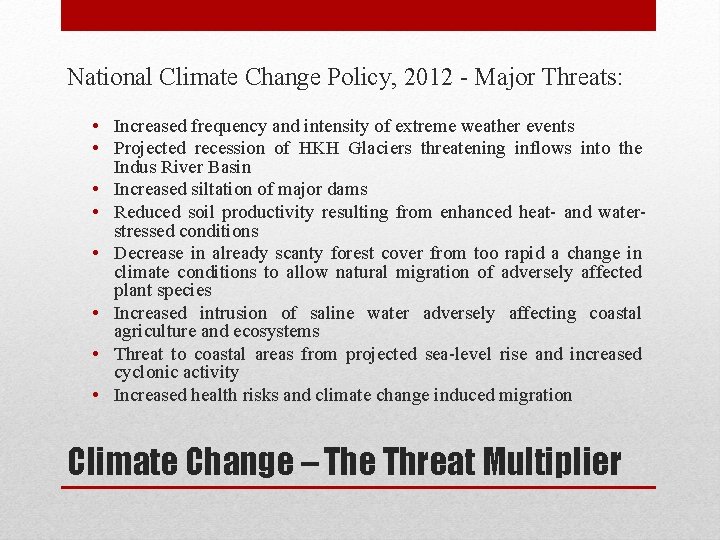
National Climate Change Policy, 2012 - Major Threats: • Increased frequency and intensity of extreme weather events • Projected recession of HKH Glaciers threatening inflows into the Indus River Basin • Increased siltation of major dams • Reduced soil productivity resulting from enhanced heat- and waterstressed conditions • Decrease in already scanty forest cover from too rapid a change in climate conditions to allow natural migration of adversely affected plant species • Increased intrusion of saline water adversely affecting coastal agriculture and ecosystems • Threat to coastal areas from projected sea-level rise and increased cyclonic activity • Increased health risks and climate change induced migration Climate Change – The Threat Multiplier
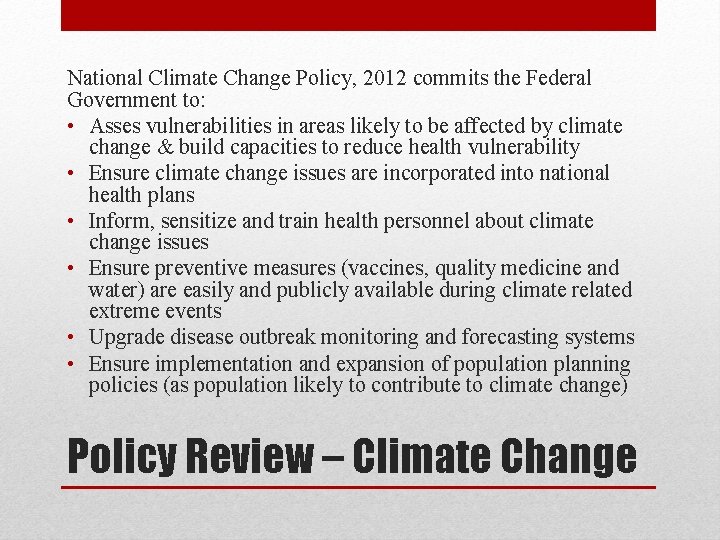
National Climate Change Policy, 2012 commits the Federal Government to: • Asses vulnerabilities in areas likely to be affected by climate change & build capacities to reduce health vulnerability • Ensure climate change issues are incorporated into national health plans • Inform, sensitize and train health personnel about climate change issues • Ensure preventive measures (vaccines, quality medicine and water) are easily and publicly available during climate related extreme events • Upgrade disease outbreak monitoring and forecasting systems • Ensure implementation and expansion of population planning policies (as population likely to contribute to climate change) Policy Review – Climate Change
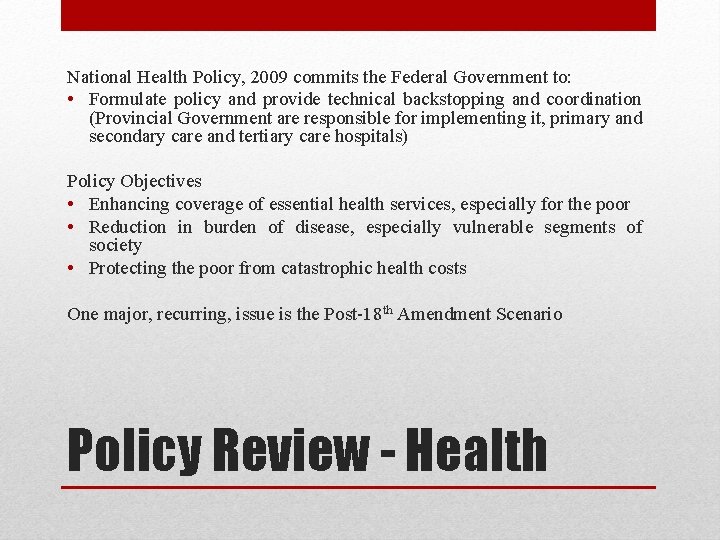
National Health Policy, 2009 commits the Federal Government to: • Formulate policy and provide technical backstopping and coordination (Provincial Government are responsible for implementing it, primary and secondary care and tertiary care hospitals) Policy Objectives • Enhancing coverage of essential health services, especially for the poor • Reduction in burden of disease, especially vulnerable segments of society • Protecting the poor from catastrophic health costs One major, recurring, issue is the Post-18 th Amendment Scenario Policy Review - Health
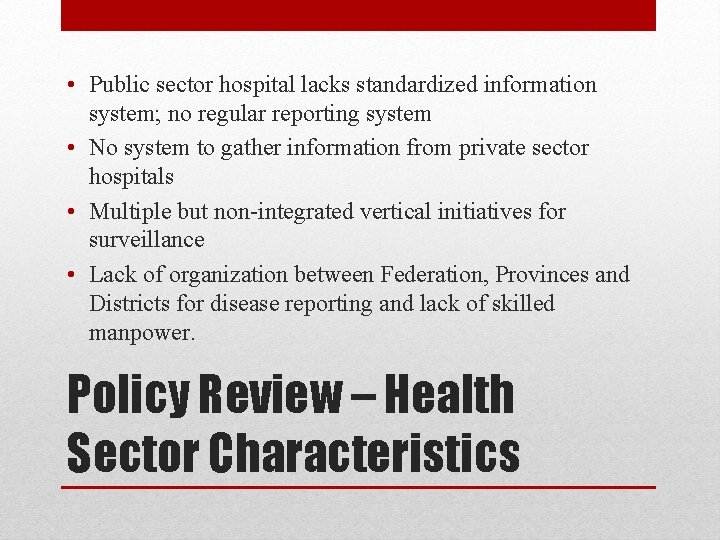
• Public sector hospital lacks standardized information system; no regular reporting system • No system to gather information from private sector hospitals • Multiple but non-integrated vertical initiatives for surveillance • Lack of organization between Federation, Provinces and Districts for disease reporting and lack of skilled manpower. Policy Review – Health Sector Characteristics
• 18 th Amendment provides the opportunity of a clean slate • Poor capacity at provincial level • While institutional resistance to devolution will persist, 18 th Amendment gives provinces the chance to learn from modern best practices • Need to prioritize health and population issues and link them to climate change • Need for informed policy (in place of “Governance by Presentation”) • Need for accurate health sector data collection, M&E and Surveillance • EPAs and Mo. CC should be able to pinpoint health “hotspots” • Large private sector hospitals be approached with information gathering initiatives • Better understanding and context of health issues may be through quantification of health-related costs of climate change. Stakeholder Dialogue Findings
• Health, especially women’s health, reproductive health and child health should be given top political priority • Every Ministry and Department should have a Climate Change Cell and Focal Person to coordinate climate issues • Health, Population Welfare and Women’s Development Departments be clustered together for better coordination. The Climate Change Cell of this cluster should have a fixed pool of funds available to them and tied to PDMAs and DDMAs • HMIS and M&E systems should be improved to improve assessment of cost of climate change to the health sector. Stakeholder Dialogue – Proposed Administrative Changes
Thank You – Be Green