
Climate Change and Oregons Water Future The Oregon
- Slides: 29
Climate Change and Oregon’s Water Future The Oregon Water Conference 2011 Evaluating and Managing Water Resources in a Climate of Uncertainty Corvallis, OR 24 -25 May 2011 Michael E. Campana Professor of Geosciences Oregon State University aquadoc@oregonstate. edu
“The climate system is an angry beast, and we are poking at it with sticks. ” --Wallace Broecker, Columbia University
Presentation Organization • Oregon water status report • Global warming • Mt. Hood glaciers and more • Runoff: snowmelt or rain dominance? • Earlier snowmelt – issues • Integrated Water Resources Strategy • Groundwater • Oregon’s water future • What Oregon needs to do
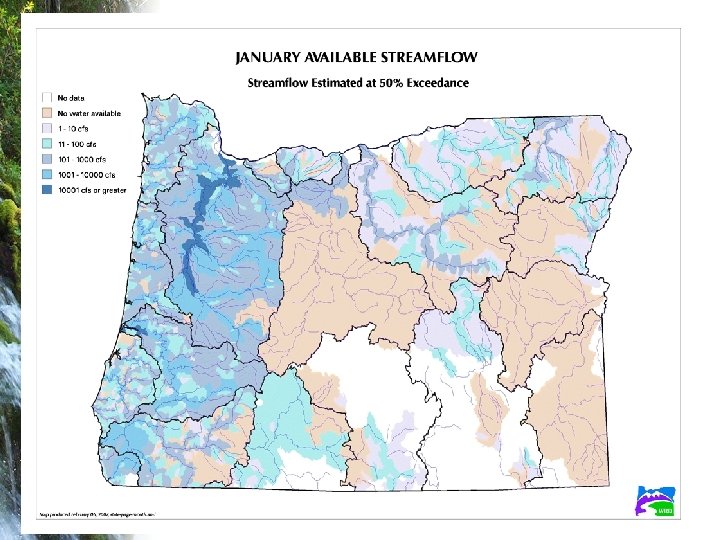
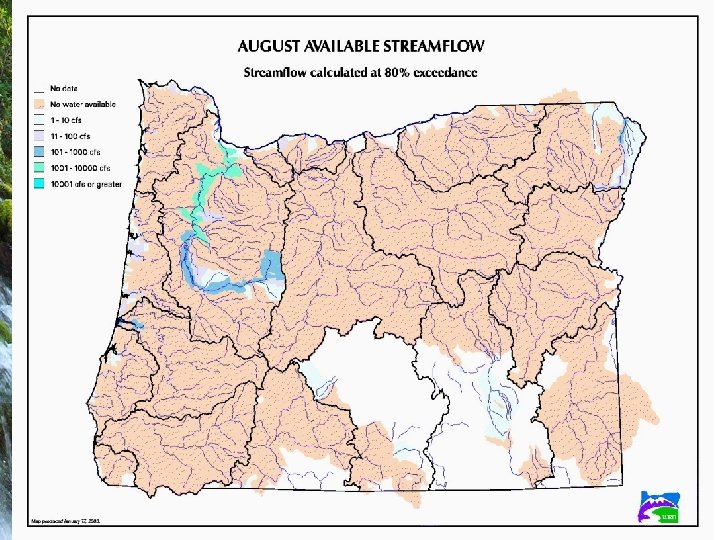
Oregon Water Status Report - 1 S Government must deal with water quantity and water quality issues as growth is projected to increase by nearly 41% in Oregon by 2030 (more if we have climate refugees). S Most stream systems in Oregon have been heavily modified to achieve various flood control, agricultural irrigation, navigation, hydropower, recreation, and M&I water supply benefits. S Oregon’s water supply is generally fully-allocated and in places, over-allocated, during the low flow summer and fall months. Instream flow needs and flows do not always correspond. S Relative dependence on groundwater in the Willamette Valley and Columbia Plateau region make quality and quantity of groundwater a special concern in these regions.
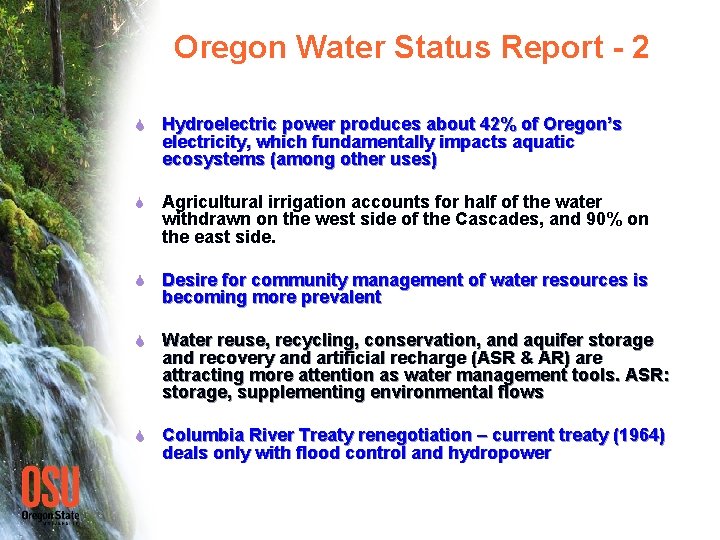
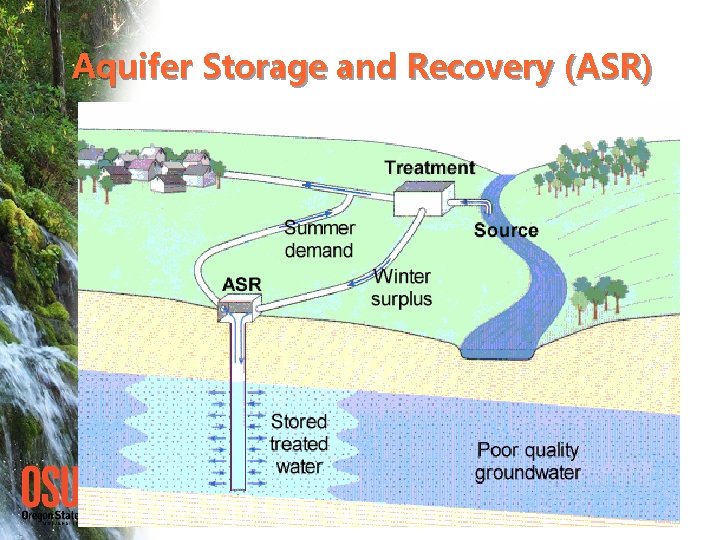
Oregon Water Status Report - 2 S Hydroelectric power produces about 42% of Oregon’s electricity, which fundamentally impacts aquatic ecosystems (among other uses) S Agricultural irrigation accounts for half of the water withdrawn on the west side of the Cascades, and 90% on the east side. S Desire for community management of water resources is becoming more prevalent S Water reuse, recycling, conservation, and aquifer storage and recovery and artificial recharge (ASR & AR) are attracting more attention as water management tools. ASR: storage, supplementing environmental flows S Columbia River Treaty renegotiation – current treaty (1964) deals only with flood control and hydropower
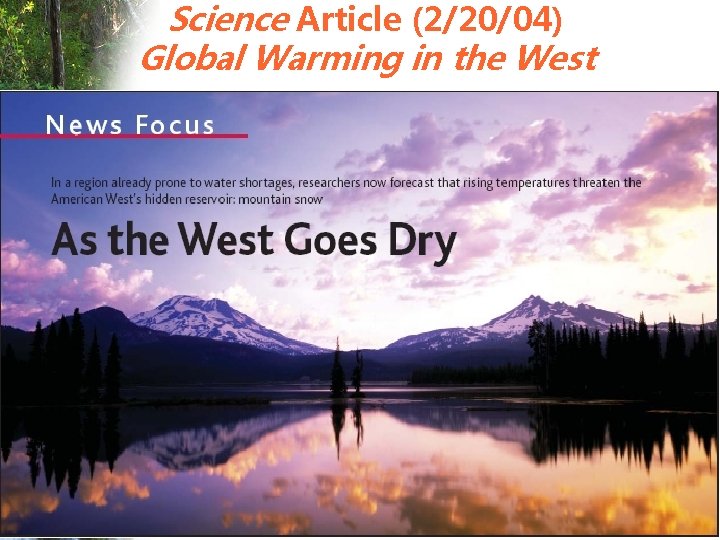
Science Article (2/20/04) Global Warming in the West
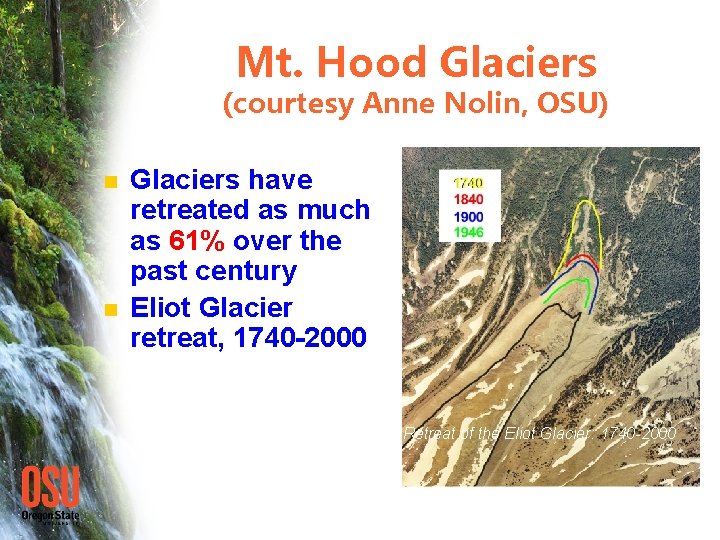
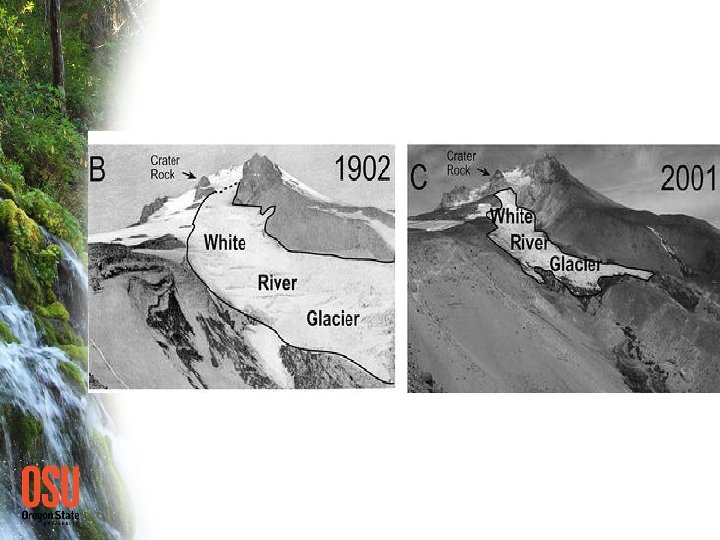
Mt. Hood Glaciers (courtesy Anne Nolin, OSU) n n Glaciers have retreated as much as 61% over the past century Eliot Glacier retreat, 1740 -2000 Retreat of the Eliot Glacier: 1740 -2000
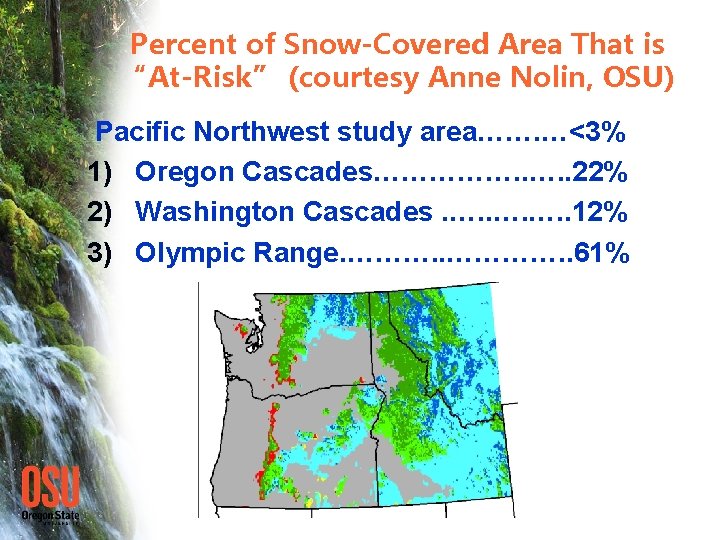
Percent of Snow-Covered Area That is “At-Risk” (courtesy Anne Nolin, OSU) Pacific Northwest study area……. …<3% 1) Oregon Cascades……………. . 22% 2) Washington Cascades. …. …. . 12% 3) Olympic Range. …………. . 61%
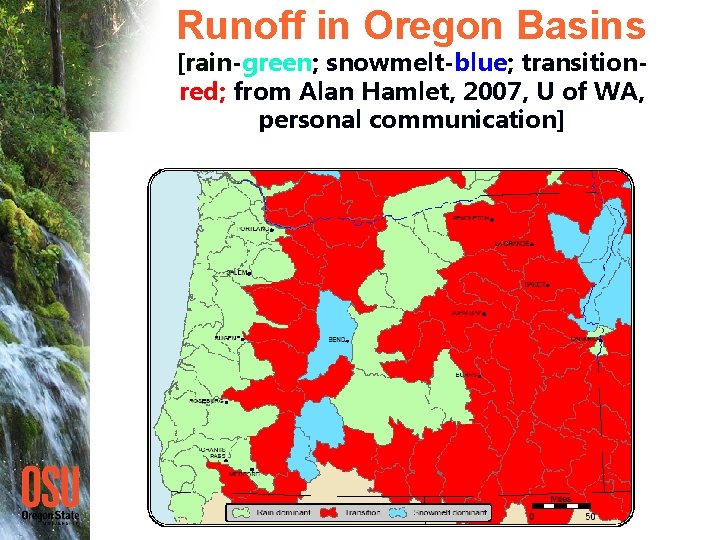
Runoff in Oregon Basins [rain-green; snowmelt-blue; transitionred; from Alan Hamlet, 2007, U of WA, personal communication]
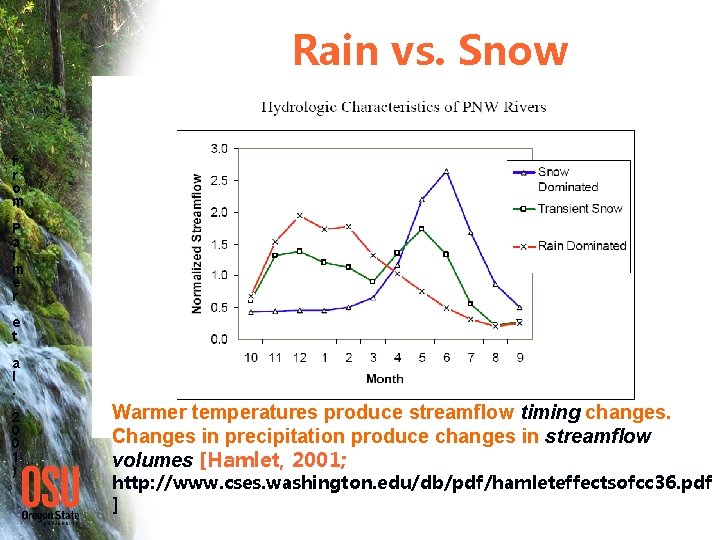
Rain vs. Snow f r o m P a l m e r e t a l. 2 0 0 1 ) Warmer temperatures produce streamflow timing changes. Changes in precipitation produce changes in streamflow volumes [Hamlet, 2001; http: //www. cses. washington. edu/db/pdf/hamleteffectsofcc 36. pdf ]
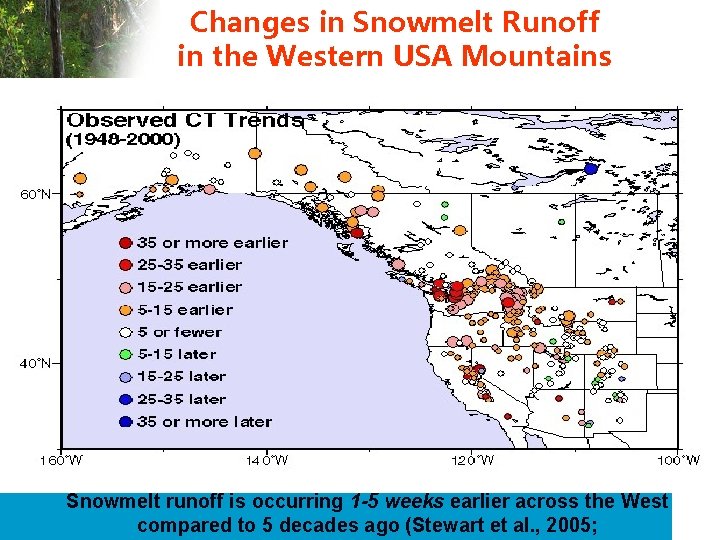
Changes in Snowmelt Runoff in the Western USA Mountains Snowmelt runoff is occurring 1 -5 weeks earlier across the West compared to 5 decades ago (Stewart et al. , 2005;
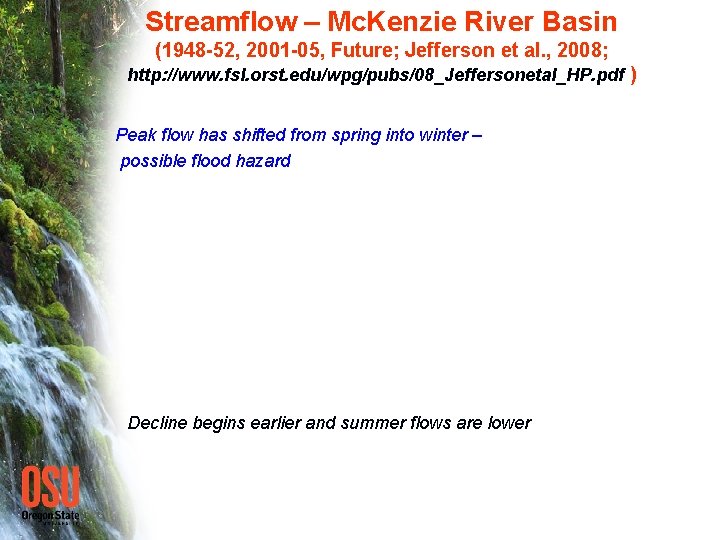
Streamflow – Mc. Kenzie River Basin (1948 -52, 2001 -05, Future; Jefferson et al. , 2008; http: //www. fsl. orst. edu/wpg/pubs/08_Jeffersonetal_HP. pdf ) Peak flow has shifted from spring into winter – possible flood hazard Decline begins earlier and summer flows are lower from Jefferson et al. , submitted to Hydrological Proc.
Earlier Snowmelt – Issues • May need more storage facilities – snowpack is “free storage” (ASR & AR? ) • Impacts water supply and power generation (warmer summers, but less power generation) • Will affect ecosystems – environmental flows, temperatures, invasive species • Dilution of wastes (water quality considerations) • • Navigation, recreation impacted • Earlier floods, mudslides Increase forest/range fires – affect water yield, water quality (sediment load, etc. )
Earlier Snowmelt – More Issues • Water rights holders – out of luck, out of business? [junior water rights holders out of luck: CA study] • More groundwater could be used because of lack of surface water storage • • Change in groundwater recharge Columbia River Treaty (USA, Canada) Increased conflict Will lack of Columbia River compact haunt Oregon and PNW?
Aquifer Storage and Recovery (ASR)
“Society exists by hydrological consent, subject to change at a moment’s notice. ”-apologies to Will Durant “Climate is what you expect, weather is what you get. ” – Mark Twain
Oregon’s Integrated Water Resources Strategy (www. oregon. gov/OWRD/LAW/Integrated_Water_Sup ply_Strategy. shtml) • One of two Western states (AK, OR) without a longterm water resources strategy • Oregon WRD Water Supply & Conservation Initiative • In 2008 Oregon State University and Oregon Sea Grant Extension conducted five ‘statewide water roundtables’ to assess citizens’ thoughts/concerns • In 2009, legislature passed HB 3369 which mandated development of an Integrated Water Resources Strategy • Water Resources Commission has responsibility • Led by Water Resources Department with others: Fish and Wildlife, Environmental Quality, Agriculture • Process initiated in Fall 2009, to be completed by 2012
“It’s the forest, stupid!” -- Carol Collier, Executive Director, Delaware River Basin Commission
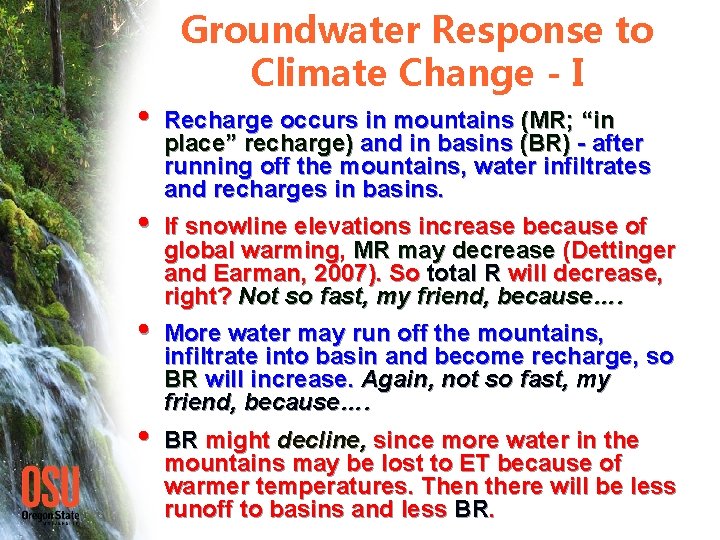
• • Groundwater Response to Climate Change - I Recharge occurs in mountains (MR; “in place” recharge) and in basins (BR) - after running off the mountains, water infiltrates and recharges in basins. If snowline elevations increase because of global warming, MR may decrease (Dettinger and Earman, 2007). So total R will decrease, right? Not so fast, my friend, because…. More water may run off the mountains, infiltrate into basin and become recharge, so BR will increase. Again, not so fast, my friend, because…. BR might decline, since more water in the mountains may be lost to ET because of warmer temperatures. Then there will be less runoff to basins and less BR.
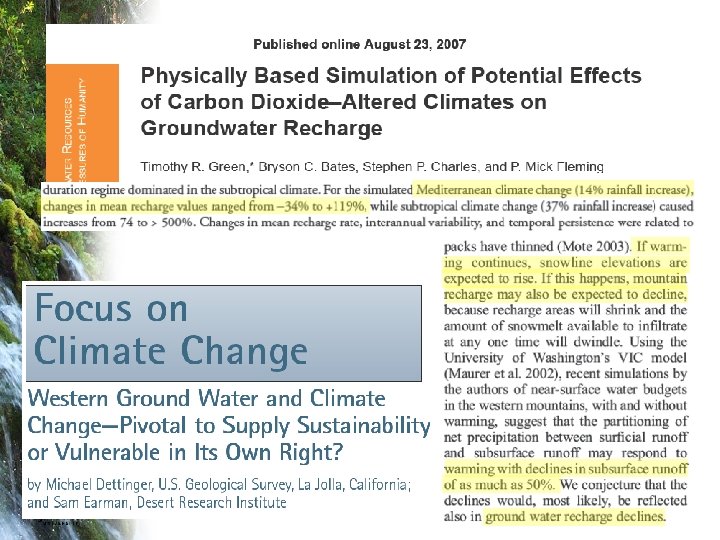
Groundwater Response to Climate Change - II • • Computer simulations are inconclusive Lack tools and data to predict groundwater responses to climate change with confidence Groundwater recharge papers (Green et al. , 2007; Dettinger and Earman, 2007): aquadoc. typepad. com/waterwired/2007/09/cli mate-change-. html Groundwater-fed streams – response to climate change: aquadoc. typepad. com/waterwired/2007/10/ariver-for-war. html
• • • Oregon’s Water Future Climate change will alter timing, spatial distribution and possibly the amount of streamflow. Other hydrologic flows (ET, P, etc. ) will be affected, too. All these changes will have important societal (conflict, demographics) and environmental ramifications. Warmer, possibly slightly wetter (west) More storage likely necessary Junior water rights holders could suffer in areas where snowmelt runoff occurs earlier and there is insufficient storage Climate change effects on groundwater are difficult to ascertain because we lack tools and data to predict with confidence groundwater responses to climate change, especially in mountainous regions
• • What Oregon Needs to Do to Ensure a Good Water Future Develop more aquifer storage recovery and artificial recharge (ASR & AR) projects Assess its surface water and groundwater supplies Ensure climate change is incorporated into its Integrated Water Resources Strategy, currently under development Educate its citizenry Prepare for the possible influx of climate refugees Explore, with its US Columbia Basin partners, the development of a Columbia River Compact Implement market solutions Implement, update, and revise various laws, regulations, practices, policies to better enable the state to cope with an uncertain water future.
PNW Climate Refugees? Hello, (email received) We live in Northern California in a small town (St. Helena) in the Napa Valley. There has been little planning here for either water use/supplies for the future or global warming. We are looking to move to a place that has and will have water. We also want a local economy that produces food and a place where we can garden and grow our own. We have been looking at climate maps and water maps endlessly but no one source seems to lead to an answer. We would love to stay in CA but we realize that CA, especially Northern CA, has no plan to capture the excess rain water that we will be expecting. We want a walking community so that cars are not a necessity. We are in our 50's and 60's respectively and hopefully can find a place to settle for the long haul. Any suggestions? Yes – take I-5 north and don’t stop till you reach British Columbia.
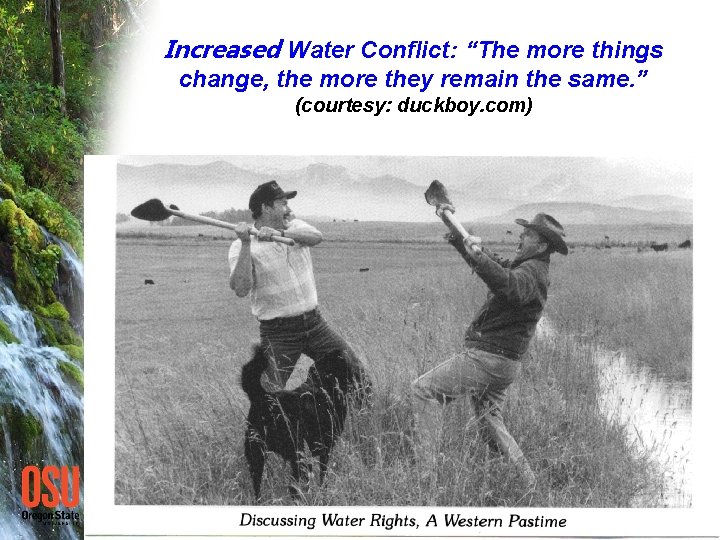
Increased Water Conflict: “The more things change, the more they remain the same. ” (courtesy: duckboy. com)
Thank You! • Water. Wired blog: aquadoc. typepad. com/waterwired • Water. Wired Twitter: twitter. com/waterwired • Email: aquadoc@oregonstate. edu • AWRA Summer Specialty Conference on IWRM (www. awra. org) – 27 -29 June 2011: IWRM: The Emperor’s New Clothes or Indispensable Process?