
Climate Change and Air Pollution General considerations on
- Slides: 15
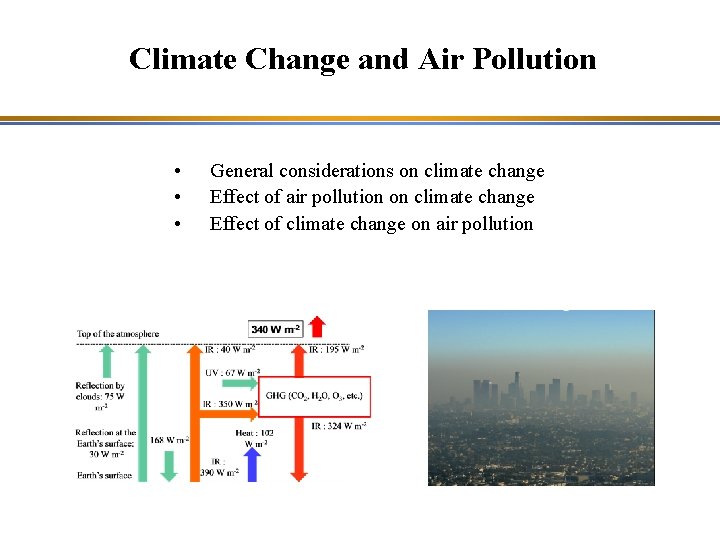
Climate Change and Air Pollution • • • General considerations on climate change Effect of air pollution on climate change Effect of climate change on air pollution
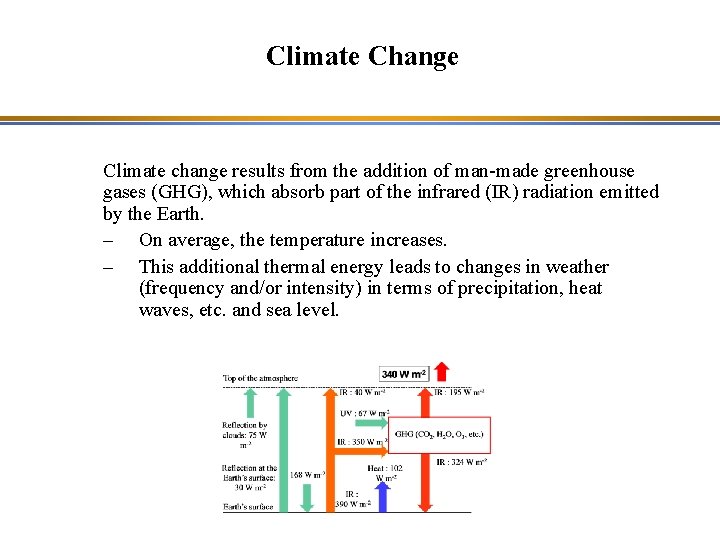
Climate Change Climate change results from the addition of man-made greenhouse gases (GHG), which absorb part of the infrared (IR) radiation emitted by the Earth. – On average, the temperature increases. – This additional thermal energy leads to changes in weather (frequency and/or intensity) in terms of precipitation, heat waves, etc. and sea level.
Climate Change Observed Changes • A mean global warming since the middle of the 19 th century is certain and is without any precedent since decades or even millennia. • The atmospheric concentrations of several greenhouse gases (GHG) including carbon dioxide (CO 2), methane (CH 4), and nitrous oxide (N 2 O) have increased compared to their concentrations in 1750 (i. e. , prior to the industrial era) by 40, 150, and 20 %, respectively. • Based on the longest time series of available temperature data, the globally averaged (combined land ocean) surface temperature has increased by 0. 72 to 0. 85 °C from the 1850 -1900 period to the 20032012 period. Source: IPCC, 2014
Climate Change Observed Changes • Changes in atmospheric temperature have been accompanied by changes in precipitation and heat waves. • The ocean dominates in terms of the amount of thermal energy being stored in the climate system, since it accounts for more than 90 % of this increased energy. It is virtually certain that the upper part of the ocean (i. e. , from the surface to a depth of about 700 m) has warmed up from 1971 to 2010. • The ice sheets of Greenland Antarctica have lost mass and the glaciers throughout the world, the Arctic sea ice, and the spring snow cover of the northern hemisphere have continued to lose surface area. • Sea level has increased by about 19 cm (± 2 cm) from 1901 to 2010. Source: IPCC, 2014
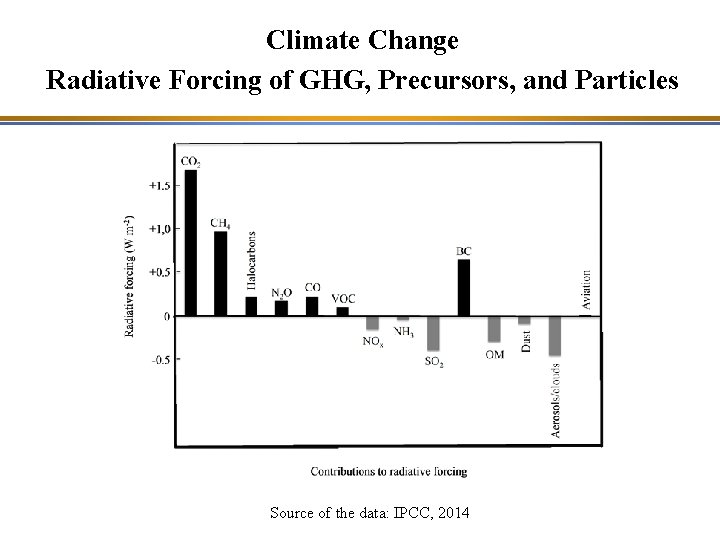
Climate Change Causes • Radiative forcing measures the impact of perturbations (for example, an increase in the atmospheric concentration of a greenhouse gas). • The greatest contribution to this radiative forcing is due to the increase in the atmospheric concentration of CO 2. • The radiative forcing due to emissions of CO 2, CH 4, halocarbons, and N 2 O is estimated to be 1. 68, 0. 97, 0. 22, and 0. 17 W m-2, respectively. • Atmospheric particles (aerosols) lead to absorption of radiation in the case of black carbon (positive forcing), but to scattering of solar radiation in the case of the other components (organic and inorganic) of particulate matter (PM) (negative forcing). Source: IPCC, 2014
Climate Change Radiative Forcing of GHG, Precursors, and Particles Source of the data: IPCC, 2014
Climate Change Causes • Particles have direct, indirect, and semi-direct effects on radiative forcing. – Direct effect: Atmospheric particles absorb and scatter radiation. – Indirect effect: Particles are involved in cloud formation and influence precipitation via the size distribution of cloud droplets. – Semi-direct effect: Atmospheric particles affect cloud formation via the perturbation of atmospheric temperatures.
Future Climate Change • Climate change over the next several years will depend on future emissions of GHG, atmospheric particles, and their precursors. Different scenarios, called representative concentration pathways (RCP), have been used to represent various scenarios of population, energy production and consumption, and technological progress. • It is likely that in 2100 the mean temperature at the Earth’s surface will have increased by 1. 5 °C compared to its value during the second half of the 19 th century (1850 to 1900), except for the most optimistic scenario. It could exceed 2 °C for the most pessimistic scenarios. • Estimated increases in sea level from the beginning to the end of the century are in the range of 26 to 55 cm for the most optimistic scenario and in the range of 45 to 82 cm for the most pessimistic scenario. Source: IPCC, 2014
Effect of Air Pollution on Climate Change • Ozone (O 3) is a GHG. It is also an important air pollutant. • Particles have mostly a negative radiative forcing, with the exception of black carbon (BC), which absorbs radiation. • Other air pollutants are involved in climate change in various ways: – by leading to the formation of a GHG – by leading to PM formation – by leading to oxidant formation, which may affect the lifetime of some GHG.
Effect of Air Pollution on Climate Change • CO, NOx, and VOC are precursors of O 3. Therefore, their emissions contribute via O 3 formation to positive radiative forcing. • These O 3 precursors also lead to hydroxyl (OH) radical formation. OH radicals are the oxidant of CH 4. Therefore, the corresponding contribution is negative radiative forcing (less CH 4). • NOx, VOC, sulfur dioxide (SO 2), and ammonia (NH 3) are precursors of PM (nitrate, organics, sulfate, and ammonium, respectively); i. e. , negative radiative forcing.
Effect of Air Pollution on Climate Change • Without any air pollution, global warming would have been greater (in great part due to the negative radiative forcing of PM). • However, the main GHG (CO 2) is the main product of combustion. Since combustion processes are also the source of many air pollutants and precursors such as NOx, CO, VOC, SO 2, and particles, the increase of CO 2 emissions cannot be dissociated from the increase in air pollution. • If emission control technologies are used to reduce air pollution without reducing CO 2 emissions, a slight increase in global warming will result.
Effect of Climate Change on Air Pollution • Climate change has various effects on air pollution through the change in atmospheric temperature and precipitation for example, but also more specifically through the change in the occurrence and intensity of weather types (anticyclones, fronts, etc. ). • Two kinds of analyses may be performed to address the effect of climate change on air pollution: – the effect of a future scenario (such as an RCP scenario) on climate change and air pollution – the effect of climate change only (i. e. , keeping air pollutant emissions constant) on air pollution (analyzed here)
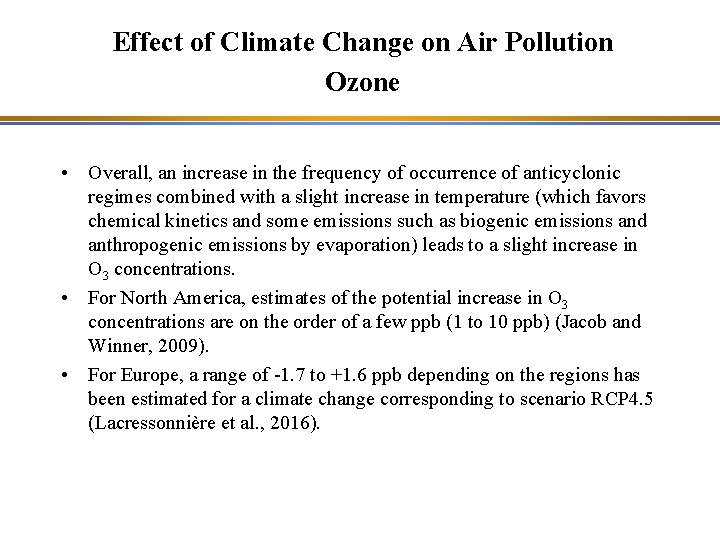
Effect of Climate Change on Air Pollution Ozone • Overall, an increase in the frequency of occurrence of anticyclonic regimes combined with a slight increase in temperature (which favors chemical kinetics and some emissions such as biogenic emissions and anthropogenic emissions by evaporation) leads to a slight increase in O 3 concentrations. • For North America, estimates of the potential increase in O 3 concentrations are on the order of a few ppb (1 to 10 ppb) (Jacob and Winner, 2009). • For Europe, a range of -1. 7 to +1. 6 ppb depending on the regions has been estimated for a climate change corresponding to scenario RCP 4. 5 (Lacressonnière et al. , 2016).
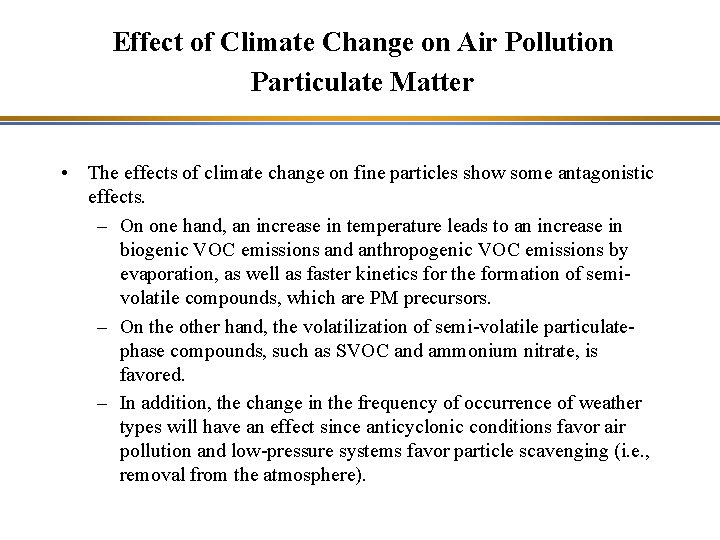
Effect of Climate Change on Air Pollution Particulate Matter • The effects of climate change on fine particles show some antagonistic effects. – On one hand, an increase in temperature leads to an increase in biogenic VOC emissions and anthropogenic VOC emissions by evaporation, as well as faster kinetics for the formation of semivolatile compounds, which are PM precursors. – On the other hand, the volatilization of semi-volatile particulatephase compounds, such as SVOC and ammonium nitrate, is favored. – In addition, the change in the frequency of occurrence of weather types will have an effect since anticyclonic conditions favor air pollution and low-pressure systems favor particle scavenging (i. e. , removal from the atmosphere).
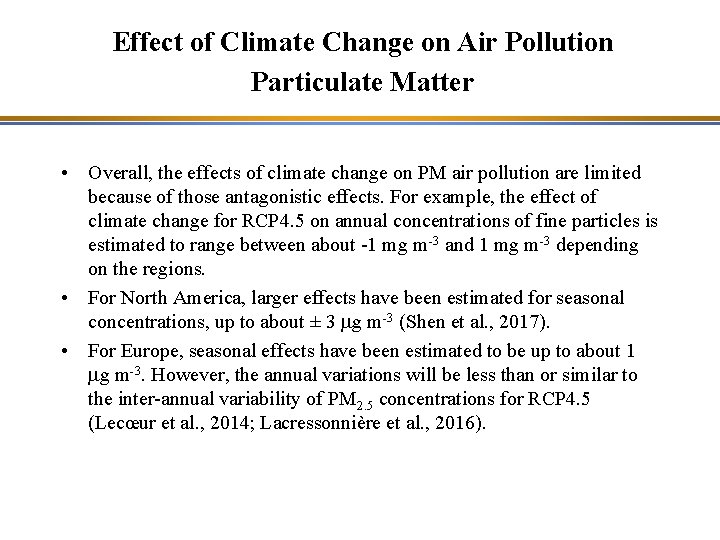
Effect of Climate Change on Air Pollution Particulate Matter • Overall, the effects of climate change on PM air pollution are limited because of those antagonistic effects. For example, the effect of climate change for RCP 4. 5 on annual concentrations of fine particles is estimated to range between about -1 mg m-3 and 1 mg m-3 depending on the regions. • For North America, larger effects have been estimated for seasonal concentrations, up to about ± 3 mg m-3 (Shen et al. , 2017). • For Europe, seasonal effects have been estimated to be up to about 1 mg m-3. However, the annual variations will be less than or similar to the inter-annual variability of PM 2. 5 concentrations for RCP 4. 5 (Lecœur et al. , 2014; Lacressonnière et al. , 2016).