
Climate Change Alternative Energy An interdisciplinary course for
- Slides: 1
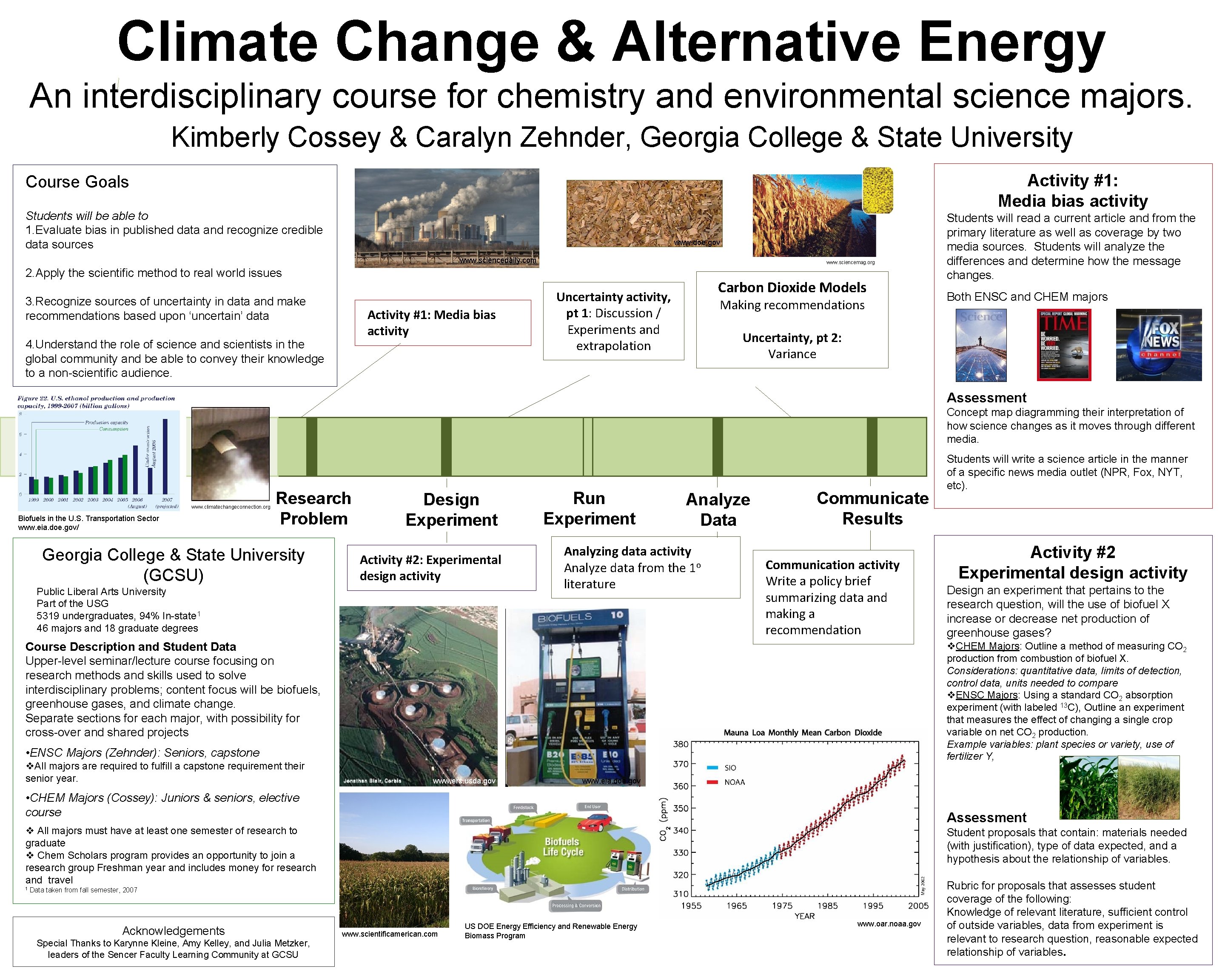
Climate Change & Alternative Energy An interdisciplinary course for chemistry and environmental science majors. Kimberly Cossey & Caralyn Zehnder, Georgia College & State University Activity #1: Media bias activity Course Goals Students will be able to 1. Evaluate bias in published data and recognize credible data sources www. doe. gov www. sciencedaily. com www. sciencemag. org 2. Apply the scientific method to real world issues 3. Recognize sources of uncertainty in data and make recommendations based upon ‘uncertain’ data Activity #1: Media bias activity 4. Understand the role of science and scientists in the global community and be able to convey their knowledge to a non-scientific audience. Carbon Dioxide Models Uncertainty activity, pt 1: Discussion / Experiments and extrapolation Making recommendations Students will read a current article and from the primary literature as well as coverage by two media sources. Students will analyze the differences and determine how the message changes. Both ENSC and CHEM majors Uncertainty, pt 2: Variance Assessment Concept map diagramming their interpretation of how science changes as it moves through different media. www. climatechangeconnection. org Biofuels in the U. S. Transportation Sector www. eia. doe. gov/ Research Problem Georgia College & State University (GCSU) Design Experiment Activity #2: Experimental design activity Public Liberal Arts University Part of the USG 5319 undergraduates, 94% In-state 1 46 majors and 18 graduate degrees Run Experiment Analyze Data Analyzing data activity Analyze data from the 1 o literature Communicate Results Communication activity Write a policy brief summarizing data and making a recommendation Course Description and Student Data Upper-level seminar/lecture course focusing on research methods and skills used to solve interdisciplinary problems; content focus will be biofuels, greenhouse gases, and climate change. Separate sections for each major, with possibility for cross-over and shared projects www. ers. usda. gov Assessment v All majors must have at least one semester of research to graduate v Chem Scholars program provides an opportunity to join a research group Freshman year and includes money for research and travel Student proposals that contain: materials needed (with justification), type of data expected, and a hypothesis about the relationship of variables. Data taken from fall semester, 2007 Acknowledgements Special Thanks to Karynne Kleine, Amy Kelley, and Julia Metzker, leaders of the Sencer Faculty Learning Community at GCSU Design an experiment that pertains to the research question, will the use of biofuel X increase or decrease net production of greenhouse gases? www. eia. doe. gov • CHEM Majors (Cossey): Juniors & seniors, elective course 1 Activity #2 Experimental design activity v. CHEM Majors: Outline a method of measuring CO 2 production from combustion of biofuel X. Considerations: quantitative data, limits of detection, control data, units needed to compare v. ENSC Majors: Using a standard CO 2 absorption experiment (with labeled 13 C), Outline an experiment that measures the effect of changing a single crop variable on net CO 2 production. Example variables: plant species or variety, use of fertilizer Y, • ENSC Majors (Zehnder): Seniors, capstone v. All majors are required to fulfill a capstone requirement their senior year. Students will write a science article in the manner of a specific news media outlet (NPR, Fox, NYT, etc). www. scientificamerican. com US DOE Energy Efficiency and Renewable Energy Biomass Program www. oar. noaa. gov Rubric for proposals that assesses student coverage of the following: Knowledge of relevant literature, sufficient control of outside variables, data from experiment is relevant to research question, reasonable expected relationship of variables.