
CLIMATE BOX Module 1 Basic course on climate

CLIMATE BOX Module 1. Basic course on climate change. Section 1. 3. National content. United Nations Development Program 2020
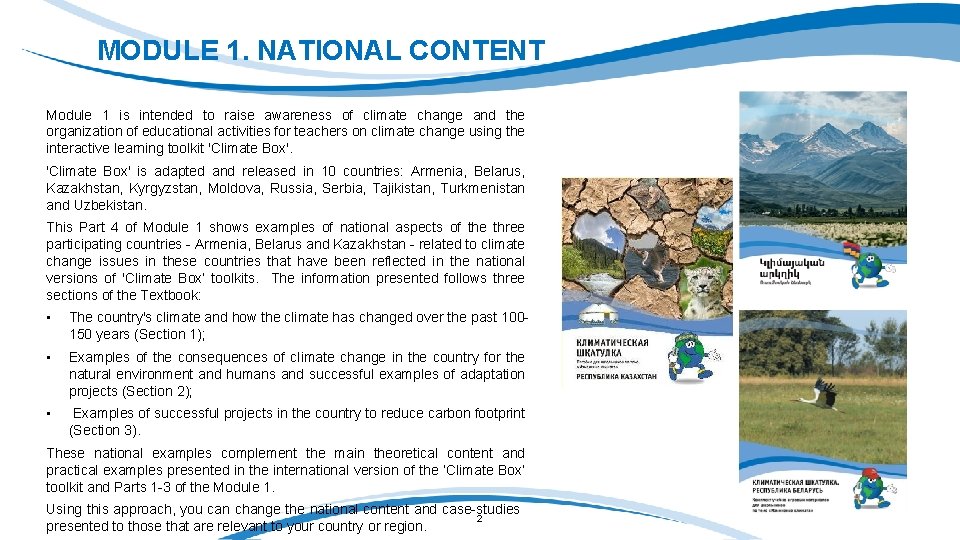
MODULE 1. NATIONAL CONTENT Module 1 is intended to raise awareness of climate change and the organization of educational activities for teachers on climate change using the interactive learning toolkit 'Climate Box' is adapted and released in 10 countries: Armenia, Belarus, Kazakhstan, Kyrgyzstan, Moldova, Russia, Serbia, Tajikistan, Turkmenistan and Uzbekistan. This Part 4 of Module 1 shows examples of national aspects of the three participating countries - Armenia, Belarus and Kazakhstan - related to climate change issues in these countries that have been reflected in the national versions of 'Climate Box‘ toolkits. The information presented follows three sections of the Textbook: • The country's climate and how the climate has changed over the past 100150 years (Section 1); • Examples of the consequences of climate change in the country for the natural environment and humans and successful examples of adaptation projects (Section 2); • Examples of successful projects in the country to reduce carbon footprint (Section 3). These national examples complement the main theoretical content and practical examples presented in the international version of the ‘Climate Box’ toolkit and Parts 1 -3 of the Module 1. Using this approach, you can change the national content and case-studies 2 presented to those that are relevant to your country or region.
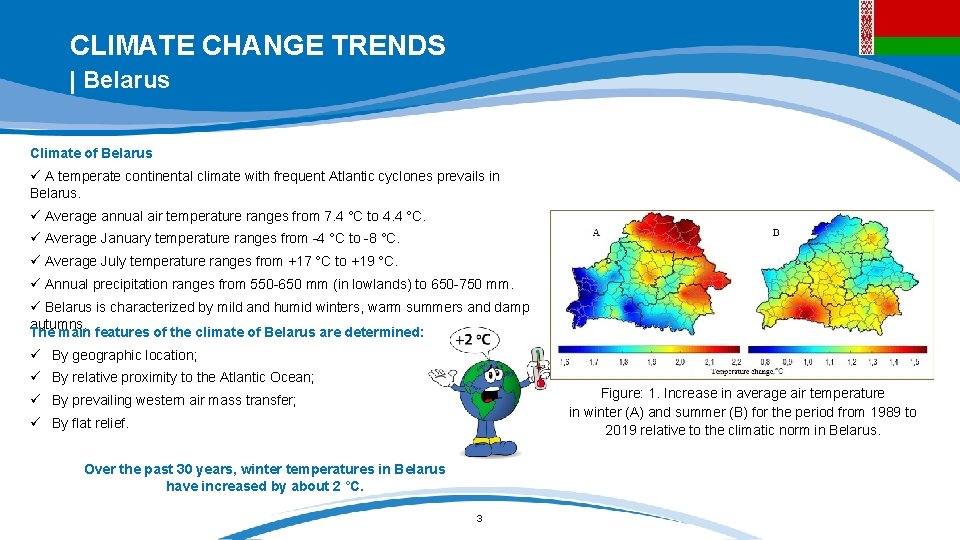
CLIMATE CHANGE TRENDS | Belarus Climate of Belarus ü A temperate continental climate with frequent Atlantic cyclones prevails in Belarus. ü Average annual air temperature ranges from 7. 4 °C to 4. 4 °C. ü Average January temperature ranges from -4 °C to -8 °C. ü Average July temperature ranges from +17 °C to +19 °C. ü Annual precipitation ranges from 550 -650 mm (in lowlands) to 650 -750 mm. ü Belarus is characterized by mild and humid winters, warm summers and damp autumns. The main features of the climate of Belarus are determined: ü By geographic location; ü By relative proximity to the Atlantic Ocean; Figure: 1. Increase in average air temperature in winter (A) and summer (B) for the period from 1989 to 2019 relative to the climatic norm in Belarus. ü By prevailing western air mass transfer; ü By flat relief. Over the past 30 years, winter temperatures in Belarus have increased by about 2 °C. 3
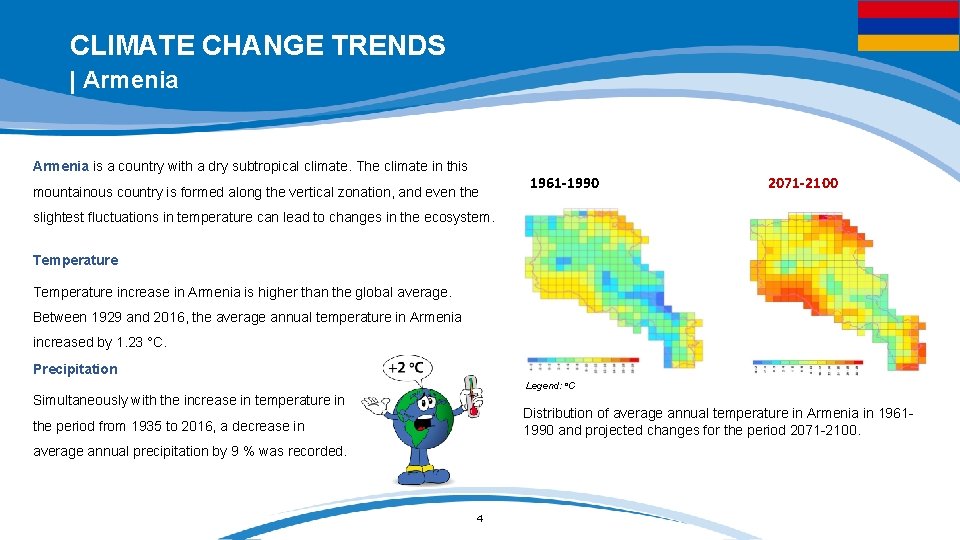
CLIMATE CHANGE TRENDS | Armenia is a country with a dry subtropical climate. The climate in this mountainous country is formed along the vertical zonation, and even the 1961 -1990 2071 -2100 slightest fluctuations in temperature can lead to changes in the ecosystem. Temperature increase in Armenia is higher than the global average. Between 1929 and 2016, the average annual temperature in Armenia increased by 1. 23 °C. Precipitation Legend: о. С Simultaneously with the increase in temperature in Distribution of average annual temperature in Armenia in 19611990 and projected changes for the period 2071 -2100. the period from 1935 to 2016, a decrease in average annual precipitation by 9 % was recorded. 4
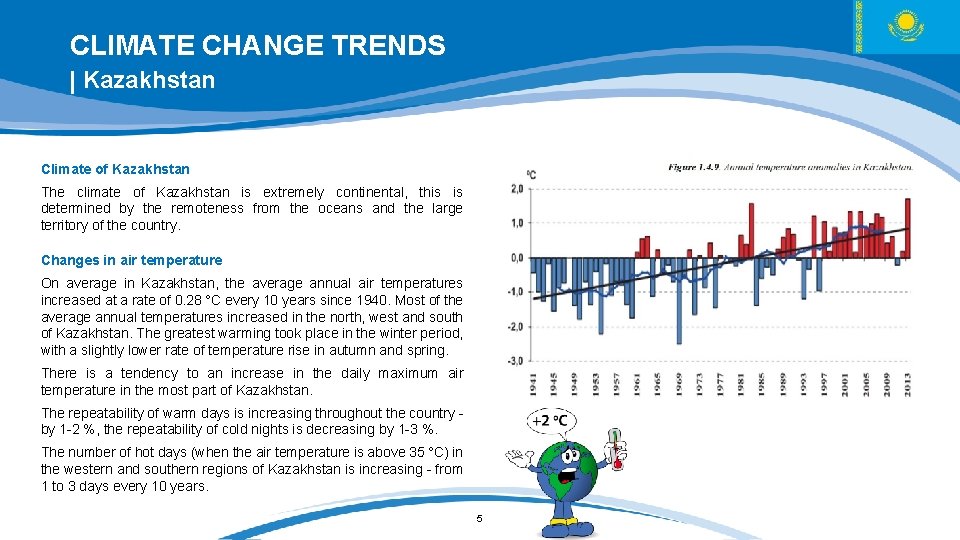
CLIMATE CHANGE TRENDS | Kazakhstan Climate of Kazakhstan The climate of Kazakhstan is extremely continental, this is determined by the remoteness from the oceans and the large territory of the country. Changes in air temperature On average in Kazakhstan, the average annual air temperatures increased at a rate of 0. 28 °C every 10 years since 1940. Most of the average annual temperatures increased in the north, west and south of Kazakhstan. The greatest warming took place in the winter period, with a slightly lower rate of temperature rise in autumn and spring. There is a tendency to an increase in the daily maximum air temperature in the most part of Kazakhstan. The repeatability of warm days is increasing throughout the country by 1 -2 %, the repeatability of cold nights is decreasing by 1 -3 %. The number of hot days (when the air temperature is above 35 °C) in the western and southern regions of Kazakhstan is increasing - from 1 to 3 days every 10 years. 5
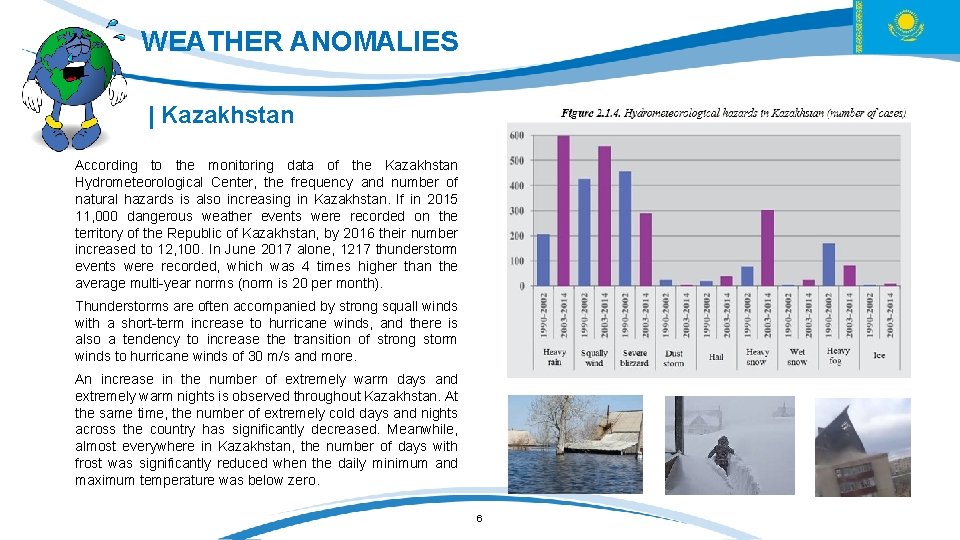
WEATHER ANOMALIES | Kazakhstan According to the monitoring data of the Kazakhstan Hydrometeorological Center, the frequency and number of natural hazards is also increasing in Kazakhstan. If in 2015 11, 000 dangerous weather events were recorded on the territory of the Republic of Kazakhstan, by 2016 their number increased to 12, 100. In June 2017 alone, 1217 thunderstorm events were recorded, which was 4 times higher than the average multi-year norms (norm is 20 per month). Thunderstorms are often accompanied by strong squall winds with a short-term increase to hurricane winds, and there is also a tendency to increase the transition of strong storm winds to hurricane winds of 30 m/s and more. An increase in the number of extremely warm days and extremely warm nights is observed throughout Kazakhstan. At the same time, the number of extremely cold days and nights across the country has significantly decreased. Meanwhile, almost everywhere in Kazakhstan, the number of days with frost was significantly reduced when the daily minimum and maximum temperature was below zero. 6
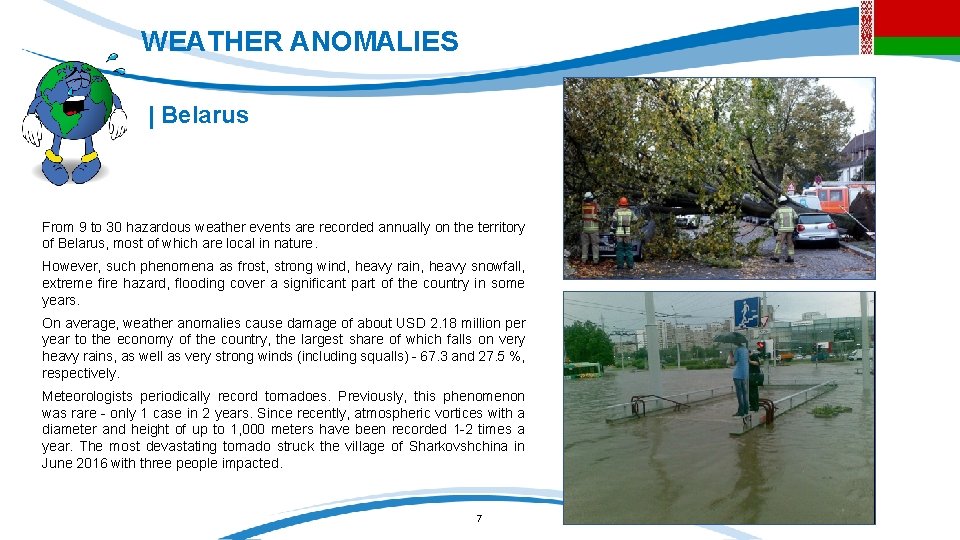
WEATHER ANOMALIES | Belarus From 9 to 30 hazardous weather events are recorded annually on the territory of Belarus, most of which are local in nature. However, such phenomena as frost, strong wind, heavy rain, heavy snowfall, extreme fire hazard, flooding cover a significant part of the country in some years. On average, weather anomalies cause damage of about USD 2. 18 million per year to the economy of the country, the largest share of which falls on very heavy rains, as well as very strong winds (including squalls) - 67. 3 and 27. 5 %, respectively. Meteorologists periodically record tornadoes. Previously, this phenomenon was rare - only 1 case in 2 years. Since recently, atmospheric vortices with a diameter and height of up to 1, 000 meters have been recorded 1 -2 times a year. The most devastating tornado struck the village of Sharkovshchina in June 2016 with three people impacted. 7
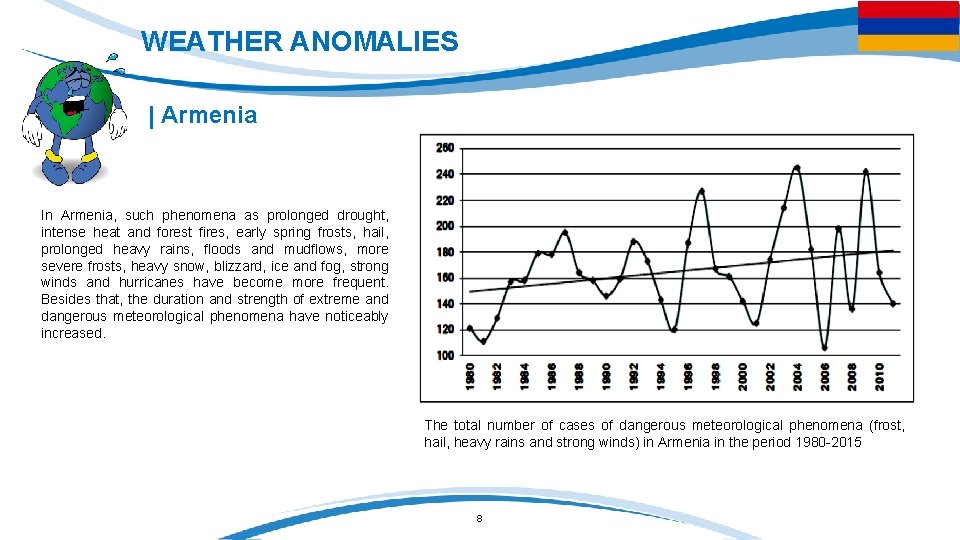
WEATHER ANOMALIES | Armenia In Armenia, such phenomena as prolonged drought, intense heat and forest fires, early spring frosts, hail, prolonged heavy rains, floods and mudflows, more severe frosts, heavy snow, blizzard, ice and fog, strong winds and hurricanes have become more frequent. Besides that, the duration and strength of extreme and dangerous meteorological phenomena have noticeably increased. The total number of cases of dangerous meteorological phenomena (frost, hail, heavy rains and strong winds) in Armenia in the period 1980 -2015 8
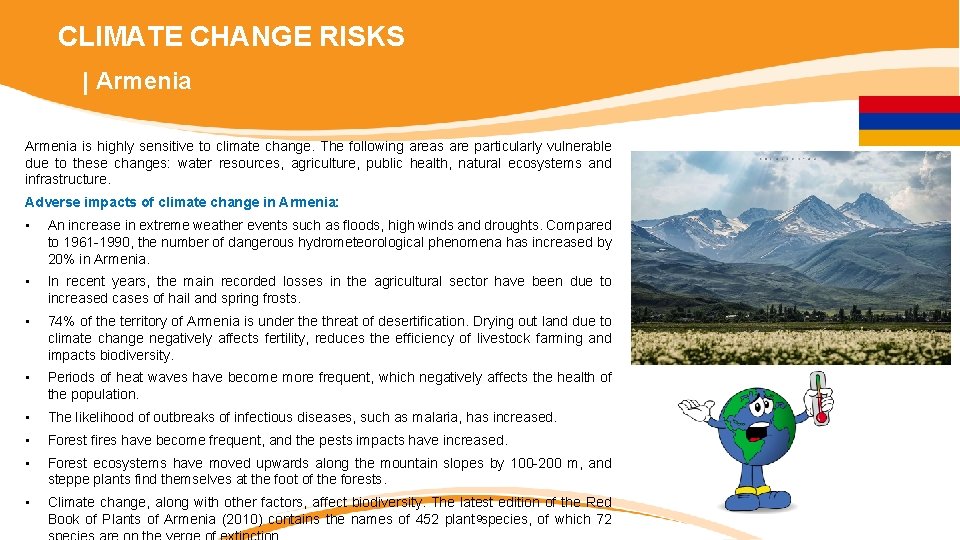
CLIMATE CHANGE RISKS | Armenia is highly sensitive to climate change. The following areas are particularly vulnerable due to these changes: water resources, agriculture, public health, natural ecosystems and infrastructure. Adverse impacts of climate change in Armenia: • An increase in extreme weather events such as floods, high winds and droughts. Compared to 1961 -1990, the number of dangerous hydrometeorological phenomena has increased by 20% in Armenia. • In recent years, the main recorded losses in the agricultural sector have been due to increased cases of hail and spring frosts. • 74% of the territory of Armenia is under the threat of desertification. Drying out land due to climate change negatively affects fertility, reduces the efficiency of livestock farming and impacts biodiversity. • Periods of heat waves have become more frequent, which negatively affects the health of the population. • The likelihood of outbreaks of infectious diseases, such as malaria, has increased. • Forest fires have become frequent, and the pests impacts have increased. • Forest ecosystems have moved upwards along the mountain slopes by 100 -200 m, and steppe plants find themselves at the foot of the forests. • Climate change, along with other factors, affect biodiversity. The latest edition of the Red Book of Plants of Armenia (2010) contains the names of 452 plant 9 species, of which 72
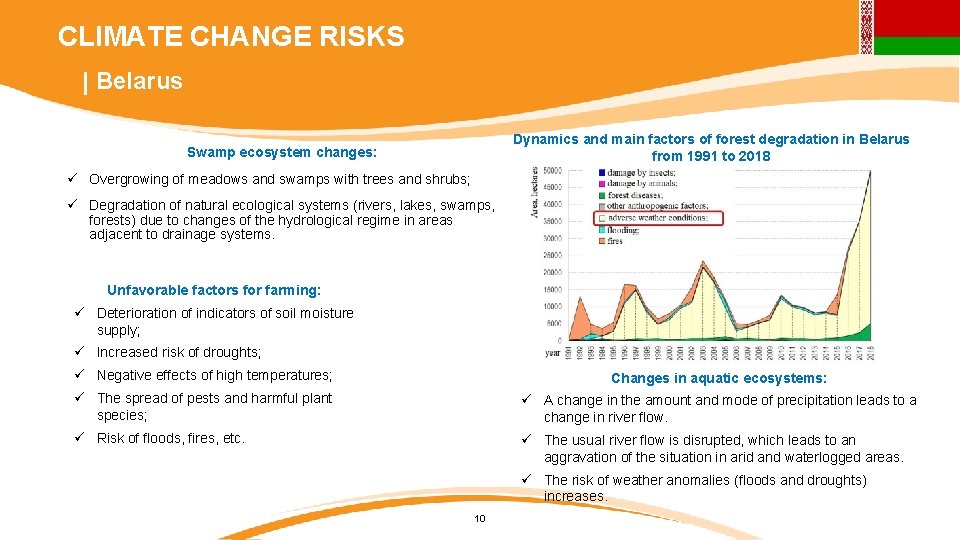
CLIMATE CHANGE RISKS | Belarus Dynamics and main factors of forest degradation in Belarus from 1991 to 2018 Swamp ecosystem changes: ü Overgrowing of meadows and swamps with trees and shrubs; ü Degradation of natural ecological systems (rivers, lakes, swamps, forests) due to changes of the hydrological regime in areas adjacent to drainage systems. Unfavorable factors for farming: ü Deterioration of indicators of soil moisture supply; ü Increased risk of droughts; ü Negative effects of high temperatures; Changes in aquatic ecosystems: ü The spread of pests and harmful plant species; ü A change in the amount and mode of precipitation leads to a change in river flow. ü Risk of floods, fires, etc. ü The usual river flow is disrupted, which leads to an aggravation of the situation in arid and waterlogged areas. ü The risk of weather anomalies (floods and droughts) increases. 10
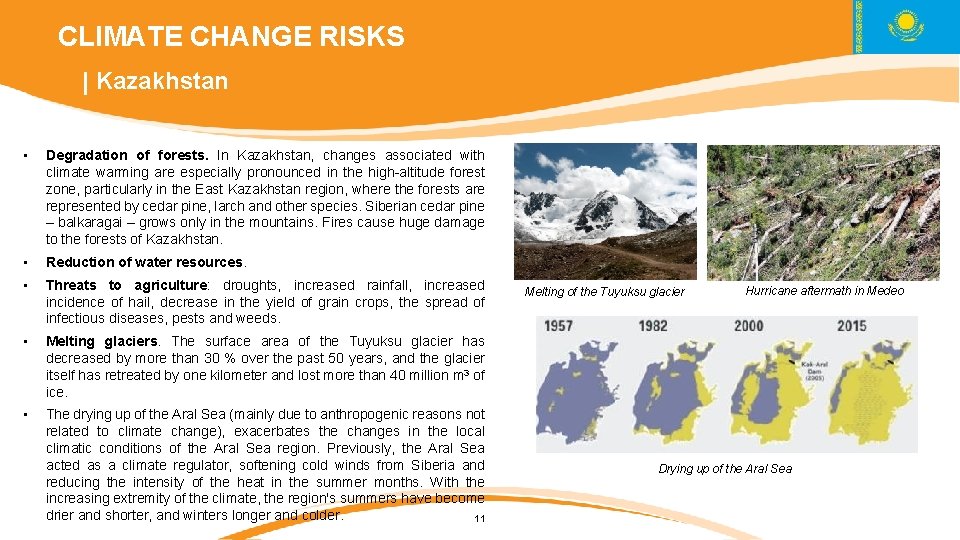
CLIMATE CHANGE RISKS | Kazakhstan • Degradation of forests. In Kazakhstan, changes associated with climate warming are especially pronounced in the high-altitude forest zone, particularly in the East Kazakhstan region, where the forests are represented by cedar pine, larch and other species. Siberian cedar pine – balkaragai – grows only in the mountains. Fires cause huge damage to the forests of Kazakhstan. • Reduction of water resources. • Threats to agriculture: droughts, increased rainfall, increased incidence of hail, decrease in the yield of grain crops, the spread of infectious diseases, pests and weeds. • Melting glaciers. The surface area of the Tuyuksu glacier has decreased by more than 30 % over the past 50 years, and the glacier itself has retreated by one kilometer and lost more than 40 million m 3 of ice. • The drying up of the Aral Sea (mainly due to anthropogenic reasons not related to climate change), exacerbates the changes in the local climatic conditions of the Aral Sea region. Previously, the Aral Sea acted as a climate regulator, softening cold winds from Siberia and reducing the intensity of the heat in the summer months. With the increasing extremity of the climate, the region's summers have become drier and shorter, and winters longer and colder. 11 Melting of the Tuyuksu glacier Hurricane aftermath in Medeo Drying up of the Aral Sea
ADAPTATION MEASURES | Armenia Climate change adaptation activities in Armenia include: • Rational use of ground and surface waters and water-saving technologies (drip irrigation), use of a temporary irrigation regime and mulching; • Installing anti-hail nets; • Using drought tolerant plants; • Carrying out measures aimed at combating mudflows and floods, and installing protective systems; • Correcting urban planning; • Landscaping of settlements, including innovative landscaping methods such as vertical landscaping and green roofs; • Raising public awareness. 12
ADAPTATION MEASURES | Belarus ü Improving the accuracy of the weather forecast (up to 97%), including the lead time of warnings about hydrometeorological hazards (up to 59 hours!). ü Sustainable agriculture and land use, measures to preserve forest and wetlands, to optimize agricultural land. ü Awareness improvement to promote responsible behavior in forests, resource conservation, including water conservation. Conservation of biodiversity - through a network of specially protected natural areas. There are 4 national parks in Belarus: There are 2 reserves in Belarus: • • Belovezhskaya Pushcha; • Berezinsky Biosphere Reserve; Braslav lakes; • Polesie Radiation-Ecological Reserve. Narochansky; Pripyatsky. In Belarus, there are 376 reserves of republican and local significance, as well as 904 natural monuments. The total area of protected natural areas in Belarus is more than 18. 6 thousand square kilometers or 8. 9 % of the country's area. 13
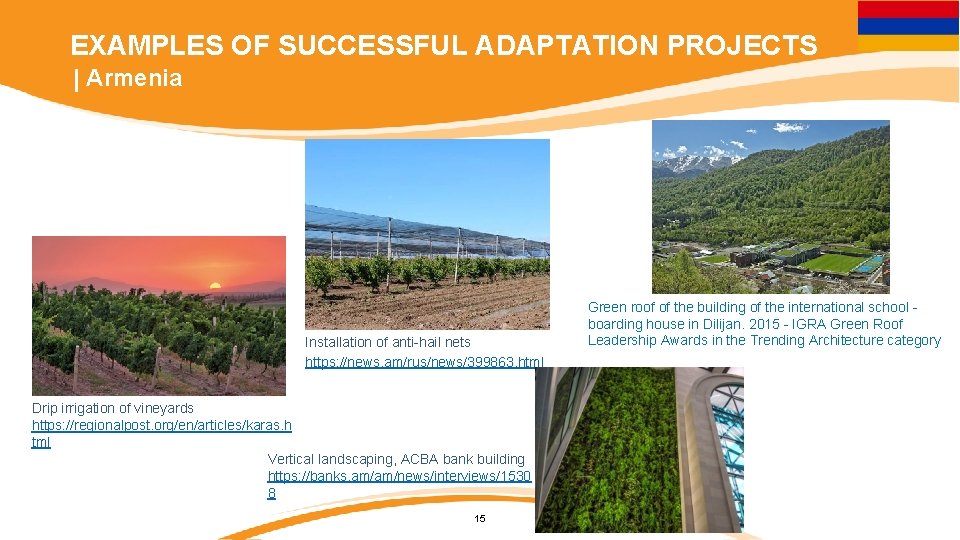
EXAMPLES OF SUCCESSFUL ADAPTATION PROJECTS | Armenia Installation of anti-hail nets https: //news. am/rus/news/399863. html Drip irrigation of vineyards https: //regionalpost. org/en/articles/karas. h tml Vertical landscaping, ACBA bank building https: //banks. am/am/news/interviews/1530 8 15 Green roof of the building of the international school boarding house in Dilijan. 2015 - IGRA Green Roof Leadership Awards in the Trending Architecture category
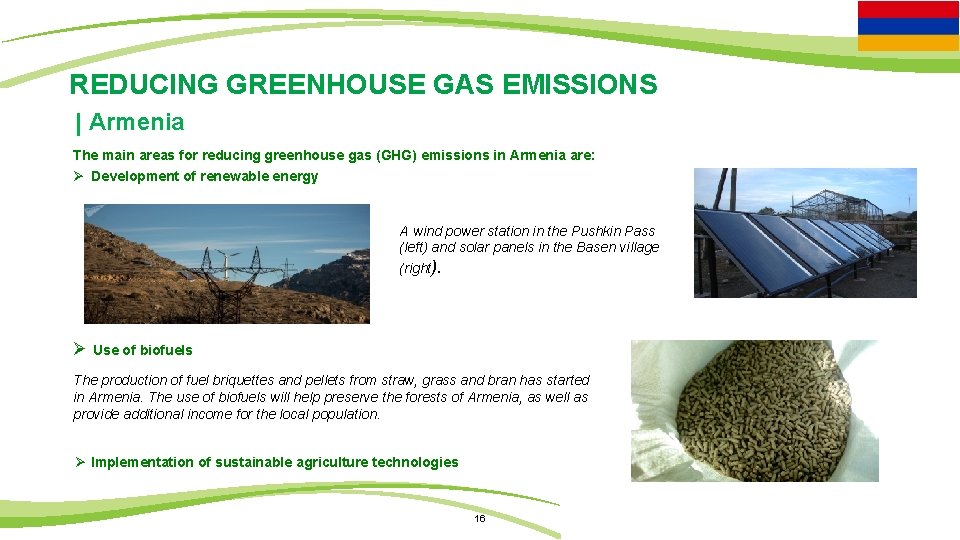
REDUCING GREENHOUSE GAS EMISSIONS | Armenia The main areas for reducing greenhouse gas (GHG) emissions in Armenia are: Ø Development of renewable energy A wind power station in the Pushkin Pass (left) and solar panels in the Basen village (right). Ø Use of biofuels The production of fuel briquettes and pellets from straw, grass and bran has started in Armenia. The use of biofuels will help preserve the forests of Armenia, as well as provide additional income for the local population. Ø Implementation of sustainable agriculture technologies 16
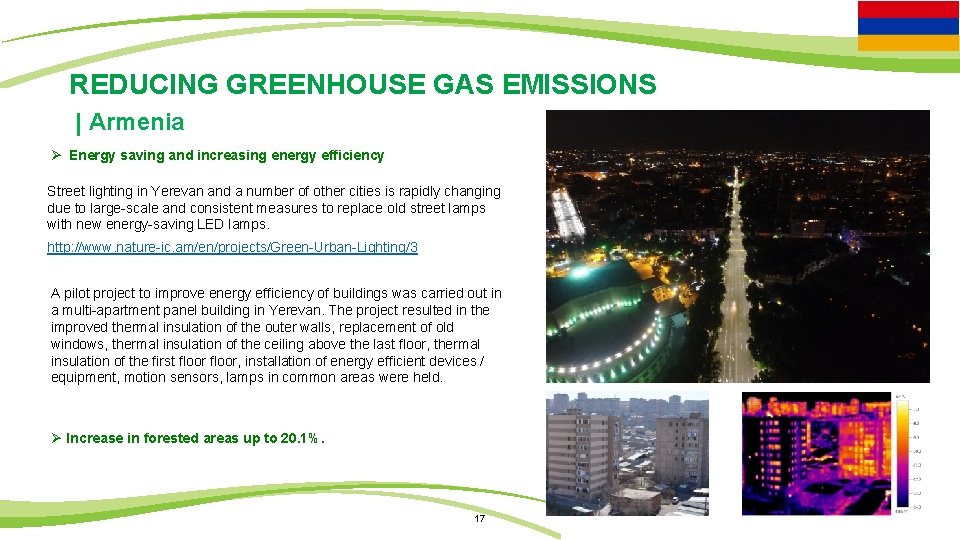
REDUCING GREENHOUSE GAS EMISSIONS | Armenia Ø Energy saving and increasing energy efficiency Street lighting in Yerevan and a number of other cities is rapidly changing due to large-scale and consistent measures to replace old street lamps with new energy-saving LED lamps. http: //www. nature-ic. am/en/projects/Green-Urban-Lighting/3 A pilot project to improve energy efficiency of buildings was carried out in a multi-apartment panel building in Yerevan. The project resulted in the improved thermal insulation of the outer walls, replacement of old windows, thermal insulation of the ceiling above the last floor, thermal insulation of the first floor, installation of energy efficient devices / equipment, motion sensors, lamps in common areas were held. Ø Increase in forested areas up to 20. 1%. 17
'GREEN' ENERGY SOURCES | Belarus Favorable conditions have been created for expanding the production of electric and thermal energy based on renewable energy sources. As of 2018, renewables make up for 6. 2% of the gross consumption of fuel and energy resources. Future prospects: • by 2025, the share of renewable energy sources in the consumption of fuel and energy resources in the country should reach 7%, • by 2030 - 8%, • by 2035 - 9%. Solar energy Ø For the period from 2013 to 2016, solar energy production increased 70 times. Ø In 2019, 55 photovoltaic power plants with a total capacity of 156. 6 MW operated in Belarus. Ø In the Cherikovsky district, a 100 MW photovoltaic station is under construction, which will become one of the largest not only in Belarus, but also in the CIS. Wind and other energy sources Ø There are 99 wind turbines operating in Belarus with a total capacity of 108 MW (as of 2019); Ø Implemented 25 projects for biogas production at livestock farms. ØPossibilities for utilization of geothermal resources. Energy of moving water ØAs of 2019, 51 hydropower plants operated in the country of the total capacity of 95. 3 MW. Among them, the largest are Vitebsk power plant with a total capacity of 40 MW and Polotsk power plant with a total capacity of 21. 66 MW. 18
‘GREEN’ TRANSPORT | Belarus Electric transport ü Electric buses are already in the streets of Minsk; ü Development of passenger electric vehicles, utility vehicles, minivans; ü Prototypes of electric bicycles, electric scooters; ü Experimental battery assembly area; ü Infrastructure for the use of electric transport is being created, including charging stations. Bicycles There are from 770 thousand to 850 thousand bicycles for adults in Minsk, which is practically equal to the number of passenger cars. 47% of the adult population of Minsk aged from 16 to 64 have bicycles. Bicycle sharing (bike rental without stations) has been developing in Belarus since 2019. In 2020, the company offered 3, 000 bicycles, 300 electric bicycles, 660 electric scooters in Minsk, Brest, Grodno, Gomel, Borisov, Zhodino and Pinsk. 19
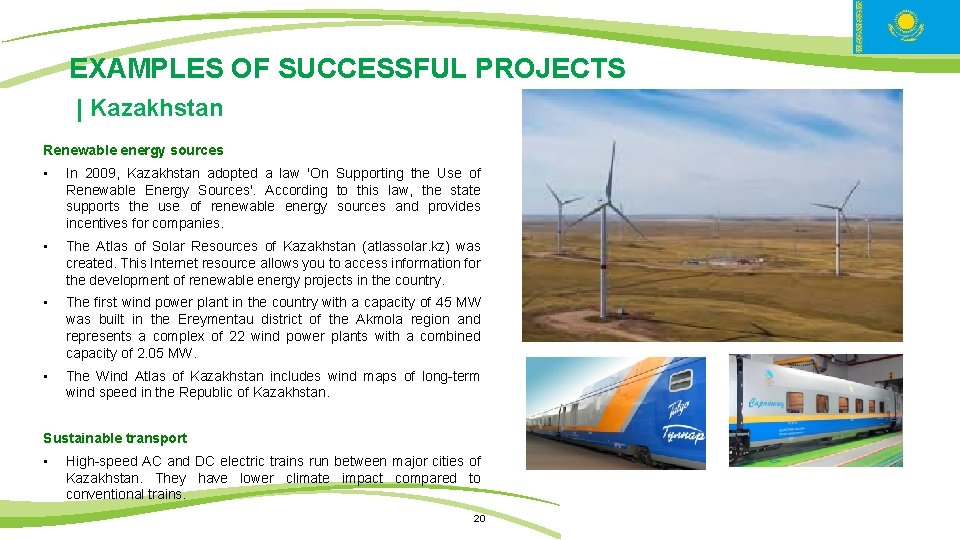
EXAMPLES OF SUCCESSFUL PROJECTS | Kazakhstan Renewable energy sources • In 2009, Kazakhstan adopted a law 'On Supporting the Use of Renewable Energy Sources'. According to this law, the state supports the use of renewable energy sources and provides incentives for companies. • The Atlas of Solar Resources of Kazakhstan (atlassolar. kz) was created. This Internet resource allows you to access information for the development of renewable energy projects in the country. • The first wind power plant in the country with a capacity of 45 MW was built in the Ereymentau district of the Akmola region and represents a complex of 22 wind power plants with a combined capacity of 2. 05 MW. • The Wind Atlas of Kazakhstan includes wind maps of long-term wind speed in the Republic of Kazakhstan. Sustainable transport • High-speed AC and DC electric trains run between major cities of Kazakhstan. They have lower climate impact compared to conventional trains. 20
The photos and illustrations used in the module, where sources are not specified, are either taken from the Climate Box toolkit (see the List of illustrations at the end of the textbook) or provided by the program participants. THANK YOU! Программа развития ООН 2020
- Slides: 20