
CLIL Content and language integrated learning What is






- Slides: 27
CLIL Content and language integrated learning
What is CLIL? It is a dual-focused educational approach in which an additional language is used for the learning and teaching of both content and language. § (Marsh, 2008)
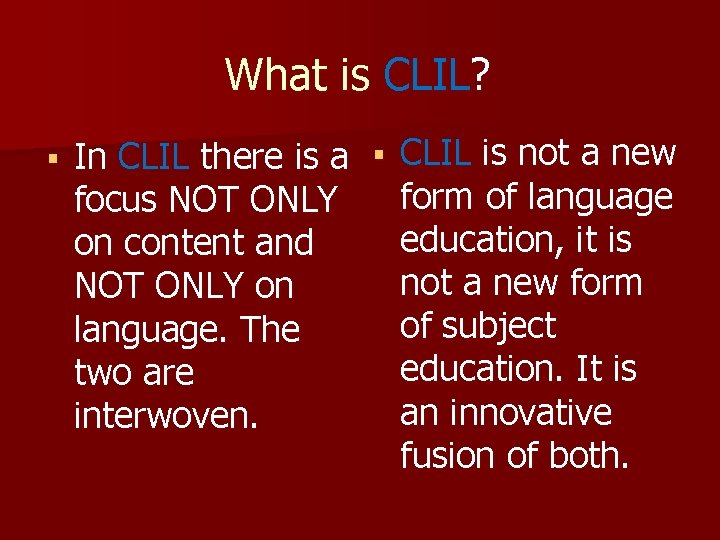
What is CLIL? § In CLIL there is a § CLIL is not a new form of language focus NOT ONLY education, it is on content and not a new form NOT ONLY on of subject language. The education. It is two are an innovative interwoven. fusion of both.
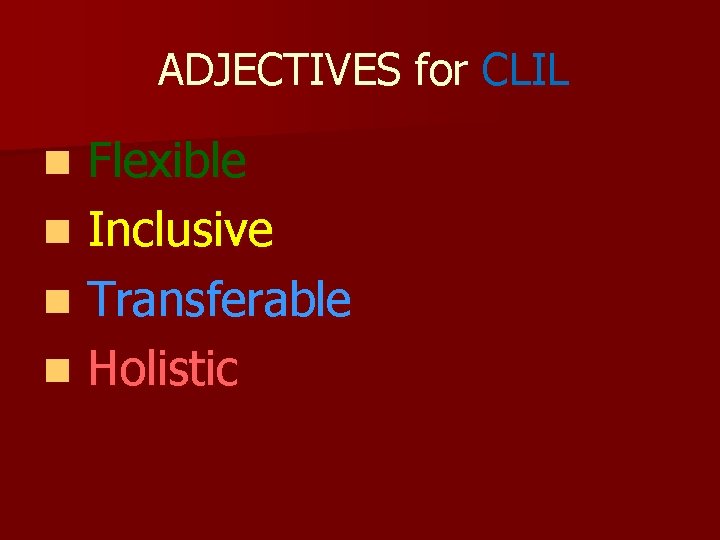
ADJECTIVES for CLIL Flexible n Inclusive n Transferable n Holistic n
Where does CLIL come from? P It was coined in 1994, but CLIL-type programme is as old as education. It existed in ancient Rome as it exists today in multilingual societies, created through mobility and education
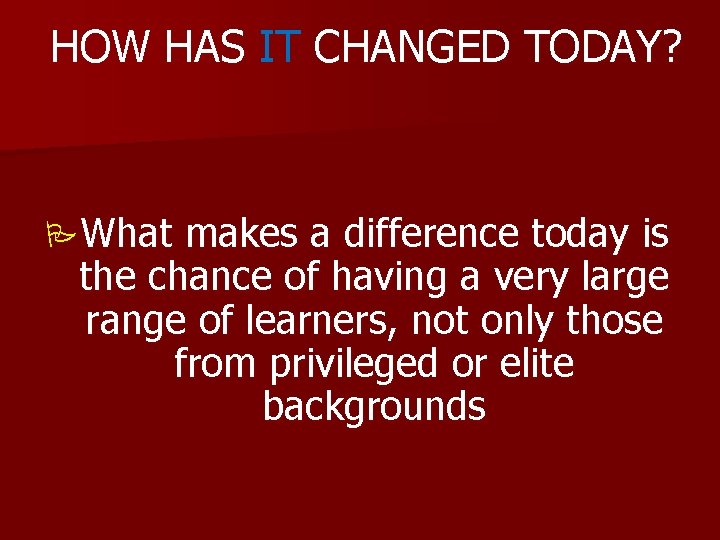
HOW HAS IT CHANGED TODAY? PWhat makes a difference today is the chance of having a very large range of learners, not only those from privileged or elite backgrounds
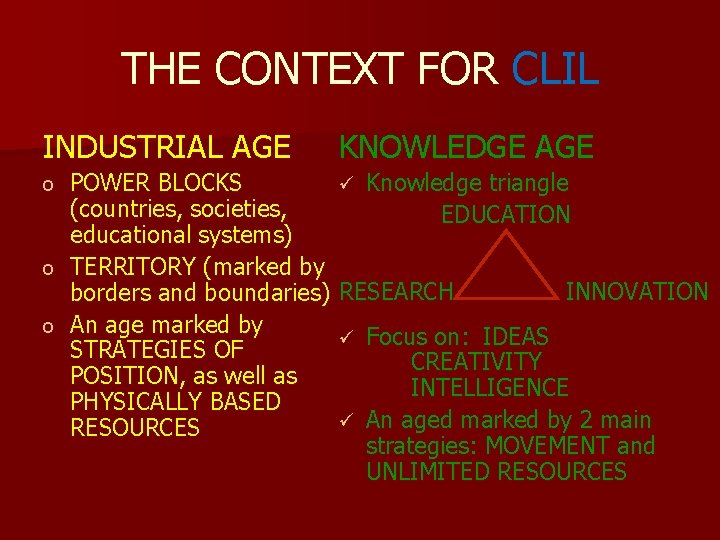
THE CONTEXT FOR CLIL INDUSTRIAL AGE KNOWLEDGE AGE POWER BLOCKS (countries, societies, educational systems) o TERRITORY (marked by borders and boundaries) o An age marked by STRATEGIES OF POSITION, as well as PHYSICALLY BASED RESOURCES ü o Knowledge triangle EDUCATION RESEARCH INNOVATION Focus on: IDEAS CREATIVITY INTELLIGENCE ü An aged marked by 2 main strategies: MOVEMENT and UNLIMITED RESOURCES ü
The demands of the present T By the mid-90 s globalization had an impact on WHO learns WHICH language, AT WHAT STAGE of their development and in WHICH WAY. T 2 AIMS: to achieve the best possible results in the shortest time AND get better results in content teaching to
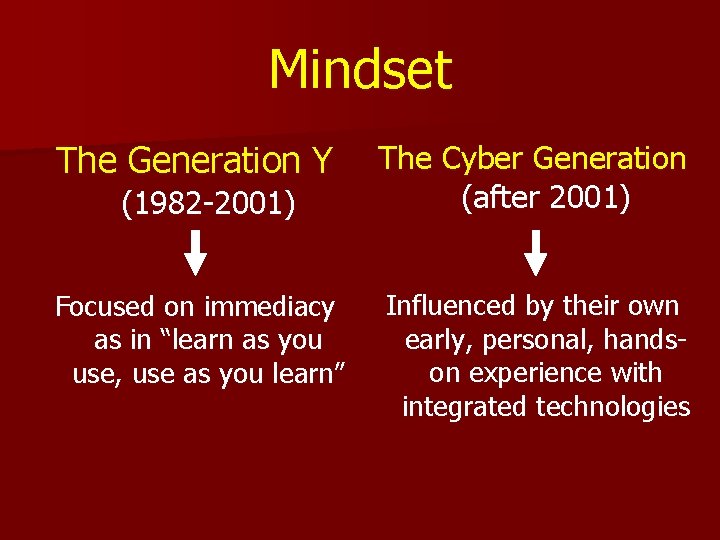
Mindset The Generation Y The Cyber Generation (after 2001) Focused on immediacy as in “learn as you use, use as you learn” Influenced by their own early, personal, handson experience with integrated technologies (1982 -2001)
CLIL theoretical background 8 The cognitive revolution Neurosciences at present) (Broadbent 1958; 8 The constructivist perspective (Bruner, Piaget, Vygotskj + Ceri at present) 8 Multiple intelligences (Gardner) Learner autonomy (Gredler, Kukla) Language-learning strategies (Oxford, 1990)
CONSEQUENCES FOCUS on MOTIVATION LEARNERS’ INVOLVEMENT IN THEIR EDUCATION
Integration Äthe nonlanguage subject is not taught IN a foreign language, but WITH and THROUGH a foreign language ÄIt is a process of CONVERGENCE Ä-fusions of elements previously fragmented(subjects in the curriculum)
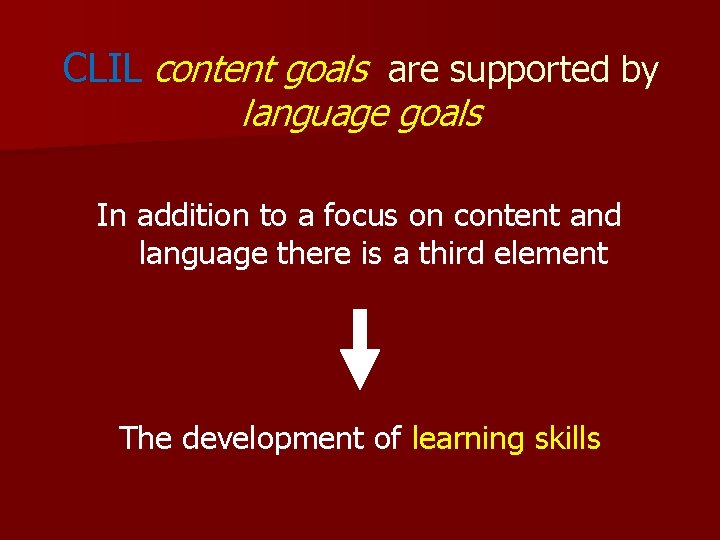
CLIL content goals are supported by language goals In addition to a focus on content and language there is a third element The development of learning skills
CLIL as a form of convergence
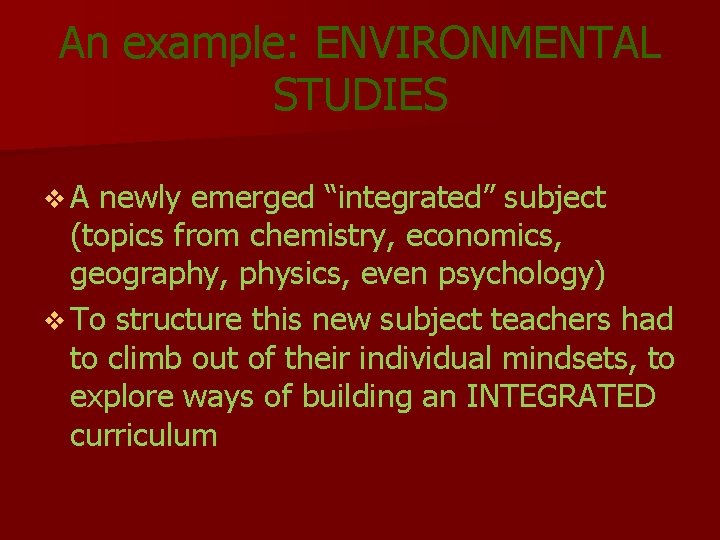
An example: ENVIRONMENTAL STUDIES v. A newly emerged “integrated” subject (topics from chemistry, economics, geography, physics, even psychology) v To structure this new subject teachers had to climb out of their individual mindsets, to explore ways of building an INTEGRATED curriculum
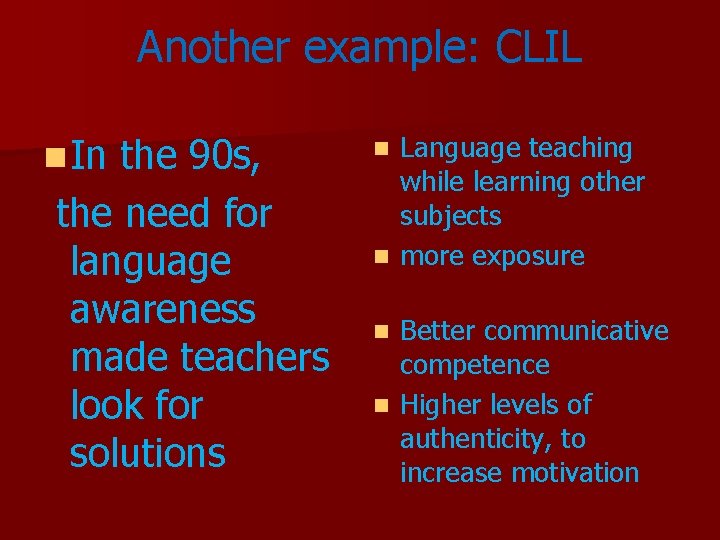
Another example: CLIL n In the 90 s, the need for language awareness made teachers look for solutions Language teaching while learning other subjects n more exposure n Better communicative competence n Higher levels of authenticity, to increase motivation n
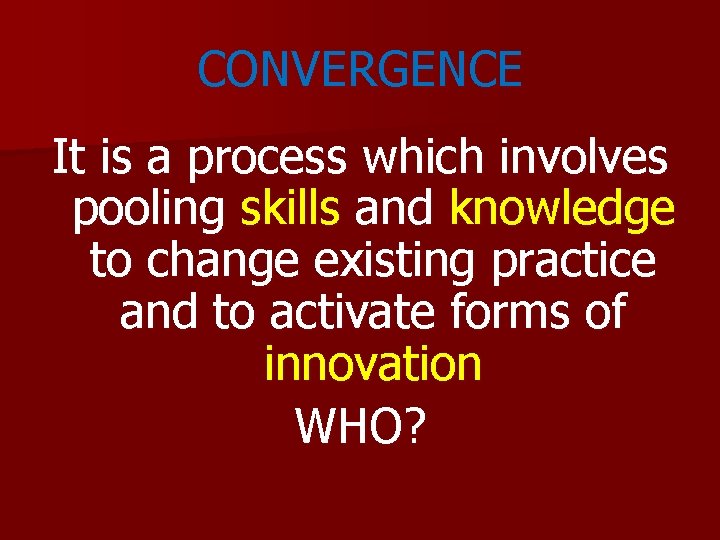
CONVERGENCE It is a process which involves pooling skills and knowledge to change existing practice and to activate forms of innovation WHO?
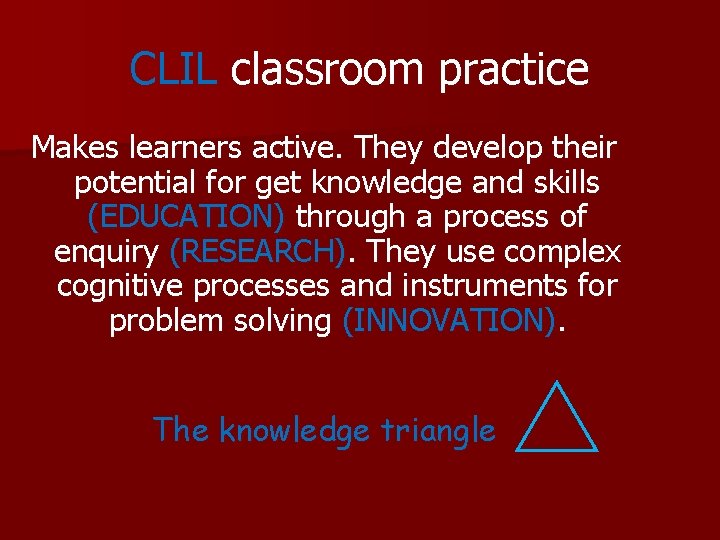
CLIL classroom practice Makes learners active. They develop their potential for get knowledge and skills (EDUCATION) through a process of enquiry (RESEARCH). They use complex cognitive processes and instruments for problem solving (INNOVATION). The knowledge triangle
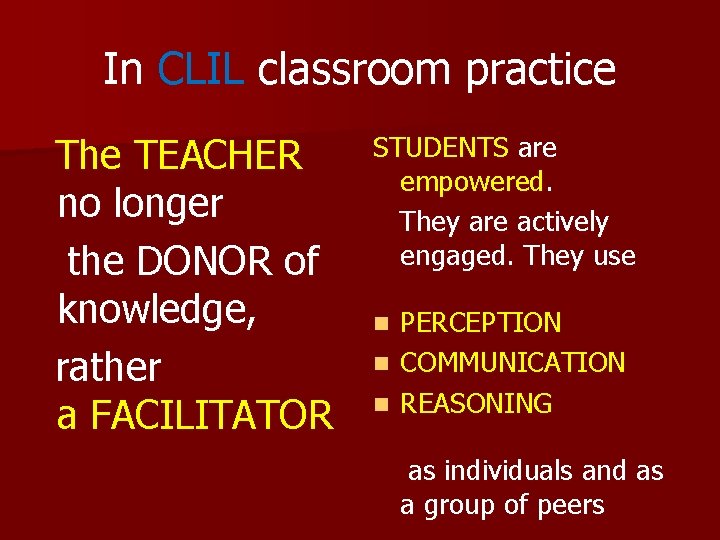
In CLIL classroom practice The TEACHER no longer the DONOR of knowledge, rather a FACILITATOR STUDENTS are empowered. They are actively engaged. They use PERCEPTION n COMMUNICATION n REASONING n as individuals and as a group of peers
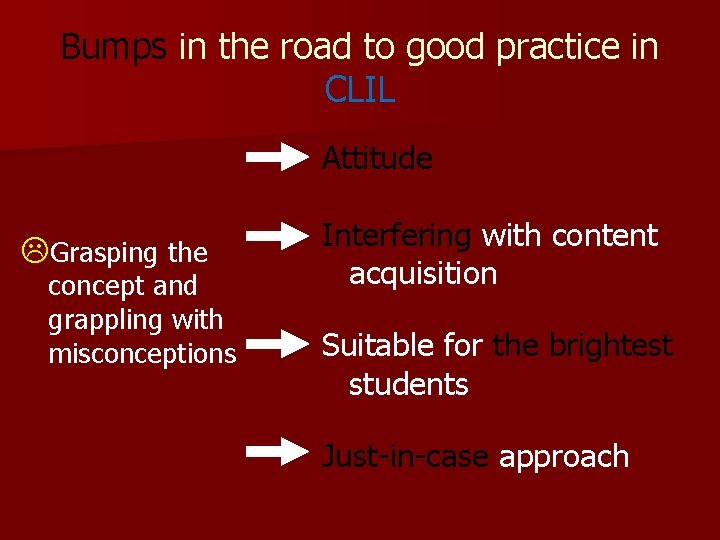
Bumps in the road to good practice in CLIL Attitude LGrasping the concept and grappling with misconceptions Interfering with content acquisition Suitable for the brightest students Just-in-case approach
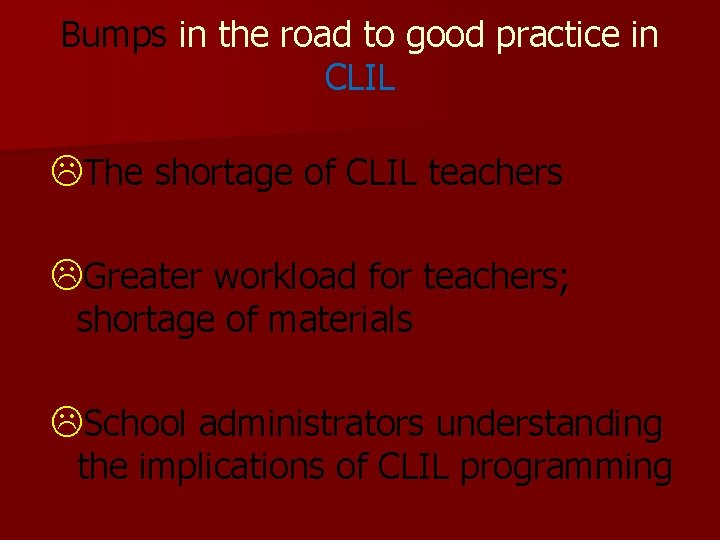
Bumps in the road to good practice in CLIL LThe shortage of CLIL teachers LGreater workload for teachers; shortage of materials LSchool administrators understanding the implications of CLIL programming
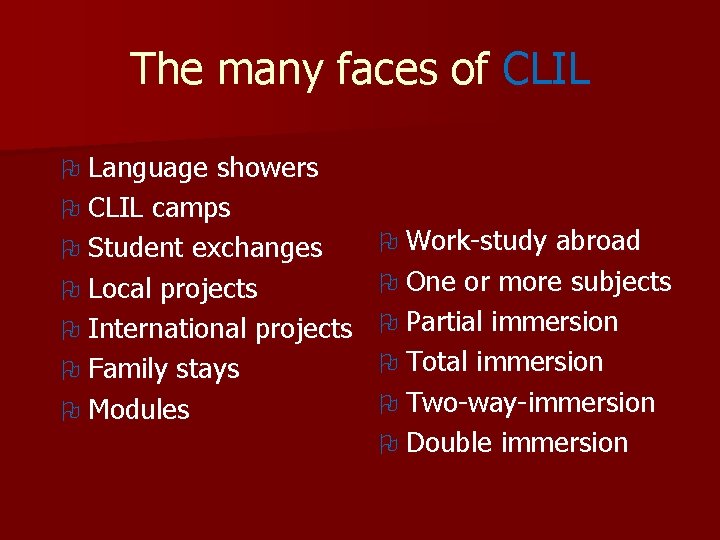
The many faces of CLIL O Language showers O CLIL camps O Student exchanges O Local projects O International projects O Family stays O Modules O Work-study abroad O One or more subjects O Partial immersion O Total immersion O Two-way-immersion O Double immersion
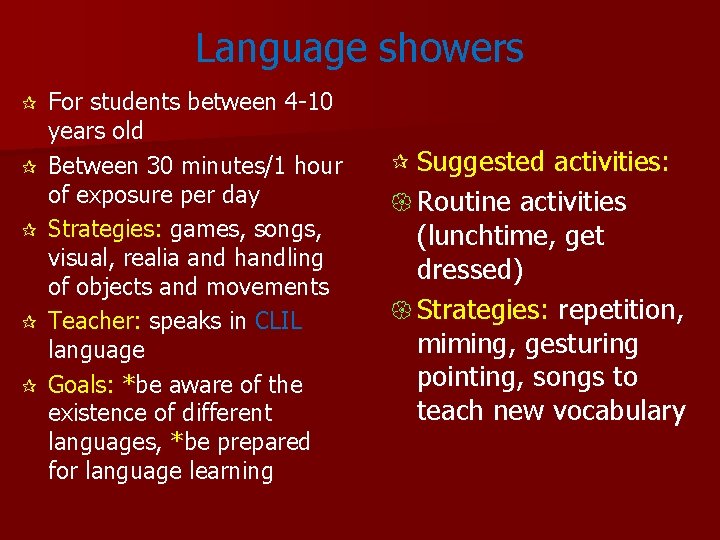
Language showers ¶ ¶ ¶ For students between 4 -10 years old Between 30 minutes/1 hour of exposure per day Strategies: games, songs, visual, realia and handling of objects and movements Teacher: speaks in CLIL language Goals: *be aware of the existence of different languages, *be prepared for language learning ¶ Suggested activities: { Routine activities (lunchtime, get dressed) { Strategies: repetition, miming, gesturing pointing, songs to teach new vocabulary
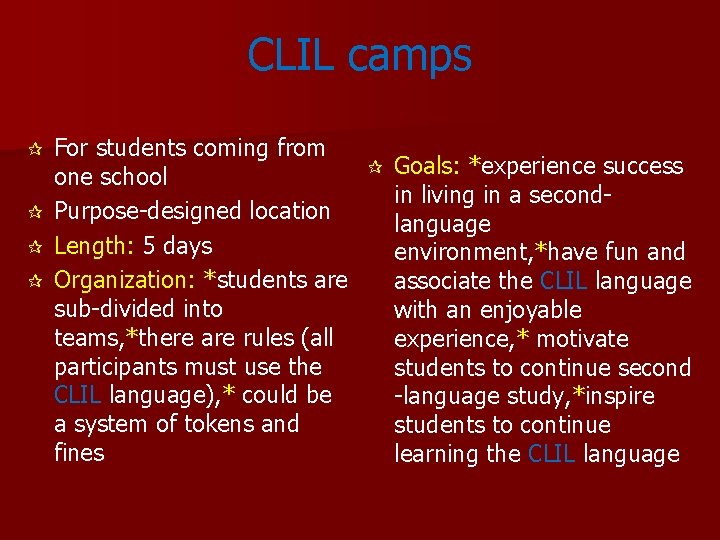
CLIL camps For students coming from ¶ Goals: *experience success one school in living in a second¶ Purpose-designed location language ¶ Length: 5 days environment, *have fun and ¶ Organization: *students are associate the CLIL language sub-divided into with an enjoyable teams, *there are rules (all experience, * motivate participants must use the students to continue second CLIL language), * could be -language study, *inspire a system of tokens and students to continue fines learning the CLIL language ¶
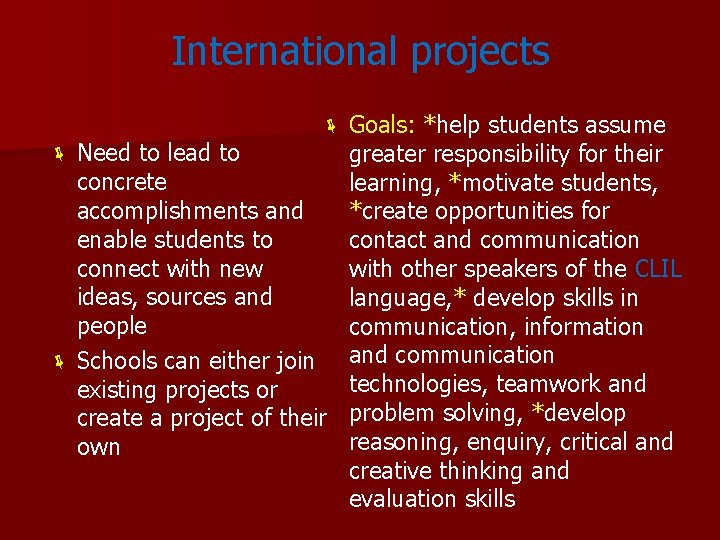
International projects Goals: *help students assume ë Need to lead to greater responsibility for their concrete learning, *motivate students, accomplishments and *create opportunities for enable students to contact and communication connect with new with other speakers of the CLIL ideas, sources and language, * develop skills in people communication, information and communication ë Schools can either join technologies, teamwork and existing projects or create a project of their problem solving, *develop reasoning, enquiry, critical and own creative thinking and evaluation skills ë
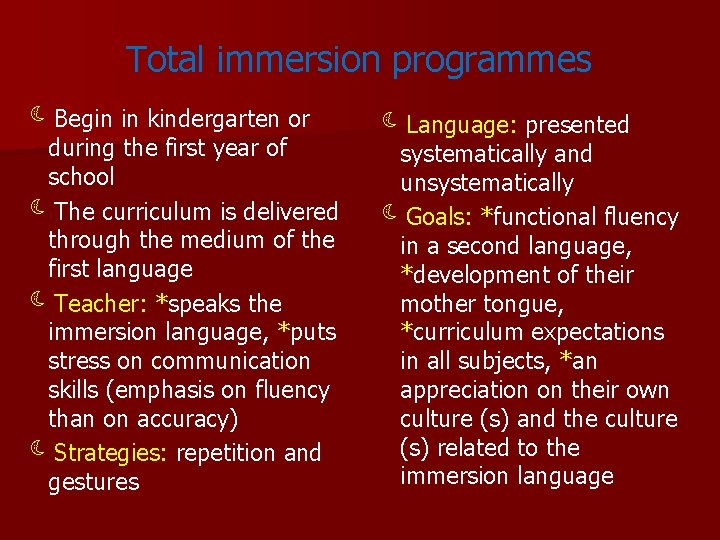
Total immersion programmes àBegin in kindergarten or during the first year of school àThe curriculum is delivered through the medium of the first language àTeacher: *speaks the immersion language, *puts stress on communication skills (emphasis on fluency than on accuracy) àStrategies: repetition and gestures àLanguage: presented systematically and unsystematically àGoals: *functional fluency in a second language, *development of their mother tongue, *curriculum expectations in all subjects, *an appreciation on their own culture (s) and the culture (s) related to the immersion language