
ClientLevel Data Collection in the Houston EMA Elizabeth
Client-Level Data Collection in the Houston EMA Elizabeth Love, MPH Harris County Public Health and Environmental Services Department HIV Services Section
FY 1998 • The Ryan White Planning Council (RWPC) prioritized a client-level data collection and reporting system for the Houston EMA • Desired capabilities included: – Compiling and tracking health, demographic and service utilization data – Centralizing client intake – Supporting a unit cost-based reimbursement structure – Assisting in the coordination of client care – Decreasing administrative burden on service providers
FY 1998 • The RWPC assigned responsibility for procuring, developing, implementing and managing the system to Harris County Public Health Department’s HIV Services Section, the Title I administrative agent • The RWPC determined that its role would be one of general process oversight
FY 1998 • HIV Services facilitated a series of meetings with stakeholders to develop system criteria, cost estimates and timelines – Participants included service providers, consumers, RWPC members and representatives from other Ryan White Titles – Major issues included client confidentiality, secondary gain for providers, reduced paperwork for clients and cost
FY 1999 – 2000 • An RFP was issued in order to procure a vendor • A contractor was selected in October 1999 • The logical and physical database designs were completed in March 2000 • Beta version testing occurred March – May 2000 • Training for system users began in April 2000 • The data system went live in June 2000
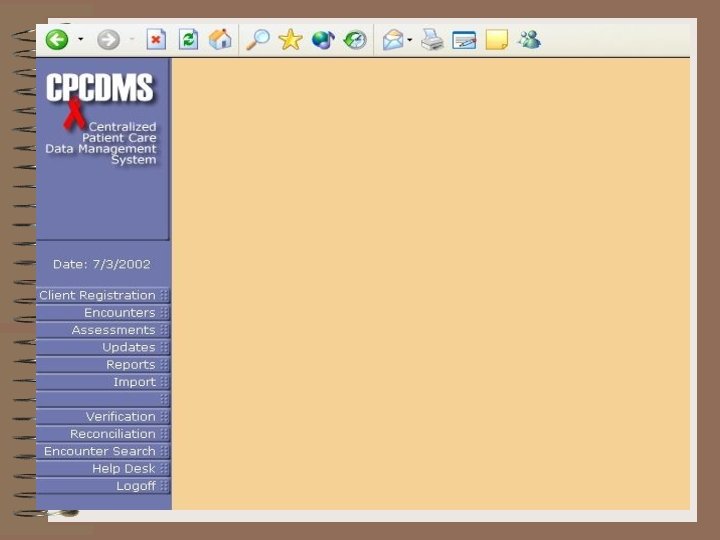
What is the CPCDMS? • The CPCDMS is a computer database application that enables Title I-funded agencies and other users to share client eligibility information and to document services delivered to clients
How does it work? • The CPCDMS is a real-time database linking service providers together using advanced data management and communications technology • Records are created, accessed and updated by providers via ISDN/DSL data linking using a unique 11 -character code • Client records are stored at HIV Services on a database server in SQL format
System Requirements – V 1 -3 • In Versions 1 -3, the system ran over an agency’s existing computer network using ISDN linking • Agencies without an existing network were provided with a server and necessary workstations in a small LAN configuration • All agencies were provided with an application server, workstations, printer and Cisco router
System Requirements – V 4 • In Version 4, the database runs over an agency’s existing computer network • Agencies must have high-speed internet connectivity to access the system (DSL, T-1, cable modem) • All agencies are provided with workstations and printers • An intrusion detection and protection device exists on each side of the firewall
Confidentiality • Clients sign consent forms agreeing to participate in the CPCDMS • No client-identifying information is collected – Prior to CPCDMS Version 4, client-identifying information resided on the agency server, while nonidentifying information was sent to HIV Services • Client records are distinguished with unique 11 character codes
JHDE 0727741 • The 11 -character code is a unique alphanumeric identifier derived from the first and third letters of a client’s first and last names, the client’s six-digit date of birth and the client’s gender – Male client John Doe, born on July 27, 1974 would have the 11 -character code listed above
Confidentiality/Security • Access to the CPCDMS is granted to specific users by HIV Services – Different database “rights” are assigned based on the duties of the user • The database is password protected • The data is encrypted
Data Collection • Client Registration • Service Encounter Information • Medical Updates
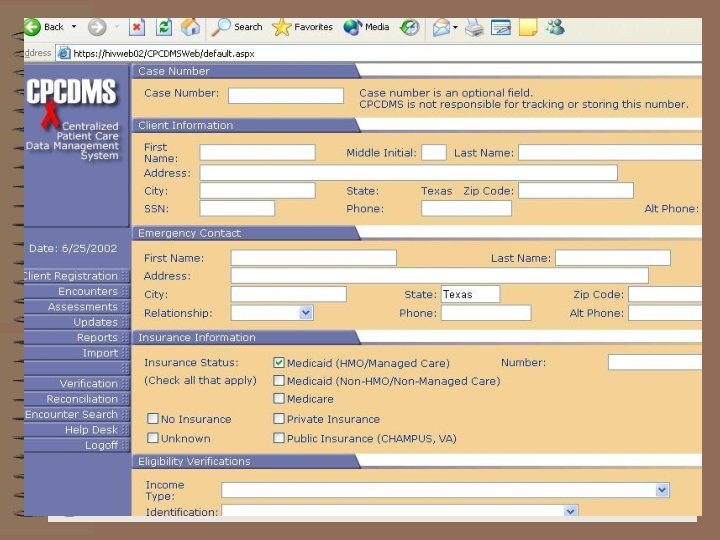
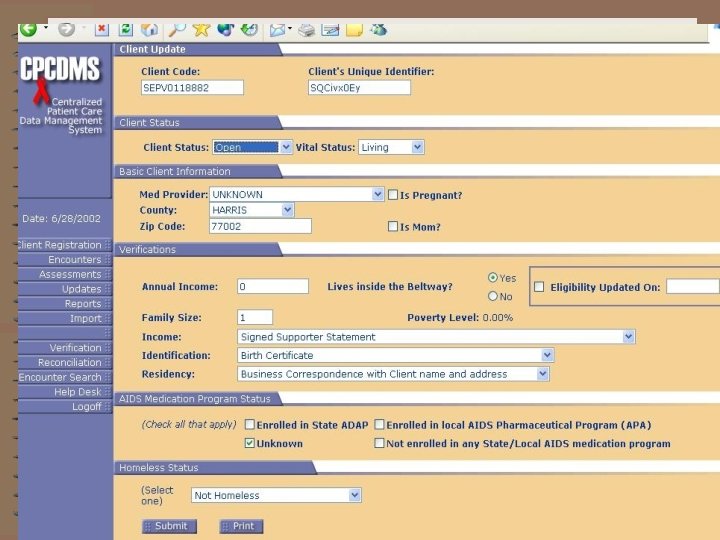
Data Collection - Registration • Client demographic information is collected through a process called registration, which also establishes a client’s eligibility for Title I services • Examples of information collected at registration include race, ethnicity, income, mode of transmission, co-morbidities, insurance status, year of diagnosis, etc. • At registration clients sign consent forms agreeing to participate in the data system
Data Collection - Registration • Only primary care, case management and outreach/EIS providers may register clients • Outreach/EIS providers must transfer “ownership” of client records to a primary care or case management provider within 60 or 120 days • Registration and eligibility information is updated annually by the record-owning agency
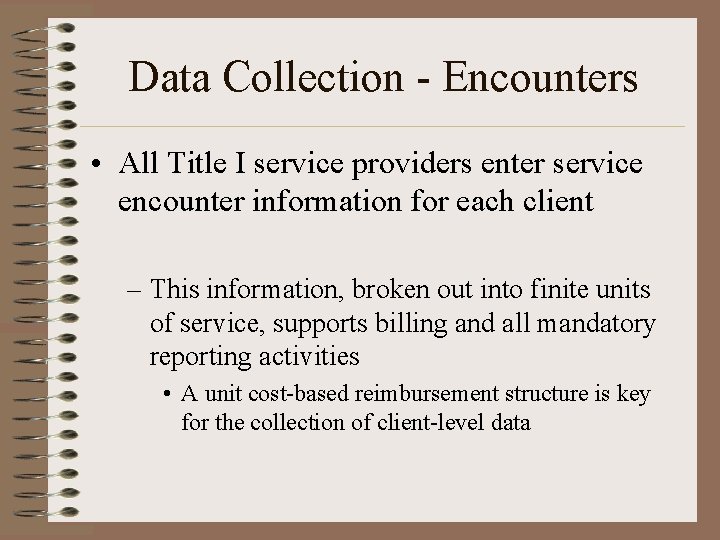
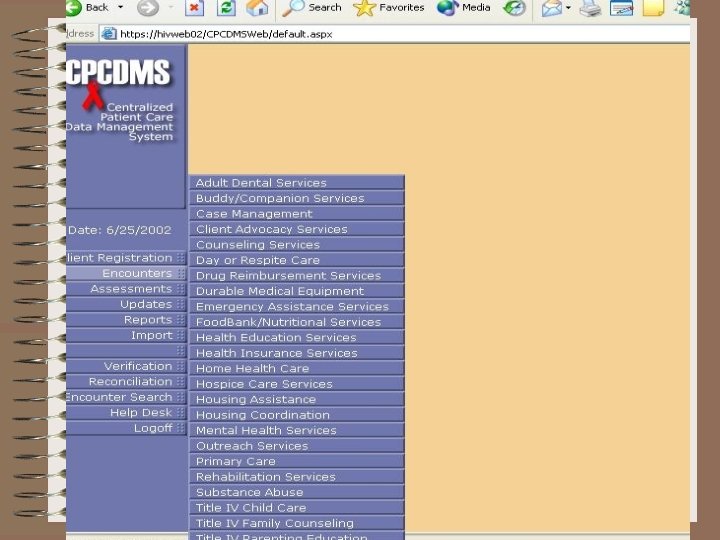
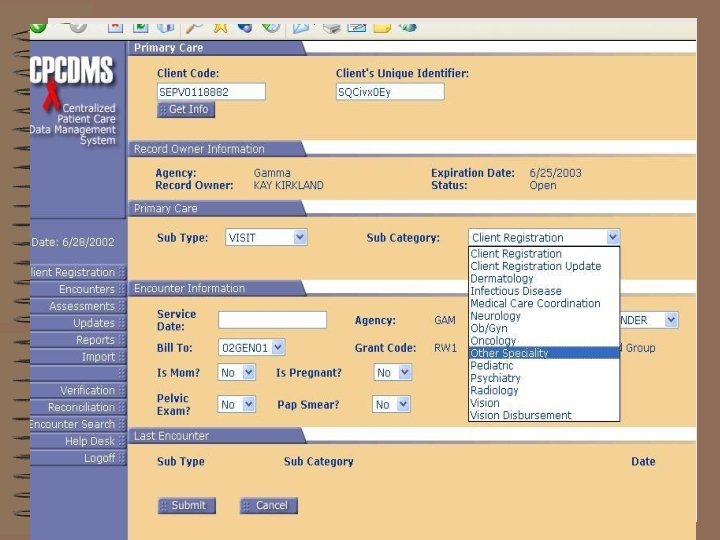
Data Collection - Encounters • All Title I service providers enter service encounter information for each client – This information, broken out into finite units of service, supports billing and all mandatory reporting activities • A unit cost-based reimbursement structure is key for the collection of client-level data
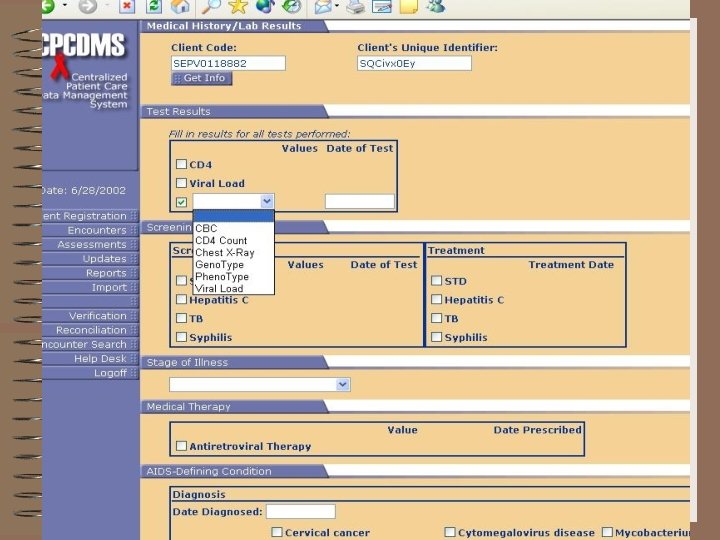
Data Collection – Medical Updates • In addition to encounters, primary care providers enter medical update information – Lab results, treatment information, opportunistic infection diagnoses, stage of illness diagnoses, mortality data, pregnancy status, etc.
Reports • Agencies schedule reports using Seagate Info and Crystal Reports software • Run at the central site, reports are viewed and printed at the agency site • Reports are used by agencies to generate backup documentation for billing and to manage programs
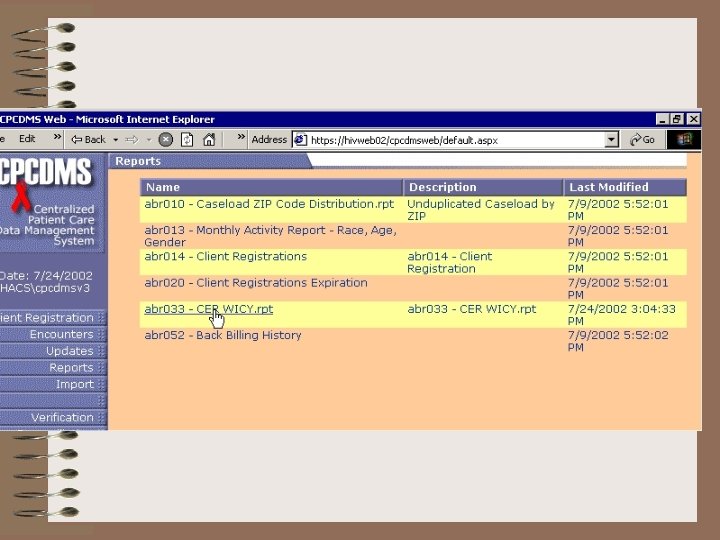
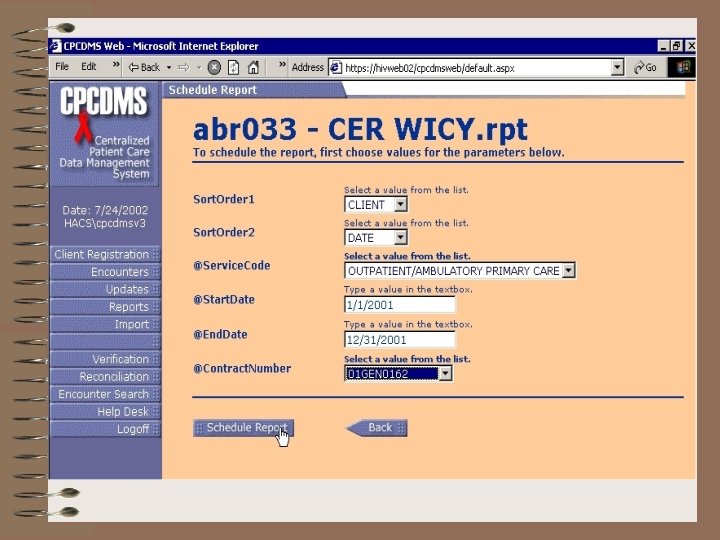
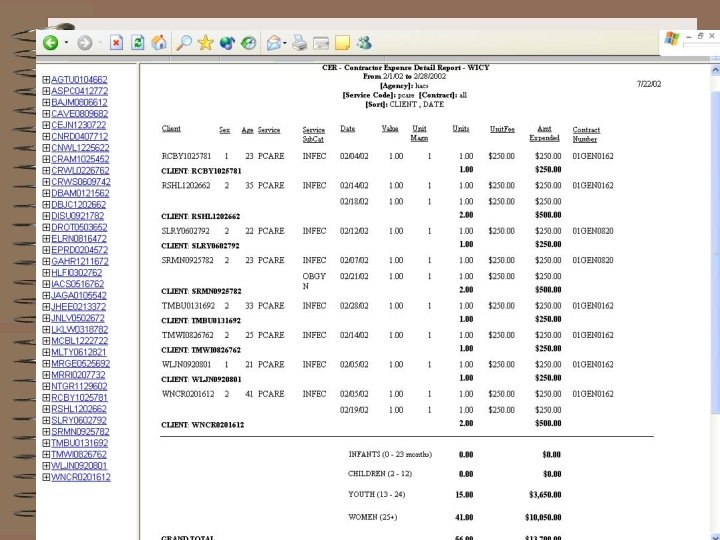
Reports • While providers can only run reports specific to their agency’s clients, HIV Services can run reports for all agencies, service categories and grant codes – The RWPC Office of Support also has this capability, with some limitations
Training and Support • HIV Services provides hands-on training in the Health Department’s computer training room • Training includes instruction on data entry, security, client confidentiality, policies, procedures, reports, forms and client consents • On-site technical assistance and help desk support is provided as needed
Current Status • 24 Ryan White-funded agencies are online and using the CPCDMS to register clients, verify client eligibility for services and document client service encounter and medical lab data – 4 additional Title II-funded agencies are scheduled to come online this spring • Since June 2000 over 9, 800 clients have been registered
Version 2 • CPCDMS Version 2 was implemented in March 2001. Added features included the ability to: – – Batch import service encounter and medical lab data Link every service encounter with a grant and contract Edit and delete service encounter data Export CPCDMS data into the TDH COMPIS system
Version 3 • Version 3 was implemented in August 2002. Added features included the following: – A browser-based user interface that was the precursor to the current internet-based application – The elimination of servers at agencies that did not perform client registration – Reduced training and support time – The automation of survey administration and data entry
Version 4 • Version 4 moves the system from ISDN linking to internet connectivity – A private network connection between agencies and HIV Services is no longer necessary – Providers access the system from any workstation that has internet connectivity at www. cpcdms. com – Servers are no longer needed at agency sites, resulting in significant resource savings
Oversight • An RWPC standing committee meets bi-monthly to discuss CPCDMS issues and concerns – Members include consumers, service providers and representatives from other Ryan White Titles – HIV Services provides a status report at each meeting – Significant process changes are approved by the committee and the full RWPC • Example – CPCDMS Version 4
Achievements • From conception to production, the CPCDMS was implemented in less than two years • The system has buy-in from all stakeholders – Service providers, consumers, RWPC, grantees • Three significant system upgrades have been completed in three years • The CPCDMS is HIPAA-compliant
Achievements • Administrative processes have been automated – Providers can generate expense reports, utilization summaries and service histories • Many previously-required reports are now unnecessary because HIV Services can run them – HIV Services can generate reports that summarize required data for HRSA • WICY, CBC/MAI, CADR
Achievements • The client eligibility process has been streamlined – Clients establish eligibility for all Title I services once a year – Service providers need only to access the CPCDMS to verify client eligibility
Achievements • The unduplicated client-level data enhances planning – The RWPC incorporates CPCDMS data into their various planning activities: • • Setting service definitions Priorities and allocations Needs assessments Comprehensive planning
Achievements • The CPCDMS enabled the Houston EMA to rapidly develop and implement QM activities – Outcomes evaluation – Clinical chart review – Client satisfaction measurement
Lessons Learned • Include stakeholders in all planning and development activities • Keep stakeholders informed and involved on an ongoing basis • Overestimate project costs and staff time • Minimize the “pain” of data entry when possible
Resources • The Houston EMA has spent less than 3% of its combined FY 98 -03 grant award on developing, implementing, upgrading and maintaining the CPCDMS – 45% for application development, enhancement and support – 30% for equipment and software licenses – 25% for grantee staff support
Resources • HIV Services has three FTE staff members supporting the CPCDMS project – Project Coordinator – Systems Administrator – Trainer • A consultant is also utilized – Significant application changes – Advanced reports development
For more information… Elizabeth G. Love, MPH Project Coordinator – Evaluation and QM Harris County Public Health Department HIV Services Section (713) 439 -6041 elove@harriscountyhealth. com www. harriscountyhealth. com/hivservices
- Slides: 44