
CLIENT SERVER BY DHARANI K OUTLINES clientserver Client

CLIENT /SERVER BY DHARANI. K

OUTLINES � client/server � Client /server concept � Benefits � Client server models � Architecture � Tier architecture

CLIENT/SERVER What Is A Client/Server? Client A client is a single-user workstation that provides presentation services, database services and connectivity along with an interface for user interaction to acquire business needs. Server A server is one or more multi-user processors with a higher capacity of shared memory which provides connectivity and the database services along with interfaces relevant to the business procedures. Client/Server computing provides an environment that enhances business procedures by appropriately synchronizing the application processing between the client and the server.

CLIENT/SERVER CONCEPTS
Benefits Improved Data Sharing � Integration of Services � Shared Resources � Easy maintenance � Security � Impact of centralized architecture � Accessibility � Backup & recovery � Proper management �

Client server model � The client machine (or the client process) makes the request for some resource or service, and the server machine (the server process) handles the request and sends the response (result) back to the client. � In database server, the client queries the server for records from the database, and the server looks up the records and responds to the client. � The user on the client machine may not even know what machine in the network actually has the database. � In fact, the database may be distributed across several machines on the network.
� The Client needs to know the existence and the address of the server. � However, the server does not need to know the existence or address of the client prior to the connection. � Once a connection is established, both sides can send and receive information. � Distributed data � Distributed presentation � Remote data � Distributed logic

Client server model

Technical Architecture and Application Architecture � Hardware � Vendor � Sizing � Network Application � Functional modules � Common service � Framework � Object design � GUI design
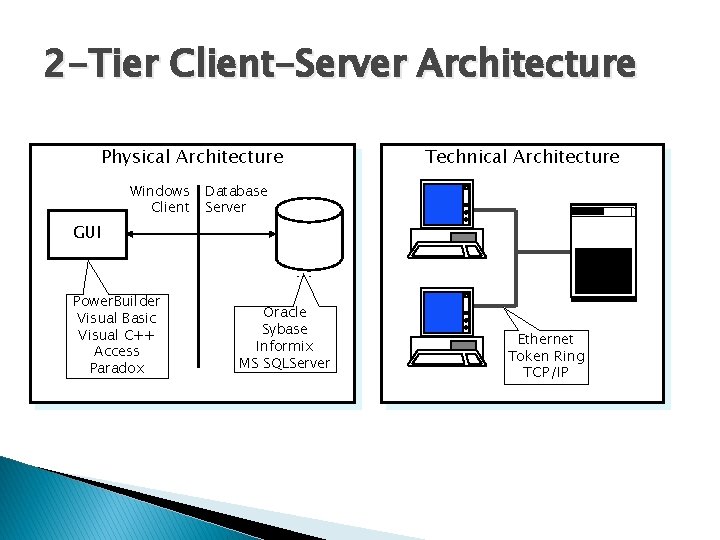
2 -Tier Client-Server Architecture Physical Architecture Windows Client Technical Architecture Database Server GUI … Power. Builder Visual Basic Visual C++ Access Paradox Oracle Sybase Informix MS SQLServer Ethernet Token Ring TCP/IP
2 -Tier Client-Server Pros / Cons � Internal Applications � Small to Medium User Base � Controlled Hi-Bandwidth Network Environment � Homogenous Hardware (hopefully) Heavy load on database Limited option for scaling Costly software distribution Poor separation of software components “Fat Client”
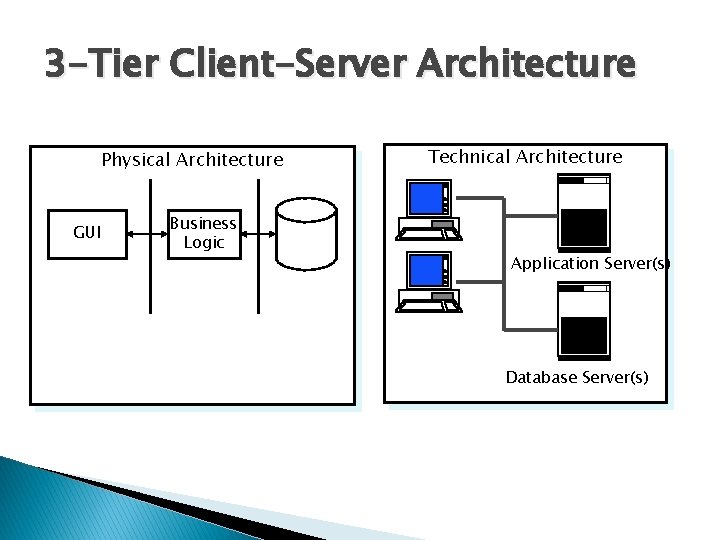
3 -Tier Client-Server Architecture Physical Architecture GUI Business Logic Technical Architecture Application Server(s) Database Server(s)

3 -Tier Client-Server Pros / Cons Medium to Large User Base � Controlled Hi-Bandwidth Network Environment � Better separation of presentation and business logic � More options for scaling � Costly software distribution � Poor cross-platform support � “Fat Client” �

N-tier architecture � N-Tier : An unlimited number of tiers � Each tier may have multiple computers � Advantages : – More powerful applications – Many services to many clients � Enhanced security, scalability and availability � Disadvantages : – Software is more complex (effects design, reliability, maintainability) – More complicated to design and model – Performance risks – Not sure how to achieve reliability – Software maintenance is very different
- Slides: 14