
Client Registry An enterprise master patient index EMPI

- Slides: 12
Client Registry • An enterprise master patient index (EMPI), or Client Registry manages the unique identity of citizens receiving health services with the country – “For whom”
Considerations • Challenge: – Health data generated in many locations with differing identifiers • Approach(es): – Explore National ID / Healthcare Identifiers – Leverage sophisticated matching algorithms – Develop Policies/processes for reconciling identities • Close coordination with SHR
Provider Registry • A Provider Registry is the central authority for maintaining the unique identities of health providers within the country – “By whom”
Considerations • Challenge: – Providers may have differing identifiers in differing contexts – Various use cases must be supported (e. g, , credentialing, provider quality of care reports) • Approach(es): – Develop a standardized, shared source of canonical provider ID’s • Close coordination with FR
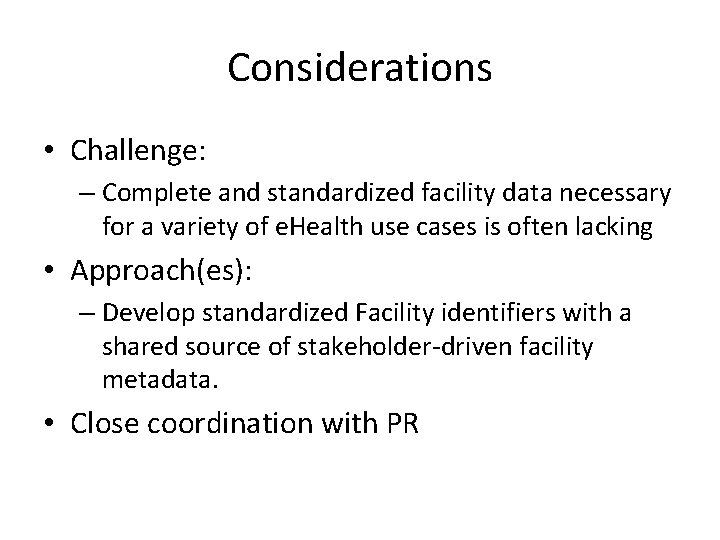
Facility Registry • A Health Facility Registry serves as a central authority to uniquely identify all places where health services are administered within the country – “Where? ”
Considerations • Challenge: – Complete and standardized facility data necessary for a variety of e. Health use cases is often lacking • Approach(es): – Develop standardized Facility identifiers with a shared source of stakeholder-driven facility metadata. • Close coordination with PR
Terminology Service • A Terminology Service serves as a central authority to uniquely identify the clinical activities that occur within the care delivery process by maintaining a terminology set mapped to international standards such as ICD 10, LOINC, SNOMED, and others – “What? ”
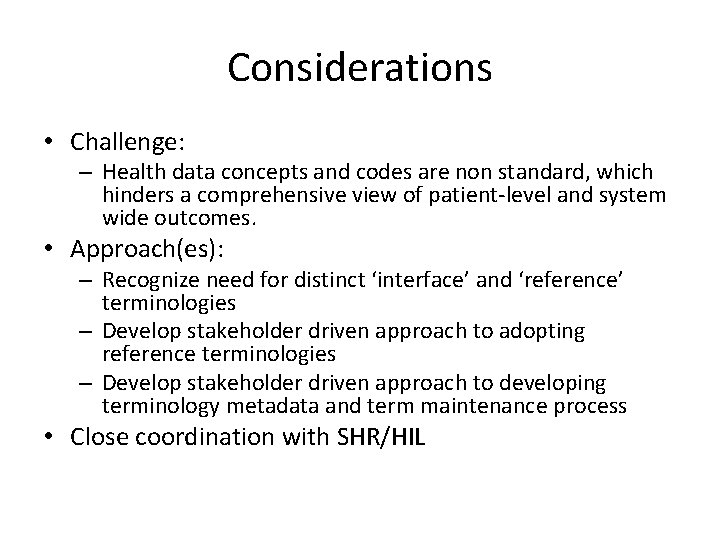
Considerations • Challenge: – Health data concepts and codes are non standard, which hinders a comprehensive view of patient-level and system wide outcomes. • Approach(es): – Recognize need for distinct ‘interface’ and ‘reference’ terminologies – Develop stakeholder driven approach to adopting reference terminologies – Develop stakeholder driven approach to developing terminology metadata and term maintenance process • Close coordination with SHR/HIL
Shared Health Record • A Shared Health Record (SHR) is a repository containing the normalized version of content created within the community, after being validated against each of the previous registries. It is a collection of personcentric records for patients with information in the exchange.
Considerations • Challenge: – e. Health data is often stored in differing formats among disparate systems, limiting availability and usability • Approach(es): – Develop stakeholder driven approach to define data access requirements – Develop stakeholder driven approach to developing terminology metadata and term maintenance process • Close coordination with SHR/HIL
Health Interoperability Layer • A Health Interoperability Layer receives all communications from point of service applications and orchestrates message processing between the point of service application and the hosted infrastructure elements.
Considerations • Challenge: – e. Health data is generated and transmitted often stored in differing formats among disparate systems, limiting availability and usability • Approach(es): – Develop stakeholder driven approach to define/specify information exchange requirements and “bus behavior” • Close coordination with all components