
Clicker Questions Psychology 7 th Edition by Sandra
Clicker Questions Psychology, 7 th Edition by Sandra E. Hockenbury, Susan A. Nolan, and Don H. Hockenbury Slides by Cathleen Campbell-Raufer, Ph. D. Chapter 8: Motivation and Emotion
1. Which component of motivation involves the initiation or production of behavior? a. intensity b. persistence c. activation d. vigor
1. Which component of motivation involves the initiation or production of behavior? a. intensity b. persistence c. activation d. vigor
2. Which phrase would not be compatible with instinct theories? a. fixed action patterns b. higher order learning c. innate behavior d. evolutionary programming
2. Which phrase would not be compatible with instinct theories? a. fixed action patterns b. higher order learning c. innate behavior d. evolutionary programming
3. The body tries to maintain relatively constant levels of internal states such as body temperature. This is referred to as: a. a drive. b. homeostasis. c. incentives. d. sensations.
3. The body tries to maintain relatively constant levels of internal states such as body temperature. This is referred to as: a. a drive. b. homeostasis. c. incentives. d. sensations.
4. Sensation seekers provide evidence for the idea behind: a. arousal theory b. incentive theory c. drive theory d. instinct theory
4. Sensation seekers provide evidence for the idea behind: a. arousal theory b. incentive theory c. drive theory d. instinct theory
5. Which theorist espoused a humanistic theory of motivation? a. Abraham Maslow b. Carl Rogers c. both of the above d. none of the above
5. Which theorist espoused a humanistic theory of motivation? a. Abraham Maslow b. Carl Rogers c. both of the above d. none of the above
6. How do we spend the majority of our energy? a. walking b. digesting food c. doing tasks (like brushing teeth) d. body heat, respiration, heartbeat (the BMR)
6. How do we spend the majority of our energy? a. walking b. digesting food c. doing tasks (like brushing teeth) d. body heat, respiration, heartbeat (the BMR)
7. Each body has a natural or optimal weight called a: a. ghrelin b. satiation level c. leptin d. set-point
7. Each body has a natural or optimal weight called a: a. ghrelin b. satiation level c. leptin d. set-point
8. A healthy BMI would be: a. below 18 b. between 18 and 25 c. between 25 and 29. 9 d. 30 or above
8. A healthy BMI would be: a. below 18 b. between 18 and 25 c. between 25 and 29. 9 d. 30 or above
9. The lowest level of Maslow’s hierarchy emphasizes: a. safety needs. b. physiological needs. c. belongingness and love needs. d. esteem needs.
9. The lowest level of Maslow’s hierarchy emphasizes: a. safety needs. b. physiological needs. c. belongingness and love needs. d. esteem needs.
10. Being given a personal pan pizza for reading a book is an example of: a. self-determination b. self-actualization c. intrinsic motivation d. extrinsic motivation
10. Being given a personal pan pizza for reading a book is an example of: a. self-determination b. self-actualization c. intrinsic motivation d. extrinsic motivation
11. Which of the following is a projective test that involves creating stories about ambiguous scenes that can be interpreted in a variety of ways? a. MMPI b. Rorschach c. Raven’s Progressive Matrices d. Thematic Apperception Test
11. Which of the following is a projective test that involves creating stories about ambiguous scenes that can be interpreted in a variety of ways? a. MMPI b. Rorschach c. Raven’s Progressive Matrices d. Thematic Apperception Test
12. Which is NOT a component of emotional intelligence? a. superior reasoning powers b. the ability to manage one’s own emotions c. comprehending the emotional responses of others d. appropriate responding to others’ emotions
12. Which is NOT a component of emotional intelligence? a. superior reasoning powers b. the ability to manage one’s own emotions c. comprehending the emotional responses of others d. appropriate responding to others’ emotions
13. Which of the following is NOT one of the basic emotions? a. jealousy b. disgust c. happiness d. surprise
13. Which of the following is NOT one of the basic emotions? a. jealousy b. disgust c. happiness d. surprise
14. According to William James, we feel emotions because of: a. stimuli in the environment. b. our perception of physiological changes in the body. c. our appraisal of stimuli in the environment. d. learning.
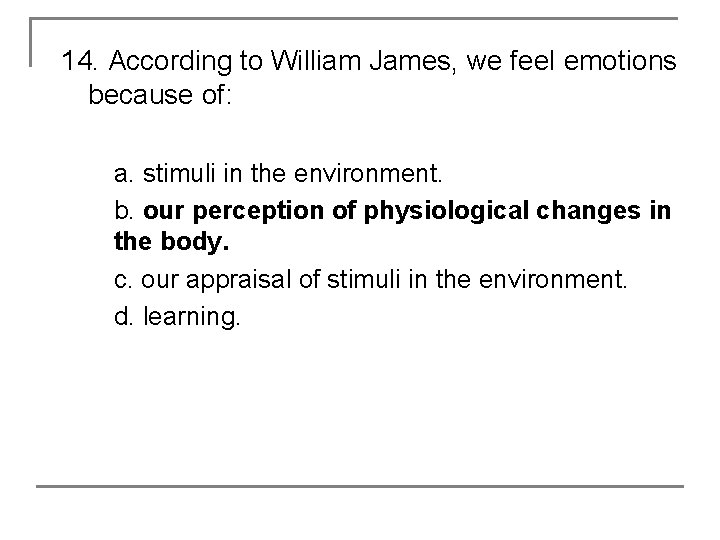
14. According to William James, we feel emotions because of: a. stimuli in the environment. b. our perception of physiological changes in the body. c. our appraisal of stimuli in the environment. d. learning.
15. According to the ______ theory, emotion consists of the separate but interacting factors of physiological arousal & cognitive appraisal. a. two-factor b. James-Lange c. cognitive appraisal d. facial feedback
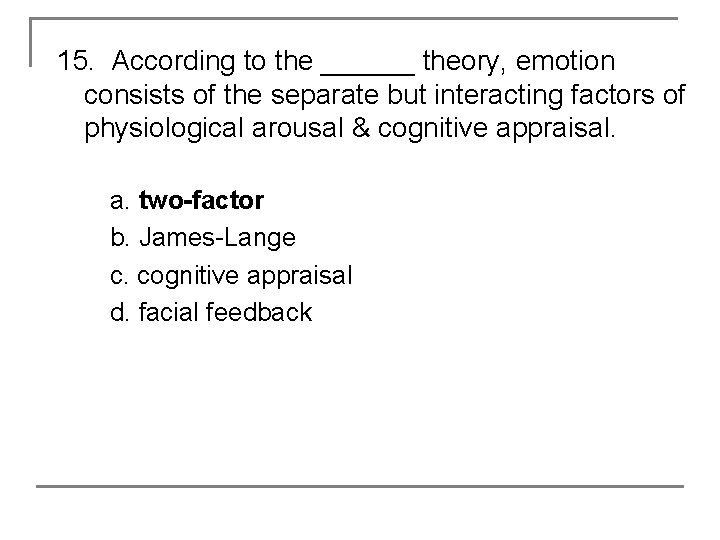
15. According to the ______ theory, emotion consists of the separate but interacting factors of physiological arousal & cognitive appraisal. a. two-factor b. James-Lange c. cognitive appraisal d. facial feedback
- Slides: 31