
Click on the picture Main Menu Permutation Example
- Slides: 43
Click on the picture Main Menu Permutation Example 1 Example 2 Circular Permutation Permuting r of n objects Example 1 Example 2 Example 3 Example 4 Addition Rule Example 1 Example 2 Difference Rule Example 1 (Click on the topics below)
Permutations Sanjay Jain, Lecturer, School of Computing
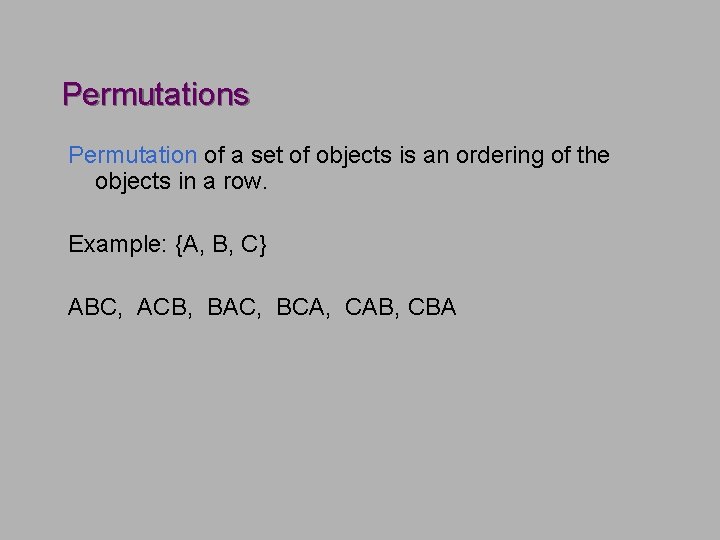
Permutations Permutation of a set of objects is an ordering of the objects in a row. Example: {A, B, C} ABC, ACB, BAC, BCA, CAB, CBA
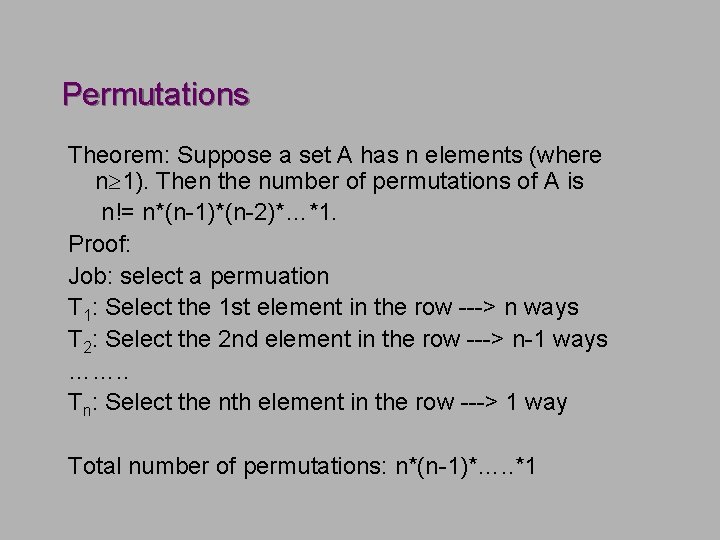
Permutations Theorem: Suppose a set A has n elements (where n 1). Then the number of permutations of A is n!= n*(n-1)*(n-2)*…*1. Proof: Job: select a permuation T 1: Select the 1 st element in the row ---> n ways T 2: Select the 2 nd element in the row ---> n-1 ways ……. . Tn: Select the nth element in the row ---> 1 way Total number of permutations: n*(n-1)*…. . *1
END OF SEGMENT
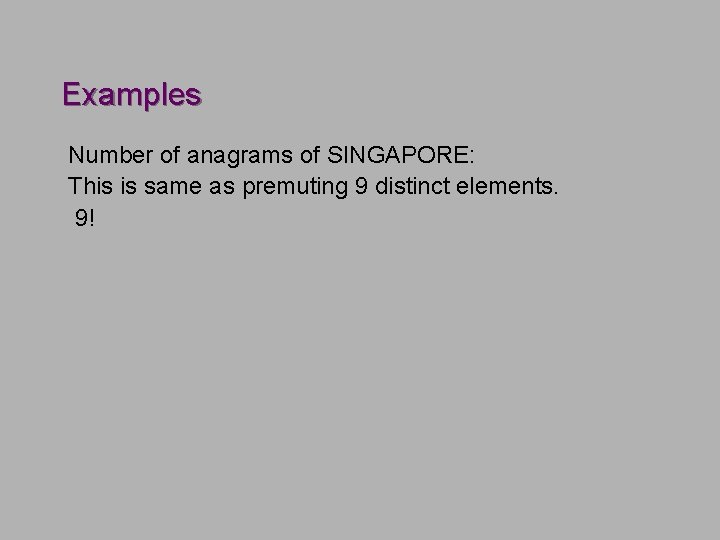
Examples Number of anagrams of SINGAPORE: This is same as premuting 9 distinct elements. 9!
END OF SEGMENT
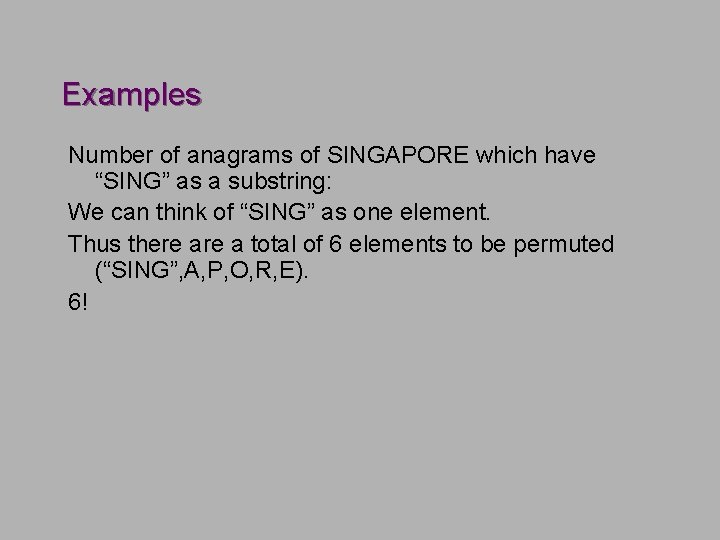
Examples Number of anagrams of SINGAPORE which have “SING” as a substring: We can think of “SING” as one element. Thus there a total of 6 elements to be permuted (“SING”, A, P, O, R, E). 6!
END OF SEGMENT
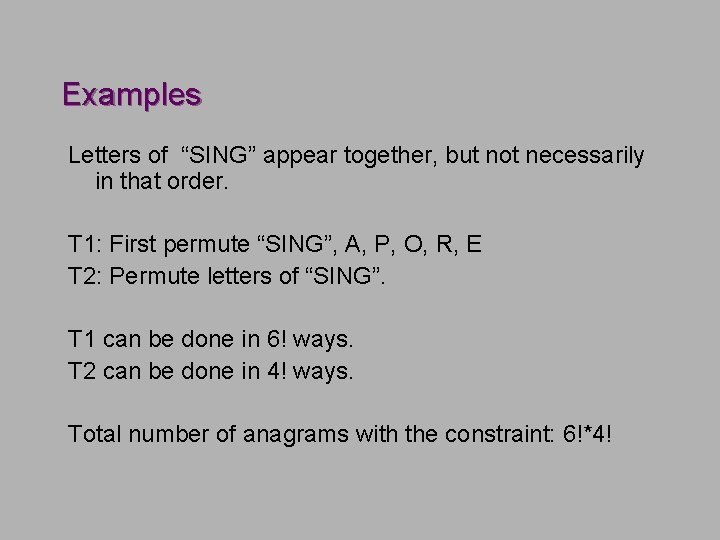
Examples Letters of “SING” appear together, but not necessarily in that order. T 1: First permute “SING”, A, P, O, R, E T 2: Permute letters of “SING”. T 1 can be done in 6! ways. T 2 can be done in 4! ways. Total number of anagrams with the constraint: 6!*4!
END OF SEGMENT
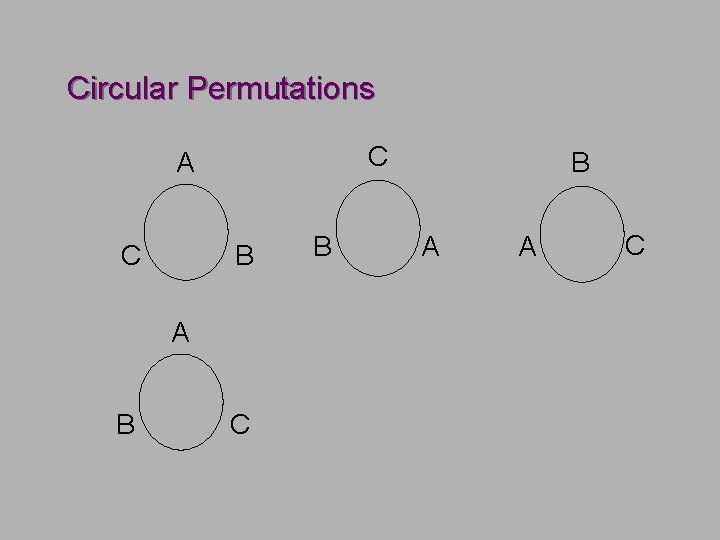
Circular Permutations C A C B A B C B B A A C
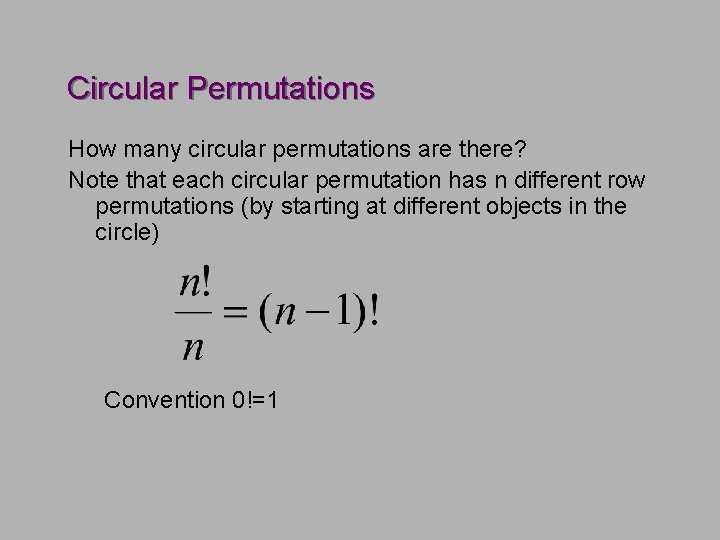
Circular Permutations How many circular permutations are there? Note that each circular permutation has n different row permutations (by starting at different objects in the circle) Convention 0!=1
END OF SEGMENT
Permuting r of n objects Suppose 1 r n. An r-permutation of a set of n elements is an ordered selection of r elements from the set. The number of r-permutations of a set of n elements is denoted by P(n, r) n. P r
END OF SEGMENT
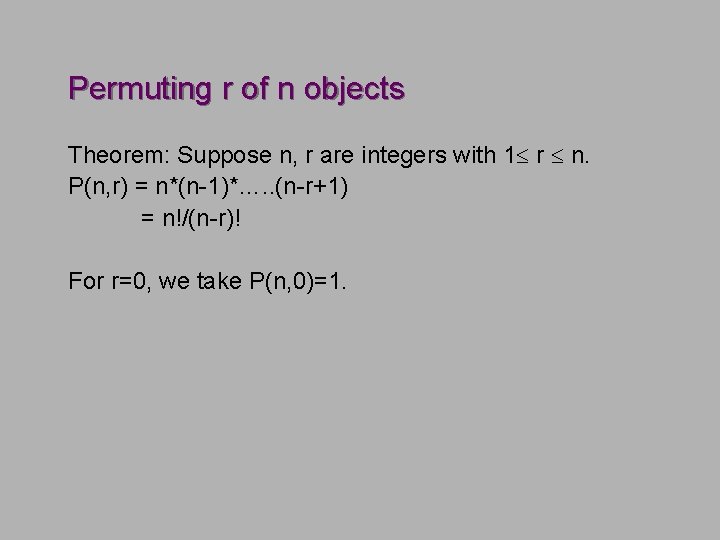
Permuting r of n objects Theorem: Suppose n, r are integers with 1 r n. P(n, r) = n*(n-1)*…. . (n-r+1) = n!/(n-r)! For r=0, we take P(n, 0)=1.
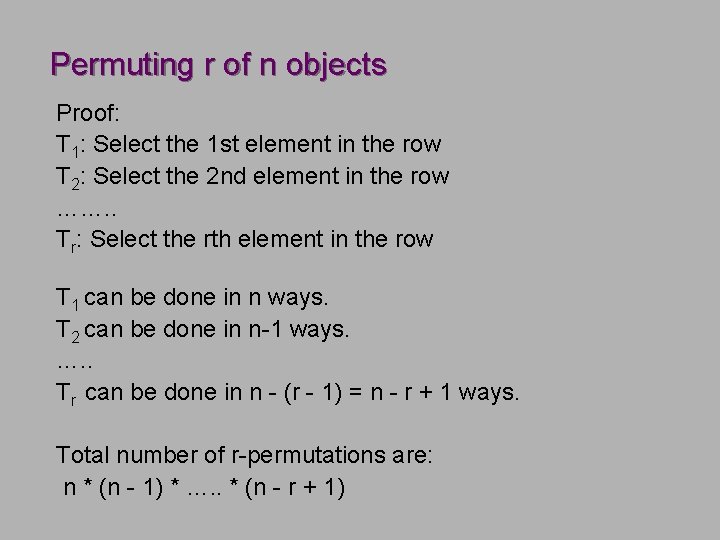
Permuting r of n objects Proof: T 1: Select the 1 st element in the row T 2: Select the 2 nd element in the row ……. . Tr: Select the rth element in the row T 1 can be done in n ways. T 2 can be done in n-1 ways. …. . Tr can be done in n - (r - 1) = n - r + 1 ways. Total number of r-permutations are: n * (n - 1) * …. . * (n - r + 1)
END OF SEGMENT
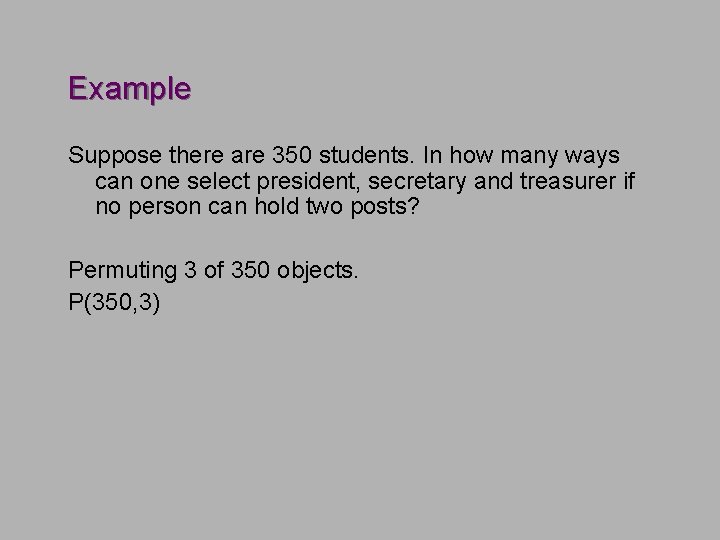
Example Suppose there are 350 students. In how many ways can one select president, secretary and treasurer if no person can hold two posts? Permuting 3 of 350 objects. P(350, 3)
END OF SEGMENT
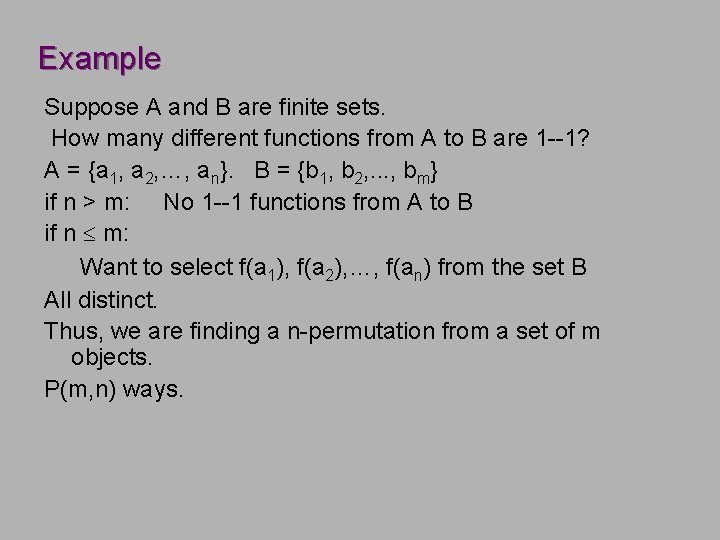
Example Suppose A and B are finite sets. How many different functions from A to B are 1 --1? A = {a 1, a 2, …, an}. B = {b 1, b 2, . . . , bm} if n > m: No 1 --1 functions from A to B if n m: Want to select f(a 1), f(a 2), …, f(an) from the set B All distinct. Thus, we are finding a n-permutation from a set of m objects. P(m, n) ways.
END OF SEGMENT
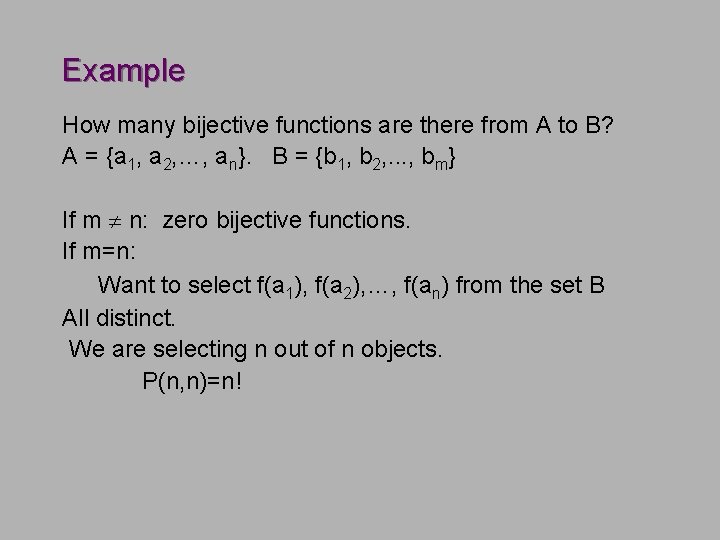
Example How many bijective functions are there from A to B? A = {a 1, a 2, …, an}. B = {b 1, b 2, . . . , bm} If m n: zero bijective functions. If m=n: Want to select f(a 1), f(a 2), …, f(an) from the set B All distinct. We are selecting n out of n objects. P(n, n)=n!
END OF SEGMENT
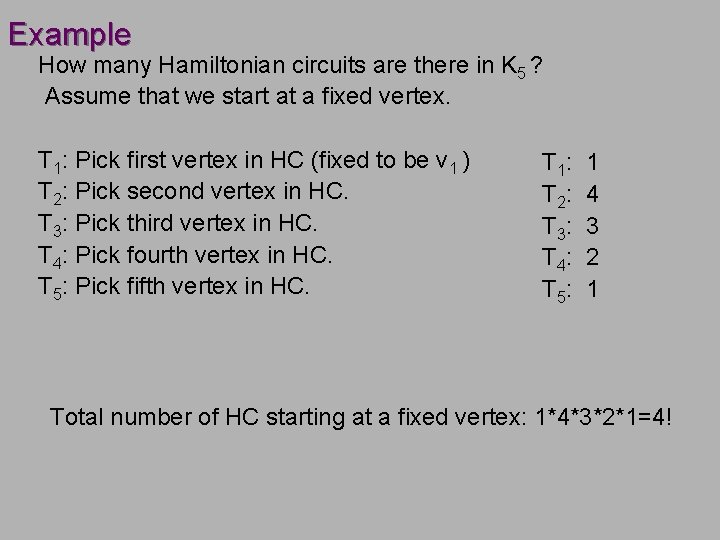
Example How many Hamiltonian circuits are there in K 5 ? Assume that we start at a fixed vertex. T 1: Pick first vertex in HC (fixed to be v 1 ) T 2: Pick second vertex in HC. T 3: Pick third vertex in HC. T 4: Pick fourth vertex in HC. T 5: Pick fifth vertex in HC. T 1: T 2: T 3: T 4: T 5: 1 4 3 2 1 Total number of HC starting at a fixed vertex: 1*4*3*2*1=4!
END OF SEGMENT
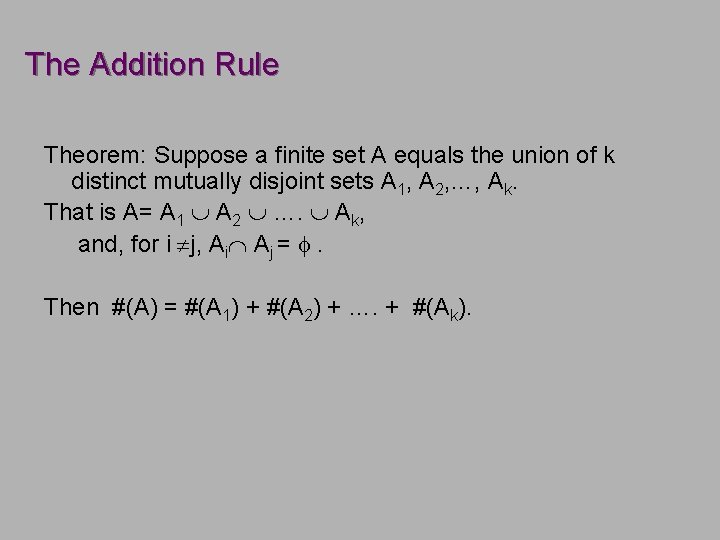
The Addition Rule Theorem: Suppose a finite set A equals the union of k distinct mutually disjoint sets A 1, A 2, …, Ak. That is A= A 1 A 2 …. Ak, and, for i j, Ai Aj = . Then #(A) = #(A 1) + #(A 2) + …. + #(Ak).
END OF SEGMENT
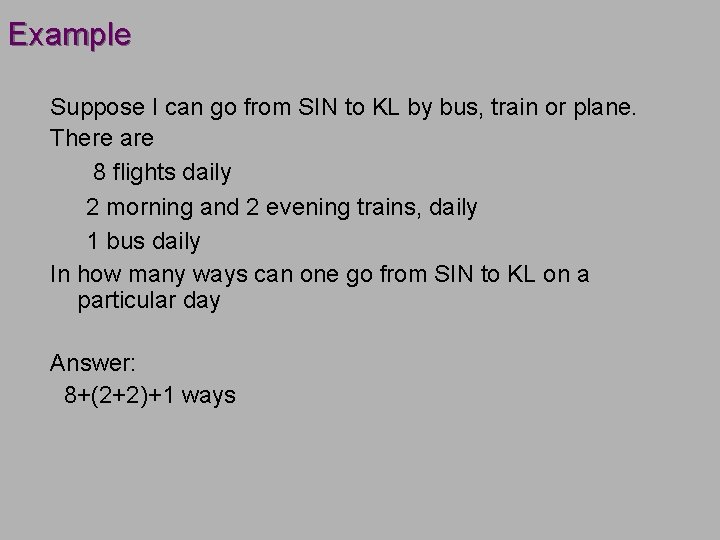
Example Suppose I can go from SIN to KL by bus, train or plane. There are 8 flights daily 2 morning and 2 evening trains, daily 1 bus daily In how many ways can one go from SIN to KL on a particular day Answer: 8+(2+2)+1 ways
END OF SEGMENT
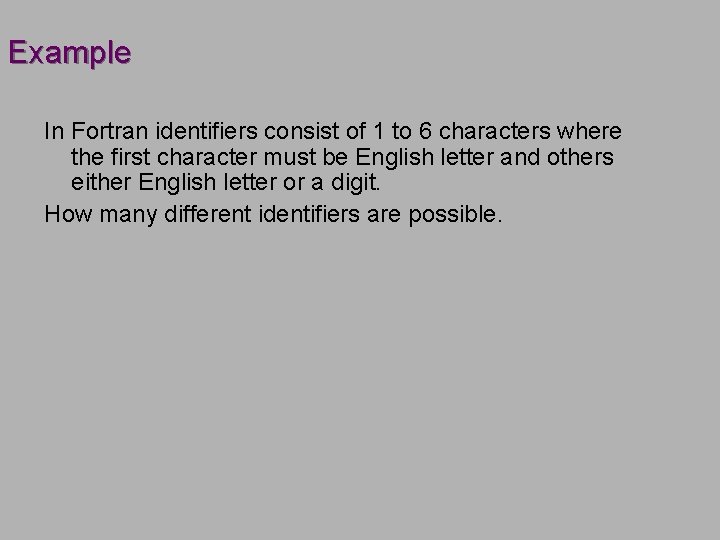
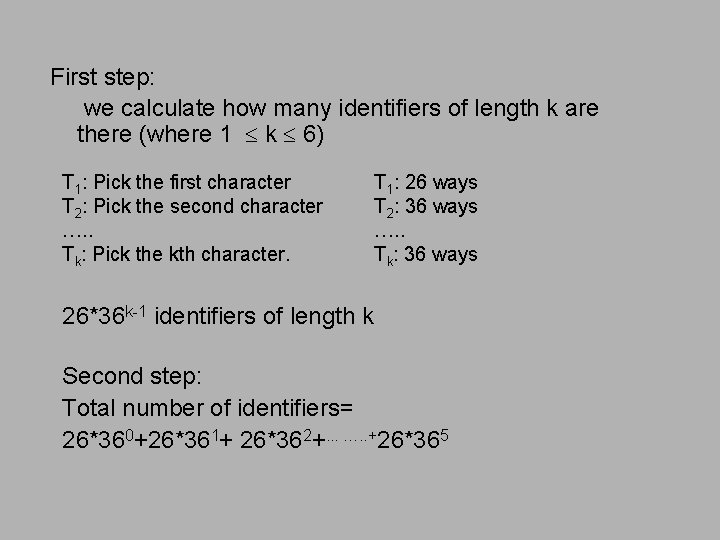
Example In Fortran identifiers consist of 1 to 6 characters where the first character must be English letter and others either English letter or a digit. How many different identifiers are possible.
First step: we calculate how many identifiers of length k are there (where 1 k 6) T 1: Pick the first character T 2: Pick the second character …. . Tk: Pick the kth character. T 1: 26 ways T 2: 36 ways …. . Tk: 36 ways 26*36 k-1 identifiers of length k Second step: Total number of identifiers= 26*360+26*361+ 26*362+. . . …. . +26*365
END OF SEGMENT
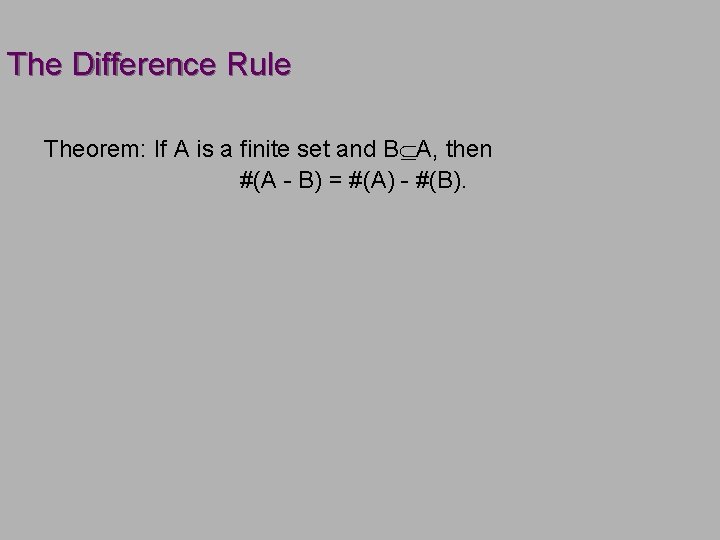
The Difference Rule Theorem: If A is a finite set and B A, then #(A - B) = #(A) - #(B).
END OF SEGMENT
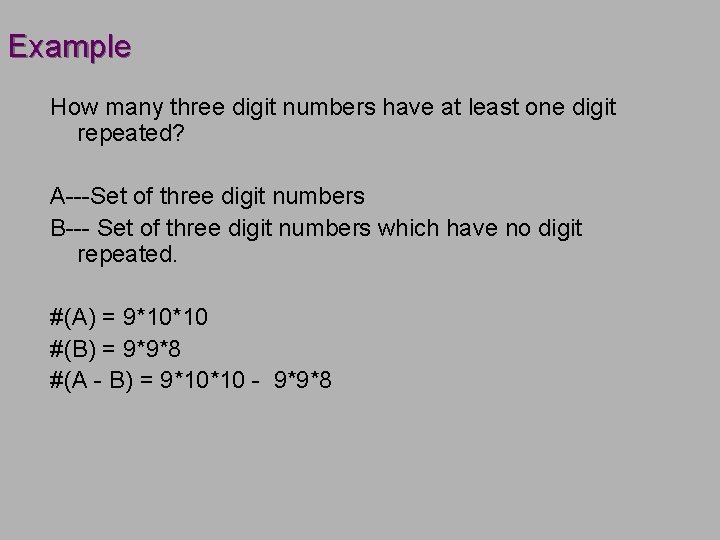
Example How many three digit numbers have at least one digit repeated? A---Set of three digit numbers B--- Set of three digit numbers which have no digit repeated. #(A) = 9*10*10 #(B) = 9*9*8 #(A - B) = 9*10*10 - 9*9*8
END OF SEGMENT
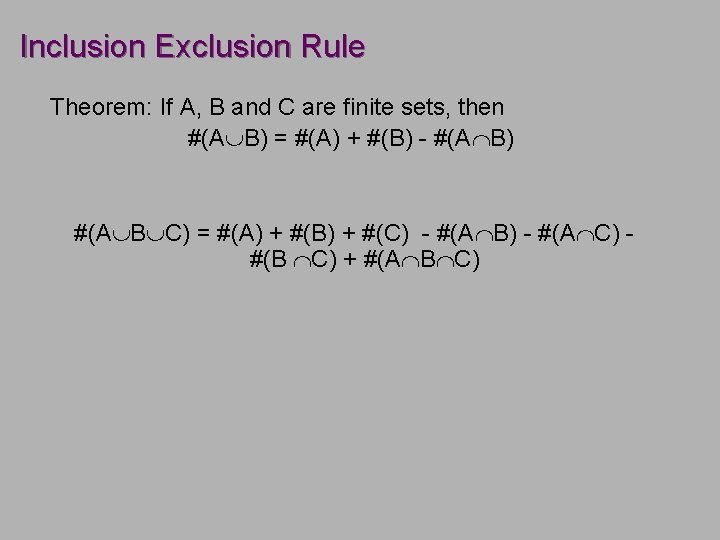
Inclusion Exclusion Rule Theorem: If A, B and C are finite sets, then #(A B) = #(A) + #(B) - #(A B) #(A B C) = #(A) + #(B) + #(C) - #(A B) - #(A C) #(B C) + #(A B C)
END OF SEGMENT
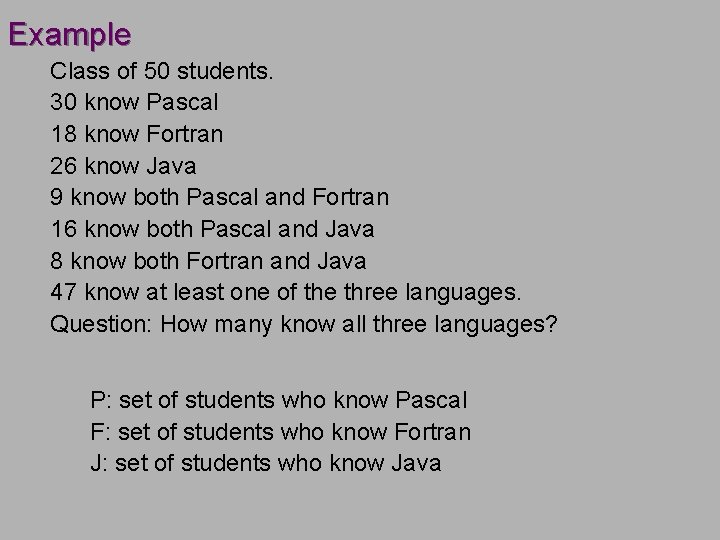
Example Class of 50 students. 30 know Pascal 18 know Fortran 26 know Java 9 know both Pascal and Fortran 16 know both Pascal and Java 8 know both Fortran and Java 47 know at least one of the three languages. Question: How many know all three languages? P: set of students who know Pascal F: set of students who know Fortran J: set of students who know Java
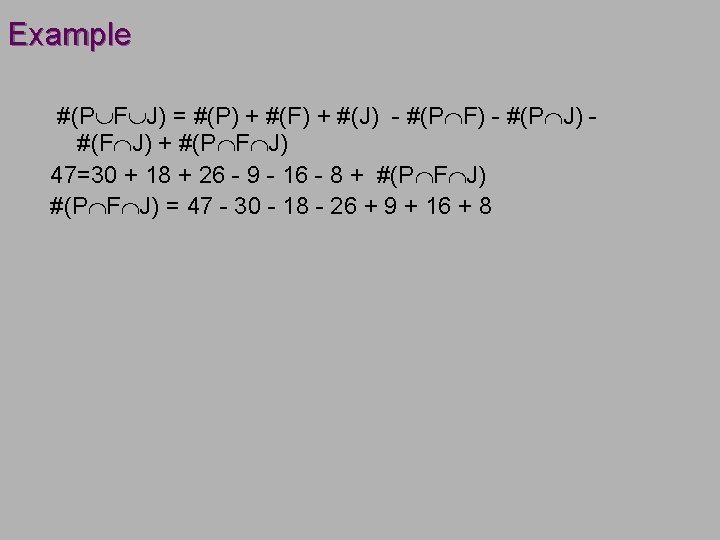
Example #(P F J) = #(P) + #(F) + #(J) - #(P F) - #(P J) #(F J) + #(P F J) 47=30 + 18 + 26 - 9 - 16 - 8 + #(P F J) = 47 - 30 - 18 - 26 + 9 + 16 + 8
END OF SEGMENT